Friday, January 23, 2026
Home Blog Page 4623

Cheney Rec Winter Schedule Released

0

credit – CRC

Winter/Valentine’s Craft

Join CRC for a fun wintertime craft project.  Winter & Valentine’s Day & other fun projects will be created.

Date:                       Sunday, February 1

Age:                        Age 5-Grade 3

Time:                      3:00-4:00 p.m.

Fee:                         $7.00

Location:                CRC Office

Deadline:                Wednesday, Jan. 21


Mini Builders

Sign your little guy or gal up to learn about some basic tools and “how-to” use them.  Each participant will receive their own piece of wood, mini project and tool to take home.

Date:                       Wednesday, April 1

Age:                        1st-5th grade

Time:                      5-6 p.m.

Fee:                         $7.00

Location:                CRC Office

Deadline:                Tuesday, March 24


Family Flashlight Easter Egg Hunt

CRC would like to invite your family to take part in this fun family event.  Participants will be required to bring their own flashlight (no spot lights), and may collect a total of 10 eggs plus any additional candy/toys lying around.  Each egg is filled with a surprise.  Some eggs have special prizes inside, plus don’t forget the golden egg.  Children 5 & under must be accompanied by an adult.  We will not be able to take any new participants the night of the event.  If the weather is bad, it will be held inside the CRC Building.

Date:                       Friday, March 27

Time:                      8:20 p.m.

Age:                        5th grade & under

Fee:                         $2 per participant

Location:                Meet at Fairground front gates

Deadline:                Tuesday, March 24


Fantasy Baseball

Fantasy sports players come and get in the CRC fantasy baseball league.  The league will be run through Yahoo.com.  Sign up for a good time being the general manager of your own super stars.  Contact CRC to receive the league website and passwords.  FREE program.  MLB season begins late March.  League draft will be the week before the season begins late March.


Daddy/Daughter Bowling Date Night

This is a special evening for dads and daughters!  As a group you will receive a keepsake picture, a small single topping pizza (please indicate what type of pizza desired on form), drinks, shoes and get unlimited bowling until 8:30 p.m.  We will eat at 6:30 p.m. and get bowling shortly after eating.  Additional child will increase 1 pizza size.  Space is limited-must call in to reserve spot. Please provide an email address for photos.

Date:       Friday, April 17

Time:      6:30-8:30 p.m.

Fee:         $13 per couple, $5 each additional child

Location:  D’Marios/Cheney Lanes

Deadline:  Friday, April 10

Barton men pick up two wins in Michigan

0
barton cc

The Barton Community College men’s basketball picked up a pair of wins this weekend in Kalamazoo, Michigan, to close out the pre-Christmas portion of the schedule.  The Cougars opened the Kalamazoo Christmas Classic Friday evening defeating the host Kalamazoo Valley Community College 83-66 then with a quick turnaround for Saturday’s 1:00 p.m. game blew out Kellogg Community College 94-66.  Barton improves to 12-2 heading into conference play slated January 3 as the Cougars host defending Jayhawk Conference champions Seward County Community College in a 7:30 p.m. tip-off at the Barton Gym.

Ahmad Walker posted his second double-double of the season as the sophomore led four Cougars in double-digit scoring in the victory over Kalamazoo.  Walker scored nineteen points grabbing eleven rebounds while dishing out a team high six assists and tying for team honors with three steals.  Kenny Enoch dropped in fifteen while Tyrone Acuff and Jalin Barnes each added eleven to go along with three steals each tying Walker for team high.

Jacob Watts-Jenkins came off the bench to lead the Cougars of Kalamazoo Valley with twelve points.  Terry Davis and Brian Harris each added ten with Tevis Robinson grabbing a game high twelve rebounds.

In Saturday’s victory over Kellogg, five Cougars reached double-digits.  Kenny Enoch, who was 7-13 behind the arch for the Classic knocked down 5-of-10 on Saturday for a team high twenty-one points.  Walker had another all-around game posting his second straight double-double with consecutive nineteen point games and grabbing a career high twelve rebounds and dishing out another team high six assists.  Khalil Gracey added eighteen off the bench while Jalin Barnes and Tyrone Acuff contributed eleven and ten points respectively.

Angus Bennett led Kellogg with seventeen and team high nine rebounds while Curtis Trigg an, Mafiaion Joyner, and Jalen Owens each added ten.

Private pesticide safety training offered from UNL Extension

0

LINCOLN, Neb. — Pesticide safety education training sessions start in January for Nebraska’s private pesticide applicators seeking first-time certification or recertification for licenses expiring in 2015.  Those interested should contact their local University of Nebraska-Lincoln Extension office for information on these training sessions.


Pesticide applicators with private licenses can buy and use restricted-use pesticides on their own farming operations after completing the training. Statewide, around 3,500 private applicators are eligible for recertification in 2015.


In taking the training, applicators will learn about “Nebraska’s pesticide laws and regulations, the pesticide label, personal safety, worker protection standard, environmental protection, integrated pest management, pesticides and application, application equipment, and equipment calibration,” according to Clyde Ogg, UNL Extension pesticide safety educator.


Updates covered in the 2015 training include spill management, proper glove handling, pesticide disposal and storage, updates to the Driftwatch website to protect sensitive sites from windblown pesticides, water quality effects on pesticide performance, and an update from UNL cropping systems specialist Greg Kruger on nozzle drift prevention technology and spray nozzle selection.


Private applicators needing recertification in 2015 should have received an expiration notice letter from the Nebraska Department of Agriculture (NDA) in mid-December.  The letter includes a barcode, which eliminates the need to complete the standard NDA application form for those recertifying.  Applicators should bring the letter with them to training sessions to avoid having to fill-out the application form.


“All persons eligible for recertification will be notified by their local UNL Extension office of recertification training sessions in their area,” Ogg said.


Current licensed applicators should check the expiration date on their license.  If it expires in 2015 and they have not yet received a letter from NDA, contact them at 402-471-2351 or 877-800-4080.


UNL Extension provides the educational training for initial certification and recertification, while NDA is responsible for licensing. For a list of training sessions, sites and dates, contact your nearest UNL Extension office or go online to http://pested.unl.edu/privateschedule, where applicators will find training sites for private applicators listed by county. Cost of UNL training is $30 per person.


Applicators may also certify through completing an online course, completing a self-study manual, or attending and participating in a UNL Extension Crop Production Clinic. Cost of for the online course and self-study options is $60 while the Crop Production Clinic is $65.


Pesticide applicators can purchase access to the online course via http://marketplace.unl.edu/pested.


After completing the training, certification applications will be sent to NDA which will then send a bill to the applicator for the $25 state license fee. The private self-study manual is available from local Extension offices. Crop Production Clinics are conducted in January at locations across the state.  For more information and a schedule visit http://agronomy.unl.edu/cpc.

# # #

12/12/14-SR                  Sources: Clyde L. Ogg, extension educator, Pesticide Safety Education Program, Agronomy and Horticulture, 402-472-1632


Ben Beckman, extension assistant, Pesticide Safety Education Program, UNL Department of Agronomy and Horticulture, 402-472-1632


Emilee Dorn, extension assistant, Pesticide Safety Education Program, UNL Department of Agronomy and Horticulture, 402-472-9543


Pested.2                       Writer: Steven W. Ress, communications coordinator, Nebraska Water Center, Robert B. Daugherty Water for Food Institute, University of Nebraska, 402-472-3305, [email protected]

What are these tiny cabbages?

0
Photo source: NCAT

This question, asked by fourth graders from a low-income neighborhood during a trip to the local farmers market, prompted our FoodCorps member Kelsie Larson to arrange for the kids to visit a local pumpkin farm. There the kids were treated to an exciting afternoon learning about pumpkins, chickens, and yes, brussels sprouts. You can read Kelsie’s full account of the farm visit here.

This kind of education is what NCAT’s FoodCorps work is all about: teaching kids about heathy foods – what they are, where and how they are grown, and how to eat them.

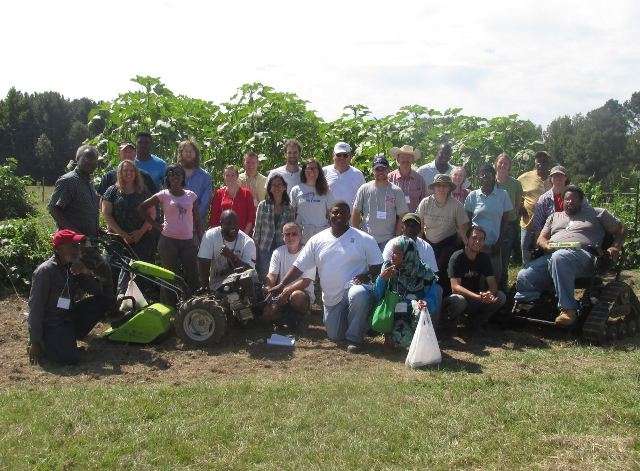
Another kind of education NCAT provides is training veterans to become sustainable agriculture producers. We help veterans like John, who served as a gunner in the Iraq war.  While trying to transition to civilian life, he found that agricultural work gave him some release from his memories of war.  Thanks to NCAT’s training, he and his wife now run a successful poultry operation.

There are thousands of veterans just like John who could benefit from a career in agriculture, and that’s why NCAT offers its Armed to Farm program, a full week of classroom and hands-on training teaching production and business skills.  We also offer guidance and assistance after the training to ensure veterans have all the resources they need to be successful.  You can read about the materials available to help veterans on our website.

These are just two of the many projects underway at NCAT, focused on serving disadvantaged and vulnerable people across the country.

We can’t do it without youYour donation is critical to our ability to educate and help kids and families live better through healthier foods, reduced energy costs, and stronger local economies.

Please make your tax-deductible contribution today.  You can give online, and help more poor children have better school lunches.

Your financial gift will ensure we can teach more veterans about agriculture, so they can continue to serve our country, this time with tractors, crops, and livestock.

Nutrient balance and integrated management are keys to optimal corn yields

0

MANHATTAN, Kan. – It takes more than high nitrogen uptake for corn to realize its maximum yield potential. Nitrogen, potassium, and phosphorus uptake needs to be in the proper ratio.

This is one of the main findings of a comprehensive review of corn research in the United States and worldwide over the past 100 years by cropping systems specialists, Ignacio Ciampitti of Kansas State University, and Tony Vyn of Purdue University.

“The highest corn yields, if there are no other limiting factors, are when nitrogen and potassium uptake is in a 1-to-1 ratio and nitrogen and phosphorus uptake is in a 5-to-1 ratio,” Ciampitti said. “Having the right nutrient balance within the plants is more important to increasing yields than just applying extra nitrogen.”

Those nutrient uptake ratios are measured in aboveground portions of the corn plant soon after physiological maturity is reached, he added. The ratios will be different at other stages of growth.

Corn takes up a higher percentage of its potassium (K) earlier in its life than nitrogen (N). By the flowering stage of development, corn has absorbed about 80 to 90 percent of its total seasonal K amount, but only 50 to 60 percent of its total seasonal N uptake, Ciampitti said.

As a result, as the season progresses, the N:K ratio in the plant gradually gets larger. At maturity, high-yielding corn has a ratio of about 1-to-1.

Similarly, the nitrogen:phosphorus (P) ratio within the plant changes as the season progresses – but in the opposite direction. P accumulation is greatest later in the season.

“Corn plants eventually accumulate most of their phosphorus in the kernels, and the proportionately later phosphorus uptake means that the nitrogen:phosphorus ratio declines as the season progresses,” Vyn said. “Changes in this ratio are related more to plant phosphorus changes than to changes in plant nitrogen.”

Although the yield level of corn is not strictly related to the N:P balance, in high-yield-potential corn systems, the best ratio in corn plants at physiological maturity was a ratio near 5-to-1, Ciampitti said.

Optimal nutrient ratios were found to be comparable between the U.S. and the rest of the world, and across the decades of corn hybrid improvement, the research review showed.  In general, high-yielding corn systems require better nutrient balance and more nutrients, Ciampitti and Vyn said.

If fertilizer application adjustments are needed for corn production in the subsequent growing season to reach optimal N:K and N:P ratios based on a plant analysis done shortly after physiological maturity in the current season, these adjustments should be based on: (1) soil test data, (2) a consideration of potential soil nutrient supply from organic sources in the soil, and (3) expected yield and crop nutrient removal rates, Ciampitti said.

As important as nutrient balance is, the specialists found other factors important to achieving corn’s maximum yield potential.

“Yield improvement, both in the U.S. and worldwide, can’t be attributed solely to changes in nutrient application. It also reflects the combined effects of other production practices, such as water management, seeding rates, timeliness of field operations, insect and disease control, weed control, and more,” Ciampitti said.

Focusing solely on nutrient applications as the means of increasing corn yields will not always help producers close the gap between potential and actual yields, he said. There needs to be an integrated approach to corn yield improvement, including genetics and management.

“For example, we found one of the main factors contributing to continued corn yield gains in the U.S. was related to genetic improvements such as reduction in barrenness, more erect leaf angles, better flowering-silking synchrony, longer leaf stay green, better tolerance to pests and drought, and better tolerance to crowding,” Ciampitti said.

Another main factor is management, such as better fertilizer application methods and timing, pest control, earlier planting dates, reduced tillage systems, and water management, he added.

An integrated approach to improving corn yields is the most effective, he said, and key nutrient ratios should be monitored and managed for proper balance and optimal yields.

For more information, a paper titled “Understanding Global and Historical Nutrient Use Efficiencies for Closing Maize Yield Gaps” by Ciampitti and Vyn is available in the Sept. 15, 2014 issue of Agronomy Journal: https://www.agronomy.org/publications/aj/pdfs/106/6/2107?search-result=1.