
A new international study from The University of Manchester has pulled together soil research to demonstrate how organisms below the ground could hold the key to understanding how the world’s ecosystems function and how they are responding to climate change. Published in Nature, the paper explores how the below-ground world can contribute to sustainable land management through pest control and climate-change resilience. Click here for more information.
K-State Crops Team claims sixth straight national championship
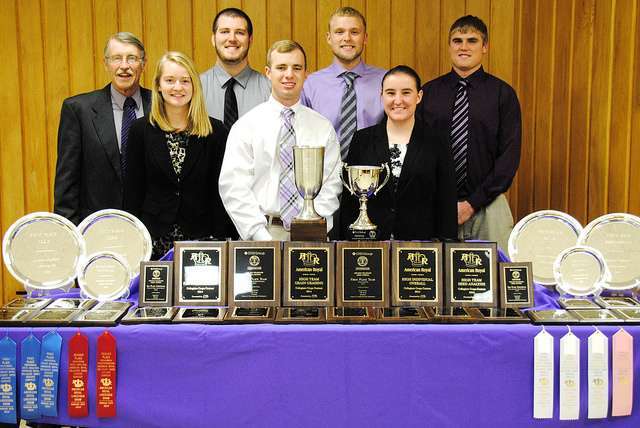

MANHATTAN, Kan. – The Kansas State University Crops Team recently captured the title of national champion for the sixth year in a row. K-State teams have now won the collegiate crops contest championship in 13 of the past 16 years. To win the 2014 national title, the team won both the Kansas City American Royal Collegiate Crops Contest on Nov. 18 and the Chicago Collegiate Crops Contest on Nov. 22.
Official members of the K-State team were Sam Knauss, Paola; Tyler Herrs, Linn; and Ben Coomes, Girard — all juniors majoring in agronomy. Alternates for both contests were Samantha L’Ecuyer, Morrowville, sophomore in agronomy, and Michaela Simmelink, Downs, senior in animal sciences and industry. Hayden Guetterman, Bucyrus, sophomore in agronomy, was also an alternate in Kansas City.
At Kansas City, the K-State team placed first in all three phases of the contest: plant-and-seed identification, grain grading, and seed analysis. At Chicago, they were first in identification and grain grading, and second in seed analysis. Individually, the three K-State team members placed 1-2-3 in Kansas City, posting the highest team score since Texas Tech University in 1965 in this contest. All three were also in the top five in Chicago.
Sam Knauss led the K-State team with a first place sweep of both Kansas City and Chicago. In doing so, he also placed first in all three components in both contests, a result that has never been accomplished in the 81-year history of both contests. His total score of 1794 out of a possible 1800 in Kansas City was the highest individual performance there since 1965.
Ben Coomes was second overall in Kansas City and fifth in Chicago. He placed third in all three components in Kansas City. At Chicago, he was third in identification, fourth in grain grading, and fifth in seed analysis.
Tyler Herrs finished third in Kansas City and fourth in Chicago. At Kansas City, he placed second in identification and seed analysis and fourth in grain grading. At Chicago, he was fourth in identification and analysis and fifth in grain grading.
The team was coached by Kevin Donnelly, K-State professor of agronomy.
The American Royal coordinated the Kansas City contest, with CHS Foundation as the primary financial sponsor. Additional sponsors were the American Society of Agronomy, DuPont Pioneer, and the South Dakota Crop Improvement Association.
The primary sponsor of the Chicago contest was the CME Group. Additional donors in Chicago included the Crop Science Society of America, Growmark Cooperative, and the Society of Commercial Seed Technologists.
Locally, sponsors for the K-State Crops Team include the Kansas Crop Improvement Association, Department of Agronomy, and the K-State Student Government Association.
For its performance, K-State received a team scholarship award from contest sponsors at Kansas City, and CME Group provided individual scholarships to the top five students at Chicago.
Farmers Union calls for new direction for Beef Checkoff
MCPHERSON (Dec. 3, 2014) – National Farmers Union (NFU) President Roger Johnson called for a ‘new direction’ Monday for the current beef checkoff program in an Agri-Pulse guest column, while also praising Secretary of Agriculture Tom Vilsack for seeking public comment on how to strengthen and modernize the outdated program.
“The checkoff program as we know it today has remained virtually unchanged for three decades while the world around it has morphed dramatically,” said Johnson. “This has raised serious doubts about the structure of the checkoff and whether it is capable of appropriately funding the much-needed research and exploring the new markets and new opportunities that the American beef industry so desperately needs. Clearly, the beef checkoff is in dire need of a major course correction.”
NFU Vice President Donn Teske, a cattleman who also serves as Kansas Farmers Union’s President, added, “It’s tiring to see my own checkoff dollars used to try and circumvent a law of the U.S., the Country-of-Origin Labeling (COOL) law that I very much approve of, and have fought for alongside my livestock producing neighbors over many years. It is time for beef check-off reform.”
Johnson noted that the current checkoff’s need for change stemmed from the fact that it is both underfunded and unacceptably inflexible. Johnson offered principles to guide adequate reform of the program under the Commodity, Promotion, Research and Information Act of 1996.
“The modernized beef checkoff should be a single program, modeled after the 1996 Act,” said Johnson. “It would have a clear separation of the policy organization from the non-political, promotional checkoff entity… exclude processors and importers from positions of leadership, ensuring that beef producers are always at the helm… and be precluded from allocating a single dime to any organization engaged in lobbying.”
“The idea of bringing new ideas and much-needed change to the checkoff is nothing new, and in fact, organizations like NFU met for three years discussing a new direction,” noted Johnson. “But the meetings were a bridge to nowhere, because they were largely controlled by the organization that has a vested interest in making sure the current structure never changes. That organization, of course, is the National Cattlemen’s Beef Association (NCBA).”
Johnson also noted that NCBA’s motivation for obstructing each and every idea should have been predictable, considering over 97 percent of all Beef Board contracts went to the NCBA, and the organization relies on the current program for a vast majority of its funding.
“NCBA regards the checkoff as its own personal financial trough and will do everything possible to cement that status into eternity,” said Johnson. “Clearly, NCBA wants to protect its turf and its income stream, but its days of living off the checkoff slush fund need to come to an end.”
Johnson commended Secretary Vilsack for stepping into the fractured discussions of the beef checkoff working group and allowing industry stakeholders to submit comments on ways the checkoff should be reformed.
“Finally, other voices and new ideas will be heard and given thoughtful consideration,” said Johnson. “Finally, after three long, frustrating years, meaningful structural change is actually a real possibility.
“The beauty of our democracy is that programs like the checkoff can be regularly scrutinized, fine-tuned or reformed. Recognizing that the success of the checkoff is an integral part of the success of rural America, let us work together to move this program forward. The promise of tomorrow relies on the changes of today.”
Delegates selected to attend Taiwan Youth Exchange Program
MANHATTAN, Kan. – The Kansas Department of Agriculture (KDA) is pleased to announce three student delegates representing Kansas at the 2015 Taiwan Youth Exchange Program. The three students are: Anna Setter, freshman at Kansas State University; Dakota Roy, senior at West Franklin High School; and RaeLynn McClelland, freshman at Allen County Community College. The exchange will take place December 7-12.
Setter, of Humboldt, Kansas, is a freshman studying food science and agriculture communications and journalism, as well as pursuing a minor in agricultural economics at Kansas State University. Growing up on a fifth generation farm, Setter developed her passion for agriculture and now wants to see it in action internationally. “I believe that this journey would be a great way to meet others who share my interest in agriculture and make a positive contribution to the industry,” said Setter.
Roy, of Pomona, Kansas, is a senior at West Franklin High School. In fall of 2015, Roy will be attending Kansas State University and studying agribusiness with a minor in international agriculture. As a student delegate in the Taiwan Youth Exchange Program, Roy will be taking her first steps into international agriculture, a path she hopes to follow into her career. “I want to work with our country’s farmers and ranchers, helping them to create new avenues for their products and services in the global community,” said Roy.
McClelland, of Maple Hill, Kansas, is a freshman at Allen County Community College studying to become and agriculture educator. She plans to take the agricultural and cultural lessons and experiences she gains through the Taiwan Youth Exchange Program back to her local, rural community. “Having new insights into agriculture will allow me to teach my future students and community of our impact on agricultural at the global level,” said McClelland.
Composed of young people passionate about agriculture, the Kansas representatives will visit the National Taichung Agricultural Senior High School for a week-long educational experience. During the program, the students will visit local livestock and horticulture industry representatives, giving them the opportunity to explore Taiwanese agriculture. The delegates will also be able to indulge in Taiwanese culture during their unique experience. Setter, Roy and McClelland will be able to share their knowledge of Kansas agriculture and return home with a one-of-a-kind education of agriculture in Taiwan.
Opportunities such as the Taiwan Youth Exchange Program provide tremendous knowledge and networking to both the delegates and all Kansas agriculturalists. Kansas ranks seventh in the nation in international exports, accounting for $4.9 billion. International relationships with countries such as Taiwan help account for this export sum and open opportunities for more exports in the future.
Each fall, KDA facilitates the Taiwan Youth Exchange Program application process. High school seniors or college freshman students submit a resume, letter of introduction, reference letter and essay to be considered for selection as a delegate.
For more information regarding the Taiwan Youth Exchange Program, please contact Nellie Hill, KDA Education and Events Coordinator, at [email protected] or by calling (785) 564-6756.
Broiler hatchery
ISSN: 1949-1840
Released December 3, 2014, by the National Agricultural Statistics Service
(NASS), Agricultural Statistics Board, United States Department of
Agriculture (USDA).
Broiler-Type Eggs Set in the United States Up 3 Percent
Hatcheries in the United States weekly program set 217 million eggs in
incubators during the week ending November 29, 2014, up 3 percent from a
year ago. Hatcheries in the 19 State weekly program set 209 million eggs in
incubators during the week ending November 29, 2014, up 3 percent from the
year earlier. Average hatchability for chicks hatched during the week in the
United States was 83 percent. Average hatchability is calculated by dividing
chicks hatched during the week by eggs set three weeks earlier.
Broiler-Type Chicks Placed in the United States Up 3 Percent
Broiler growers in the United States weekly program placed 168 million
chicks for meat production during the week ending November 29, 2014, up 3
percent from a year ago. Broiler growers in the 19 State weekly program
placed
163 million chicks for meat production during the week ending November 29,
2014, up 3 percent from the year earlier. Cumulative placements from
December 29, 2013 through November 29, 2014 for the United States were 8.23
billion.
Cumulative placements were up 1 percent from the same period a year earlier.
Broiler-Type Eggs Set – 19 Selected States and United States: 2014
——————————
——————————
: Week
ending
State
:—————————–
——–
: October 25, : November 1, : November 8,
:November 15, :November 22, :November 29,
: 2014 : 2014 : 2014 :
2014 : 2014 : 2014
——————————
——————————
: 1,000
eggs
:
Alabama ………………….: 26,945 26,191 26,971
28,364 28,637 28,456
Arkansas …………………: 20,742 21,574 20,775
22,378 22,339 21,509
Delaware …………………: 4,746 4,748 4,707
4,738 4,765 4,747
Florida ………………….: 1,224 1,225 1,224
1,224 1,223 1,224
Georgia ………………….: 33,212 31,839 33,710
34,758 34,023 34,722
Kentucky …………………: 7,580 6,936 7,253
7,401 7,927 7,670
Louisiana ………………..: 3,470 3,620 3,651
3,772 3,741 3,726
Maryland …………………: 7,775 7,566 7,688
7,890 7,893 7,876
Mississippi ………………: 17,538 16,234 16,869
17,666 18,025 18,009
Missouri …………………: 7,745 7,077 7,647
8,269 8,297 8,299
:
North Carolina ……………: 20,971 20,859 21,045
21,167 21,340 21,276
Oklahoma …………………: 6,012 6,661 6,618
6,704 6,608 6,834
Pennsylvania ……………..: 3,721 4,157 4,256
4,449 4,451 4,302
South Carolina ……………: 5,309 5,287 5,134
5,498 5,665 5,551
Texas ……………………: 14,388 13,980 13,339
14,801 14,962 15,439
Virginia …………………: 6,864 6,228 6,348
6,447 6,476 6,758
California, Tennessee, :
and West Virginia ………..: 10,089 10,639 11,017
11,658 11,716 12,249
:
19 State total ……………: 198,331 194,821 198,252
207,184 208,088 208,647
Percent of previous year …..: 102 102 103
102 103 103
:
Other States ……………..: 7,077 7,257 7,887
8,156 8,072 8,090
:
United States …………….: 205,408 202,078 206,139
215,340 216,160 216,737
Percent of previous year …..: 101 102 103
102 103 103
——————————
——————————
Broiler-Type Chicks Placed – 19 Selected States and United States: 2014
——————————
——————————
: Week
ending
State
:—————————–
——–
: October 25, : November 1, : November 8,
:November 15, :November 22, :November 29,
: 2014 : 2014 : 2014 :
2014 : 2014 : 2014
——————————
——————————
: 1,000
chicks
:
Alabama ………………….: 20,559 21,176 20,949
20,959 19,881 20,888
Arkansas …………………: 19,399 18,457 19,109
18,343 19,651 18,541
Delaware …………………: 5,185 4,951 4,304
4,989 5,292 3,431
Florida ………………….: 1,272 1,332 1,100
1,340 1,229 1,452
Georgia ………………….: 25,797 26,530 26,071
26,182 24,650 25,844
Kentucky …………………: 5,899 6,260 5,779
5,775 5,904 6,363
Louisiana ………………..: 2,747 3,081 2,959
3,095 3,116 3,133
Maryland …………………: 5,566 6,042 5,689
5,955 5,963 7,353
Mississippi ………………: 13,020 13,922 14,561
14,657 13,595 13,974
Missouri …………………: 5,604 6,021 5,695
5,798 4,974 5,501
:
North Carolina ……………: 15,294 15,262 15,948
16,685 16,257 16,248
Oklahoma …………………: 4,111 5,373 3,464
3,944 3,923 4,482
Pennsylvania ……………..: 3,508 3,665 3,467
3,031 3,310 3,663
South Carolina ……………: 5,107 4,429 3,720
4,458 4,667 4,746
Texas ……………………: 10,660 11,227 11,444
11,963 11,523 11,110
Virginia …………………: 5,358 5,162 5,412
5,930 5,142 5,543
California, Tennessee, :
and West Virginia ………..: 10,381 10,210 9,984
9,689 10,192 10,397
:
19 State total ……………: 159,467 163,100 159,655
162,793 159,269 162,669
Percent of previous year …..: 104 104 103
101 102 103
:
Other States ……………..: 5,548 5,740 5,754
5,556 5,236 5,580
:
United States …………….: 165,015 168,840 165,409
168,349 164,505 168,249
Percent of previous year …..: 104 104 103
101 101 103
——————————
——————————
Statistical Methodology
Survey Procedures: Data for broiler hatchery estimates are collected weekly
from all broiler-type hatcheries that hatch at least one million chicks a
year. Individual NASS field offices maintain a list of all known hatcheries
and update their lists on a continual basis. All hatcheries that meet the
minimum size criteria are given adequate time to respond to the weekly
survey. Those that do not respond are contacted by telephone.
Estimating Procedures: All data are analyzed for unusual values. Data from
each operation are compared to their own past operating profile and to
trends from similar operations. Data for missing operations are estimated
based on similar operations or historical data. NASS field offices prepare
these estimates by using a combination of survey indications and historic
trends.
Individual State estimates are reviewed by the Agricultural Statistics Board
for reasonableness. Individual hatchery data are summed to State, 19 State
total, Other States, and the United States.
Revision Policy: Revisions are generally the result of late or corrected
data. Revisions made to the previous five-week’s data during the current
week are published in this report. Final estimates are published in the
annual Hatchery Production Summary released in April.
Reliability: Estimates are subject to errors such as omission, duplication,
and mistakes in reporting, recording, and processing the data. While these
errors cannot be measured directly, they are minimized through strict
quality controls in the data collection process and a careful review of all
reported data for consistency and reasonableness.
Information Contacts
Listed below are the commodity specialists in the Livestock Branch of the
National Agricultural Statistics Service to contact for additional
information. E-mail inquiries may be sent to [email protected]
Dan Kerestes, Chief, Livestock Branch …………………………
(202) 720-3570
Bruce Boess, Head, Poultry and Specialty Commodities Section ………..
(202) 720-4447
Alissa Cowell-Mytar – Cold Storage …………………………
(202) 720-4751
Heidi Gleich – Broiler Hatchery, Chicken Hatchery ……………….
(202) 720-0585
Michael Klamm – Poultry Slaughter, Turkey Hatchery, Turkeys Raised ..
(202) 690-3237
Tom Kruchten – Census of Aquaculture …………………………
(202) 690-4870
Kim Linonis – Layers, Eggs …………………………
(202) 690-8632
Joshua O’Rear – Honey …………………………
(202) 690-3676
Vacant – Catfish Production, Egg Products, Mink, Trout Production …
(202) 720-3570
Access to NASS Reports
For your convenience, you may access NASS reports and products the following
ways:
All reports are available electronically, at no cost, on the NASS
web
site: http://www.nass.usda.gov
Both national and state specific reports are available via a free e-
mail subscription. To set-up this free subscription, visit
http://www.nass.usda.gov and in the “Follow NASS” box under “Receive reports
by Email,” click on “National” or “State” to select the reports you would
like to receive.
