Sunday, February 8, 2026
Home Blog Page 401

Tip Blackberries, Black Raspberries and Purple Raspberries

0

Raspberries and blackberries have similar growing and fruiting habits. The perennial root system grows for several years. The canes are biennial (live for two years).

The first-year canes are called primocanes and do not produce fruit. The second year, the primocanes become floricanes which fruit and then die. Primocanes are produced each year so plants have both types of canes present simultaneously.

Primocanes should be tipped by removing the top two to three inches to promote branching and fruiting.

The species and fruiting habits of the plant determines how the plant should be tipped. Plants that do not fruit on primocanes are referred to as “everbearing”. Plants that produce fruit only the second year are called “traditional”.

Here are guidelines for tipping blackberries and raspberries:

  • Traditional blackberries: tip at 4 feet
  • Everbearing blackberries: tip at 25-30 inches; tip laterals at 25-30 inches as well
  • Black Raspberries: tip at 3 feet
  • Purple Raspberries: tip at 36-40 inches
  • Red Raspberries: do not tip

Will loud, pervasive 13-year or 17-year cicadas emerge from the earth this year in Kansas

0

A loud, pervasive type of cicada that emerges only once every 17 years will appear this year in far western Missouri, but apparently not in Kansas.

Cicadas from what is known as “Brood XIII” are projected to come up from the ground in an area extending as far east as Benton County, Missouri — which is adjacent to Crawford County in southeast Kansas — says a 2024 cicada map compiled using data from various federal agencies and published May 7 by USA Today.

But Brood XIII cicadas aren’t expected to emerge in Kansas, which is anticipated to see “only the non-periodical cicadas we see every year,” said Rodrigo Mercader, an assistant professor of biology at Washburn University.

“We will have to wait until 2032 to see periodical cicadas in Kansas when Brood IV emerges,” Mercader told The Capital-Journal on Monday.

Brood IV cicadas also come up from their subterranean homes every 17 years, and last did so in Kansas in 2015, he said.

Why are people excited about periodical cicadas?

There are at least 15 cycles, or “broods,” of periodical cicadas, some of which emerge every 17 years while others emerge every 13 years.

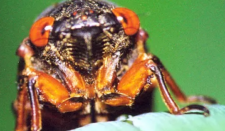
The red-eyed bugs with black bodies and translucent, orange-tinted wings stay above ground for a few weeks, mating and laying eggs, before they die. Their eggs then produce the next generation of cicadas.

Mercader said people are becoming excited about periodical cicadas this year for two main reasons:

• Numerous periodical cicadas from two different groups — Brood XIII, which emerges from the ground every 17 years and Brood XIX, which comes up every 13 years — are appearing this year. Though the geographic areas where those broods appear are adjacent, there is little overlap and only small areas of central Illinois are expected to see both broods. The two broods last emerged at the same time in 1803.

• Broad XIX periodical cicadas will be present in a large geographic area, appearing in “quite a few” states.

Where are periodical cicadas expected to appear this year?

Different broods of cicadas emerge in different parts of roughly the eastern half of the United States in different years. Other species of cicada show up every summer.

Cicadas have not been seen in the far West.

Many of this year’s cicadas have already come up from the ground.

States anticipated to see periodical cicadas this year are Alabama, Arkansas, Georgia, Illinois, Indiana, Iowa, Kentucky, Louisiana, Michigan, Mississippi, Missouri, North Carolina, Oklahoma, South Carolina, Tennessee, Wisconsin and Virginia.

As reported in the Topeka Capital Journal

Third-party United Kansas registered in Kansas after gathering nearly 20,000 signatures

0

United Kansas met the requirements to become a registered political party in the state, one of only three minor political parties active in the state, according to the Kansas Secretary of State’s Office.

The party started canvassing for supporters two months ago to get to the statutorily required 19,548 signatures, or 2% of the total votes cast during the last gubernatorial election. United Kansas follows No Labels Kansas, which was recognized in January as a minor party, and the Libertarian Party of Kansas, which has been recognized since 1992.

The party says its mission is “to unite Kansas under shared values and common goals” and that it values multiparty dialogue, grassroots community efforts and inclusivity for all Kansans. It says its key issues are fostering business-friendly environments, affordable health care, quality education and continuous funding, fostering civic engagement, infrastructure modernization and environmental protection.

In a letter on its website, United Kansas’s party chair Jack Curtis advocates for fusion voting to transform the Democratic process to make it more collaborative.

“By allowing them to cross-nominate candidates, we ensure that these parties have a genuine stake in the electoral process rather than be sidelined as a potential spoiler. This not only amplifies diverse voices but also encourages major parties to adopt more moderate and inclusive stances, leading to a more balanced political environment,” Curtis wrote.

Curtis is joined in party leadership by vice chair Sally Cauble, a former Republican State Board of Education member, and treasurer Aaron Estabrook, an Independent former member of the Manhattan City Commission and USD 383 Board of Education.

The party will be able to select candidates for the November elections through a convention or caucus by June 3. It will be able to hold statewide primaries for office if its candidate for governor gets more than 5% of the vote statewide.

As reported in the Topeka Capital Journal
Water rights, law on agenda for June 13-14 Western Ag and Environmental Law Conference

0
“The Western agricultural industry is confronted with a unique body of legal and policy issues, with water issues often at the very top of the list.” — Harrison Pittman.

Instream water rights and the future of irrigated ag. The Klamath River Basin and the Endangered Species Act. The future of water quality in the West. Legal ethics and state water boards. Each of these issues and more will be on the agenda for the National Agricultural Law Center’s 2nd Annual Western Agricultural & Environmental Law Conference, set for June 13-14 in Reno, Nevada.

“The Western agricultural industry is confronted with a unique body of legal and policy issues, with water issues often at the very top of the list,” said Harrison Pittman, director of the National Agricultural Law Center. “We’re thrilled that some of the most respected water law experts in the West will be part of our terrific lineup of conference sessions.”

The conference, which will be held at the University of Nevada, Reno, will also be livestreamed. A complete conference agenda, as well as conference registration, is available online.

The Western Conference features 12 hours of continuing legal education credits, including two hours of ethics. It has been approved for CLE in Nevada and Idaho, and will be submitted for approval in Oregon, California, Arizona and Utah. It has also been approved for continuing education from the American Society of Farm Managers and Rural Appraisers. The NALC will coordinate with attendees to self-report in other states.

The water law sessions and speakers for the Western include:

  • Going With the Flow: Instream Water Rights & the Future of Irrigated Ag
  • The Klamath River Basin & the Endangered Species Act: Implications for Ag in Western States
  • WOTUS & Water Quality in the West in a Post-Sackett World
  • Water Law & Ethics: Sinking and Swimming With Litigation, Water Districts, and Agencies
    • Lauren D. Layne, Shareholder, Baker Manock & Jensen
    • Joe M. Marchini, Shareholder, Baker Manock & Jensen

Pittman said that Western attendees from a wide variety of backgrounds will benefit from the information shared at the conference.

“The Western Conference is designed for attorneys and non-attorneys alike,” he said. “It’s a great learning and networking opportunity for ag professionals, attorneys, students and more.”

For information about the National Agricultural Law Center, visit nationalaglawcenter.org or follow @Nataglaw on X. The National Agricultural Law Center is also on Facebook and LinkedIn.

Now’s the time to fertilize warm-season grasses in Kansas

0
Late spring, early summer applications are ideal, says K-State horticulture expert.

It’s crunch time for homeowners and others who manage warm-season grasses in Kansas.

“Turfgrasses should be fertilized when they are actively growing,” said K-State horticulture instructor Cynthia Domenghini, who manages the university’s Horticulture Response Center. “For warm-season grasses, that time is here.”

Domenghini said late spring and early summer fertilizer applications are ideal for bermudagrass, buffalograss and zoysiagrass. Fertilizing too early, she said, does not help warm-season grasses, but rather encourages cool season weeds to grow.

“Northern and northwest Kansas can wait until May 30 or after to fertilize warm-season grasses,” Domenghini said. “Those in other areas of the state can fertilize beginning now (mid-May). Fertilizing too late in the season can increase the turfgrass’ vulnerability to winter damage.”

Domenghini said homeowners should avoid fertilizing warm-season turf with nitrogen after Aug. 15.

Some recommendations for fertilizing the three most common warm-season varieties include:

  • Bermudagrass – Apply one pound of nitrogen per 1,000 square feet every four weeks.
  • Zoysiagrass – Apply three-fourths pound of nitrogen in two applications: one in June and one in mid-July.
  • Buffalograss – Nitrogen is not needed for its survival, but applying a nitrogen fertilizer will improve the color and density of the lawn. Apply one pound of nitrogen sometime between mid-May and early June. If a darker green is desired, follow the same fertilizer recommendations as zoysiagrass.

More information on fertilizing a warm-season lawn is available in the K-State Research and Extension publication, Fertilizing Kansas Lawns.

Domenghini and her colleagues in K-State’s Department of Horticulture and Natural Resources produce a weekly Horticulture Newsletter with tips for maintaining home landscapes and gardens. The newsletter is available to view online or can be delivered by email each week.

Interested persons can also send their garden and yard-related questions to Domenghini at [email protected], or contact your local K-State Research and Extension office.