Tuesday, February 24, 2026
Home Blog Page 606

KU News: Pollen analysis suggests peopling of Siberia and Europe by modern humans occurred during a major Pleistocene warming spell

0

From the Office of Public Affairs | http://www.news.ku.edu

Headlines

Pollen analysis suggests peopling of Siberia and Europe by modern humans occurred during a major Pleistocene warming spell
LAWRENCE — It’s an Ice Age mystery that’s been debated for decades among anthropologists: Exactly when and how did the flow of Homo sapiens in Eurasia happen? Did a cold snap or a warming spell drive early human movement from Africa into Europe and Asia? A new study appearing in Science Advances compares Pleistocene vegetation communities around Lake Baikal in Siberia, Russia, to the oldest archeological traces of Homo sapiens in the region. The researchers, including a University of Kansas professor of anthropology, use the “remarkable evidence” to tell a compelling story from 45,000-50,000 years ago with new detail: how the first humans migrated across Europe and Asia.

The Commons announces Global Revolution film series
LAWRENCE — A new film and discussion series at the University of Kansas will explore historical efforts to create change and what motivates individuals to come together to launch revolutions. The first event will take place at 5:30 p.m. Sept. 27 at The Forum in Marvin Hall, featuring the 2013 film “The Square.” KU researchers as well as students with ties to the featured countries and regions will lead discussions following each screening.

New AAI center to focus on the intersection of technology, education
LAWRENCE — The Achievement & Assessment Institute at the University of Kansas has announced a new center, Flexible Learning through Innovations in Technology & Education (FLITE). Led by Lisa Dieker, Williamson Family Distinguished Professor in Special Education, FLITE will focus on simulation and innovations in technology, including Dieker’s current funded projects in developing artificial intelligence agents to support students with disabilities in inclusive settings.

Full stories below.

————————————————————————

Contact: Brendan Lynch, KU News Service, 785-864-8855, [email protected], @BrendanMLynch
Pollen analysis suggests peopling of Siberia and Europe by modern humans occurred during a major Pleistocene warming spell
LAWRENCE — It’s an Ice Age mystery that’s been debated for decades among anthropologists: Exactly when and how did the flow of Homo sapiens in Eurasia happen? Did a cold snap or a warming spell drive early human movement from Africa into Europe and Asia?
A new study appearing in Science Advances compares Pleistocene vegetation communities around Lake Baikal in Siberia, Russia, to the oldest archeological traces of Homo sapiens in the region. The researchers use the “remarkable evidence” to tell a compelling story from 45,000-50,000 years ago with new detail: how the first humans migrated across Europe and Asia.
The new pollen data suggest warming temperatures supported forests that expanded into Siberia and facilitated early human migration there, at roughly the same time as more and western areas of Eurasia.
“This research addresses long-standing debates regarding the environmental conditions that early Homo sapiens faced during their migration into Europe and Asia around 40,000 to 50,000 years ago,” said co-author Ted Goebel, professor of anthropology at the University of Kansas. “It provides critical insights into environmental conditions at Lake Baikal, using pollen records to reveal surprising warmth during this period.”
Indeed, the pollen data suggest that the dispersal of people occurred during some of the highest temperatures in the late Pleistocene, which also would have featured higher humidity. The ancient pollen record shows coniferous forests and grasslands characterized the region, able to support foraging and hunting by humans. Goebel said the environmental data, combined with archeological evidence, tell a new story.
“This contradicts some recent archaeological perspectives in Europe,” said the KU researcher. “The key factor here is accurate dating, not just of human fossils and animal bones associated with the archaeology of these people, but also of environmental records, including from pollen. What we have presented is a robust chronology of environmental changes in Lake Baikal during this time period, complemented by a well-dated archaeological record of Homo sapiens’ presence in the region.”
Goebel’s collaborators were lead author Koji Shichi of the Forestry and Forest Products Research Institute in Kochi, Japan; Masami Izuho of Tokyo Metropolitan University, Hachioji, Japan; and Kenji Kashiwaya of Kanazawa University, Kanazawa, Japan.
While the pollen analysis was carried out in Japan, Goebel and Izuho tied the pollen data to important evidence in the archeological record of early human migration. Goebel said the emergence of full-fledged Homo sapiens in the archaeological record corresponds to changes in culture and behavior. Early modern humans of this period were making stone tools on long, slender blades, working bone, antler and ivory to craft tools — including some of the first bone needles with carved eyelets for sewing and early bone and antler spear points.
“Some of us argue that as the anatomical changes were occurring, as evidenced by the fossil record, there was a simultaneous shift in behavior and cognition,” Goebel said. “These early humans were becoming more creative, innovative and adaptable. This is when we start to observe significant changes in the archaeological record, such as cave paintings. We also find mobile art, like the early carvings known as Venus figurines. In Central Europe, there’s even an ivory sculpture dating back to this early period, depicting a lion-headed man. It’s not just replicating nature; it’s about creative expression, inventing new things, exploring new places.”
At least one human bone has been found in the region that dates to the era, according to the KU researcher.
“There is one human fossil from Siberia, although not from Lake Baikal but farther west, at a place called Ust’-Ishim,” Goebel said. “Morphologically, it is human, but more importantly, it’s exceptionally well-preserved. It has been directly radiocarbon-dated and has yielded ancient DNA, confirming it as a representative of modern Homo sapiens, distinct from Neanderthals or Denisovans, or other pre-modern archaic humans.”
Goebel said the earliest human inhabitants of the area likely would have lived in extended nuclear families or small bands, as they seem to have done in other areas of Eurasia. But because so much archeological evidence is degraded, it’s difficult to know with certainty.
“At Ust’-Ishim in Siberia, we have evidence of a fully modern human co-existing with the sites we’ve been discussing,” he said. “However, Ust’-Ishim was an isolated discovery, found by geologists eroding from a riverbank. We lack information about its archaeological context, whether it was part of a settlement or simply a solitary bone washed downstream. Consequently, linking that single individual to the archaeological sites in the Baikal region is tenuous — do they represent the same population? We think so, but definitely need more evidence.”
-30-
————————————————————————
Don’t miss new episodes of “When Experts Attack!,”
a KU News Service podcast hosted by Kansas Public Radio.

https://kansaspublicradio.org/when-experts-attack
————————————————————————

Contact: Emily Ryan, The Commons, 785-864-6293, [email protected], @TheCommonsKU
The Commons announces Global Revolution film series
LAWRENCE — A new film series at the University of Kansas will explore the theme of revolution around the globe. The first event will take place at 5:30 p.m. Sept. 27 at The Forum in Marvin Hall, featuring the 2013 film “The Square.”
The film series aims to answer questions around historical efforts to create change and what motivates individuals to come together to launch revolutions. It is co-sponsored by The Commons, International Affairs, International Support Services, the Global Awareness Program, the Center for Global & International Studies, the Center for Latin American & Caribbean Studies and the School of Architecture & Design.
Series curator Alireza Mirzaeinezhad, graduate student in visual art, initially suggested the idea for the series last spring after the formation of the women, life, freedom movement in Iran.
“My understanding of these events was largely shaped by the videos I discovered on the internet,” Mirzaeinezhad said. “This led me to envision a series that could serve as a valuable platform for exploring the concept of revolution through the relationship between moving images and protests — specifically as they document, report and archive these transformative moments.”
Charles Bankart, KU’s senior internationalization officer, said that it is essential to construct opportunities to come together in dialogue as a global community.
“Convening around the theme of change through revolution and exploring what revolution is, what its catalysts are and how such social movements can be viewed through different cultural and historical lenses represents a unique and powerful opportunity to acknowledge our global presence, responsibility and connections,” he said.
Film screenings will be followed by discussions led by researchers at KU whose expertise and study are relevant to the regions and topics of the events, as well as students who have relationships with the countries and regions featured.
The first event, which focuses on Egypt and the Arab Spring, will feature Marie Grace Brown, associate professor of history, whose research on the modern Middle East centers questions of intimacy, gender, empire and the body as historical text, and Ahmad Mustafa, doctoral student in political science, who studies international relations, Islamic studies, Islamic law and religiopolitical discourse in the Middle East.
The Global Revolution film series is free and open to the public. Refreshments will be available.
A second event, in conjunction with Latin American Heritage Month, will take place Oct. 11 and feature a screening of “Las Sandinistas,” followed by a discussion led by Hispano Durón, Langston Hughes Visiting Professor of Film & Media Studies.

-30-
————————————————————————
The official university Twitter account has changed to @UnivOfKansas.
Refollow @KUNews for KU News Service stories, discoveries and experts.


————————————————————————

Contact: Alicia Marksberry, Achievement & Assessment Institute, [email protected], @AAI_at_KU
New AAI center to focus on the intersection of technology, education

LAWRENCE — The Achievement & Assessment Institute (AAI) at the University of Kansas has announced a new center, Flexible Learning through Innovations in Technology & Education (FLITE), whose mission is to provide an integrated structure for emerging technologies aligned with student and teaching learning.

Led by Lisa Dieker, a Williamson Family Distinguished Professor in Special Education, FLITE will focus on simulation and innovations in technology, including Dieker’s current funded projects in developing artificial intelligence agents to support students with disabilities in inclusive settings and creating observational tagging tools and harvesting resources for coaches and special education teachers in STEM instruction.
“I do not want to do what’s already there. I want to do what no one else has dared to try yet, using technology grounded in best practices and education,” Dieker said.
Dieker comes to KU from the University of Central Florida where she was a Pegasus Professor and Lockheed Martin Eminent Scholar in the College of Community Innovation and Education. She served as the director of the Lockheed Martin Mathematics and Science Academy, program coordinator for the doctoral program in special education and co-directed the UCF Center for Research in Education Simulation Technology.
Her research interests include special education, STEM education, teacher training and professional development, artificial intelligence, virtual environments, and diversity, equity, inclusion and belonging.
“Lisa is a well-known and respected leader in the field of education, and her addition to AAI is extremely exciting,” said Neal Kingston, director of AAI and University Distinguished Professor of Educational Psychology. “FLITE is an exceptional addition to the institute, and I look forward to seeing what new discoveries and innovative approaches Lisa will take in her new role as director.”
Dieker’s work encompasses technological inventions, trademarks and patents, including software, simulations and artificial intelligence. Dieker said FLITE gives her even more freedom and opportunity to explore and experiment with emerging concepts.
“The beauty of being the director of my own center is the freedom to take risks, jump off cliffs and think differently,” Dieker said. “You can’t take flight without an engine, and AAI will be the engine that helps FLITE take off and become a hub of innovation.”
Dieker has worked closely with faculty, researchers and students to improve professional development and the use of technology in classrooms. FLITE will have both affiliated and core faculty working on grants and projects that advance the center’s mission. Dieker said she hopes to continue making connections at KU to improve flexible learning and technology across all fields of study.
“I want FLITE to be a gathering spot for people,” Dieker said. “It will be a place that does its own innovation but also acts as a hub or a resource for other people that are not necessarily part of the center.”
Dieker has multiple degrees in special education, and much of her work since the beginning of her career has focused on students with disabilities and their education in science and math classes. Dieker’s work in emerging technology and its use in classrooms grew from her interest in the education of students with disabilities and seeing how technology helped her students with disabilities succeed.
“Technology is a game changer. I have graduated 24 Ph.D. students with disabilities, and many of them had really high-tech skills, so that’s why I think technology is a pathway for access and equity,” she said.
An example of how Dieker is able to use emerging technology to benefit the education of students with disabilities in STEM is Project RAISE, a collaborative project between United Cerebral Palsy of Central Florida and the University of Central Florida to research how artificial intelligence can be used to teach children on the autism spectrum how to code and recognize social cues. The project involves an AI avatar and biometric monitoring to gauge students’ stress levels and emotions.
“I want to find ways to ensure equity and access in math and science classes by making sure students have the right technological tools and the right teacher with the right tools. My goal is for everyone to be at or above grade level,” she said.
Although FLITE focuses heavily on innovative technology, Dieker said she wants to make sure to include all learners of all abilities and preferences to ensure FLITE is being as equitable and accessible as possible.
“I chose not to use special education in the center’s name and chose to use flexible learning instead with the vision that students can be the ones who decide how to learn,” Dieker said.
FLITE’s vision and work is grounded in KU’s strategic plan, Jayhawks Rising, particularly in student success and research and discovery. Its addition this, it continues AAI’s mission of improving the lives of children and adults through academics and research.
“We are so excited and honored to welcome Professor Dieker to KU and the School of Education,” said Rick Ginsberg, dean of the School of Education & Human Sciences. “Her energy and passion for innovation and student success is apparent. I am excited to see her at the helm of FLITE and working together with AAI to improve and advance education for all students.”

-30-
————————————————————————

KU News Service
1450 Jayhawk Blvd.
Lawrence KS 66045
Phone: 785-864-3256
Fax: 785-864-3339
[email protected]
http://www.news.ku.edu

Erinn Barcomb-Peterson, director of news and media relations, [email protected]

Today’s News is a free service from the Office of Public Affairs

“Exercise for healthier aging”

0


We all know that exercise is great for our overall health. Exercise is important for our cardiovascular health of course, which is why the American Heart Association recommends 150 minutes of moderate intensity exercise every week. No less importantly, and especially as we get older, another huge benefit of exercise is in fall and injury prevention.
Starting an exercise routine, especially when starting from scratch, can be daunting. The simplest way to get started is to start a timed walking routine. Start with 15 minutes per day. If you can’t walk outdoors or on a treadmill, find a long hallway or a large indoor space like a store or mall and just walk. If you are consistent, you will find that week by week you will be able to increase your time ideally up to 30 minutes a day or more. If you have a friend or family member who shares the same goal, a walking partner will increase your odds of success.
If you have a condition or disability that keeps you from walking, alternatives abound. Some people are much more able to use a stationary bike, or exercise in a pool. Chair exercise or upper body only routines can be found online; use the same principles, starting at 15 minutes and increasing the time gradually.
Already got walking or your alternative down? You can increase the intensity by exercising more briskly or adding some hills or resistance to your routine. And better yet, you can add some strength training to maintain and build muscle. No fancy equipment needed – start with some squats from a sturdy chair; try a 30 second plank. Adding some variety to your routine is great to keep things interesting and reduce any risk of overuse injury.
There are some great ways to work on exercise in a group if your community has access. Many communities have free group chair exercise or walking groups that you can try out. If able, try a yoga, pilates, or tai chi class. That pesky friend who keeps inviting you to play pickle ball – say “why not” and give it a go! Probably the most important thing to help you be consistent with exercise is to find activities that you actually enjoy doing, so don’t be afraid to try something new!
Our exercise abilities and goals might change as we get older, but the benefits of moving our bodies are present at all ages. So get out there and move! You’ll be glad you did.
Kelly Evans-Hullinger, M.D. is part of The Prairie Doc® team of physicians and currently practices internal medicine in Brookings, South Dakota. Follow The Prairie Doc® at www.prairiedoc.org and on Facebook featuring On Call with the Prairie Doc® a medical Q&A show providing health information based on science, built on trust, streaming live on Facebook most Thursdays at 7 p.m. central.

KU News: Week of events celebrates completion of walking labyrinth at KU Field Station

0

From the Office of Public Affairs | http://www.news.ku.edu

Headlines

Week of events celebrates completion of walking labyrinth at KU Field Station
LAWRENCE — Several public events in early October will celebrate the completion of “here-ing,” an environmentally embedded artwork by Janine Antoni at the KU Field Station. A two-mile walking labyrinth, “here-ing” is shaped like the anatomy of the human ear that traverses a reseeded former cropland and woodland. In addition to artist talks, the plans include a two-day celebration with music, poetry and more from 5 p.m. to 7 p.m. Oct. 6 and from 1 p.m. to 3 p.m. Oct. 8.

1923 Jayhawk Celebration scheduled for Sept. 22 as part of Family Weekend events
LAWRENCE — KU Memorial Unions will host a 1923 Jayhawk Celebration at 12:30 p.m. Sept. 22 outside of the Kansas Union on Ascher Plaza, Level 4. Join Union staff in singing “Happy Birthday” to the beloved Jayhawk. Refreshments will be served. This event is part of Family Weekend, hosted by Student Affairs, which will conclude with the KU football game against the Brigham Young University at David Booth Kansas Memorial Stadium.

Military jets to fly over campus Friday, Saturday in advance of football game
LAWRENCE – Two military jets are scheduled to fly over campus twice this week in advance of Saturday’s football game between the University of Kansas and Brigham Young University. The jets will fly over David Booth Kansas Memorial Stadium about 15 minutes before the 2:30 p.m. kickoff Sept. 23 and do a practice run over the stadium at 1 p.m. Sept. 22.

Full stories below.

————————————————————————

Contact: Elizabeth Kanost, Spencer Museum of Art, 785-864-0142, [email protected], @SpencerMuseum
Week of events celebrates completion of walking labyrinth at KU Field Station

LAWRENCE — Several public events in early October will celebrate the completion of “here-ing,” an environmentally embedded artwork by Janine Antoni at the KU Field Station. A two-mile walking labyrinth, “here-ing” is shaped like the anatomy of the human ear that traverses a reseeded former cropland and woodland.
The Spencer Museum of Art commissioned Antoni to create a public artwork at the University of Kansas. The resulting multiyear project is a partnership that includes researchers from the Kansas Biological Survey & Center for Ecological Research and students from the Designbuild Studio in KU’s School of Architecture & Design. In addition to creating the labyrinth, the project has taken steps to help restore portions of the landscape through prescribed burns, cultural burns and the reseeding of native plants. At the heart of the project is an invitation for the public to return to their bodies by engaging with the land.
“Walking the circuitous path gives us an opportunity to slow down, arrive in our bodies and enter a receptive state,” Antoni said. “As we continue to draw the ear with our steps, we listen more deeply.”
Antoni and art historian Carol Becker of Columbia University will discuss the project’s creative process during a free public talk titled “To Grow an Artwork” at 5:30 p.m. Oct. 3 at the Kansas Union in the Malott Room. Other KU researchers involved in the project will join Antoni for a discussion titled “Communing with the Land: How the Arts, Ecology, and Architecture Meeting Along the Path” at 6 p.m. Oct. 5 at Sunflower Outdoor & Bike Shop.
Finally, the public is invited to experience the labyrinth in an immersive way with music, poetry, stone carving, audiology, ecology and more. This two-day celebration will occur from 5 p.m. to 7 p.m. Oct. 6 and from 1 p.m. to 3 p.m. Oct. 8.
“‘here-ing’ has brought together researchers, students, and the public to experience the land, appreciate its history, and participate in mutual rejuvenation,” said Joey Orr, Spencer Museum Curator for Research. “Walking ‘here-ing’ creates the path for others to follow.”
The “here-ing” labyrinth is open daily from sunrise to sunset and is located adjacent to the Roth Trailhead at the KU Field Station. It is searchable on Google Maps. Visitors are encouraged to wear hats, sunscreen and closed-toe shoes with long pants tucked into socks to avoid ticks.
-30-
————————————————————————
The official university Twitter account has changed to @UnivOfKansas.
Refollow @KUNews for KU News Service stories, discoveries and experts.


————————————————————————

Contact: Mikayla Leader, KU Memorial Unions, [email protected]
1923 Jayhawk Celebration scheduled for Sept. 22 as part of Family Weekend events
LAWRENCE — KU Memorial Unions will host a 1923 Jayhawk Celebration at 12:30 p.m. Sept. 22 outside of the Kansas Union on Ascher Plaza, Level 4. Join Union staff in singing “Happy Birthday” to the beloved Jayhawk.
A century ago, sophomores Jimmy O’Bryon and George Hollingbery designed a new Jayhawk that the Kansas Alumni magazine characterized as “quaint” and “duck-like.” This Jayhawk led to more extensive use of the Jayhawk trademark, which began to appear on jackets, sweaters and uniforms around campus as well as on commercial products off-campus.
Celebrate 100 years of the 1923 Jayhawk with cupcakes, activities and more for all to enjoy including a special announcement from the KU Bookstore.
This event is part of Family Weekend, hosted by Student Affairs, which will conclude with the KU football game against the Brigham Young University at David Booth Kansas Memorial Stadium. View more information about Family Weekend, Sept. 22-23 on the website.

-30-
————————————————————————
Subscribe to KU Today, the campus newsletter,
for additional news about the University of Kansas.

http://www.news.ku.edu
————————————————————————

Contact: Joe Monaco, Office of Public Affairs, 785-864-7100, [email protected], @UnivOfKansas
Military jets to fly over campus Friday, Saturday in advance of football game
LAWRENCE – Two military jets are scheduled to fly over campus twice this week in advance of Saturday’s football game between the University of Kansas and Brigham Young University.
The jets will fly over David Booth Kansas Memorial Stadium about 15 minutes before the 2:30 p.m. kickoff Sept. 23.
The jets will do a practice run over the stadium at 1 p.m. Friday, Sept. 22.
Both flyovers will originate from the south and proceed north over the stadium.

-30-
————————————————————————

KU News Service
1450 Jayhawk Blvd.
Lawrence KS 66045
Phone: 785-864-3256
Fax: 785-864-3339
[email protected]
http://www.news.ku.edu

Erinn Barcomb-Peterson, director of news and media relations, [email protected]

Today’s News is a free service from the Office of Public Affairs

Wait, Kansas has to turn clocks back for daylight saving time? Didn’t lawmakers end it?

0

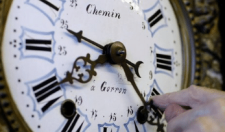
Kansas residents will soon gain an hour when they set their clocks back at 2 a.m. Nov. 5 for the end of daylight saving time, which began in March.

Fall officially began Sept. 23, and the sun is setting earlier while residents await cooler autumn weather.

Legislators in Kansas and across the U.S. have introduced many bills aiming to change the practice of “springing forward” and “falling back.” Here’s what to know about the state of daylight saving in Kansas.

Daylight saving time legislation in Kansas

Kansas legislators introduced a bill to exempt the state from daylight saving time in 2019, but it died in committee in 2020.

In 2021, lawmakers tried another route by introducing House Bill 2060, which would make daylight saving time permanent in the state. This bill died in May 2022.

These recent pieces of legislation were far from the only effort to end clock-changing, and the U.S. Senate has signed off on similar measure for the nation. But so far, Hawaii and Arizona are the only states in the country that don’t observe daylight saving time, and the Navajo Nation portion of Arizona does practice daylight saving .

The history of daylight saving

Daylight saving time was made a legal requirement by the Uniform Time Act of 1966, the U.S. Department of Transportation’s Bureau of Transportation Statistics reports.

State governments cannot independently change time zones or the length of daylight saving time, the department reports, but they can exempt themselves from the practice.

“States do not have the authority to choose to be on permanent Daylight Saving Time,” the U.S. Department of Transportation website reads.

Next year’s daylight saving time will begin March 10, 2024.

How does daylight saving affect sleep?

While Kansas residents will gain an hour Nov. 5, the time change might not actually translate to more sleep.

“There is little evidence of extra sleep” on the fall night when daylight saving ends, according to a 2013 article from the Sleep Medicine Reviews journal, and you might actually be losing rest .

“The cumulative effect of five consecutive days of earlier rise times following the autumn change again suggests a net loss of sleep across the week,” the article’s abstract reads.

The end of daylight saving time has also been linked to other issues, such as increased collisions with deer , a 2022 article published by Current Biology reports.

While you might be less well-rested when the time changes this November, a March article from the Mayo Clinic Health System offers tips on how to reduce your sleep loss :

  • If you feel tired a few days after daylight saving time ends, take a 15-to 20-minute-long nap in the early afternoon.
  • Assess whether naps are helpful to you. Napping can hurt nighttime sleep for some people, while others may benefit from short naps.
  • Make an effort to be well-rested before the time changes.
  • As reported in Wichita Eagle.

Auction in rear-view mirror

0
Thayne Cozart
Milo Yield
Our big downsizing auction is now in our rear-view mirror. It was anything but big, money-wise, as far as auctions go, but it was big in the one respect that really mattered — we got rid of almost all our superfluous “stuff” that we didn’t need any more, had gotten the joy out of, and won’t have room for in our new home. So, we figger the auction a success in the big picture of our little universe.
Watching your possessions change hands during an auction is any interesting phenomenon. Country music singer Sammy Kershaw long ago recorded a song titled “Yard Sale” that has some lyrics that fit a downsizing auction, too. Here are a few of those excerpted lyrics: “
“Oh, they’re sortin’ through
What’s left of you and me.
Paying yard sale prices
For each golden memory.
Oh, I never thought
I’d ever live to see
The way they’re sorting through
What’s left of you and me.
…Well there goes the baby’s windup,
And the mirror from the hall.
I’d better take just one last look
Before they take it all.”
In my life, I’ve been to too many auctions looking for “buy bargains” to ever be critical of folks who did the same at our auction. But, as I watched folks tote off things I paid good money for long ago, it made me chuckle a bit to wonder what value I saw in the item when I bought it. All I can say is I hope they get as much use or enjoyment out of their newly acquired item as I did.
Judging from our auction, nobody really buys used furniture these days. I’m left to guess that folks put a premium on buying only new furniture. Which leads me to this observation: We won’t be insuring the contents of our new home for nearly as much as we have the contents of our current home insured for. In the future, it only makes sense to insure the six major appliances — refrigerator, deep freezer, stove, washer, clothes dryer, and dish washer — and a few thousand bucks for all the rest of the contents. If disaster strikes, you can replace all your other furniture at substantially less than new price.
Reflecting on it all, it’s rather refreshing to face the future with an updated slate of possessions. That said, just this morning at the Old Geezers’ Breakfast Club, I acquired my first extraneous new possession.  I got a brand new one-piece bread toaster — for free. It was a good way to start our new collection of “ new stuff.”
***
Before I quit the auction report completely. One item that didn’t sell is the fiberglass pickup truck bed cover. It fit the bed of my long-departed 1997 Ford F-150. I will give it to anyone who will come get it. Just give me a call at 620-344-1350 if you’re interested.
***
Our new home is gradually nearing completion. The builders are mostly working on the shelving, the lighting, the bathroom tiling, and installation of plumbing fixtures. It will nip and tuck to see if we still get to move the first week of October.
***
I regularly mention my wildlife encounters at Damphewmore Acres. Well, after the last one, I can assure that the world’s strongest raccoon recently showed up here. One evening, I discovered an old hen had gone to chicken heaven. It was too late in the day to bury her carcass in the compost pile, so I placed it under a 20 gallon stainless water tank that weighs at least 25 pounds. I figgered to compost her the next morning.
Alas, I had not figgered on King Kong Raccoon. The next morning I drove my UTV to the chicken house and, “Whoa,” I discovered the stainless steel tank had been slid at least 30 feet into the middle of the driveway. And, it was overturned and the hen carcass long gone. Only the dusty tracks of King Kong Raccoon told the tale. I wish I could have seen how it moved the heavy tank and how it overturned it for a chicken dinner. It would have been an interesting sight.
***
I’m always thinking about ways to make a quick buck easily. After watching TV for decades, I think I’ve hit upon a new money-making scheme. I want to be paid to come up with new names for new prescription medicines. Now, the pharmaceutical companies pay big bucks for expensive public relations companies to come up with the weirdest new medical names — like Zulaxid. Penctil, Ovyvara, Kydatid, Jalepto, Bedenyx, Peqavi, Kyrolen, Viagra, Cialis, Eliquis, Jevtana, Xgeva, and Ozempic, as examples.
Well, I can do job just as good and for a lot less money. I will build a “Medico-Dart Board” with lots of the letters Q, Z, J, X, and V. There will be fewer of the letters B, C, D, F, G, K, M, P, and W. The rest of the alphabet will have just a smattering of letters on my “Medico-Dart Board.”
When a pharmaceutical company needs a new medicine name, all it will have to do is tell me how many letters it wants in the name. Then, for a cool, but cheap, $10,000, I’ll go to my “Medico-Dart Board” and throw the proper number of darts. Voila, a new medicine will be named at a fraction of the current cost — which means the med can be sold to us much cheaper.
***
Two more good friends went to the Great Beyond this week. One friend and former co-worker died in Puyallup, Wash. The second was a current neighbor lady. Both were good folks who will be missed. RIP.
***
My words of wisdom for the week are from Christopher Parker: “Procrastination is like a credit card. It’s a lot of fun until you get the bill.”
Have a good ‘un.