Thursday, February 26, 2026
Home Blog Page 630

Tomato Soup

0
It’s a late-night burn at our abode.  Never enough hours in the day to get everything done that’s on my ‘do’ list.   I have so many projects going on.  The ‘just cleaned’ house looks like a tornado blew through.  But….I have been doing my research on food from the depression, and we are off and rolling.
One of the first things I have noticed as I approached this little study is how many of these recipes I make, however; I have no recipe!  For those of you who are
reading my column for the first time today.  I am traveling for a few weeks through foods that were popular during the Great Depression.  Black Thursday started on October 24, 1929 which started our ten-year run of the Depression.  What caused the stock market crash and the span of ten difficult years?
Slow consumer demand-
Mounting consumer debt-
Decreased industrial production-
Rapid, reckless expansion of the US Stocks Market-
A large decline in spending-
Inactivity followed by overaction by the Federal Gov’t-
Tight money policies adopted by Central Bank of America-
Stock Market Crash-
Failure of banks-
The Smoot Hawley Tariff of 1930, which raised taxes on imported goods.
In order to survive this economic time our great-grandparents had to be creative when it came to cooking.  Foods had to be cheap and wholesome.  Foods that were rationed were:  sugar, coffee, pork, fish, butter, eggs and cheese.
Farmers and those who had access to gardening were fortunate.  In my mother’s family they had many supplies because they ran a self-sufficient farm.  Truck garden, regular gardens, ponds for fish, cattle, pigs, chickens and a sorghum mill.  The picture was totally different for people residing in large cities.  For example, in 1931 New York City food lines were serving 85,000 people per day.
My recipe for the depression this week is going to be tomato soup.  I grew up on homemade tomato soup.  I never had a can of Campbell’s tomato soup until I was 43 years of age!  Seriously, the only way I knew to make it was from scratch.  Campbells had 5 flavors of soup at that time:  Tomato, Chicken, oxtail, vegetable & consommé.   Soups and stews were staple meals throughout the depression.  In some areas folks were using discarded vegetable tops and peels to help them make a soup with flavor.   Many meals had no meat whatsoever.
Spaghetti was made with bacon versus beef because it was cheaper and it lended a great deal of flavor to the sauce.   Hot dogs were a huge hit because they were cheap.  They were actually in one recipe called ‘Poor Man’s Supper.’  This would have been fried potatoes and onions with diced hot dogs.  My dad is going to get a hoot out of this one, because it was one dish he would make for us when I was a young girl.  I actually think it was one of his favorites!   At least ‘I’ thought so!
Basically, nothing was wasted, Eleanor Roosevelt even got on board providing inexpensive recipes like her prune pudding.  Spam became a staple item, those in rural areas were eating wild game.
I can tell this is going to be an interesting subject and each column could probably go on for days!  As a child growing up the conversations about the depression, I remember the most was the chatter about ham and beans.  In fact, the first time I had them in elementary school, I thought: “Wow, the cooks don’t have much to cook with right now!”   Every region, state and country had foods that were unique to their regions.   Buttermilk also became a well-used ingredient during this time frame.
OK friends, it’s perfect timing for some old-fashioned tomato soup.  Since I first wrote this recipe I have changed/altered the dish so many different times.  Sometimes I blend about 1/2 of the soup and leave the rest with pieces of tomato more visible.  I enjoy using different spices and herbs to jazz it up.  Nothing is more soul-warming than a bowl of tomato soup.  I enjoy the soup served with a marble bread grilled cheese sandwich.  If there’s no sandwich, I like to add toasted cubes of seasoned marble bread on top of the soup.   Ok, OK, here comes the recipe.  Simply yours, The Covered Dish.
TOMATO Soup
 (14.5 oz.) can diced tomatoes with garlic and onions
1 quart of tomatoes or 1 (14.5 oz.) can store bought whole tomatoes
2-3 tablespoons butter
1 pint of milk, (I used 2%)
1 pint of fat free half and half, sure use regular
Dried basil to taste
1 teaspoon baking soda
1 cup shredded cheddar cheese
1 cup milk, for thickening
3 tablespoons flour
You will be using 2 separate pans to start this soup.  Place the quart of tomatoes in a blender and smoothly mix, add about 2/3’s of the diced tomato blend.  Blend these smooth.  Pour the smooth tomato mixture and the remaining tomato pieces into a saucepan with the basil and pepper.  In another saucepan heat 1 cup of milk, 1 cup of half and half, butter and soda.  When both saucepans have reached about the same temperature combine the tomatoes into the milk mixture.  Stir to blend, add cheese, and mix until smooth.  After the soup is thoroughly warm you can whisk the flour into the remaining cup of milk.  Add the slurry to the soup and continue with a whisk or spoon until smooth.  Do not allow to boil.  Don’t leave tomato soup unattended as it can get too hot very very quickly.
Sometimes I add onions and peppers which I have sautéed in a small amount of butter, celery is another good addition.  The truth is every time I make tomato soup the recipe is slightly different.  Sometimes I don’t puree the tomatoes as much and I leave more pieces floating.  Do what pleases you the most. Debbie

The Legend of Sink Hole Sam

0


Once upon a time near a sleepy little town called Inman, in a land far, far away known as Kansas, a legend was born; a legend that would bring this quiet town notoriety for a time those 100 years ago. The legend became that of Sink Hole Sam.

Believe it or not, prior to the 1920s, a string of small freshwater lakes stretched across part of central Kansas, coming within a couple miles of the town of Inman. It is reported that people from around the state actually came here to fish in those lakes, and the duck hunting there was said to be so good that hunters would fill wagons with harvested ducks and haul them with teams of horses north to the town of Conway where they would be sent by train to exclusive restaurants in Kansas City. Eventually the lakes were drained, leaving Lake Inman, and a few low pockets of water now known as “sinkholes.” Inman Lake remains as the largest natural lake in the state. The biggest of the sinkholes took the astonishing name,” the Big Sinkhole.” Here, a legend was born in the form of a large serpent-like creature that became Sink Hole Sam.

Alright, alright let’s get real here. I suppose that back in the day certain “liquid refreshments” were easily obtained in the back rooms of most hardware stores and from what I hear, tranquil little Inman, KS was an exception. But how many visits to the back room would it take to fabricate stories about freshwater lakes here where some years its so dry that fire hydrants chase dogs up the street and kids are actually urged to pee in the pool?

Anyway, people speculated that Sam had been living in some prehistoric underground cavern that had somehow filled with water from the sinkhole, allowing him to finally venture forth. Evidently no one got close enough to see if the critter should be named Sam or Samantha, but I’ll stay true to the legend and use “Sam.” Two “unidentified” Inman men fishing at the sinkhole first reported seeing Sam. Soon after, Inmanites Albert Neufeld and George Regehr spotted him also. Albert sought to save the town by taking pot shots at poor Sam from a nearby bridge (I suspect the bridge was not really all that nearby!) Of course, descriptions of the beast varied according to the audience and the time of day, but Sam ended up being a very large snake-like critter, about fifteen feet long and the diameter of an automobile tire.

Now, everyone likes a good legend, and the discovery of Sam was no exception. The story spread like hot peanut butter! Newspapers caught wind of the tale, (no pun intended) and locals started getting calls from strangers all across the country. Today, some residents still recall seeing hundreds of cars parked around the big sinkhole hoping “Sammy” would make a curtain call.

In an attempt to quell speculation about their new prehistoric mascot, (here the legend takes a sharp southern detour) some “great scientific minds” were brought on board in the persons of Ernest Dewey and his assistant Dr. Erasmus P. Quattlebaum. Earnest D. and the Dr. informed Inman that Sam was a “Foopengerkle,” one of a species thought to be the “extinctest” creatures ever to inhabit the Kansas Plains. This must be where he became Sam rather than Samantha, because Ernest and Dr. Q. maintained that no female “Foopengerkles” ever existed. Their final report urged caution, since Sam did not seem to realize he was extinct.

Like I said, everyone likes a good legend. Millions of dollars have been spent attempting to disprove the existence of Bigfoot and The Loch Ness Monster. As far as I know, all such attempts have failed, so both creatures must still live, if only in myth. Sink Hole Sam put Inman on the map and in the news those many years ago, and no one has ever disproven his existence to me. After all, this is America, and stranger things have happened! Like I said, everyone likes a good legend…Continue to Explore Kansas Outdoors!

Steve can be contacted by email at [email protected].


Clock’s a’Ticking

0
Thayne Cozart
Milo Yield
Time seems to be speeding up toward Saturday, Sept. 16. That’s the date for our big Milo Yield Damphewmore Acres downsizing auction. We’ve got a lot done preparing for the auction, but there’s a lot more to do and it doesn’t seem like much time to get it all done.
One part of the auction is decided. Everything for sale will be close to the house. That’s because we have more household related “stuff” for sale than we do farm and garden “stuff.” And, thanks to our huge garage, a lot of the auction can be held indoors. The sale starts at 10 a.m.
We have a regular auction ad running this week in the paper where you can read the auction listing (aka: Thayne & Sharon Cozart). But, for folks who just want to know the general categories of auction listings, here they are: furniture and household, music boxes, shadow boxes, huge selection of wall hangings, 2 firearms, hunting/fishing/recreation, trolling motor, wildlife art prints and decoys, commemorative knives, lawn and garden tools, hand tools, cattle panels, tomato cages, fencing, stock tank, golf cart, and Rhino rotary mower, storage shelves.
***
Our new home is getting closer and closer to completion. If the construction schedule holds to plan, we should be able to move into our new digs near Riley, Kan., the first week of October. That date will be here before we know it.
***
In sorting through all my old papers and items I’ve saved down through the decades, I keep finding outdated material that I think deserves to go into my columns. Though outdated, it’s still pertinent to the rural community.
With the fall crop harvest already underway, and with all types of agriculturists keenly watching the commodity markets daily, I thought this piece that I found, entitled “Murphy’s Laws For Commodity Traders,” would hit a sweet spot. The paper clipping that I discovered said the author was unknown. Be that as it may, here it is.
All points listed below hinge around this Commodity Market Axiom: “The market goes your way the day after your stop is hit. Corollary: The big move begins the day after your option expires.”
l. It is morally wrong to allow a sucker to keep his money.
2. Everybody has a trading strategy that won’t work.
3. For every expert who says the market is going up, there is one who says it’s going down.
4. If you can drink it, don’t trade it.
5. If you are tempted to play with bellies, go find your spouse.
6. The successful speculator is one who dies before his time comes.
7. He who sells uncovered options goes broke.
8. If you feel like doubling up on a profitable position, slam your dialing finger in your desk drawer, or hit it with a hammer, until the feeling goes away.
9. The perfect strategy works every time until you start using it.
10. If your strategy seems to be working well, you haven’t been using it long enough. .
11. The guy who owns the horse when it dies is the loser.
12. When it comes to luck or skill, you can’t beat luck.
13. Livestock won’t eat $4 corn or $400 soybean meal.
14. When the plate of cookies goes around the table, take a couple.
15. When the market is wrong, it doesn’t pay to be right.
16. He who sells what isn’t his’n, pays the price or goes to prison.
17. Be right — sit tight.
18.The best way to make a small fortune is to start with a large one.
19. He who knows, doesn’t tell; he who tells, doesn’t know.
20. When you’re hot, you’re hot; when you’re not, take a vacation.
21. The market knows more than the sum total of everyone watching it.
22. What everyone knows, ain’t worth knowing.
23. The market will do whatever it has to in order to fool the majority.
24. Fundamentals are seldom what they appear to be, and are never fun.
25. If you always do what you’ve always done, you’ll always get what you’ve always got.
26. The first five letters of”broker” spell “broke.”
27. The market punishes those who make mistakes.
***
Another item I found says this: “Young adults and teenagers, if you are tired of being hassled by unreasonable parents, now it the time for action. Leave home and pay your own way while you still know everything.”
That saying applied to”young” me. I headed to college at 17 and knew it all. Today, six decades later, I realize that back then I knew much about nuthin’.
Today, I know so much that I spend a lot of time complaining. Perhaps, I’ve become one of those persons Spiro T. Agnew, Vice President in the Nixon administration, was citing when he said, wisely: “In the United States today we have more than our share of Nattering Nabobs of negativity.” Have a good ‘un.

A people amendment

0
john marshal

When the echoes faded and the dust had settled in Philadelphia in 1787, the United States had a Constitution. From May into mid-September that year, the founders debated the afflictions of a weak central government under its Articles of Confederation. They agreed to a new document, a Constitution which set out how America would be governed.
The people would rule. Not the Army or the police, the Speaker of the House or even the president. The people would govern by way of their elected legislators and appointed services. That was the order then and the way it is supposed to work now.
Critical to our Constitution are the initial ten amendments, a bill of rights. The First Amendment is generally the most publicized and often the most misunderstood.
For example, in September 1987, a special “Congress” was organized in Philadelphia to observe the Constitution’s 200th birthday and to celebrate the First Amendment. At the same time, a poll from George Gallup found that most Americans didn’t know what the First Amendment was.
Decades later, a lot of us still don’t.
A Kansas judge recently sanctioned a police-state raid in Marion to search the local newspaper office and the homes of its editor and a local councilwoman. The affidavit for the raid’s “search warrant” was a mash of rumor, intimation and vengeful innuendo, a script reminiscent of a Gestapo playbook.
*
The First Amendment is the one that guarantees us the right to speak our piece, to print what we like, to have meetings, to believe as we choose. All of those good things are supposed to be done without any interference, government or otherwise.
It’s a pity that the majority of Americans had never heard of such a basic law. Perhaps Gallup hadn’t asked the question the right way. Nonetheless, not much has changed in 37 years or 237 years. Too many Americans still misunderstand this law or remain unaware of it.
The best thing to come out of the Philadelphia Congresses – the first one, and the one 200 years later – was the effort to get everyone involved. Some people who do know about the First Amendment think it was put there on behalf of people who own newspapers or radio and television stations and that’s all. It was put there for all of us, and when it gets dented, we all get hurt.
It may tick off editors when one of their reporters gets kicked out of a school board meeting so members can talk in secret, but the real losers are the people who pay for their schools and send children there.
The First Amendment is a People Amendment, not a Free Press Amendment. Not altogether.
We’ve learned a lot about the Constitution, the Bill of Rights and the First Amendment over the past two centuries and more. Our continuing education has at times come the rough way – in bloody protests, vicious rebukes – or the litigious way, in court.
*
The First Amendment may acquire new angles and take on new technologies but its guarantee – freedom to speak, to think, to meet – must remain timeless. It must remain a force.
It must resist the fakery of firebrands who bleat “fake news” at the drop of a fact, just as it persevered in the face of goons who sought to incinerate newspaper offices for daring to publish the truth.
With today’s digital deluge, anything – anything at all – can be published in an instant and palmed off as valid. The Amendment allows us the privilege to sit back and say: How nice, is it true?
This is how our society is to be free indeed, and not managed. We must continue to guard against efforts to distort the First Amendment or pervert its purpose, for the obvious reason that the next step is enslavement of the people.


Lettuce Eat Local: Brining home the bacon

0

Amanda Miller
Columnist
Lettuce Eat Local

Like with parents of any child, Brian and I are not always sure where some of Benson’s phrases or actions come from. Shoot, we don’t even exactly know how he got his blue eyes and blond hair, considering we both have brown eyes and brown hair. The magic of recessive genetic traits.
Speaking of magic as of this past week, suddenly his new thing is: “Let me show you a magic trick!” I think I said that to him once, although he started saying it himself after spending an evening with cousins, so maybe they taught it to him? At any rate, it feels out of the blue.
After his declaration, Benson will then proceed to do some strange stretching move, climb onto a stepstool in a weird way, or most often, perch with one foot on a chair rung and the other on the bookshelf ledge — whatever it is, executed with all the finesse and confident enthusiasm a two-and-a-half-year-old body can muster. While the “trick” itself may be underwhelming, the grin that accompanies it isn’t, and it’s impossible not to applaud generously.
My cuteness levels are nowhere near Benson’s, so I won’t expect similar applause, but I feel like I’ve found my own magic trick that I want to show you. Roasted chile mayonnaise, ta-da! I’ll save my bow for after you’ve tried it.
I’ve long felt that mayo has a magical aura to it; a creamy emulsion of previously very disparate ingredients that can transform a dish with even just a dollop of its velvety richness. (And although its name would suggest it belongs here, I am a mayonnaise snob and I do not categorize Miracle Whip in the same mystical way.) And while mayo is remarkable on its own, flavor additions only make it more so. I’ve found most of my favorites while making sushi: adding just a few things to mayonnaise to make it Japanese kewpie-style, wasabi, or sriracha.
But now I have a new favorite, at least currently. Kind of like Benson’s magic tricks, I’m not sure if I saw chile mayo somewhere or if I just made it up, but here it is. The concept is quite simple — I added a little sugar and rice vinegar like I do for that addictive kewpie mayo, and chopped grilled poblano peppers. The spicy earthiness of the poblanos melds with the tangy luxuriousness of the mayonnaise, all of it brightened by the acid and deepened by the grill char. I’m unfortunately not kidding when I say sometimes I don’t even look for a vehicle and just eat it on a spoon.
That said, it’s probably better with things. Slathered on grilled zucchini slices or roast chicken, stirred into scrambled eggs or tomato soup, spread on biscuits or a grilled cheese sandwich.
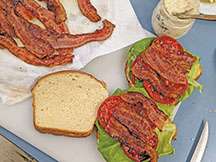
Its highest calling, however, may be as a component in BLTs. I tried it in preparation for a monthly class I teach in Arlington, and oh. my. goodness. Technically it may have just been all the other lovely fresh ingredients — soft homemade bread and juicy garden slicing tomatoes and crispy farm-raised bacon — but I had to put my BLT down after my first bite to take it all in and savor the magic. Brian even commented on how incredible the sandwich was, and while I’m not usually a bacon person (gasp!), I was quite pleased there was plenty left of everything for another meal or two. It might even be worth it to smell up the kitchen again frying up more bacon if necessary.
And if that’s what roasted Chile mayo can do, that’s quite a magic trick.

You don’t really need a recipe for BLTs, but they are just such a perfect vehicle for this spicy mayo that I couldn’t help but tag it along. Since the ingredients are so simple, make sure you use quality ones. Draining the tomato slices keeps you safe from a soggy sandwich, which in my book is another magic trick. The mayo can be made a week in advance, but of course your sandwich needs to be eaten immediately after assembly for best results.
Prep tips: use any Chile of your preference, but remember, use mayo and not miracle whip.

1 cup mayonnaise
1-3 grilled or broiled Chiles (poblano, hatch, Anaheim, jalapeño…), chopped
splash of rice wine vinegar
pinch of salt and sugar
thick slices of fresh tomato
good bread
lettuce leaves
crispy bacon

Mix mayo and Chiles (deseed the Chiles, or don’t add them all if it’s seeming too spicy). Add in vinegar and salt to taste; refrigerate. Set tomato slices on a paper towel and sprinkle with salt. Let dry a bit. Lightly toast the bread (decide if you’re doing open- or closed-face sandwiches). Assemble sandwich in this order: bread, mayo, lettuce, tomato, bacon. Eat.