The Kansas State Fair wants to close its money-losing racetrack in Hutchinson, with officials telling lawmakers that the area could be better used for a smaller dirt track and a money-saving permanent stage.
The 67th Hutchinson Grand Nationals Auto Races were held in July, and 2023 could have been the last year. Race fan efforts to convince the Kanas State Fair Board to reconsider its decision have since escalated.
“What they don’t understand is that, to have a facility like this, it costs a lot of money,” said Bryan Schulz, the fair’s general manager. “I’ve been doing a profit loss statements for the last few days that Rep. (Paul) Waggoner has requested. … It’s costing us way too much money to continue having that on the grounds.”
The Kansas State Fair racetrack loses money
When considering the fair’s revenues and expenses from the races and food and beverage, which are separate contracts, the fair stands to lose about $11,000 this year.
The races brought in about $63,000 in revenue, but the fair will lose about $12,000 after expenses. Food and drink brought in about $18,000, but expenses will bring the profit down to about $1,000.
“We can’t continue doing that,” Schulz said.
The Hutch nationals have three days of races, and the fairgrounds hosts zero races the rest of the year.
Schulz said the fair has not been approached by promoters in recent years to have more races at the fairgrounds. Additionally, were races to continue, “The track itself, it is in dire need of some updates.” Concrete wall panel replacements would cost at least $56,000, he said.
Racing fans want to save the Hutchinson racetrack
Schulz testified before the Legislative Budget Committee on Tuesday.
Rep. Troy Waymaster, R-Bunker Hill and chair of the House Appropriations Committee, said he has received a lot of emails about trying to keep the racetrack open.
So has the fair board, Schulz said, prompting the board to decide it will possibly revisit the topic after the fair.
“But again, no promoters have stepped up and said that they’re interested in keeping the track open and/or additional monies that it would take to bring that track up to speed,” Schulz said.
Schulz said there are no official attendance numbers. While the races are considered sellouts, he estimated there were a couple thousand empty seats out of 9,000 total when he stopped by.
Ending the races in Hutchinson discussed for almost 20 years
Removing the racetrack is not a new idea, Schulz said, with the fair board having discussed it after an incident in the 2000s and then again in the 2010s.
“In 2004, I believe, the board had made a decision to stop racing during the fair,” Schulz said. “Because I believe it was during one of their races, coming out of turn No. 3 into 4 a wheel flew off of one of the sprint cars, went over the wall, bounced several times and almost hit two young girls. So at that point in time, the board had made a decision to stop racing during the fair. They also started looking at the revenue streams that were coming in from this. We did not and do not have a promoter, other than the three days of the Hutch nationals.”
When Schulz was hired in 2021, the question of what to do with the racetrack area was brought to his attention.
The buildings and grounds committee in November recommended to the fair board that 2023 should be the last year of the Hutch nationals and racing at the fairgrounds.
“Because it is not being utilized,” he said. “It is about 18 acres that we could be putting into use of something else. It would just be the actual track itself. We would continue using a portion of it where the grandstand entertainment stage is set. But we will be able to use a lot more of the area where the actual track is for other purposes, including parking and other vendors during fair time.”
Here’s how the fair would redevelop the 18 acres
The fair already has an idea for how it would use the 18 acres where the racetrack sits.
School is officially back in full swing, and kids all over the States are transitioning back into academic routines. Benson is only two, so definitely too young for school, but he’s been working on his own major transition the last couple weeks.
Technically, he and I both have. It’s so fun and rewarding to see your kids growing up…and also it’s so hard. I’ve been meaning to wean Benson off of his giraffe pacifier, or “Babby” as he calls it, for some time now, but there’s always too much going on to ask more of him at the moment. We often have kids in and out of our home, whether through respite/foster care or just for fun, and helping a toddler share all his space and things is plenty to occupy his mind. Over the summer, in addition to a busy schedule and long days without seeing Daddy, he fully completed potty training (whether inside or outside…) and took a train adventure, not to mention broke his head.
Needless to say, we’ve been pushing it off. He only uses his pacifier for sleeping, so it’s not that big a deal, right?
Until I took him to the dentist. Benson was an absolute champ, but his teeth weren’t. Something flipped in me, and I decided we were done with Babby. Technically we’ve tried very low-key weaning before, cutting the connection between the pacifier part and the soft giraffe part, hoping the coziness of the familiar giraffe snuggie would suffice. Really all that resulted from that was having to find and reaffix “other part Babby” for months until I gave up and sewed it back together again.
But I know he’s too old to still use it, and we wanted to make this transition in plenty of time before the baby (and I’ve long since made my own transition out of any “normal” clothes: even t-shirts are getting tighter than I remembered, so our time is running out). So it was the day to be done.
And then we were. It was only two days’ worth of naptime and bedtime with a few minutes worth of heart-rending sobs and pleads for Babby, and then he was mostly okay.
At least Benson was okay. Brian and I almost felt worse about it since Benson was so brave/resigned to his fate. Benson was given a pacifier day one in the NICU, and while he was fairly noncommittal about various pacifiers for his first year and a half, he landed on this giraffe paci when I weaned him. Since then, Babby has been The Most Significant Item: irreplaceable and essential.
Bear, Bass, Moo, and Shark also sleep in the crib with him, but no matter how we tried, they never reached the same elevated relational status as Babby maintained with ease. Bass (pronounced like the fish, don’t ask me why) is even another soft giraffe stuffie, intended to sneakily overthrow Babby’s reign, but he never got close. All the animals might all get lined up, fed pom-poms, given rides, and taken along on various adventures, but Babby is the only one Benson really loves.
It was an evening just a few weeks ago when Benson got Babby out of the crib prematurely, and we told him to put him back until bedtime. Benson dissolved into dramatic shock and horror, anguishing, “But I NEED Babby! To protect mine mouth, from bears and foxes!” And then, suddenly, Babby was gone, moved away. A constant friend, companion, protector — gone. Going to sleep has definitely been harder for him, but he’s only asked for Babby once after those first two days, even though this last week we had a little boy for respite care who was permanently attached to his own pacifier.
And now, Mommy’s the one who feels a little sad and nostalgic. I didn’t even give him something in replacement, I just took it away! So as much for myself as for Benson, I promised him giraffe pancakes. I cannot speak the name of Babby out loud, so he’ll never get the significance, but I will.
Goodbye, Babby. Hello, brave new world.
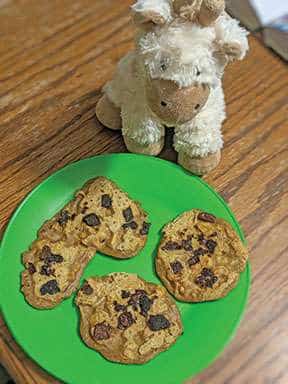
Giraffe (Cinnamon Apple & Chocolate) Pancakes
While there are lots of very cute giraffe snack ideas on Pinterest, I know my own limitations and anything with a face is guaranteed to turn out terrifying. Benson had been asking for pancakes anyway, so I went with my own easy idea that promised the potential of giraffey-ness and the certainty of chocolate. Are they perfectly picturesque? No. Did Benson have fun dropping in the chocolate chunks? Yes. Does he care at all that they are supposed to look like a giraffe in memoriam of his beloved Babby (without mentioning that name, of course)? No, but I do.
Prep tips: if you don’t have oat flour on hand, consider getting some, because it’s delicious; or also just use all whole-wheat or some white. The turmeric is optional, just for a hint of color.
1 cup whole-wheat flour
½ cup oat flour
½ teaspoon salt
1 teaspoon baking powder
1-2 teaspoons cinnamon
a dash of turmeric
1 tablespoon brown sugar
3 eggs
1 tablespoon peanut butter
1 cup milk/buttermilk
1 cup finely diced apples
chocolate chunks
Combine the dry ingredients. In a separate bowl, beat the eggs well, then whisk in the peanut butter and milk; whisk this into the drys. Stir in the apples. Fry in butter in a nonstick skillet, either in rounds or hypothetically the shape of a giraffe head and neck, and before you flip the first time, drop on a few chocolate chunks for giraffe spots.
The Kansas Department of Agriculture Division of Animal Health has received notification of multiple confirmed cases of West Nile virus (WNV) in horses across the state over the past few weeks. Confirmed cases have been reported in Barber, Butler, Douglas and Pratt counties.
WNV is a preventable disease, with annual vaccinations that have proven highly effective. All of the confirmed cases of WNV in Kansas were in unvaccinated horses or horses with an unknown vaccination history so were assumed to be unvaccinated. All horse owners should consult with their local veterinarians and make a vaccination plan for their horses.
WNV is a virus that can infect humans, horses, birds and other species. Horses infected with WNV can have symptoms that range from depression, loss of appetite and fever to severe neurologic signs such as incoordination, weakness, inability to rise, and hypersensitivity to touch or sound. WNV can be fatal in horses. If you see symptoms of WNV in your horse, contact your veterinarian immediately.
The virus is carried and transmitted by mosquitoes; it is not directly contagious from horse to horse or from horse to human. WNV is a reportable disease in Kansas, which means veterinarians are required by law to report any confirmed cases to the State Veterinarian.
For more information about West Nile virus or other animal disease issues in Kansas, go to the KDA Division of Animal Health website at agriculture.ks.gov/AnimalDiseases.
Members of Kansas’ congressional delegation say they remain optimistic about the fate of the once-every-five-year Farm Bill — though there is an acknowledgement that lawmakers could blow their Sept. 30 deadline in advancing the key agricultural package.
Extensive negotiations over the bill, which must be passed once every five years, are commonplace, as are delays requiring a short-term extension of the many programs that must be authorized.
Kansas officials have made clear their desire to see a deal reached sooner rather than later.
“I know the rest of the delegation is working every single day to make certain that that happens,” said U.S. Rep. Jake LaTurner, R-Kansas. “We have to protect crop insurance for our farmers. We have to provide certainty for them. We are going to work diligently to get this done.”
But there are signals that conflicts over spending could make for a more contentious dynamic than in years past.
And while agriculture groups say they are optimistic about a deal, their message is similar to that of Chris Tanner, a northwest Kansas farmer.
“If you have to get an extension to get it right, well, that would be worth it,” said Tanner, who is vice president of the Kansas Association of Wheat Growers. “But, from a farmer’s standpoint, if we get an extension so we can play politics, well, that’s kind of disheartening as an American citizen.”
Farm Bill unlikely to be done on time, lawmakers acknowledge
The behind-the-scenes work of crafting the Farm Bill has been going on for years and it is the first time in years that former U.S. Sen. Pat Roberts, of Kansas, won’t be involved in shepherding it through the legislative process.
But lawmakers have not yet begun the process of rolling out a final version of the bill and advancing it to the U.S. House and Senate floors.
There is concern that the Farm Bill will be coming to a head at the same time as a series of key spending bills needed to avert a government shutdown, meaning lawmakers will have to prioritize.
“The challenges perhaps are greater than they normally are,” U.S. Sen. Jerry Moran, R-Kansas, said in an interview Friday. “Congress is, sadly, historically slow. There’s no reason that you can’t reach an agreement in advance of a deadline instead of after a deadline. But it seems that Congress always is waiting for them.”
With a price tag expected to top $1 trillion for the first time ever, conservative Republicans may take a more hardline approach to the Farm Bill than in years past, creating worries that the process could resemble a contentious fight to raise the debt ceiling earlier this year.
Lawmakers have said they expect the most conservative members of the U.S. House Republican caucus to be on board, something LaTurner echoed.
“We’ve had folks second-guess the ability of the House Republican Conference to come together to pass meaningful legislation,” LaTurner said. “And we’ve done it time and time again since January and I’m confident we’re going to do it on this.”
Despite its name, the Farm Bill is overwhelmingly comprised of programs focusing on nutrition, notably the Supplemental Nutrition Assistance Program, or food stamps.
Some members want to use the reauthorization of the nation’s largest food safety net program as a way to leverage change, such as an expansion of work requirements for recipients or requiring that benefits be used only on healthy foods.
Others want to spin SNAP off from the Farm Bill entirely. Past delays in passing the measure have often been because of the program, which affects 40 million Americans.
U.S. Sen. Roger Marshall, R-Kansas, noted that delays in the Farm Bill are often de rigeur and would necessitate a short-term extension, with the hope of getting a permanent solution to President Joe Biden by the end of the calendar year.
“The challenge in D.C. is that it seems like we just go from one crisis to another and it doesn’t give us the ability to make good long-term plans,” Marshall said in an interview following a Topeka event this week. “So I’m trying to get it right and we’ll get it done by Dec. 31.”
Crop insurance and safety net programs key for agricultural groups
The biggest priority for the state’s agricultural groups is reauthorizing crop insurance, which must be done in the Farm Bill.
In the U.S., the federal government helps subsidize and regulate the most commonly used plans sold by private insurers. Typically, those plans will cover any number of naturally occurring issues that farmers might encounter and payouts are based on the value of a specific crop.
Ryan Flickner, senior director of public policy for the Kansas Farm Bureau, said avoiding a situation where crop insurance access could be restricted or means tested was imperative.
“Crop insurance is the cornerstone of risk protection in a state like Kansas,” he said.
But advocates are seeking some tweaks to the program nonetheless.
Wheat production in Kansas typically falls into two categories. Farmers might plant wheat in the fall after previously harvesting soybeans or corn in that same spot over the summer months. In other cases, they might leave those fields fallow in the spring and summer before using them for wheat.
If a hailstorm or other natural disaster wreaks havoc on their crop, the two methods would be treated the same way for crop insurance purposes, even though they require different levels of investment and have different yields.
Then there are two programs that provide aid to farmers who either are hit with lower-than-expected crop prices or who are seeing a period of high-income bottom out.
Payouts in the Price Less Coverage and Agriculture Risk Coverage programs, however, are tied into per-acre rates set by Congress. Tanner said he hadn’t availed himself of either in years because the rates have not been updated and are out-of-whack with the increased costs farmers now face.
While funding can vary depending on the commodity involved, Tanner said wheat farmers would need a 20% increase to bring the programs up to market rate.
“It’s not a safety net. It’s safety asphalt,” he said of the current setup.
How can Kansas farmers be supported in drought conditions?
The Farm Bill negotiations come against the backdrop of a challenging few years for many Kansas farmers.
Currently, there are 83 counties in the state that have received a drought disaster designation from the U.S. Department of Agriculture. Nearly 70% of the state remains in some form of drought, with 30% of the state in extreme or exceptional drought.
For Tanner, this was a much better growing season than last year, which he termed a “devastating” moment for Kansas agriculture.
“As an agriculturalist, you go out and you plant your crop and hope for a harvest,” he said. “Just seeing things not even make it to a reproductive stage in the field because they burned up due to drought is not the reason I started farming.”
A rainier than usual July has helped in much of western Kansas, but there are wide swaths of the state that would need as much as a foot of rain to relieve the drought conditions, according to National Weather Service data.
Using the Farm Bill to help farmers weather more extreme climatic conditions has been a priority for many policymakers.
“Instead of placing burdensome regulations on farmers and ranchers with already thin margins,” Gov. Laura Kelly wrote in a letter to congressional agriculture committees last year, “the next Farm Bill should invest in voluntary conservation programs, drought-resistant crops like sorghum and cotton, robust crop insurance, and biological and technological innovation that will drive down the cost of regenerative agriculture in the long run.”
For Zach Pistora, a lobbyist for Kansas’ chapter of the Sierra Club, the goal was to invest in local food systems that are more resilient in the face of drought and other environmental hazards.
Critics have said crop insurance in its current form isn’t always the best way of doing that and could make farmers less likely to adapt in the face of climate change.
Encouraging conservation programs, investing in training and promoting technological innovations to use less water were all important areas of emphasis, Pistora said.
“As we’re adapting to the new normal or new circumstances with harder weather challenges, then agriculture will have to adapt,” he said. “And then we need those tools to help adapt.”
Flickner noted that uncertainty isn’t confined to drought but also the roller coaster of commodity prices that has blasted farmers in recent years, not to mention the COVID-19 pandemic, a trade war with China and rising prices for fertilizer and other materials.
“Where we are at as an agricultural state, as producers and growers across the state and the nation, times are a lot different here in 2023 than they were in 2018,” he said.
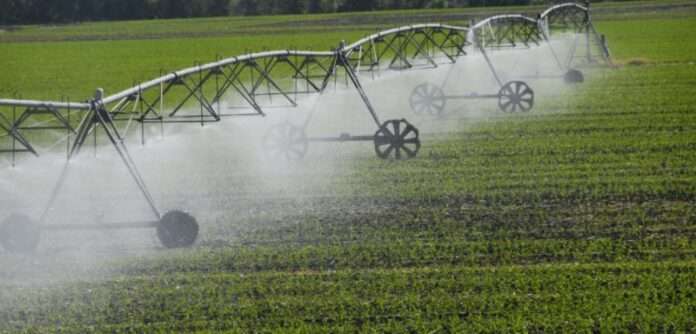
But Marshall said while he believed Kansas farmers were on the cutting edge of learning how to irrigate their crops more efficiently, he noted that the drought was just a part of the inherent risk that comes from being an agricultural producer.
“I grew up a fifth-generation farm kid,” he said. “We had droughts about every three to five years, a very common thing. And when it wasn’t drought, it was too much rain. And if it wasn’t too much rain, it was a hailstorm. And my dad used to say that farming is the biggest gamble there is out there. Farming has always been tough.”
Lovina’s Amish Kitchen
Lovina Eitcher,
Old Order Amish
Cook, Wife &
Mother of Eight
First of all—a very happy 57th birthday to dear sister Verena. May she have many more happy, healthy years. She still misses sister Susan so much. We all do, but Verena most of all because they lived together all their lives. Yes, life brings us many changes. It’s good we can’t see the future and only take one day at a time. God is a great help as we travel into the unknown future.
Family night was held at daughter Verena’s house on Friday evening. It was also granddaughter Kaitlyn’s seventh birthday. Daughter Lovina made a cake for her and decorated it. Kaitlyn was so excited to blow out the candles. She kept telling Lovina how it was her “bestest” cake ever. It’s cute how everything is her bestest at this age. She’s a darling and has won our hearts since she joined our family. I asked her what she wanted for her birthday, and she said craft things, so we gave her a few different craft sets, and she was so excited about it. She had also said she likes fruity ChapSticks, so we added that to the gift. Her eyes lit up when she saw what she had in the bag.
Kaitlyn started school last week. She attends the Amish school in our church district. She is in first grade.
On Monday, Abigail, six; Jennifer, five; and Isaiah, five, started at our small public school, which our children have attended since our move to Michigan. There are less than 300 students in K–12. It is a small, close-knit village about three miles from here. Abigail is in first grade, and Jennifer and Isaiah are in kindergarten. They were all excited to go to school. I’m sure daughter Susan’s house felt extra empty this morning when three of her five children left. She has Ryan, four, and Curtis, three (He will be four next month) at home with her.
Wednesday night, most of our church families gathered at neighbors Joas and Susan’s house for their annual fish fry. Joas loves to fish and always has plenty of fish to fry. Everyone brought a dish, and the tables were filled with lots of food for everyone.
My husband Joe stayed home because he has some sores on his legs that won’t heal. The boards at work bang against them, and it seems that once he gets a sore, it won’t heal very fast. I have been putting bandages on them with a medicated cream from the doctor. We did find out his sugar level was higher than normal, so that could be a reason for it not healing fast. He’s been trying to cut back on foods that aren’t good for that. His legs were so swollen, so he decided to stay home and elevate them, so I took Stormy and the pony wagon to pick up sister Verena to go to the fish fry.
On the way home, some of the grandchildren wanted to ride with me and Verena. Sister Emma and nephew Benjamin, Crystal, and son Isaiah were stopping in at daughter Loretta and Dustin to meet their sweet little Byron Liam. I asked sister Verena if she wanted to stop in there too to see the baby again. So Tim and Elizabeth and Ervin and Susan also came to pick up their children, who had been left with us. Tim and Elizabeth had just left with the children when we heard a crash outside. A car had run the stop sign by Dustin’s house and hit a young girl heading east. We ran to help the girl, who was very shaken up. An ambulance was called, and there was quite a commotion for the next few hours as police and fire rescue trucks came.
Son Joseph had gone home earlier from the fish fry and walked our mower down to sister Verena’s house to mow her grass. This same car that had run the stop sign earlier that night almost hit him and the mower. So we were thankful no one was killed. There are bad memories when we hear of an accident. I always feel bad for the ones involved.
It is just after 5 a.m. now. Daughter Lovina walked over to be with Loretta and the little ones when Dustin left for work. Joe and son Joseph left for work, and son Benjamin will leave in an hour.
Take care, and God’s blessings to all!
Peaches and Cream Pie
Pie Crust:
1 1/2 cups flour
1 1/2 tablespoons sugar
1/4 cup corn oil
1/8 teaspoon salt
2 tablespoons milk
Filling:
8 ounces cream cheese
2 tablespoons milk
2 tablespoons sugar
2–3 fresh peaches, diced
16 ounces whipped topping, divided
1 (3.4 ounces) box instant vanilla pudding
1 cup milk
1/4 teaspoon almond flavoring
Crust: Mix ingredients and press into a 9-inch pie pan. Bake at 350 degrees for 15 minutes. Set aside to cool.
Filling: Mix cream cheese with 2 tablespoons milk and sugar, and fold in 2 cups whipped topping. Spread in pie crust. Press diced peaches into the filling. Mix pudding with 1 cup milk and almond flavoring. Let set for 5 minutes, fold in the remaining 2 cups of whipping topping. Put on top of peaches. Garnish with whipped topping and peaches, as desired.
Lovina’s Amish Kitchen is written by Lovina Eicher, Old Order Amish writer, cook, wife, and mother of eight. Her newest cookbook, Amish Family Recipes, is available wherever books are sold.Readers can write to Eicher at Lovina’s Amish Kitchen, PO Box 234, Sturgis, MI 49091 (please include a self-addressed stamped envelope for a reply); or email [email protected] and your message will be passed on to her to read. She does not personally respond to emails.