
KG Medical, LLC, a new medical clinic in Arlington, Kansas, will be honored for its commitment to the community.
KG Medical, LLC was named a winner of the 2023 Rising Star Award as a community member that has gone above and beyond to contribute to the betterment of the Arlington community. The nomination came from Arlington Community PRIDE, a participant in the state’s Kansas Community Empowerment program. The award is given by Kansas Community Empowerment which is a partnership of K-State Research and Extension, the Kansas Department of Commerce, the Kansas Masons, and Kansas PRIDE, Inc.
“Community partners like KG Medical, LLC are instrumental in improving the quality of life in the state and we want to thank them for all they do,” said Jan Steen, K-State Research and Extension program co-coordinator for Kansas Community Empowerment. Presentation of the 2023 Rising Star Award will take place at KG Medical, LLC, 100 S. Lincoln St, in Arlington on Friday, August 25th at 1:00 PM. The public is invited to attend the presentation.
Kansas Community Empowerment is a volunteer-led organization that serves communities across the state by assisting local government and volunteers in making their communities better places to live and work. Through the program, local volunteers identify what they want to preserve, create, or improve in their communities and work with K-State Research and Extension agents and specialists, and the Kansas Department of Commerce to achieve their goals.
More information about Kansas Community Empowerment is available by visiting kce.k-state.edu or emailing [email protected].
Kansas Community Empowerment to Honor Arlington Business

Lettuce Eat Local: So much cheer in cherry tomatoes
Amanda Miller
Columnist
Lettuce Eat Local
Research suggests that kids are more likely to try and enjoy new, healthy foods when they are involved in the process, whether that be the planning, shopping, or cooking. I say “suggests,” because we all know kids have a mind of their own and might be the exception to the rule every day. But involvement can’t hurt, even if it doesn’t “work” all the time — because I would suggest that even if your kids don’t end up appreciating a wide range of foods, it’s still totally a success if they have the memories and experience of helping in and around the kitchen.
This is of course what I remind myself when Benson is perpetually right beside me in the kitchen, constantly mixing and spilling and sampling and driving me crazy, and then wants to subsist on cereal (or cerealrealreal, as he currently calls it) and ice cream.
But in reality I absolutely love how much he likes to “help” me and how interested he is in all the ingredients and ways we cook together, and right now I’m seriously loving the seasonal aspect of starting our supper journey all the way out in the garden. Things did not go as smoothly as I had hoped earlier this year: Benson was not nearly as distracted by the playthings I strategically placed around the garden, and he made weeding even less appealing than it already is. This baby belly of mine is so big and the weeds so advanced that apparently I now just mow the parts of the garden that we have finished harvesting. It’s special.
Anyway, now that we have spent months visiting the garden and talking about the plants, we finally reached the stage that is fun for a two-year-old, and my goodness is it fun. Immature vegetables were very hard for him to keep his hands off of, and hearing that they need to grow and grow and get bigger and bigger wasn’t nearly as much fun as picking them immediately. Yet when they actually did just that, I think it started to make sense — and the glee of his delayed gratification is one of my current favorite moments of daily grace.
I thought I enjoyed harvesting…but in comparison to Benson, my joy is very mild. The cherry tomatoes are his favorite, as his shrieks of elation prove. I like to plant at least three different varieties every year: red, gold, and a purplish one. He likes to reach through the leaves and pick them, to drop them in the bucket, to pop them in his mouth. He liked them last year, too, but he understands so much more about the process this time. And he’s paying attention — he even notices the different sounds different sizes of tomatoes make as he drops them in the bucket in different ways.
As with most things in life with a toddler, the process of picking tomatoes takes so much longer with him than it would if I did it alone. But also as with most things, it’s so much richer, fuller, and funnier with him along. Each juicy sweet pop of cherry tomato is even sweeter because of his help.
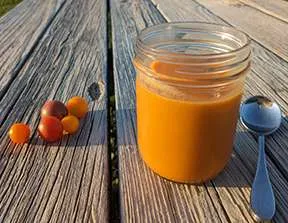
Chilled Golden Tomato Soup
This soup has the interesting identity of being a pinnacle combination of three of Brian’s least favorite food qualities ever — which, incidentally, are three of my most favorite. Soup, that is pureed, and cold: either the perfect food or the opposite, depending which of us you ask. Benson was fairly noncommittal, eating some but not much, so you’ll have to break the tie by trying it yourself. Although I will say, I took this recipe to a cook book club at the library, and I think more people were on my side than his. Usually I feel sad blending cherry tomatoes because they’re so lovely in their own right, but we have enough that I didn’t lament their use in this way — and they make the soup extra thick and rich.
Prep tips: This soup is so simple yet so tasty with good ingredients, and it was almost as good hot right after making it as it is cold. It’s slightly adapted from a recipe in Vivian Howard’s Deep Run Roots.
2 yellow onions, diced
2 tablespoons olive oil
8 cups cherry tomatoes, preferably yellow but a mixture of colors/sizes is fine
3 bay leaves
a dash of chili flakes
about 4 cups water
1 cup dairy: buttermilk, cream, milk, or a combo
1 tablespoon rice vinegar
Saute onions in oil with ½ teaspoon salt in a heavy saucepan until tender and browned a bit. Add tomatoes, bay leaves, chili flakes, and just enough water to cover; bring to a boil and simmer for 30ish minutes, until tomatoes have burst/are very soft and liquid has reduced.
Remove bay leaves, and carefully blend soup until smooth. Blend in the dairy, vinegar, and another teaspoon salt. Pour through a fine-mesh sieve into a serving container. Chill completely and taste for seasoning before serving.

Composting: Choosing a Bin
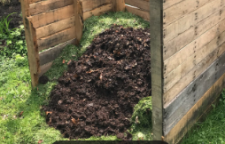
Composting within a bin is not a requirement for decomposition to occur. However, containing your compost piles in some manner serves several purposes including keeping a tidy appearance and expediting decomposition.
An ideal compost pile should be no larger than 3 ft x 3 ft x ft. This is a manageable size for turning by hand and reduces the likelihood of compaction. At this size the pile will generate enough heat to improve decomposition and kill off pests and weed seeds within the pile. Do not make the pile any larger than 5 ft x 5 ft x 5 ft.
Compost bins that facilitate regular turning can be purchased, but a more cost effective option is to build one. Compost bins can be built using a variety of materials including some that can be sourced free such as pallets. Here are plans for some do-it-yourself options https://extension.missouri.edu/publications/g6957
A common compost setup uses three bins to store materials throughout the stages. The first bin stores green material. The second bin holds the actively decomposing material and the third bin houses the finished compost that is ready to be used.
Here is a video to help with selecting the compost bin system that is right for you. https://kansashealthyyards.org/all-videos/video/composting-choosing-a-bin
Cynthia Domenghini, Extension Agent
Pears
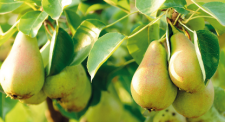
Pears are typically ready for harvest from now through October. Don’t wait until fully ripe to harvest though; pears left to ripen on the tree may develop a gritty texture. Harvesting at maturity but before peak ripeness along with a chilling period can bring out the sweet flavors we love from pears.
Pears that are ready for harvest change to a darker green color. Some varieties will have brown spots on the skin. These are the fruits’ “breathing pores” known as lenticels. The lenticels are white or greenish-white on immature pears and change to brown at maturity. The fruit will develop a waxy coating and will separate easily from the branch when twisted. Mature fruit should have a pear aroma.
When harvesting, carefully remove the fruit by lifting it at an angle and twisting. Avoid damaging the twig where it attaches as this could negatively impact fruit development next year.
Refrigerate newly harvested pears at 31 to 50 degrees F for two days to several weeks depending on the variety.
To complete ripening, remove pears from the cold storage and allow to sit at 60 to 65 degrees F for one to three weeks. Conditions that are too warm may cause the fruit to rot instead of ripening.
Cynthia Domenghini, Extension Agent
