Wednesday, February 11, 2026
Home Blog Page 435

Lettuce Eat Local: Turning Less Sour On Lemons

0

Amanda Miller
Columnist
Lettuce Eat Local

There were three different-sized jars of lemon juice in the fridge, along with a container of blended lemon pulp, a pint of lemon syrup, and a little plastic deal crammed with lemon zest. Lemon halves, looking awkward and forlorn since having been robbed of their zest and juice, were floating in my water glass, steeping in my tea, cleaning out my sink’s disposal. These spent lemons were even packed into two of their own jars, either soaking in honey-water to make lemonade or in white vinegar to make cleaning solution. I’ve got ideas for charred jalapeno honey lemon vinaigrette, lemon poppyseed crepes, cream cheese lemon spread. 

At this point you might assume I’m on the American Lemon Board or something. But no, I’m just a person with a lot of lemons.  

It all began at a place far, far away, at a time long, long ago. Or rather, in my kitchen a few months back. A friend asked me to bake the cakes for her daughter’s wedding, both the sheet cakes for the guests and the actual wedding cake, and they wanted lemon. 

Have I ever done wedding cakes before? No. Should I have said yes? Possibly not. I will be the first to admit that while I do a decent job making food taste good, making it look good at the same time is not one of my fortes. I’m happy with knowing and staying within my limitations for the most part, content with an average level of aesthetic pleasantness for my dishes. “Good enough” isn’t, however, a good enough goal for wedding cake. 

So there was some practice involved, especially since there were also some fairly constricting allergies to bake around. Needless to say, many lemons were harmed in the process — and also some mandarins and limes, since there’s a chance that for some of the trial batches I remembered the “cake” part and forgot the “lemon” part until I was already started. Awkward.

And now I throw in the Plot Twist. I’m pretty finicky about lemons. I can drink lemon things all day long (lemon in my water, lemony hot tea, Chick-Fil-A sugarfree lemonade), but eating lemon things typically has no appeal for me (lemon bars, chicken with lemons, lemony pasta salad). I know a splash of acid can hypothetically be that step that takes a dish to perfection, but I’m not convinced; often if I begrudgingly add it as per directions, I regret it, wishing I had substituted lime or vinegar or skipped it altogether. 

Ironically, Brian doesn’t like many desserts, but his favorite ones are lemony. 

Having been somewhat saturated in lemons recently, however, may be turning me less sour on them. I came to appreciate the way my hands smelled so bright and fresh after zesting eventual dozens of lemons, and while I still wouldn’t necessarily choose lemon as a cake flavor, it ranks above vanilla for me now. The lemon cream cheese frosting was straight up delicious, which is a double surprise, since only within the last decade have I learned to not spurn cream cheese as well. 

I still doubt I’ll be making lemon meringue pie or lemon piccata chicken anytime soon (unless it’s for the meringue or the capers, both items I love), but that lemon almond coffeecake was surprisingly tasty, I wasn’t mad I added lemon juice to a dilly veggie saute, and I can sense a tahini-ginger-lemon sauce coming on. 

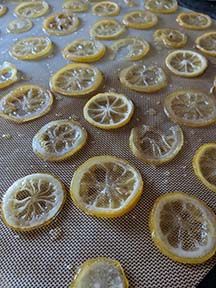
The best thing about lemons recently, though, in addition to having managed the wedding cakes “good enough,” was making candied lemon slices as the garnish. Sour turned sweet, which is kind of how my lemon journey is going. 


Candied Lemon Slices

These were kind of an afterthought as for the sheetcakes, but I’m so glad I did them. I quartered the slices and put one on each piece; they worked beautifully both as a simple yet elegant garnish and as an indicator of flavor. Candying them basically couldn’t have been easier, and their prep had neither the danger of zested knuckles or getting acidic juice into scratches on my hands. Some of the slices had gotten too thick or too thin, and I found myself consuming them as quality control as I laid them out to dry. I’ll definitely be doing them again with lemon desserts — if I happen to make any. 

Prep tips: keep the resultant lemon syrup! It’s an added bonus of the recipe. 

1 ½ cups sugar

1 ½ cups water

3 lemons, sliced thinly

Add sugar and water to a wide-bottomed saucepan; bring to a simmer and whisk to dissolve. Add lemon slices, gently stirring to ensure submersion, and simmer for 30-45 minutes. Remove from heat, and carefully remove slices with a tongs or fork. Arrange in a single layer on a silicone mat/parchment paper and let dry overnight. Use within a day or two. 


“Dry skin? Join the club”

0

An exceedingly common question I get in clinic, especially in the heart of a South Dakota winter, is how to remedy dry skin. And the questions arent just in clinic; my own kids, family, friends, everyone seems to have an occasional problem with dry and irritated skin.

Dry skin is something we are all familiar with; if your dry spots come with a rash or anything else unusual, it may be worth showing it to your primary care provider, as it could be something else entirely. Eczema, a common inflammatory skin condition, often goes along with and is made worse by dryness.

Soothing your dry skin doesn’t have to be fancy or expensive. There are a handful of tricks we can all use to help ourselves when it comes to dryness. The first advice is to avoid things that cause your skin to become drier. For many, that means to bathe less. That’s right; I said it: bathe less.

Every time you bathe or shower, it washes away natural oils on the skin. Often our instinct when our skin becomes irritated is to wash it more, but in this case more is not better. Of course, I’m not asking you to forego hygiene entirely. But most people can probably bathe every other or every third day. This is especially true of babies and kids who struggle with eczema – cut down the daily baths.

When we do bathe or shower, we can modify factors that will worsen dry skin. The hotter the water, the drier the skin afterward, so try lowering the temperature a bit. Less time spent in the bath or shower can help. And be mindful of the soap or cleanser you use – to reduce dryness, use less soap and a gentler soap. For kids who love the tub, skip the bubble bath and just put some gentle soap on a washcloth at the end of the bath when it is time to wash up.

After that bath or shower, how do you choose from the hundreds of creams or lotions out there claiming to soothe dry skin? The dermatologists I know love products with petroleum jelly (i.e. Vaseline®) for dry skin; remember, I said this didn’t need to be fancy! Stick with fragrance-free products and keep it simple. Whatever you choose, slather it on as soon as the skin is dry.

Dry skin affects many of us, but I hope these tips will help the next time you find yourself irritated with this common condition.

Kelly Evans-Hullinger, M.D. is part of The Prairie Doc® team of physicians and currently practices internal medicine in Brookings, South Dakota. Follow The Prairie Doc® at www.prairiedoc.org and on Facebook featuring On Call with the Prairie Doc® a medical Q&A show providing health information based on science, built on trust, streaming live on Facebook most Thursdays at 7 p.m. central.

Local Spotlight – Martin Hoskinson on Traveling Nurses

0

It’s always so wonderful to see and explore entirely new areas to us. For the adventurous soul, traveling is one of the true pleasures that sustains us. Now just imagine if it was part of your job, to travel to these new places. Such is the life of Haven, Kansas local, Martin Hoskinson. This past week, I conducted an interview with this continental traveler, discussing the ins and outs of his career as a traveling nurse. If you’re anything like me, you’ll find plenty of interesting information on this wonderfully rewarding occupation. Keep reading for more!

Upon talking to Martin, I discovered he’s been working as a traveling nurse for some time now. His last placement was in the heart of the West, smack dab near the 4 corners. Working out of New Mexico, Hoskinson had quite a few culture shocks. For one, “the majority population was Native American”. Apache, Navajo, and more call these regions their native ancestral homes, and the culture is vastly different than that of rural central Kansas. Hoskinson talked about those indigenous populations being some of the nicest people he’s come across and recalls the variances in dwellings, historical sites, and weather patterns. “Coming back to Kansas, I thought I was going to die (from the difference in humidity)”, Hoskinson said, “It’s a whole other climate”. During his time working as an ICU nurse at San Juan Medical Center, Martin worked with many other traveling nurses as well as staff nurses (non-traveling). He explained that traveling nurses typically were more experienced in a variety of afflictions due to their traveling experience. But like in any field, some come in less experienced than they should.

As you can imagine, there are a lot of good benefits to being a traveling nurse. One of them is sightseeing. In the 4 corners, Hoskinson got to see all the cliff dwellings, the natural beauty of New Mexico, and things that don’t exist much in Kansas, like mountains. Furthermore, traveling nurses get paid per diem for food and lodging costs depending on the location. Needless to say, there are great aspects to living as a traveling nurse.

You may be asking yourself, how does one become a traveling nurse? The first step, become a nurse. Just kidding, but there are quite a few steps involved. Martin for one was a nurse at St. Francis for 20 or 25 years as an ICU nurse. Sitting at the top of the pay scale, he decided to become a traveling nurse. First, he had to get an agency that would find these opportunities for him. Hoskinson has 3 agencies that he works with currently that secure him contracts in various locations. Recruiters from each of these agencies look for occupations that suit Martin based on where he wants to go and how good the pay is, etc. Such was the case when looking for his next contract. “I wanted to go to Alaska”, Hoskinson said, but he was told that there weren’t many opportunities available at the moment. So instead he began looking at other northern areas of the contiguous United States. There are many available contracts and they go incredibly fast, so if you find one you like, you have to jump on it immediately.

Overall, life as a traveling nurse is quite interesting and adventurous. It takes a love of travel, the ability to adapt, and a great work ethic to make traveling in the medical field a prosperous career. Martin Hoskinson has certainly done that for himself as he plans to find the next adventure/work experience. For those of you who know Martin for his work with Haven Signs, don’t worry, he will be passing on the business to his son, who will continue to do a wonderful job with the family trade. That’s all for our local spotlight, I hope you enjoyed

learning about this most interesting occupation at least half as much as I did. Last but not least, thank you to all the nurses who continue to work to help the people they do.

KU News: People underestimate AI capabilities due to ‘exponential growth bias,’ study finds

0

From the Office of Public Affairs | http://www.news.ku.edu

Headlines

People underestimate AI capabilities due to ‘exponential growth bias,’ study finds

LAWRENCE — A new scholarly article from a University of Kansas professor of business examines the human biases that underestimate artificial intelligence’s full capabilities. In his study, Nate Meikle examined the effects of motivated reasoning and exponential growth bias on human judgment. Questions tested how participants might envision the interaction between AIs and humans decades from now. “We are, on average, going to be surprised at how quickly AI progresses and potentially surpasses human capability,” he said.


School of Business to recognize 2024 Distinguished Alumni Award recipient

LAWRENCE — The University of Kansas School of Business will honor executive Jason “Jay” Meschke with its 2024 Distinguished Alumni Award on April 18 during a private event. He earned his bachelor’s degree in business administration in 1980 and his MBA in 1982, both from KU. Meschke is the president of CBIZ EFL Associates and CBIZ Talent & Compensation Solutions.

Researcher reclaims 16th century Moroccan woman leader from obscurity

LAWRENCE – While growing up in Morocco, Amal El Haimeur was never taught about Sayyida al-Hurra, the country’s 16th century “pirate queen” who overcame sexism to lead and defend the people of her city-state and region. The KU professor then embarked upon a research journey through cities and archives across Morocco, combing through rare scholarly resources, that resulted in the article titled “Sayyida al-Hurra: A Forgotten North African Queen and Military Leader,” published in the first edition of the new KU scholarly journal Africana Annual.


Full stories below.


————————————————————————


Contact: Jon Niccum, KU News Service, 785-864-7633, [email protected]

People underestimate AI capabilities due to ‘exponential growth bias,’ study finds


LAWRENCE — When asked to name the greatest potential threat to humanity, many scientists believe artificial intelligence (AI) to be a top contender. Yet there seems to be very little currently being done to ensure its safety.

“We are, on average, going to be surprised at how quickly AI progresses and potentially surpasses human capability,” said Nathan Meikle, an assistant professor of business at the University of Kansas.

His new paper, titled “Unaware and Unaccepting: Human Biases and the Advent of Artificial Intelligence,” examines the human biases that impede AI’s assessment. His experiments find that people are prone to underestimate AI capabilities due to exponential growth bias and people reject the aversive implications of rapid technological progress even in cases in which they themselves predict the growth rate.

The new work is published in Technology, Mind, and Behavior.

“We’re motivated to believe things we want to have happen,” said Meikle, who co-wrote the paper with Bryan Bonner of the University of Utah.

“Most of us don’t want to live in a world where AI is smarter than humans. And because we want humans to be superior to AI, there’s a chance that we are sticking our head in the sand. We don’t want AI to surpass human intelligence. Therefore, we think it’s not going to happen.”

Motivated reasoning emerges most often when the facts are ambiguous.

“For instance, I don’t want to get cancer. Say my odds of getting cancer in a lifetime are 40%. But because I don’t want cancer, and because I can look to my past and say, ‘I’m reasonably healthy, and I’ve never had cancer,’ I’m prone to underestimate my odds of getting cancer, and I might think the probability is only like 20%,” he said.

But exponential growth bias (which is our inability to accurately estimate exponential growth curves) becomes even more skewed when a concept turns more abstract.

“A simple example is would you rather have a billion dollars or would you rather have the money from doubling a penny 64 times?” he said. “Our intuition tells us to take the billion. But from doubling a penny, you’re actually looking at more than 184 billion dollars. And this example is especially relevant to AI because AI has been progressing at an exponential rate, in tandem with computing speed.”

To verify this theory as it relates to underestimating AI, Meikle recruited several hundred participants in the U.S. and conducted two experiments that examined the effects of motivated reasoning and exponential growth bias on human judgment. The questions tested how participants might envision the interaction between AIs and humans decades from now. (Sample: Imagine 20 years into the future and AIs are equal in intelligence to humans. How positive do you feel about the future you just imagined?)

“An AI doesn’t need to be way smarter than us to pose an existential risk,” Meikle said.

“Genetically, we share about 99% of our DNA with chimpanzees. But it’s just that little bit of extra intelligence which allows us to be at the top of the food chain. And so if an AI were to become more intelligent than humans — which I think there’s a reasonable probability of happening very soon — then maybe the AI adopts a goal that is not consistent with human flourishing … and we’re in trouble. Or, even more believably now, people use AI to manipulate other humans.”

An Idaho native, Meikle came to KU in 2021. He is a former receiver with the BYU Cougars. (He caught a dozen passes in the 2005 Las Vegas Bowl.) He also hosts a podcast titled “Meikles and Dimes,” where he interviews guests about leadership, including Kansas City Chiefs head coach Andy Reid. Meikle teaches courses in leadership and ethics at KU.

Meikle said he personally employs AI all the time.

“I’m getting to the point now where I use ChatGPT every day. It’s one of my most commonly opened apps — just asking it questions about what happened here, what happened there,” he said.

Is he fearful it might eventually replace him?

“Does it bother me that a calculator can run calculations better than me? No. And so in some ways, we don’t care. But I think we’re especially concerned about if artificial intelligence takes our jobs,” Meikle said. “I don’t mind if a calculator can calculate faster than me. But if it’s collecting my paycheck, there are going to be problems.”

-30-

————————————————————————

The official university account for X (formerly Twitter) is @UnivOfKansas.

Follow @KUnews for KU News Service stories, discoveries and experts.


————————————————————————


Contact: Lauren Cunningham, School of Business, 785-864-9540, [email protected], @KUbschool

School of Business to recognize 2024 Distinguished Alumni Award recipient


LAWRENCE — The University of Kansas School of Business will honor executive Jason “Jay” Meschke with its 2024 Distinguished Alumni Award.

Meschke will be recognized for his dedication to business excellence, community service and commitment to KU on April 18 during a private event.

He earned his bachelor’s degree in business administration in 1980 and his MBA in 1982, both from KU. Meschke is the president of CBIZ EFL Associates and CBIZ Talent & Compensation Solutions.

In his role, he has completed more than 800 successful senior-level searches spanning several industries. Meschke’s achievements during his 30-year history in the executive search field place him in the top 1% of search consultants in the U.S. He began his career in Texas at one of the country’s 25 largest banks. Following that, he worked at two Kansas City banking franchises, holding roles as chief lending officer/minority owner at one and president at the other. The two financial institutions were later sold to Nasdaq-traded companies.

Meschke serves on the KU School of Business Dean’s Advisory Board, and he is immediate past chairman of the Enterprise Center of Johnson County, a venture development organization. He also holds a senior adviser role with Star Mountain Capital, a New York City-headquartered private equity/private credit firm. He previously has served on the boards of numerous organizations, including as chair of KCPT (Kansas City Public Television) and the Shawnee Mission Medical Center Foundation.

The School of Business established the Distinguished Alumni Award in 1998 to honor outstanding graduates. To date, 67 alumni have been recognized with the award. Previous recipients include businessman and investor David Booth, Deloitte’s global chief operating officer Frank Friedman, entrepreneur and investor Tim Barton, and Cerner Corp. co-founder Cliff Illig.

Award recipients are chosen from the nominations of other alumni and the Dean’s Advisory Board. Candidates are selected based on their business success and service to their communities and to KU.

-30-

————————————————————————

Don’t miss new episodes of “When Experts Attack!,”

a KU News Service podcast hosted by Kansas Public Radio.


https://kansaspublicradio.org/podcast/when-experts-attack

————————————————————————


Contact: Rick Hellman, KU News Service, 785-864-8852, [email protected], @RickHellman

Researcher reclaims 16th century Moroccan woman leader from obscurity


LAWRENCE – While growing up in Morocco, Amal El Haimeur was never taught about Sayyida al-Hurra, the country’s 16th century “pirate queen” who overcame sexism to lead and defend the people of her city-state and region.

So when El Haimeur, now an assistant teaching professor of African & African American studies at the University of Kansas, read a passing reference to al-Hurra in a book titled “The Forgotten Queens of Islam,” she went looking for more information about her. But there was hardly any.

Thus, El Haimeur embarked on a research project that took her to cities and archives across Morocco and resulted in the article titled “Sayyida al-Hurra: A Forgotten North African Queen and Military Leader” in the first edition of the new scholarly journal Africana Annual, based in KU’s Department of African & African-American Studies.

“I went to the 2022 summer book fair in Rabat, with publishers coming from all over the Arab world and Africa. I thought I would find resources there, but I did not find anything available about her,” El Haimeur said.

Editors and bookstore owners told her they had nothing available on her scholarly search, El Haimeur said.

“So I decided to go to Chefchaouen, her hometown. There is an educational center there, and they connected me with two historians — one who lives there and the other who lives in Rabat.”

El Haimeur said Ali Risouni and Fatima Bouchmal provided her with copies of history books that cite both primary and secondary sources about al-Hurra and that are unavailable elsewhere — neither commercially nor in libraries.

El Haimeur took pictures or made copies of the materials.

“There is not another edition available,” El Haimeur said. “It’s really sad that resources are not available about her.”

Rectifying this lack of information about al-Hurra – particularly in English — was one of El Haimeur’s purposes in writing the article about her. El Haimeur’s translations of the Arabic writings the Moroccan scholars loaned her are the basis for the article’s narrative.

The KU researcher said that al-Hurra’s family status as sharifis, or descendants of the Islamic Prophet Muhammad, gave al-Hurra a certain degree of power. Her father founded Chefchaouen, building the fortress there that today serves as a museum. He was a trained military leader, and she learned tactics and strategy from him.

She learned naval warfare from her first husband, Moulay Ali al-Mandri. El Haimeur said that Muslim leaders considered these high-seas actions to be jihad, or justified warfare, while Europeans considered them piracy.

In addition to Arabic, al-Hurra spoke Spanish and Portuguese, giving her an advantage in diplomacy with those countries.

El Haimeur writes that al-Hurra’s two marriages served to make alliances with nearby rulers to strengthen their conjoined political entities. It was while al-Mandri was away on military missions that al-Hurra began her rule. She later led pirate raids against the Spanish and Portuguese in the Mediterranean Sea and Atlantic Ocean, earning the nickname “the pirate princess of jihad.”

The al-Hurra family had been victims of the Reconquista expulsion of Muslims from Andalusian Granada, El Haimeur writes, and they feared further losses.

El Haimeur writes that, in addition to keeping her enemies off balance, “Piracy gave al-Hurra revenue as well as a means to strengthen diplomatic relationships with foreign countries.”

Following al-Mandri’s death, al-Hurra took over as governor of the Mediterranean port city Tetouan and the surrounding area. She led the northern part of Morocco in the midst of ongoing conflicts between the Iberian powers and the north African Muslim kingdoms.

Al-Hurra’s second marriage, to Sultan Ahmad al-Wattasi, was less successful. The couple never lived together, and the Wattasid clan was overthrown by an alliance that included al-Hurra’s own brother.

El Haimeur said she is pleased to have brought al-Hurra’s story to a wider audience in the English-speaking world with her article. And in fact, she has heard from a Moroccan publisher who wishes to publish it as a booklet in Arabic, to be distributed in her home country.

-30-

————————————————————————


KU News Service

1450 Jayhawk Blvd.

Lawrence KS 66045

Phone: 785-864-3256

Fax: 785-864-3339

[email protected]

http://www.news.ku.edu


Erinn Barcomb-Peterson, director of news and media relations, [email protected]


Today’s News is a free service from the Office of Public Affairs

 

KU News: New book gathers insights, methods from rising generation of Indigenous archaeologists

0

From the Office of Public Affairs | http://www.news.ku.edu

Headlines

New book gathers insights, methods from rising generation of Indigenous archaeologists

LAWRENCE — A book co-edited by a University of Kansas scholar that collects the experiences and know-how of younger Indigenous archaeologists, titled “Indigenizing Archaeology: Putting Theory into Practice,” is newly published by the University Press of Florida.

Second dean candidate for vice chancellor for research to give presentation

LAWRENCE — Marc Mendonca, director of research development and professor of radiation oncology and of medical and molecular genetics at Indiana University, will be the second candidate for the vice chancellor for research position to share his vision and strategies for the future of research and discovery at the University of Kansas. His public presentation will take place 2-3 p.m. April 19.

Scholar will give talk on book connecting cannabis industry to settler colonialism

LAWRENCE – An assistant professor in Native American studies from California State Polytechnic University, Humboldt, will give a talk this week at the Cider Gallery as part of a visit to the University of Kansas and Haskell Indian Nations University. Yurok/Hupa/Oneida scholar Kaitlin Reed will speak about research that contributed to her book “Settler Cannabis: From Gold Rush to Green Rush in Indigenous Northern California.” The free public event will take place at 7 p.m. April 17.

Full stories below.

————————————————————————

Contact: Brendan Lynch, KU News Service, 785-864-8855, [email protected], @BrendanMLynch

New book gathers insights, methods from rising generation of Indigenous archaeologists


LAWRENCE — A book co-edited by a University of Kansas scholar that collects the experiences and know-how of younger Indigenous archaeologists, titled “Indigenizing Archaeology: Putting Theory into Practice,” is newly published by the University Press of Florida.

Carlton Shield Chief Gover, acting assistant professor of anthropology and acting assistant curator of archaeology at KU, conceived and co-edited the new volume. Its chapters include lessons and case studies from the discipline.

“This is the first book to our knowledge completely comprised of Indigenous scholars in archaeology, including our copy editors,” said Shield Chief Gover. “What makes this form of archaeology different within the field is its methods. This book is the ‘how-tos’ of Indigenous archaeology. It reflects how different people from different tribes do their version of archaeology. There’s not just some monolith of Native Americans. Rather, each nation has its own way of doing archaeology based on their own cultural practices.”

Shield Chief Gover said the book’s contributors were mostly scholars in early stages of their careers.

“My colleague and co-editor (Emily Van Alst, anthropologist at Washington State University) and I started this project when we were early in our Ph.D.s,” he said. “Everyone’s contributions in this volume are based either on their master’s thesis or doctoral work. So, we’re all junior academics reflecting on how we were able to get through school and the methods that it took.”

According to Shield Chief Gover, the new tome is geared toward a general readership as a practical guide to Indigenous archaeology rather than a theoretical treatise. He said the rise of the field of Indigenous archaeology can be traced to passage of the Native American Graves Protection and Repatriation Act in the 1990s.

“That’s what forced archaeologists and Indigenous people to sit down at the table with one another as equals to actually explore, ‘OK, well, how do we get these individuals and their grave goods back home to their communities — and which communities do they belong to?’” he said. “A lot at the base level of Indigenous archaeology is communication and collaboration. It’s just engaging with the communities that you used to do research ‘on.’ Now you’re doing research ‘with’ and having communities incorporated from beginning to end so they’re part of the entire process, not just this little back-end piece, which was called ‘consulting.’ You did all the work; you did the research questions. Then, at the end you’d ask, ‘OK, hey, what do you guys think about this?’ You know, just to check a box.”

Shield Chief Gover said his fellow contributors’ insights and experiences especially benefit Indigenous cultural staff at institutions around the country and internationally.

“We’re hoping this book could be a tool for them to replicate our work through their own nationhood and to move their nations forward with archaeology,” he said. “It’s really distinct from what’s been published before, which have been mostly theoretical ideas by well-established authors writing for scholars in this field. But our book is meant for the average NAGPRA officer or tribal historic preservation officer or early rising students in the field of archaeology, both Indigenous and non-Indigenous.”

Shield Chief Gover’s own contributed chapter reflects on his experiences as a graduate student on his way to becoming the first Pawnee academic archaeologist (as well as a member of a profession that often collided with Indigenous interests historically).

“It was difficult,” said the KU researcher. “My chapter reflects on how I did my master’s thesis. I struggled to communicate my thesis to my community and family, because it was so dense with statistics and the lexicon. So, I really looked at this chapter as an opportunity to say, ‘Well, this is how I went about it. This is why this is important. This is what it means. And this is how other cultural staff can utilize it to serve their own tribes’ purposes.’ At Wyoming, I was the only Indigenous graduate student there. I didn’t even know there was a field of Indigenous archaeology.”

Shield Chief Gover said it wasn’t until he started working on his doctorate later at the University of Colorado at Boulder that he encountered a body of scholarly work by Indigenous archaeologists. In part, he hopes his new volume will make the field more accessible to young academics in a similar position.

“Until then, I had no idea of these resources — I was just on my own, or at least I thought I was,” he said. “Then I realized there was already literature about Indigenous archaeology and there were already people doing what I had ‘Forrest Gumped’ myself into on my own. I felt having a book dedicated less to the theory, but more to the methods would help other folks realize, ‘Oh, this is the actual nuts and bolts of how to do this’ — rather than, ‘Well, this is why you should do it and why it’s important.’ Instead, we talk about where the rubber meets the road.”

To ensure the volume will be available to all with an interest in Indigenous archaeology, Shield Chief Gover and his colleagues made a point of providing a digital open-access copy.

“You can get an online copy of this book for free from the University Press of Florida,” he said. “We wanted to make our content freely accessible to disadvantaged communities that might not have $30 to spend, and we really wanted this accessible to cultural staff in Indian Country so they can readily have it to be employed by their offices.”

-30-

————————————————————————

The official university account for X (formerly Twitter) is @UnivOfKansas.

Follow @KUnews for KU News Service stories, discoveries and experts.

————————————————————————

Contact: Savannah Rattanavong, Office of the Provost, 785-864-6402, [email protected], @KUProvost

Second dean candidate for vice chancellor for research to give presentation

LAWRENCE — Marc Mendonca will be the second candidate for the vice chancellor for research position to share his vision and strategies for the future of research and discovery at the University of Kansas.

His public presentation will take place 2-3 p.m. April 19 in the 1502 Building Auditorium located at 15th and Iowa streets. The event will also be livestreamed, and the passcode is 020719.

Mendonca is director of research development at Indiana University, IU Research, and professor of radiation oncology and of medical and molecular genetics at IU’s School of Medicine.

The remaining two candidates will be announced approximately two business days before their respective campus visits. Their public presentations are scheduled for the following dates and locations:

Candidate 3: 3-4 p.m. April 25, Lied Center Pavilion.
Candidate 4: 2:30-3:30 p.m. May 1, 1502 Building Auditorium.

Members of the KU community are encouraged to attend each presentation and provide feedback to the search committee. Presentation recordings and the online feedback form will remain available on the search page through May 7.

Additional search information, including Mendonca’s CV, is also available on the search page.

Mendonca has served in multiple research administrative roles, including as associate vice chancellor and interim vice chancellor for research at IU & Purdue University, Indianapolis, and associate vice president for research at IU. In these roles Mendonca helped lead the development of IU’s overall and research strategic plans.

In addition, Mendonca was the president of the School of Medicine faculty steering committee and the IUPUI faculty council executive committee.

With expertise in X-ray and proton radiation and cancer biology, Mendonca generally focuses on understanding the mechanism of radiation-induced cancer and its prevention by natural antioxidants, as well as increasing the effectiveness of radiation in lung and pancreatic cancer treatment.

Since 2011, Mendonca has acted as the editor-in-chief of the Radiation Research journal, and in 2022, the Radiation Research Society named him a fellow. He has also been a member of the American Society for Radiation Oncology, American Association for Cancer Research and American Board of Radiology.

Having mentored several high school, undergraduate and graduate students, Mendonca has received a number of teaching and service awards, including the American Board of Radiology’s lifetime and volunteer service awards and the IU School of Medicine’s trustee teaching award.

Mendonca earned his doctorate in biophysics from the University of California, Berkeley, and his bachelor’s degree in biology from the College of the Holy Cross.

-30-

————————————————————————

Don’t miss new episodes of “When Experts Attack!,”

a KU News Service podcast hosted by Kansas Public Radio.


https://kansaspublicradio.org/podcast/when-experts-attack

————————————————————————


Contact: Emily Ryan, The Commons, 785-864-6293, [email protected], @TheCommonsKU

Scholar will give talk on book connecting cannabis industry to settler colonialism


LAWRENCE – An assistant professor in Native American studies from California State Polytechnic University, Humboldt, will give a talk this week at the Cider Gallery as part of a visit to the University of Kansas and Haskell Indian Nations University.

Yurok/Hupa/Oneida scholar Kaitlin Reed will speak about research that contributed to her book “Settler Cannabis: From Gold Rush to Green Rush in Indigenous Northern California.” The free public event will take place at 7 p.m. April 17.

Reed also will visit classes and offer a student colloquium at Haskell during her visit.

“‘Settler Cannabis: From Gold Rush to Green Rush in Indigenous Northern California’ presents a rich landscape of Native California at the intersection of environmental history, environmental justice and Native American studies,” said Melinda Adams, assistant professor of geography & atmospheric science and Indigenous studies. “Reed’s compelling contribution weaves together the beautifully complicated story of Indigenous survivance through various iterations of colonization, environmental destruction and attempted genocide. The book and Dr. Reed’s scholarship overall offers significant pedagogy and inspires more scholarship that centers and uplifts Indigenous peoples in the West and beyond.”

Reed’s research centers Northern California and the effects of settler colonial political economies on tribal land and water rights. Her book illustrates the consequential links between extractive capitalism throughout the historical and ecological systems in northern California and explores the complicated relationship between the U.S. and its ability to recognize the sovereignty of Indigenous lands and bodies.

This work is related to ongoing work on the #landback movement led by Sarah Deer, distinguished professor of Indigenous studies, law, and women, gender & sexuality studies, and Ward Lyles, associate professor of urban planning in the School of Public Affairs & Administration.

Reed’s visit to Lawrence is hosted by several KU partners, including The Commons; the Office of Diversity, Equity, Inclusion & Belonging; the Indigenous Studies Program; and the Institute for Policy & Social Research Center for Compassionate and Sustainable Communities, in collaboration with Haskell.

-30-

————————————————————————


KU News Service

1450 Jayhawk Blvd.

Lawrence KS 66045

Phone: 785-864-3256

Fax: 785-864-3339

[email protected]

http://www.news.ku.edu


Erinn Barcomb-Peterson, director of news and media relations, [email protected]


Today’s News is a free service from the Office of Public Affairs