Wednesday, February 11, 2026
Home Blog Page 436

KU News: Legal analysis ahead of SCOTUS decision; authors with Kansas connections win Hall Center book awards

0

From the Office of Public Affairs | http://www.news.ku.edu

Headlines

SEC could patch enforcement mechanism, regardless of Supreme Court ruling, analysis shows

LAWRENCE — In November 2023, the Supreme Court heard a case about how the U.S. Securities and Exchange Commission prosecutes those accused of financial wrongdoing. SEC v. Jarkesy has some fearing it will end the agency’s ability to pursue bad financial actors, while others say it will finally end the agency’s overreach. A new analysis from a University of Kansas legal expert finds neither outcome is likely from the high court’s pending decision — and there is a simple patch to apply for the future.

Hall Center announces 2023 Byron Caldwell Smith Book Awards

LAWRENCE — The Hall Center for the Humanities at the University of Kansas has announced the winners of the 2023 Byron Caldwell Smith Book Awards, given biennially to individuals who live or are employed in Kansas and who have written outstanding books published in the previous two years. Charles Forrest Jones won the fiction award for “The Illusion of Simple,” a mystery novel set in a western Kansas county in the 1980s. Ben Chappell received the nonfiction award for his book “Mexican American Fastpitch: Identity at Play in Vernacular Sport.”

Full stories below.

————————————————————————

Contact: Mike Krings, KU News Service, 785-864-8860, [email protected], @MikeKrings

SEC could patch enforcement mechanism, regardless of Supreme Court ruling, analysis shows


LAWRENCE — The Supreme Court recently heard a case about how the U.S. Securities and Exchange Commission prosecutes those accused of financial wrongdoing. The case has some fearing it will end the agency’s ability to pursue bad financial actors, while others say it will finally end the agency’s overreach.

A new study from a University of Kansas legal expert analyzes the arguments and prosecutions the agency has made in recent years, arguing it is likely neither — and there is a simple patch to apply for the future.

In November 2023, the court heard SEC v. Jarkesy, a case in which the former prosecuted the latter in one its administrative courts for alleged wrongdoing in the way Jarkesy managed hedge funds. The SEC has regularly prosecuted people in its own courts, in which cases are heard by a judge appointed by the agency, without a jury. Jarkesy argued that was illegal, and the 5th U.S. Circuit Court of Appeals ruled in his favor, stating such prosecutions should happen in federal courts.

The Supreme Court decision is pending, but Alexander Platt, associate professor of law at KU, analyzed two years’ worth of similar actions by the SEC for his article, forthcoming in the Notre Dame Law Review Reflection and available on SSRN.

“That opinion evinced a lot of shock waves in the world of securities enforcement,” Platt said of the 5th circuit ruling. “It didn’t surprise anyone the Supreme Court took the case. It wasn’t about whether Jarkesy was guilty or innocent. The 5th Circuit said the Constitution doesn’t allow the SEC to bring this enforcement in its own courts.”

The key, Platt writes, is that Jarkesy was unregistered with the SEC. Securities traders who register with the agency get a license to trade, manage funds and perform other functions, but the financial area Jarkesy worked in was not required to be registered. Recent Supreme Court rulings hold that those who register with the SEC in essence agree to have actions taken against them heard in SEC administrative courts, Platt writes.

“It matters, I think, because there is a legal and constitutional argument that folks who register with the SEC might be consenting to appearing in the SEC’s courts,” Platt said. “You’re giving something up in order to do business.”

Further, Platt examined 1,481 actions the SEC brought in its courts from fiscal years 2021 and 2023. He found that only about 5% of the actions were taken against unregistered parties for fraud-related activities seeking monetary penalties. Therefore, should the high court rule against the SEC, little would have to change, he writes. The agency could simply amend its registration forms to include language that those who register agree to have cases against them heard in the SEC’s courts, while unregistered parties could proceed in federal court.

The paper cites media reports and arguments from legal experts speculating about the ramifications the decision would have, regardless of how the high court rules. Some express concern a ruling against the agency will gut its ability to pursue fraudsters and financial wrongdoers.

“The SEC saw the ruling from the 5th Circuit and said, ‘Oh no, that’s not good for us, because we pursue these actions in our courts all the time,’” Platt said.

Other parties have viewed the case a chance to rid the agency of powers of overreach and a further strike against the administrative state.

The true effect will likely be somewhere in the middle, Platt said, as the numbers show the SEC has pursued action against few unregistered parties. Limiting actions in its administrative courts to registered financial actors could effectively patch any hole the Supreme Court may be about to rip in the agency’s enforcement mechanism.

-30-

————————————————————————

Don’t miss new episodes of “When Experts Attack!,”

a KU News Service podcast hosted by Kansas Public Radio.

https://kansaspublicradio.org/podcast/when-experts-attack

————————————————————————

Contact: Dan Oetting, Hall Center for the Humanities, [email protected], @KUHallCenter

Hall Center announces 2023 Byron Caldwell Smith Book Awards

LAWRENCE — The Hall Center for the Humanities at the University of Kansas has announced the winners of the 2023 Byron Caldwell Smith Book Awards.

Charles Forrest Jones won the fiction award for “The Illusion of Simple,” a mystery novel set in a western Kansas county in the 1980s.

Ben Chappell received the nonfiction award for his book “Mexican American Fastpitch: Identity at Play in Vernacular Sport.”

Jones is the retired director of KU’s Public Management Center and was a courtesy associate professor in the School of Public Affairs & Administration.

Described by one reviewer as “an unflinchingly intimate epic,” the book follows the efforts of a pugnacious sheriff to solve a murder by sifting through not-so-simple politics, racism and loyalties of small-town Kansas.

The book was published by the University of Iowa Press in 2022.

Published in 2021 by Stanford University Press, Chappell’s ethnography of Mexican American fastpitch explores the cultural significance and enduring legacy of fastpitch softball within the Mexican American community.

Chappell, professor of American studies, uses research and storytelling to trace the sport’s roots from its origins in the early 20th century to its flourishing presence in Mexican American neighborhoods across the United States.

The Byron Caldwell Smith Book Awards were established at the bequest of Kate Stephens, a former KU student and one of KU’s first women professors.

As an undergraduate in the 1870s, Stephens learned to love the study of Greek language and literature from Professor Byron Caldwell Smith. In his name, she established this award, given biennially to individuals who live or are employed in Kansas and who have written outstanding books published in the previous two years.

The next application cycle will be in spring 2025.

-30-

————————————————————————

KU News Service

1450 Jayhawk Blvd.

Lawrence KS 66045

Phone: 785-864-3256

Fax: 785-864-3339

[email protected]

http://www.news.ku.edu


Erinn Barcomb-Peterson, director of news and media relations, [email protected]


Today’s News is a free service from the Office of Public Affairs

“Reflecting on Progress”

0

It’s human nature to tell stories about the past, and doctors aren’t immune to that impulse. The second year medical students rotating through my clinic have me reflecting on my own years as a fledgling physician, and the changes I’ve seen in my decades of practice.

I remember one late evening spent in the PICU watching over a toddler who had meningitis. At one point I turned and bumped into a bedrail, which came crashing down. Both my preceptor and I jumped, and I probably even shrieked. The child, however, didn’t even blink. That’s when we knew her illness had left her profoundly deaf.

The seasoned pediatrician I was with that month had started practice before the introduction of the Hib vaccine. As we talked about what we could do now for the child in our care, he told me stories from “the old days”, when the PICU at Sioux Valley Hospital would perpetually have 2 or 3 children being treated for meningitis. Less than 10 years later, our unimmunized patient was the first case they’d had in months.

Early in my own practice, winter months would see at least a child or two here in Brookings hospitalized with rotavirus on any give day, and the occasional adult. They would be with us for a few days or even a week, getting IV fluids until the diarrhea slowed down. Our first vaccine had rare but serious side effects and was pulled off the market. The vaccine we’ve been using for nearly 20 years now has turned the illness into something that rarely lands a child in our hospital. To be sure, we still see rotavirus infections. It’s just that far fewer patients are so sick that they require IVs.

This last year, we got a new weapon against another common childhood scourge. RSV has been a terror for longer than I’ve been in practice. It results in the hospitalization of nearly 2% of children before they turn 1. We now have two ways to protect infants. The first is a traditional vaccine given to expectant mothers later in their pregnancy. Mom’s immune system responds by developing antibodies, which are transferred to the infant. Since babies ’immature immune systems can’t respond to the vaccine we have for RSV, we can’t give them that vaccine. However, we have an antibody against RSV that can be given directly to newborns. We’ve had something similar for most of my career, but it was expensive and had to be given monthly, so we only used it in the highest risk children. This new version is much less costly, and requires only one shot.

These strategies don’t teach the baby’s own immune system to fight the infection. Instead, they provide temporary soldiers to wage the battle. That protection will fade, and the baby’s immune system will still have to learn to fight RSV by catching it, but we will have delayed that day until the child is older, and less likely to get terribly sick.

I am optimistic that RSV, too, will become something we still see, but that doesn’t cause the suffering it once did. And I wonder, what will my young colleagues someday tell their future students about medicine in “the old days?”

Debra Johnson, M.D. is part of The Prairie Doc® team of physicians and currently practices family medicine in Brookings, South Dakota. Follow The Prairie Doc® at www.prairiedoc.org and on Facebook featuring On Call with the Prairie Doc® a medical Q&A show providing health information based on science, built on trust for 22 Seasons, streaming live on Facebook most Thursdays at 7 p.m. central.

KU News: Hybrid research symposium planned for Undergraduate Research Week

0

From the Office of Public Affairs | http://www.news.ku.edu

Headlines

Hybrid research symposium planned for Undergraduate Research Week

LAWRENCE — The Center for Undergraduate Research at the University of Kansas will host online and in-person research presentations to celebrate Undergraduate Research Week. The 2024 Online Undergraduate Research Symposium will include 149 Jayhawk projects live on the symposium website April 15-19. In-person presentations will take place April 16-17, including by students from Fairway, Lenexa and Olathe.

KU students excel in math competitions

LAWRENCE — University of Kansas students have tested their mathematical prowess at local, state and national events, including first- and third-place team wins at the Kansas Collegiate Math Competition. Students participating in recent events include Kansans from Kechi, Lawrence, Manhattan, Overland Park, Shawnee and Topeka.

Journalism professor explores how helping students embrace data can be new approach to writing instruction

LAWRENCE — Each semester, University of Kansas journalism faculty member Christopher Etheridge hears students ask how much math will be involved in a class or suggest that they are not good with numbers. In a chapter for the new book “Better Practices: Exploring the Teaching of Writing in Online and Hybrid Spaces,” he shares how reflective learning, or helping students realize that data can be used to tell a story that is true to their own experiences, can be a new approach to writing instruction.


KU Professional Selling Program/King’s Hawaiian Sales Competition sees record growth

LAWRENCE – A record 52 students from 13 teams across the U.S. competed in the fourth annual KU Professional Selling Program/King’s Hawaiian Sales Competition on April 5–6 at Capitol Federal Hall. Winners of the individual selling competition included University of Kansas student Audrey McBride (fourth place). McBride is from Kansas City, Missouri.


Full stories below.


————————————————————————


Contact: Erin Wolfram, Academic Success, 785-864-2308, [email protected]

Hybrid research symposium planned for Undergraduate Research Week


LAWRENCE — The Center for Undergraduate Research is hosting online and in-person research presentations to celebrate Undergraduate Research Week. The 27th annual Undergraduate Research Symposium provides students a venue to share the results of their research and creative projects and the KU community the opportunity to learn from their discoveries.

There are 149 presentations registered for the 2024 Online Undergraduate Research Symposium. Student presentations (in PDF format) will be live on the symposium website April 15-19.

This will be supplemented with three students presenting (A)ccessible, (C)reative and (E)ngaging (ACE) Talks from 3:30 to 5 p.m. April 16 in the Alderson Auditorium of the Kansas Union.

An additional ACE speaker, Kaitlyn Sy, a senior majoring in biotechnology, and her research mentor, Jack Treml, will present their research on the assessment of the effects of lactic acid on T cell viability and T cell receptor signaling in vitro at 3:30 p.m. April 17 in the English Room of the Kansas Union.

“We are continually impressed with the exciting research and creative projects KU undergraduate students are completing. The impact of these projects often spans far beyond KU’s campus. I hope the KU community will visit the symposium website and attend the in-person events this year to celebrate the amazing students, mentors and their inspiring work,” said Erin Wolfram, associate director of the Center for Undergraduate Research and Office of Fellowships.

The Undergraduate Research Symposium began in 1998 with the vision of Professor Emeritus K. Barbara Schowen, who wanted to provide an opportunity for students to share the results of their research and creative projects and hone their communication skills. Over the past 25 years, the campus has seen an increase in the number of students, faculty and staff participating in and supporting this annual event.

ACE Talks

The ACE Talks are the keynote presentations for the online symposium. Students applied to give an ACE Talk by submitting an abstract of their work and a short video of themselves talking about their project. Selected ACE Talk presenters each receive $500 and have a video of their presentation posted on the homepage of the 2024 Symposium website. The 2024 ACE Talk winners:

Kaitlyn Sy, a biotechnology major from Olathe, “Hiding in Plain Sight: Is Lactate an Invisibility Cloak for Cancer?” mentored by Jack Treml and Randall Logan, School of Professional Studies.
Logan Edmondson, a behavioral neuroscience major from Fairway, “Effects of End Times Messaging on Temporal Horizons,” mentored by Mark Landau, psychology.
Duong (Diana) Nguyen, a psychology major from Ho Chi Minh City, Vietnam, “Identity-Relevant Perceptions of Immigration among Asian Americans,” mentored by Glenn Adams and Syed Muhammad Omar, psychology.
Alyson Honeyman, a biochemistry major from Lenexa, “Subcloning and Mutagenesis of Shigella Virulence Proteins Involved in Antimicrobial Resistance,” mentored by Roberto De Guzman, molecular biosciences.

-30-

————————————————————————

The official university account for X (formerly Twitter) is @UnivOfKansas.

Follow @KUnews for KU News Service stories, discoveries and experts.


————————————————————————


Editors: Some students won awards in multiple competitions, with first and last names retained throughout the release for clarity.


Contact: Gloria Prothe, Department of Mathematics, [email protected]

KU students excel in math competitions


LAWRENCE — University of Kansas students recently tested their mathematical prowess at local, state and national events.

KU Math Prize Competition

The 41st annual event, sponsored by the Department of Mathematics, took place in March. Open to all KU undergraduates, the written exam for each level covered six questions to be completed in three hours. Cash awards were presented to the top three winners at both levels.

The junior level was open to all undergraduates of non-senior standing and assumes a knowledge of first-year calculus. The winners of the junior level:

First place: Lauren D’Souza, a junior in mathematics and computer science from Overland Park.
Second place: Ceres Botkin, a junior in mathematics and economics from Shawnee.
Third place: Braden Troyer, a junior mathematics and French & Italian from Manhattan.
Top first-year student: Kodai Nakae, a freshman in electrical engineering and economics from Singapore.
The senior-level is open to all undergraduates and covers a range of standard topics of undergraduate math. The winner of the senior-level:

First place: Teerapat Saengsubin, a senior in mathematics from Samut Prakan, Thailand.
Second place: Matthew Hunt, a senior in mathematics from Kechi.
Third place: Kashif Khan, a senior in mathematics and chemical engineering from Topeka.
Hailong Dao, professor of mathematics, was in charge of the competition.

Kansas Collegiate Math Competition

KU undergraduate students took first and third place in the team competition at the 2024 Kansas Collegiate Math Competition, which was March 23 at Washburn University. The competition is part of the yearly meeting of the Kansas section of the Mathematical Association of America.

The competition is team-based, with students working together in groups of two or three to complete 10 problems in three hours. Teams from undergraduate institutions in Kansas took part. Cash awards were given to the top teams.

Members of KU’s first-place team were Teerapat Saengsubin; Ansuman Sharma, a sophomore in computer science from Visakhapatnam, India; and Shad Ahmed Shahul Hameed, a senior in mathematics and computer science from Kasaragod, India.
Second-place team members were Matthew Hunt; Maral Bat, a sophomore in mathematics and computer science from Ulaanbaatar, Mongolia; and Matvey Tabakh, a junior in accounting from Overland Park.
Reuven Hodges and Yuanqi Wang, professors of mathematics, coached the team and assisted with the competition.

William Lowell Putnam Mathematical Competition

KU students participated along with over 4,000 other undergraduate students in the Mathematical Association of America’s William Lowell Putnam Mathematical Competition. Called one of the toughest math competitions in the world, the Putnam exam is a mathematics competition open to all regularly enrolled undergraduates in colleges and universities in the U.S. and Canada. The competition took place in December.

KU has several students who scored very well on the six-hour exam consisting of 12 problems. KU’s top three highest-scoring individuals made up the team, which was the highest-scoring team representing the state of Kansas.

KU’s students who scored well on the exam are Liam McKinney (ranked 348), a senior in mathematics and computer science from Lawrence. Teerapat Saengsubin (ranked 580), Ceres Botkin, Matthew Hunt, Shad Ahmed Shahul Hameed and Matvey Tabakh.

Joonha Park and Hodges, professors of mathematics, conducted training sessions for the Putnam exam.

-30-

————————————————————————

Subscribe to KU Today, the campus newsletter,

for additional news about the University of Kansas.


http://www.news.ku.edu

————————————————————————


Contact: Mike Krings, KU News Service, 785-864-8860, [email protected], @MikeKrings

Journalism professor explores how helping students embrace data can be new approach to teaching writing


LAWRENCE — A University of Kansas professor who teaches data storytelling has written new work about how embracing the idea that data is all around can be a new approach to teaching writing.

Each semester, Christopher Etheridge, assistant professor of journalism & mass communications, hears students ask how much math will be involved in a class or suggest that they are not good with numbers. In a chapter for the new book “Better Practices: Exploring the Teaching of Writing in Online and Hybrid Spaces,” he shares how reflective learning, or helping students realize that data can be used to tell a story that is true to their own experiences, can be a new approach to writing instruction.

The chapter “Reflective Learning in Data Storytelling” shares the experiences of Etheridge and co-author Heidi Skurat Harris of the University of Arkansas at Little Rock. They key is helping students realize data is not a set of arcane numbers hidden in official databases but rather information that informs everyday life, such as tax information, sports statistics, traffic rates and business figures.

“We can do data literacy for journalists, strategic communicators, marketers and others, but it wouldn’t make as much sense or be as efficient as teaching it to all manner of writers,” Etheridge said. “Heidi and I said, ‘We want students to realize that data is around them all the time.’ A big part of the work is getting the data, but the tools to do that, you already have.”

Etheridge and Skurat Harris share their example of reflective learning in teaching writing. In their class, the authors have instructed students to pair up and reflect on an experience in their lives they feel is worth writing about. The students share their ideas with the larger class, who ask questions and offer ideas on the type of data needed to properly tell the story.

One student shared that they were nearly hit by a car while walking through an intersection. That led to questions about accident rates at various intersections, severity of accidents, numbers of tickets written in certain areas, most dangerous times of day and how such data could be found and put to use in writing about the experience.

Throughout the chapter, the authors share how they guided students to take ownership of their own stories. They also share examples of how such a reflective experience could be used in other classroom settings along with strategies adjusting approaches for different class sizes or majors.

“Better Practices,” edited by Amy Cicchino of Embry-Riddle Aeronautical University and Troy Hicks of Central Michigan University, contains 19 chapters written by authors on topics such as collaborative writing, teaching in online/hybrid courses, textual analysis, writing for social media, open-media assignments and building trust in online writing. Published by WAC Clearinghouse, each of the book’s chapters are written by an early-career writing instructor paired with a more veteran educator.

“Amy (Cicchino) and Troy (Hicks) came up with the idea that we don’t have to be the best at everything, but we can be better at what we do and how we teach writing for the book,” Etheridge said of the editors. “Originally it was looking at online teaching, but there are so many ways we are teaching these days that we decided to explore some of the ways we can get where we want to be with small adjustments to our delivery and content.”

For their chapter, Etheridge and Skurat Harris share research supporting the practice of reflective learning and steps for how writing teachers can implement it in their own classrooms or teaching modules. The key in reflective learning with data is helping students realize that data is not an intimidating set of numbers, but a useful way of telling a story and helping people understand the experiences of life, the authors wrote.

“Some of the best ideas I’ve ever had as a communicator have come from regular life and seeing how people have presented an idea through a billboard or ad campaign,” Etheridge said. “We want to help students realize they can do the same.”

Etheridge said the chapter was inspired by the idea of providing students with the skills employers say they are looking for in early-career writers. As part of previously published work, Etheridge and colleague Peter Bobkowski wrote how editors, producers, hiring managers and others told them they want students with “spreadsheet wherewithal,” or the ability to handle and interpret data for readers and audiences.

“They tell us, ‘We don’t need everybody to know how to code,’ but they do want more of their staff to be able open Excel, put in numbers and be able to get some good results and make sense of the information,” Etheridge said.

-30-


————————————————————————

Don’t miss new episodes of “When Experts Attack!,”

a KU News Service podcast hosted by Kansas Public Radio.


https://kansaspublicradio.org/podcast/when-experts-attack

————————————————————————


Contact: Ashleigh Lee, School of Business, [email protected], @KUbschool

KU Professional Selling Program/King’s Hawaiian Sales Competition sees record growth


LAWRENCE – A record 52 students from 13 teams across the U.S. competed in the fourth annual KU Professional Selling Program/King’s Hawaiian Sales Competition on April 5–6 at Capitol Federal Hall.

This year’s competition featured teams from the University of Kansas School of Business, as well as the University of Arizona, University of Central Missouri, Indiana State University, University of Iowa, University of Georgia, Marshall University, University of Minnesota, University of Missouri, University of Nebraska, University of North Dakota, Texas Tech University and University of Wyoming.

The event is sponsored and judged by King’s Hawaiian and included a two-minute, individual speed-selling competition and a three-round, tournament-style team case competition, which featured a business situation designed by the company. Winners received cash prizes and were recognized during an awards ceremony.

Winners of the team case competition

First place: University of Georgia ($4,000)
Second place: University of Central Missouri ($3,000)
Third place: University of Iowa ($2,000)

Winners of the individual speed-selling competition

First place: Josephine Trinen, University of Arizona ($600)
Second place: Vivian Menis, University of Iowa ($500)
Third place: Maya Rappe, University of Arizona ($400)
Fourth place: Audrey McBride, KU ($300). McBride is from Kansas City, Missouri.
Fifth place: Lauren Plesant, Texas Tech University ($200)
Sixth place (tie): Josh Schweizer, University of Nebraska; Natalie Thoennes, KU ($100). Thoennes is from Southlake, Texas.

“The talent at this year’s competition was first-rate and a testament to the growth of sales education,” said Kristen Helling, director of the KU School of Business Professional Selling Program. “I am thankful that so many sales coaches care deeply about teaching the craft and are willing to spend their time developing the next generation of sales professionals. It’s inspiring to see young professionals work hard to hone their skills.”

The event has grown since its inaugural event in 2021, which hosted eight teams virtually because of COVID-19 precautions. The event has since grown to include more than 10 teams during the past two years and has seen teams from nearby and faraway states.

“This year was truly fantastic,” said Patrick Meehan, president, Irresistible Food Sales and COO of Irresistible Food Group, the parent company of King’s Hawaiian. “The teams did an incredible job tackling our hardest case yet, and the University of Kansas provided a world-class venue and experience. The level of alignment between King’s Hawaiian and the KU School of Business makes this partnership so special. Both are completely committed with all their resources to create an irresistible experience for all participants every year. Getting to see, first hand, future sales leaders practice their craft with peers from all throughout the country is the most exciting part of every year.”

-30-

————————————————————————


KU News Service

1450 Jayhawk Blvd.

Lawrence KS 66045

Phone: 785-864-3256

Fax: 785-864-3339

[email protected]

http://www.news.ku.edu


Erinn Barcomb-Peterson, director of news and media relations, [email protected]


Today’s News is a free service from the Office of Public Affairs

 

Wheat Scoop: Kansas wheat crop needs more moisture, but producers report better stands than last year

0
Kansas Wheat

April Kansas Wheat Crop Conditions
For audio version, visit kswheat.com.

A late March freeze, blustery days of blowing dust and predicted 80-degree afternoons — the dramatic springtime weather in Kansas can leave everyone wondering what exactly is coming next, especially wheat producers watching their stands green up after the winter. Kansas Wheat caught up with farmer leaders from across the state to check on how this crop is stacking up compared to last year’s drought-stricken fields.

According to the USDA’s National Agricultural Statistics Service (NASS) crop progress report for the week ending April 7, 2024, winter wheat was rated at 49 percent good to excellent, 37 percent fair and 14 percent very poor to poor. A third of winter wheat, primarily in the southern tier and central-to-east regions of the state has jointed, ahead of both last year and the five year average.

Producers are currently spraying a good stand of wheat for bugs and worms in far western Kansas, where Jason Ochs farms near Syracuse. The area is in a pocket of Kansas that received adequate, but extremely variable, moisture over the winter, which was just enough to keep them out of drought status and maintain a good stand of wheat.

“The wheat drilled in absolutely beautifully, and we got a good stand right off the bat,” he said. “It’s a nice change.”

The cold temperatures at the end of March did burn just the tips of wheat, but Ochs was more concerned about spraying and getting that next round of moisture than freeze damage. He reported the top two to four inches is starting to look pretty dry.

“We missed the last three or four moisture chances, so optimism is going down a little bit,” Ochs said. “As of now, it looks like we are going to definitely raise above-average yields. I don’t know how you cannot be a little excited about that.”

A swath through central Kansas is in moderate drought, having missed out on the winter moisture that benefitted the western part of the state. That’s certainly true where Martin Kerschen farms in Reno and Sedgwick counties. He reported that ponds are still dry, and the wheat is starting to show that blue tint, indicating drought stress. He is also more concerned with the impact of upcoming 80-degree days this weekend than with the singed tops from the freeze late last month.

“Without moisture, it’s not going to be the best of situations,” Kerschen said. “But it looks a lot better right now than it did last year. That’s one positive.”

Near Plainville in north-central Kansas, Mike McClellan also feels like he’s always waiting for moisture. He planted his wheat late, waiting for rains, and some of it did not come up until the first part of March. The late emergence prevented freeze damage since the wheat was not in as vulnerable of a growth stage.

“Most of the wheat in our area is really small and has taken off now, so that helped us get through the freeze ok,” McClellan said. “Now we’re starting to get some growth and all of a sudden we’re starting to worry about moisture again.”

With four days of wind at more than 40 miles per hour, that next rainfall event is critical. However, he pointed out that he did not cut any of his winter wheat last year, so this year still has him feeling better about this crop’s chances.

Further north, near the Nebraska border, Chris Tanner feels like the drought may finally be breaking where he farms around Norton. He had nice fall moisture to drill in his wheat and then had a couple of torrential downpours and a few snows that maintained good moisture.


“Our profiles are a lot better than we’ve had in the last three years,” Tanner said. “It feels better coming out of a drought rather than going into it. We’ve done our time.”

The wheat in this area was not far enough along to suffer from cold temperatures, but a few spotty fields are showing a little stress. At this point, however, he is feeling optimistic about this year’s crop.

“We’re a lot better off than we have been in the last several years,” he said. “Right now, it’s one of the better-looking crops that I’ve seen in the last 10 years.”

Follow along with Kansas Wheat at kswheat.com for more updates from the field as the 2024 wheat crop continues progressing to this summer’s harvest.

###

Written by Julia Debes for Kansas Wheat

Hummingbirds arriving soon

0

Prepare for hummingbird season by planting bird-friendly plants and hanging hummingbird feeders in the landscape

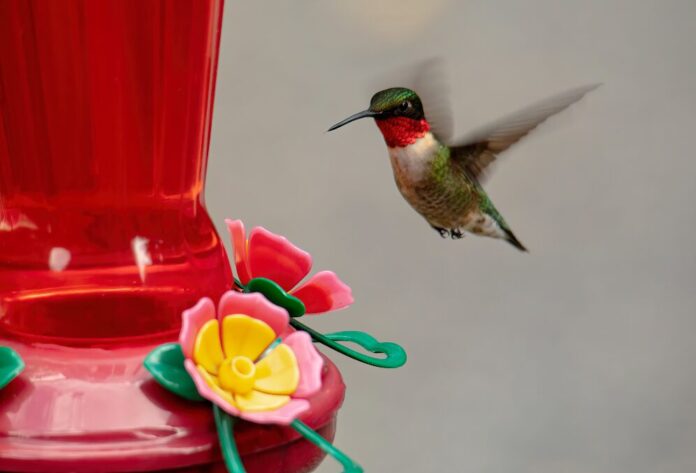
Warmer weather means flowers will soon bloom, but it is not only colorful plants and shrubs that will appear in the landscape. Hummingbirds are expected to arrive in Oklahoma at any time.

Hummingbirds are not only fun to watch, but they’re also great pollinators, said David HillockOklahoma State University Extension consumer horticulturist.

“While there are several species of hummingbirds that find their way to the Great Plains every year, the ruby-throated hummingbird is the most common,” he said. “Maintaining a garden with native trees, shrubs and herbaceous plants will create a natural habitat the birds find attractive. They are especially fond of red tubular and trumpet-shaped flowers.”

Bird-friendly plants

Plants such as trumpet vine, trumpet honeysuckle, bee balm and the red cardinal flower are a few good choices. Planting nectar-rich flowers that bloom from spring through fall will help ensure the hummingbirds remain throughout the season. These fast flyers need a constant and diverse supply of flowers to feed on through the fall.

“Native plants not only provide nectar for the hummingbirds, but they also attract insects that are a crucial part of a hummingbird’s diet,” Hillock said. “In addition to plants, water and shelter are two key elements that are essential for the well-being of the hummingbirds. Also, avoid using insecticides in areas where the hummingbirds congregate.”

Those who may not have an outdoor space in which to plant a garden can still enjoy the presence of hummingbirds by hanging feeders, said Tim O’Connell, wildlife ecologist in OSU’s Department of Natural Resource Ecology and Management.

Feeding hummingbirds

“Hummingbirds are migrating from the Yucatan Peninsula, and it takes them 18 hours to make it to the Gulf Coast,” O’Connell said. “They put down about 10 miles in from the coast and, amazingly, they can do this long journey. They don’t glide like other birds. They’re flapping the whole way here, and they’re exhausted. It’s an amazing physiological feat.”

To help replenish their energy and encourage them to hang around for the season, O’Connell suggests placing feeders strategically throughout the landscape.

“Hummingbirds are territorial birds. Even if putting out a feeder with multiple ports, you’ll likely have only one hummingbird at a time. As soon as one starts feeding, another will fly in and try to run off the other,” he said. “Bird enthusiasts should set up several single-port feeders and space them out in the landscape.”

O’Connell also suggests using a feeder that has a wide opening. This makes the feeder easier to fill, and more importantly, easier to clean. If reusing feeders from previous years, make sure they’re clean. Soak them in a bleach/water solution to eliminate any mold from all parts of the feeder. Rinse thoroughly and refill them.

It’s easy to make hummingbird nectar at home with a mixture of four parts water to one part sugar. Mix until the sugar is dissolved. Avoid adding red food coloring to the mixture. The red color of the feeder is enough to attract the hummingbirds. They don’t have an acute sense of smell and rely on eyesight to find food sources.

Extra nectar can be stored in the refrigerator for a couple of weeks, but the feeders need to be cleaned every few days, especially in the heat of the summer.

Hummingbirds are prone to injury due to collisions with windows. To protect the birds, streak the outside of windows with bar soap to break up the reflection. Learn more about the research OSU is conducting on bird/window collisions.

With warmer weather on the way, Hillock said families can get a lot of enjoyment from learning about the various birds in yards, gardens and green spaces.

“Check out a bird book from the library and spend time together as a family observing and learning about the various birds in your landscape,” he said.