

Tuesday, January 13, 2026
Home Blog Page 4729

Food animal production faces challenges with new antibiotic regulations

0
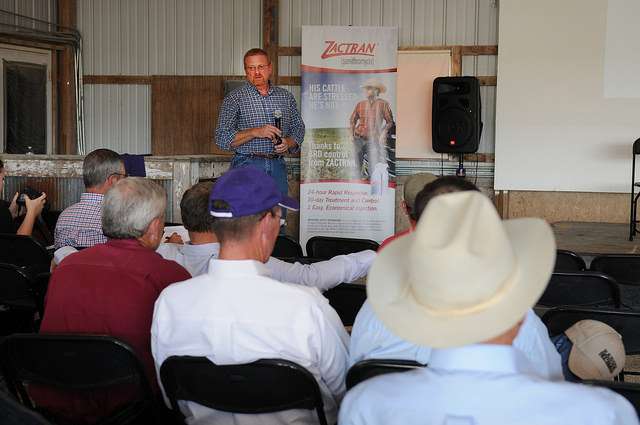
Michael Apley, Professor of Production Medicine and Clinical Pharmacology with Kansas State University’s College of Veterinary Medicine, explained new regulations regarding how veterinarians will authorize the use of medically important antibiotics in the feed of food animals at K-State’s Beef Stocker Field Day on Sept. 25, 2014.

New FDA regulations will phase out use of growth promotion indications in medically important antibiotics.


MANHATTAN, Kan. — The U.S. Food and Drug Administration (FDA) has announced that revised labels established according to Guidance Documents #209 and #213 will go into effect in December 2016.  There will also be new regulations regarding how veterinarians will authorize the use of medically important antibiotics in the feed of food animals.


Michael Apley, DVM and professor of Production Medicine and Clinical Pharmacology with Kansas State University’s College of Veterinary Medicine, explained some of the changes producers and veterinarians can expect to see as a result of the new regulations at K-State’s Beef Stocker Field Day on Sept. 25, 2014.


In 2012, the FDA finalized Guidance #209, which requests companies to phase out growth promotion indications for medically important antibiotics used in food-producing animals as well as changing the remaining antibiotic label approvals for feed and water uses of antibiotics in food animals to Veterinary Feed Directive (VFD) or prescription status, respectively.  Guidance #213 contains the procedures for companies to make these changes.


This request affects 26 companies holding 283 different product labels.  As of today, all 26 companies have agreed to cooperate and withdraw labels, or portions of labels, with growth promotion claims, as well as changing the remaining uses to VFD or prescription status.


Apley said one of the biggest questions posed by producers and veterinarians is what antibiotics will be affected. He noted that the ionophores, feed additives used in cattle diets to increase feed efficiency and body weight gain, will not be affected by the new regulations. Products including Rumensin, Bovatec and Gainpro are not involved because they are not listed as medically important to human therapy.


The new regulations have producers, licensed feed mill operators and veterinarians wondering, “Who’s paying for this?” Apley said VFD regulations would require more effort from the producer and time from the veterinarian to write the mandatory VFDs.


“By law, the veterinarian is going to be required to have knowledge of the producer’s operation to write the VFD,” he explained. “There are a lot of questions, and the licensed feed mills and feed distributors are going to have a heck of a lot of VFDs coming through to make this work.”


Looking ahead in contemporary management of growing cattle, Apley said the new VFD regulations will dramatically change the antibiotic administration process.


“I think one of the things that resonated with the stockers is the use of tetracycline in feed,” Apley said. “If they’re using the therapeutic regimen of one gram of oxytetracycline or chlortetracycline per 100 pounds per day for calves, administered in the feed, the only way they can use that is with a veterinary feed directive.”


Changes for producers
The most significant changes will come with producers’ inability to walk in, request a product and buy it, Apley said.


“Any water use is prescription now,” he said. “The cattle feeder that uses tylosin, that’s going to need to be authorized by the veterinarian for that use, strictly by the label.  But, is has always been illegal to use a drug in feed other than allowed by the label.”


While the final form of the Veterinary Feed Directive regulation is still in the works, Apley said it is clear that veterinarians will have to authorize all uses of medically important antibiotics in the feed or water of food animals.


“If there’s a Veterinary Feed Directive drug that’s used concurrently with one that’s not a VFD drug, the VFD still has to authorize the use of both drugs together,” Apley said. “For example, tylosin will be a VFD drug and monensin will not, but the veterinarian will be required to authorize the use of both in combination.”


The final form of the Veterinary Feed Directive is still in the works, but organizations like the American Veterinary Medical Association (AVMA) and American Association of Bovine Practitioners (AABP) have groups assigned to address members concerns and to have a dialogue with the FDA Center for Veterinary Medicine, Apley said. The FDA has held listening sessions across the country for people to give input.


One of the greatest concerns for the new veterinary feed directive is how they will be standardized, Apley said.


“These could be effective for up to six months, but are we going to have some that are three months, four and five months?” he asked. “You would end up with this rolling cascade of renewal requirements. We’re asking that they standardize these as much as possible for producers and veterinarians.”


Producers should look to their extension service, local veterinarian and new sources for information going into 2016, when the final version begins to emerge, Apley said.


Metrics needed to measure success


“Part of the success metrics, or a way to evaluate the intended effect of Guidance #209 is to ask, “Did antibiotic use in food animals in the United States decrease?” We’ve got a rather crude measure of actual uses now in sales reporting data, and I think they’re wanting to have more,” he said.


Apley said it is unlikely to see a dramatic decrease in antibiotic use because of the way the new regulations are structured.


“The next area of concern is the routine or constant use of in-feed antimicrobials to control a condition, such as liver abscesses,” he said. “They’re very effective, but the issue that gets pushed back at us is that we use those because of the nature of the production system. Unfortunately, the actual science of whether or not we could have any adverse effect on human therapeutics from these kind of uses ends up being only a dash of flavor in policy soup.”


Apley said the greatest catastrophe the industry faces now is the precedent for evidence that growth promotion uses are any different from other uses as to the potential to select for resistant organisms.  Hopefully, this is not the precedent for the evidence that may be required to separate off prevention and control uses from uses for therapy of diseased animals in the future.


“That gets people up in a mood to fight, but that’s the fact,” Apley said. “They really didn’t provide any data to say growth promotion is any different. That was just a line to decrease antibiotic use.”


“We’ve got to work hard as an agricultural industry to make sure that a different level of evidence is applied to evaluate prevention and control uses than was used for growth promotion uses,” he said.


Antibiotic development has run into roadblocks at every corner of the animal agriculture industry, but it’s also sparked controversy in the human health sector. Apley said the chance of animal agricultural acquiring a new set of antibiotics is unlikely.


“The last time we got a new and novel group of antibiotics approved for human and veterinary use that we use today in animal agriculture was 1978,” Apley said. “Everything we’ve had since then has been some kind of molecular modification of these existing groups.”


Apley said a new drug with slightly different properties may be released here and there, but the last two new groups of antibiotics released were for human medicine in 2000 and 2003. There is one other new antibiotic group on the horizon for human medicine.


While the absence of new antibiotics for use in animal agriculture may pose some hindrance to the industry, Apley said there are some advantages to this lack of development.


“They’re looking at new ways to address infectious disease, such as addressing the virulence of the organism – it’s ability to cause disease – rather than just outright killing it,” Apley said. “There are ways of working with the immune system and there are ways of suppressing disease. We’re just on the forefront of our genetic analysis and discovering really new and interesting things about the host-pathogen interaction.”


Apley said he and colleague Bob Larson, professor of production medicine, DVM and the Edgar E. and M. Elizabeth Coleman Chair Food Animal Production Medicine executive director, who specializes in epidemiology in K-State’s College of Veterinary Medicine, recently reviewed a paper from 1971 explaining that many advancements in control of diseases like cholera and tuberculosis came long before antibiotic intervention.


“Antibiotics took the last little bit of the disease challenge off,” Apley said. “But, the initial huge decrease in the curve was from epidemiology and applying things like basic sanitation and procedures to reduce the risk of spread. All is not lost, but we need to make sure tools are not taken from us unless there is a scientifically sound reason to do so.”


If there is a silver lining to the new FDA guidelines for food-grade antibiotic usage in animals raised for food production, Apley said it will likely be in the form of increased relationships between producers and veterinarians.


“If this fosters more interaction between producers and veterinarians, and enables veterinarians getting to know more about producers’ operations, I think that’s good for the industry,” Apley said.

USDA launches current agricultural industrial reports program

0
usda

WASHINGTON, Sept. 29, 2014 – The U.S. Department of Agriculture’s National Agricultural Statistics Service (NASS) announces the launch of the Current Agricultural Industrial Reports (CAIR) survey program. NASS will collect and publish vital statistics for the dry and wet alcohol milling and flour milling sectors.

The Current Industrial Reports program began in 1904 at the Census Bureau and was discontinued in 2011 due to budget reductions. Beginning this year, NASS will collect data and publish the industrial reports. In addition to the flour milling, and dry and wet alcohol milling sectors, CAIR surveys will also result in reports on the cotton, and fats and oilseeds industries.

“As soon as the Census Bureau announced they were discontinuing the Current Industrial Reports, we began hearing from agriculture stakeholders around the country about the impact this decision had on the industry,” said NASS Administrator Joseph T. Reilly. “These reports are such an important element of sound economic policy planning and are used for market analysis, forecasting, and decision making that we knew we had to provide the data and I’m glad that beginning this year NASS is able to do just that.”

To prepare for the program launch, NASS already conducted extensive work building up baseline profiles for the industries. On the ethanol production side, the agency will work with 200 facilities, with a reported nameplate capacity of 14.792 billion gallons per year. On the flour milling side, NASS plans to survey 183 facilities, which have a reported 24-hour milling capacity of 1,594,755 hundredweight.

NASS has a long history of collecting and publishing agriculture data. As is the case with all NASS surveys, information provided by respondents is confidential by law. NASS safeguards the privacy of all responses ensuring that no individual producer or operation can be identified. Survey responses are confidential and used only in combination with similar reports from other producers. Title 7, U.S. Code, Section 2276 and the Confidential Information Protection and Statistical Efficiency Act prohibit disclosure of individual information.

For more detailed information about the CAIR program visit http://www.nass.usda.gov/Surveys/Guide_to_NASS_Surveys/Current_Agricultural_Industrial_Reports/.

Barton Soccer scores 2-1 conference battle over Cloud County

0

There weren’t many scoring opportunities Sunday afternoon at the Cougar Soccer Complex but the Barton Community College men’s soccer team made the most of their opportunities to outscore Cloud County Community College 2-1 in a key Jayhawk Conference battle.  Following a scoreless first half with no shots by either team, offensive action picked up as each team put five shots on frame in the second half with the Cougars making the most of their opportunities.  The victory improves the Cougars to 3-1-2 and 4-3-3 overall while Cloud County drops to 3-2-1 in the Jayhawk and 4-5-1 overall.

Renan Sousa set up the game’s first goal driving his defender through the left side of the penalty box then fired a left foot cross into the 8′ finding the boot of Jiro Barriga Toyama whose one-timer slid under the T-Bird goalkeeper giving Barton the 1-0 lead just 7:02 into the second half.

Off a Cloud County inbounds pass into the 18′, the Cougars made a combo of defensive mistakes allowing the T-Birds to get the equalizer.  Unable to clear the pinball, the Cougar’s Austin Kail turned back two point-blank shots but again the Cougars couldn’t clear and the T-Bird’s Kendy Pierre made the third time the charm tying the contest with 15:08 remaining.

With a sudden charge of momentum, Cloud County had two consecutive hard attacks but the Cougars stood their ground turning both away without a shot on frame.  Barton then seized the game winning opportunity in an almost replay of the Cougars first goal.   Holding off his defender dribbling through the 18′, Matt Sherrod sent a cross to the far side of the box where Sousa finished off the pass in the lower 90 for the game winner with 11:29 left in the game.

Barton will take a week away from competition before traveling to Salina to take on the junior varsity squad of Kansas Wesleyan University on Sunday, October 5.  Kick-off for the non-conference matchup is 4:00 p.m.

I remember:  OUR Yearly  Football Game at Manhattan 

0

By Doris Schroeder

Sitting outside in a Wild Cat football stadium and honing  in on my natural listening devices, namely the ears, I can hear a sound that defies description. It starts out as a dull hum and grows into a gigantic bellow of reverberation as Wild Cats all over the 50,000 seat stadium let out their sentimental growl for the game. It is reminiscent of a flock of birds getting ready to attack.

A gigantic wave of energy vibrates all over the K-State stadium as football players clad in purple, come marching in, like the soldiers they are honoring this evening.  Their spirits are revved up to fight to the finish the Montana State football team. If by some remote chance, I do not stand with the crowd in this momentous show of emotion, I am apt to feel like a castaway, a non-survivor. Soon I am caught up in the whirl of emotion that surrounds me in the stands like a giant Kansas tornado and I succumb to the others cheering in the stands.

This was our story as we visited the K-State game in Manhattan on Saturday, September 6,  2008, with our daughter Judy and son-in-law Stan.  This was our yearly treat to a big football game, graciously offered by them.

This is a far cry from years ago. That is, before Bill Snyder came on the scene as K-State’s formidable football coach.  It has been written that before Snyder came on the scene, the football team was really at the bottom of the totem pole.  He has done wonders for the team. After his retirement, Ron Prince had taken over. At times it appeared great on the horizon but then somehow it faded into the aftermath of a hurricane.

Many of the fans, however, are out to win, and, according to the noise through the stands, will support any winning play.  I was even more interested in watching the emotions of the supporters as the game went on and they did not let me down. Some of the men were chanting some growl to egg them on.  Occasionally a woman fan raised her hands in an effort to give them support.  Then, and this was hard to believe, a woman fan sat on the bench in back of us, totally sleeping.

As we again sat in the stadium seats in the huge football field, the game started with much aplomb and through something I really didn’t understand, we made the first touch down. We were off to a great  start, even though it was told that Montana had won their first game by a huge score.  They made a touchdown after that but then it was K-State’s game almost completely to the end of the game when they won 60 something to 10.

Almost all through the evening,  the rain came down in short wet sheets. We put on the K-State parkas that Judy shared. It was amazing how they kept us dry. I know, I still couldn’t believe I was doing something I always thought so weird…sitting outside in the rain to watch a football game, even though it was a Wild Cat game.

On the other hand, to my feminine mind, much as I enjoy the camaraderie ofa winning football team, I wonder where life’s priorities really are? Does it ever seem a little frivolous that so much energy is placed on a small piece of leather in an oblong shape that by itself, can do nothing?

If one was trying to make sense of life, would it not seem more “reasonable” to make more ado about inspirational  matters, intellectual pursuits, wiser endeavors or simpler feats to perform than kicking that little oblong piece of leather or knocking someone down who is carrying it?

Of course you could pursue the trend of thought that perhaps there is an intellectual pursuit in figuring out the right plays and remembering them.  Perhaps it is good to be able to outline  some of the complicated components of the other team.  A good coach can teach his players good sportsmanship, team play and the ability to hang in when the going gets rough. These are all things that will be faced in Life. At this time, K-State is really fortunate to have Bill Snyder back as a coach once again.

If we have a Life coach who is all-knowing, we can indubitably make a touch down if we follow his directions.  Certainly God answers that description and can coach us all along the way.

Life is like a football game in many ways, but it is important HOW you play the game as well as your reason for playing.  We can study the Bible’s directions and listen to our coach by following his directions. We can become part of His team by first accepting Jesus  into our heart and life and going by his advice. It is then we will truly be victorious!

Doris welcomes your comments and can be reached at [email protected]

Kansas Farm Bureau celebrates Farm Safety and Health Week

0

KFB

Gov. Sam Brownback has declared September Farm Safety Month and the week of Sept. 21-27 Farm Safety and Health Week.

“I appreciate Gov. Brownback’s proclamation,” says Holly Higgins, Kansas Farm Bureau’s organization director/safety and agriculture education director. “It’s a great reminder to all of us that farm safety is important, and should be thought about every day on our farms and ranches.”

For more than 66 years, Kansas Farm Bureau, the state’s largest farm organization, has had a full-time staff position dedicated to safety and health issues for farmers.

“Kansas Farm Bureau is a farm organization, and we understand keeping our farm families safe is an important issue,” Higgins says. “We value this opportunity and thank our volunteers who have helped spread the safety message.”

In addition to KFB staff, County Farm Bureaus provide hundreds of farm safety programs every year reaching thousands of adults and children.

To bring awareness, KFB offers a multitude of Do-It-Yourself programs for volunteers and those interested in learning more. Annually, a safety poster program provides an opportunity for children to learn, consider and draw ways to stay safe on the farm. Kansas Farm Bureau is the only organization in the state that tracks farm accidents—something we’ve done since 1980.

For more information on farm safety, visit www.kfb.org/educationoutreach/safety.