Saturday, February 14, 2026
Home Blog Page 477

An Ugly Aggie Spectacle

0
Thayne Cozart
Milo Yield

I’d bet good money I’ve told this true aggie story once before in my column, but it had to be around 35 years ago — more than enuf time for it to be funny again to a new generation of farm and ranch folks. It’s a true story about an ugly aggie spectacle. So, here it goes:

***

A prominent southeast Kansas rancher had a huge old Limousin bull that had outlived its usefulness and needed to go to market.

This wuz back in the day that M & M Packing Company, Inc. wuz still a livestock slaughter and processing enterprise on the east side of Iola, Kan., right along U.S. Highway 54. As I recall, it wuz a small meat packing company that specialized in hot dogs, bologna and other meats. At any rate, it wuz a good local market for cull cows and bulls.

The rancher, who lived south of Gridley, Kan., got the old bull loaded in a stock trailer early in the morning and uneventfully drove to M&M. He had no inkling, and was blissfully unaware, about how his day wuz about to be upturned in a spectacular way.

When he arrived at M&M, he wuz directed to the unloading dock and an employee directed him when to stop his trailer in front of the entry door. Well, as it turned out, he stopped the trailer a few inches too far away. So, when the rancher opened the trailer door to unload the highly agitated one-ton old bull, it crashed into the tailgate with the unprepared rancher on the other side of the gate.

Crash! Smash! The bull banged the metal tailgate into the poor rancher’s noggin, bloodying his head in the process of making a thunderous escape into the suburban wilds of eastern Iola.

Now, the rancher faced a dilemma with no good options for a satisfactory outcome. First, he needed to staunch the flow of blood from his aching noggin, so he tied his bandanna around his forehead.

Second, for sure, the old bull couldn’t be herded back into the M&M unloading door, since it wuz already a block away and headed east at breakneck speed, tail in the air and slinging manure in every direction. The rancher wuz equipped with only a farm truck.

Third, the concerned folks at M&M reported the bull get-away to local police officials. When the responding officer arrived, he loaded the now-temporarily-bandaged rancher into his police vehicle and away they went looking for the rampant bull. Well, in a few minutes they found the bull in the backyards of some homes about a mile east of Iola. But, by then, the red-hot and panting bull had managed to rampage through fences, gardens and clotheslines. Mr. Bull wuz not a happy camper. In fact, he wuz “bulligerent” and ready to take on all comers.

The rancher and the police officer quickly came to a decision about what to do next. In order to limit further property damage and avert possible injury to life and limb, the bull needed to be shot on the spot.

At this point in the story, I’m unsure whether the rancher or the policeman shot the bull, but I do recall that the first bullet bounced off the bull’s head and only stunned it to its knees. A second shot put the “bulligerant” critter down for good.

But, the ugly spectacle only got worse from there. The rancher immediately bled the downed bull in hopes of salvaging a portion of its value. Then, somehow the recovery crew commandeered the use of a local John Deere tractor with a front-end loader. With a log chain around one of the massive bull’s legs, they hoisted his bloody carcass into the air. They barely managed to get the bull airborne. Plus, the tractor wuz unsteady with a ton of bull swinging from the loader.

But, the rancher finally managed to get back on Highway 54 and head slowly and carefully back west to M&M — with a lights-a-flickering police escort to protect the bumper-to-bumper traffic going both ways.

I ask readers to mentally process how the scene looked to passersby. A rancher with a bloody kerchief around his head wuz driving a tractor down the shoulder of a major highway, with a police escort, with a blood-dripping, manure-laden one-ton bull hoisted high into the air, with traffic slowed to a crawl both ways. Not a pretty mental home video, but a funny one if you’re an aggie.

In due time, the caravan arrived back at M&M. The company went ahead and processed the bull’s carcass into heaven-only-knows what kind of beef products. The rancher wuz paid some sort of salvage value. And, an Ugly Aggie Spectacle came to and end leaving behind only a story for history to process — and for us to smile about.

***

Recently, time brought a sad conclusion to an otherwise happy portion of my life. I am now the only man left standing from what I call the Four Musketeers. While I lived in Chase County, I became close friends with three other fellows. While diverse in our backgrounds, we were all aggies in one way or another and got along well.

I gave my friends the column names of Lon G. Horner, Mocepheus, and Saul M. Reader. We played cards together frequently. We hunted together. We fished together. We kibitzed with each other constantly. Now, with the sad passing of Saul last week, I’m the only remaining Musketeer. For sure, we had other folks in our circle of friends who joined us occasionally, but the four of us were close.

Saul M. Reader wuz also a lay minister in the Lutheran Church. He wuz a happy-go-lucky guy, always smiling, but devoutly connected to his church, consistently pious in his ways, and never judgmental. I greatly admired those traits about Saul.

Alzheimer’s disease deprived Saul of a normal aging process these last few years. But, thankfully, we Four Musketeers had many happy years of memory-making. Thinking of Saul will always bring back happy times and happy memories. RIP, my friend.

***

Words of wisdom for the week: “Take comfort knowing no archaeologist has ever discovered a prehistoric cave painting of a salad.” Have a good ‘un.

Caribbean Baked Beans

0

I am truly thinking about Easter, as I present this easy, yet yummy bean recipe.

It’s been several years since I wrote the dish, and because of its ingredients I also feel it

would be yummy at a more ‘casual’ Easter Celebration. Like many of you I seldom turn down a good pan of baked beans. When I was single, I would frequently turn the baked beans into a main entrée. Besides all the protein found in the beans, they can become extreme hardy with the addition of fried bacon, sausage, burnt ends etc. This recipe actually doesn’t have any meat in it, but I can easily see the burnt ends or some pulled pork in the dish.

With all the fruits it named it the Caribbean Baked Beans. If you’ve been to the Caribbean, you know how the locals (especially around Jamaica) love their jerk seasonings. I haven’t used any jerk spice, but there’s no reason why you could not implement it here. Jerk chicken is quite popular, it wouldn’t bother me to see some BBQ’s jerk chicken as an alternative ingredient.

Probably the best part about the recipe is how it’s pretty much a dump and bake dish. You can definitely change that by cooking the onions in advance and changing the crushed pineapple to perhaps tidbit, where you could brown the edges along with the onions.

To this chef one of the worst things about baked beans can be when they have no ‘body’. In other words, they float all over your plate!!! YUCK! It’s ok to cover your beans for a portion of the baking, but they need to cook down a bit in order to thicken them up. Check the recipe over because you are going to need several kinds of beans. With the use of the black beans, you will also be making the recipe more indigenous to the Caribbean. I don’t think I’ll be wrong on this one, I think they will be asking for your recipe!

I still remember a couple of cookouts my sister and I had at the edge of my grandparents’ garden. We would make a small ‘Girl Scout’ campfire and cook our beans in the can, like a hobo. It was so much fun back then. I guess my bean cooking has come a long way since then.

This past week I cooked for a Senior fair, where we did a ‘Soup Flight’, featuring 6 different types of soups. Phillip, our son, helped me once again in Stone County, as we pulled off our second successful senior event. Do not ask us to prepare 6 roasters full of soups for at least a month! I did get to meet several people who attended my classes at Silver Dollar City, and who read my column in the Branson paper. To all of you, I say thanks so very much, your loving comments mean so very much.

I hope all of you have narrowed down the Easter menu better than myself. I’m not sure where I’ll be for that day, so I really haven’t given the menu a tremendous amount of thought. Guess I better get busy. At least all my bunnies are finally out on display at home. Do you know the name of a rabbit’s tail? It’s called a ‘scut’. Many animals have scut tails, like a bear or a deer.

Here Comes Peter Cottontail…..Simply Yours, The Covered Dish.

Caribbean Baked Beans

1 (27-28 oz.) can bush maple beans, lightly drained, fat removed.

1 (15.5 oz.) can chili beans, drained

1 (15.5 oz.) can black beans, drained

1/2 cup brown sugar

1 (8 ounce) can drained, crushed pineapple

1 large mango, diced

1/2 cup (or more) sweet onion, chopped small

1/2 cup raisins, optional

1/2 cup Smoky Bourbon BBQ Sauce

2 teaspoons prepared mustard

Salt & Pepper to taste

Optional: Pulled pork or chopped ham, 1-1 1/2 cups

Mix all ingredients, place in a greased baking dish. Bake in a 350-degree oven for at least one hour or longer until beans reach the thickness level you desire. Serves 6-8 persons.

Other options might be chopped red peppers, garlic or jerk seasonings.

Spring Turkey Hunting Sickness

1

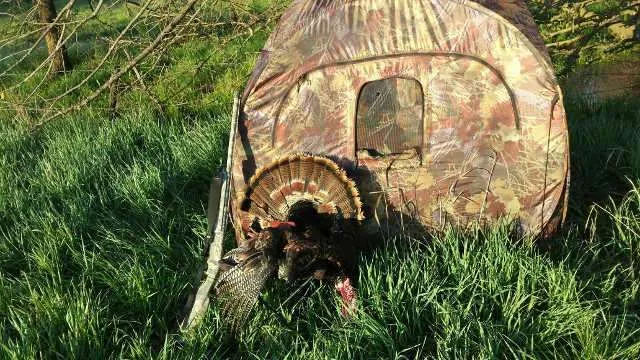
I used to get really excited about this time each year at the thought of spring turkey season; not so much anymore. I still hunt them, and I still get excited at the possibility of matching wits with a lovesick ole’ gobbler, but I guess I don’t enjoy bumbling and fumbling around in the dark as much anymore, trying to find that spot I had prepared to sit, or trying to navigate the fields and woods in the dark on older, more unstable legs than the ones that used to carry me along.

I’m not a real seasoned turkey hunter, but I have learned a thing or two, mostly by mistake, about the pursuit of Kansas gobblers. A tried-and-true way of putting yourself on turkeys at first light is to be set up to call them as they leave the roost in the morning. You need to be close, but not too close and you need to be able to get there without being seen or heard by the still-roosted birds. More than once I’ve set up in the morning where I saw birds late the night before and assumed I knew where they roosted, only to be scared spitless the next morning when a big tom gobbled much too near to me in the dark. My error was in not knowing for certain where they roosted and assuming I could come close enough. So, if calling birds as they leave the roost in the morning is your game, either stick around long enough the night before or come back after dark and do some coyote howls or owl hoots to know for sure where they are.

Also, shoot a couple shells through your shotgun to make certain you know where it hits and how the shot pattern looks. I’ve always been told to aim at the featherless part of their throat just below the head; that puts pellets above and below that point and will quickly kill the bird. Also invest in tick treated clothing or buy some good tick repellent spray to spray your outer clothing.

Another thing I’ve learned is not to give up too easily on birds you might spook. Once spooked, you will probably not get a shot at those birds anymore that day where you happen to spook them, but quietly leave and get set up somewhere ahead of them and the game is still on. A few years ago I built a blind out of brush the landowner had cut at the end of a field a couple hundred yards from where I knew a small group of turkeys was roosting. What I hadn’t planned for was the couple lone jakes roosting by themselves just a short distance from my blind.

After they had “called my bluff,” and the group I knew about had shunned me too, I set up again along a creek just around the corner of the same wooded pasture and started calling. The two jakes that had busted me came running enthusiastically and probably would have run over me had I not shot the first one.

Despite what the pros might say, turkey calling does not have to be flawless. Yes, it’s good to know enough that your calls are not screaming bad things about a gobbler’s mother, but in my opinion it’s much more important to be in the right spot and to be well camouflaged, quiet and still.

The 2024 spring turkey season in Kansas runs from April 1 – 16 for youth/disabled hunters, from April 8 – 16 for archery only, and the resident firearms season from April 17 – May 31; that’s a long season. In my mind there is no excuse not to buy a spring turkey permit for $32.50 and hit the woods. If you’re new to turkey hunting, attend a seminar or find an experienced hunter to take you along and experience that sickness known as spring wild turkey hunting as you Explore Kansas Outdoors!

Steve can be contacted by email at [email protected]

Law And Odor

0
lee pitts

There should be a law against people who smell bad. And this is coming from a guy who on many occasions was smellier than Taco Bell on a bad bean day. This law of mine would be directly aimed out those foreign exchange students (from France, I think) who could walk into a Dollar Store and whose body odor would drown out the Chinesesium smell of all the merchandise.

If I asked you what you thought most American’s preferred, a bath or a shower, what would you say? In a recent poll of Americans 57% of the people chose the smart answer which is shower, while 32% preferred to sit in their own filth and take a bath. By my count that leaves 11% and I assume these are the exchange students from France and Russia who take neither. Yakov Smirnoff, the Russian comedian once said, “I like American women. They do things sexually Russian girls would never think of doing… like showering.”

I admit that my preference for showers is a direct result of being being third in line through the bathwater. First was my dad, second was the “exalted one” my older brother, and then there was me. You’ve heard the phrase “don’t throw the baby out with the bath water?” Well, I was that baby and you might not have seen me through all the murky water.

Another phrase you’ve probably heard is “rural cleansing”. This is what happened every Saturday night in farm and ranch houses across the country. My Grandpa told me that every farm had a big old tub which was filled with hot water on Saturday night. The first one through was the father followed by the sons in descending order of age. No wonder if you were the eleventh son that your nickname at school was “Stinky”.

But these were the lucky folks. Before that most people got married in June because they were still smelling pretty good following their ANNUAL bath in May. But even in June the betrothed were both pretty ripe so the bride carried flowers to mask the smell and this is where that custom got its start, much to the pleasure of flower shop owners.

Did you know that the White House didn’t have a permanently installed bathtub until 1850? This meant that all the Presidents before Millard Fillmore smelled like they just cleaned out the hog barn. One wonders, how did they ever get re-elected?

It wasn’t that long ago that American farm boys were sewed into their long johns in November and didn’t take them off until March! Later generations, of course, took a bath every Saturday whether they needed it or not.

I often wonder what our soldiers did in World War II when they were fighting for the freedom to be filthy. How did they get clean in the trenches and in the tanks? All I know is the famous writer Ernie Pyle said that if you go long enough without a bath even the fleas will leave you alone. And what did the cowboys who drove the great herds up from Texas in the 1880’s do for a bath? Some of them couldn’t even find enough water to drink let alone take a bubble bath.

Personally, the longest I’ve ever gone without a bath or a shower was seven days and that’s because I was in a coma and I didn’t do all that much hard, sweaty work while comatose so I’m sure I didn’t stink much. But taking me home from the hospital in the car my wife wore my 3M mask with replaceable cartridges that firemen wear to breathe cleaner air.

I’ve never resided in areas with high humidity and I don’t know how people do it who live in places like Florida or Washington DC. In the South I always felt dirtier by the time I got out of the shower than I did before I got in. It was so disgusting seeing all the men and women sweating through their armpits. (No relation).

I remember being in a big-city eastern restroom that had the first deodorant dispenser I ever saw. I’ve always been an Old Spice guy and I could use a swipe or two and the dispenser supposedly had some so I put in my money only to discover that the machine was “out of odor.”

Cattle on Feed report shows slight increase in feedlot numbers

0

The latest Cattle on Feed report shows a slight increase in numbers for feedlots with capacity of 1,000 or more head.

The Feb. 23 report, issued by the U.S. Department of Agriculture’s National Agricultural Statistics Service, showed an inventory of 11.8 million head on Feb. 1, 2024, which was up from 11.75 million head on Feb. 1, 2023.

Glynn Tonsor, a professor in the department of agricultural economics at Kansas State University, said the latest report had major surprises.

“I do think we are still getting signals that nationally the herd is still not expanding,” Tonsor said.

Kansas took a little bit of a dip, Tonsor said, but there are no specific insights into why.

When looking at the annual size group estimates, the cattle and calves on feed for slaughtering market in the U.S. for feedlots with 1,000 or more capacity represented 82.7% of all cattle and calves on feed in the U.S. on Jan. 1, 2024, which was similar to a year’s ago percentage at 82.6%.

Placements in feedlots during January totaled 1.79 million head, which was 7% below 2023. Net placements were 1.71 million head. During January, placements of cattle and calves weighing less than 600 pounds were 370,000 head, 600 to 699 pounds were 395,000 head, 700 to 799 pounds were 475,000 head, 800 to 899 pounds were 377,000 head, 900 to 999 pounds were 105,000 head, and 1,000 pounds or more were 70,000 head.

The marketings of fed cattle during January totaled 1.84 million head, which was slightly below 2023.