Saturday, February 14, 2026
Home Blog Page 478

Alfalfa U keynote speaker gives 2024 weather outlook

0

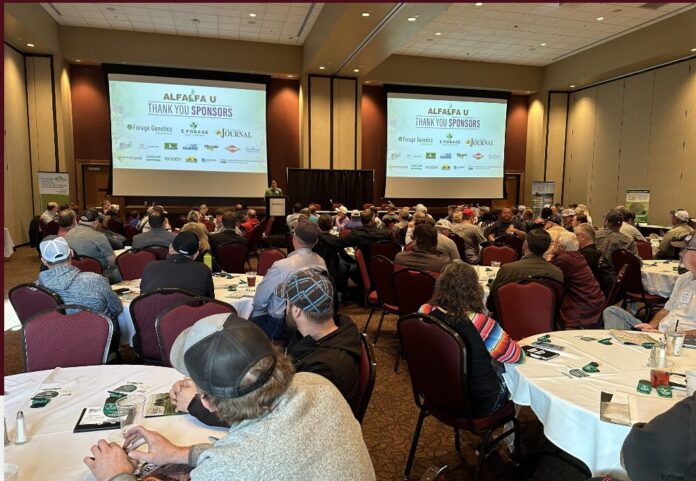
More than 130 alfalfa growers and industry experts from multiple states gathered in Dodge City, Kansas, for Alfalfa U on Feb. 27. The event was sponsored by E-Forage, Forage Genetics International, High Plains Journal and a number of other alfalfa adjacent companies and organizations.

Alfalfa U included six breakout speakers, an alfalfa industry panel, a luncheon speaker and a closing keynote. The closing keynote speaker was Jeff Hutton, meteorologist and owner of Hutton Weather Futures, LLC, located in Kingman, Kansas. His session included a Plains weather review and seasonal outlook for 2024 and beyond.

Hutton gave an overview of the weather patterns in 2023, and he made a point that last year is in the history books and will have no bearing on the weather that will come in 2024 or 2025. He said weather patterns reset every fall and start a new cycle. Next, Hutton asked Alfalfa U attendees how they define climate change and if they believe it is real.

“Everybody should raise their hand because climate changes all the time,” Hutton explained. “Climate is weather, whether it’s temperature, precipitation or wind, it doesn’t matter. If you take weather over about a 30-year period, that’s climate, and weather is always changing within that climate. Climate change is just a matter of fact that climate is changing, but it does not cause change.”

On the subject of El Niño and La Niña weather patterns, Hutton said one misconception people have is that these two patterns cause specific weather conditions. For example, La Niña is associated with drought and dry conditions, but just because we transition into La Niña, it does not guarantee a drought.

“El Niño and La Niña do not cause weather,” he said. “They’re just a contribution to the weather pattern. They could enhance it, or they could not enhance it. Not all El Niño or La Niña events are the same.”

Hutton also warned producers to be careful where they source weather data. He said a lot of the apps available use computer data to make forecasts. These types of apps might not be as accurate because they tend to create an average of the data, rather than pinpoint a specific location and its data, he said.

Hutton’s 2024 outlook

The weather pattern for 2024 began in the fall of 2023 and will start to die out around August and September. Currently, the High Plains are in a fading El Niño, which could have some impacts on the future conditions this summer. Hutton said all the computer models show the region entering a La Niña at some point, and it could be a strong one. The question is when that transition will occur.

“I just don’t know how much contribution there will be from this dying El Niño,” Hutton said. “It looks like it will happen pretty quickly. Forcing El Niño to La Niña will change things, but I’m a little uneasy about how it will change it.”

Several weather aspects will affect the weather this year, Hutton said. These include the orientation of the jet stream between fall 2023 and spring 2024; location of troughs and ridges; where geographic amplification will take place; and most importantly, the locations of atmospheric “forcing.”

“We had a really cold stretch back in January, but I think we will probably get back into a colder period the last few days of March and into April,” Hutton said.

Producers should expect an active spring, he said, but added that he does have concerns about dry weather in the future months.

“If we have a wet spring, sometimes that can carry into the summer,” Hutton said. “Can we have another event like last year where everything gets stagnant and then just parks over us? That is certainly a possibility. I don’t think it’s going to be a 2011 or 2021, but I think next year will be drier than this year.”


Lettuce Eat Local: Oh for Pat’s sake

0

Amanda Miller
Columnist
Lettuce Eat Local


Though his name is literally the title, I’m guessing a vast majority of people celebrate the day without ever actually thinking of the man at all. You can say “St. Patrick’s Day” a thousand times without once remembering that yes, it’s a day commemorating a saint named Patrick.
Be honest with yourself — had you thought of a 5th-century author before I mentioned it? And now that I did, are you picturing a swarthy Irishman with curly red hair and a bonny brogue? Wearing a green robe and drinking beer, of course.
Perhaps Patrick wore green, but he was British by birth; he only came to Ireland on a slave ship after being abducted as a teenager. After six years of servitude he escaped back to England, likely not with the fondest memories of the Emerald Isle.
Nevertheless, after a vision, he felt compelled to return to the land of his suffering and to bring the gospel with him. Both his history in Ireland and his lack of education caused understandable trepidation, but according to Brittanica, “once in the field, however, his hesitations vanished. Utterly confident in the Lord, he journeyed far and wide, baptizing and confirming with untiring zeal.” It wasn’t all cream and shamrocks from there, and Patrick lived in danger; yet his mission’s success was “phenomenal” and his writings, which “mirror a truth and simplicity of the rarest quality,” are still impactive today.
I could go on and on, of course, but there’s a basic glimpse at Ireland’s patron saint, national apostle, and man behind the holiday.
Emigrants to the US turned St. Patrick’s Day over time into the less saintly observance it is now, a secular celebration of all things Irish, or Irish-associated, or at least green. It’s my sister-in-law’s favorite holiday: “Because I’m Irish-ish and I love green and potatoes.” Seems fair. She also said it doesn’t get enough credit as a holiday so someone needs to hype it up; she’s happy to be that person.
We’ve always been told my mother-in-law has some Irish in her heritage…according to her ancestry composition, she’s got 3.1% in the category of British and Irish, so we might need to focus on the “some.” But actual ancestry rarely keeps anyone from joining in on St. Patrick’s Day fun, and who can blame us when Lucky Charms, shamrock shakes, and pots of gold are on the line.
Are any of those actually Irish either? Hardly — even Bailey’s Irish Cream, which literally has it in the name, was created by an Englishman.
We could keep going: Guinness and soda bread are actually from Ireland, but corned beef as we know it started with Irish-American and Jewish immigrants, and even “Irish” potatoes were native to South America before they made it to Ireland in the 1500s.
I like to dig down and get to the real, authentic history and traditions — but sometimes I am reminded that authenticity looks different in different contexts and means different things. Just because potatoes didn’t originate in Irish soil doesn’t lessen their “authenticity” to Ireland now; maybe St. Patrick did or maybe he didn’t explain the Trinity using the three parts of a shamrock, but it’s part of Irish tradition now. Perhaps you grew up always drinking mint milkshakes on March 17, which is totally inauthentic, and yet also totally authentic because it’s your experience. There is a lot to be said for authenticity in many forms. Food isn’t fake, so roll with it.
Well, except for green beer. Skip that one.

Authentically Delicious Fake Bailey’s
Ireland is known for its dairy products and whiskey, and Bailey’s Irish Cream came about as part of a marketing campaign based on those products. Awkwardly, this version has neither cream nor alcohol, but it is so delicious that I’m not even sad. I’ve made several variations before, but this is the first time with coconut milk; distinctly not Irish, but lending such a sweet luxuriousness. Quick to make and family-friendly, this rich and creamy beverage would pair wonderfully with soda bread or scones with cream and jam.
Prep tips: this keeps at least a week in the fridge (hypothetically — you’d have to not drink it all to find out), so make a good-size batch and have plenty ready to share with friends.
1 [13.5-ounce] can coconut milk
1 tablespoon instant espresso powder
2 tablespoons cocoa powder
½ – 1 teaspoon almond flavoring
1 teaspoon vanilla
Pinch of salt
2 tablespoons maple syrup, or to taste
to serve: ice, milk, and/or coffee; whipped cream
Combine all ingredients in a blender and process until smooth, adding more maple syrup if you like. You can drink it anywhere on the spectrum from super-thick as is, or over ice and with any amount of milk or coffee.

Authentically Delicious Fake Bailey’s

Ireland is known for its dairy products and whiskey, and Bailey’s Irish Cream came about as part of a marketing campaign based on those products. Awkwardly, this version has neither cream nor alcohol, but it is so delicious that I’m not even sad. I’ve made several variations before, but this is the first time with coconut milk; distinctly not Irish, but lending such a sweet luxuriousness. Quick to make and family-friendly, this rich and creamy beverage would pair wonderfully with soda bread or scones with cream and jam.
Prep tips: this keeps at least a week in the fridge (hypothetically — you’d have to not drink it all to find out), so make a good-size batch and have plenty ready to share with friends.

1 [13.5-ounce] can coconut milk
1 tablespoon instant espresso powder
2 tablespoons cocoa powder
½ – 1 teaspoon almond flavoring
1 teaspoon vanilla
Pinch of salt
2 tablespoons maple syrup, or to taste
to serve: ice, milk, and/or coffee; whipped cream

Combine all ingredients in a blender and process until smooth, adding more maple syrup if you like. You can drink it anywhere on the spectrum from super-thick as is, or over ice and with any amount of milk or coffee.

Media Advisory: New book chronicles successful business model for rural newspapers

0


From the Office of Public Affairs | http://www.news.ku.edu

Headlines

Contact: Mike Krings, 785-864-8860, [email protected]

Media advisory: New book chronicles successful business model for rural newspapers
LAWRENCE — As news deserts expand and challenges to small newspapers grow, a new book aims to help such publications employ a new business model to survive and thrive. “Reviving Rural News: Transforming the Business Model of Community Journalism in the U.S. and Beyond” shares the results of an experiment that has proven viable and can help papers update a financial model that’s been in place nearly unchanged for 200 years.


Teri Finneman, associate professor of journalism at the University of Kansas, led an experiment with Kansas Publishing Ventures, which owns and operates Harvey County Now in Newton and the Hillsboro Free Press in Hillsboro. Finneman is available to speak with media about the book recommendations, current and future publishing business models, news deserts, the central role newspapers play in rural areas, the history of journalism and similar topics.


Written with co-authors Nick Mathews of the University of Missouri and Patrick Ferrucci of the University of Colorado, “Reviving Rural News” details the project in which researchers and their publishing partners developed and tested a model known as Press Club. Based on surveys with more than 400 rural readers, the model is designed to help weekly publications expand from the advertising and subscription model that has been dominant since the 19th century. The book shares findings from the experiment as well as historical context on American publishing and recommendations on how to adapt financial strategies of weekly newspapers to suit modern readers.


Based on data from surveys, focus groups and a yearlong oral history study of Kansas Publishing Ventures, the book shares a template that includes memberships, events and newsletters to engage community members via the Press Club model.


“It’s one thing for researchers to predict what business model could work. Our strategy was actually implemented in a working newsroom, which saw both significant revenue gains and improvements in community relations as a result of fairly simple changes,” Finneman said.


Finneman has conducted research, including oral histories, of how newspapers operated during the pandemic and is publisher of The Eudora Times, a community newspaper serving Eudora produced by KU students, and is host of the podcast Journalism History. To schedule an interview about the book and newspaper business models, contact Mike Krings at 785-864-8860 or by email.


-30-


————————————————————————


KU News Service

1450 Jayhawk Blvd.

Lawrence KS 66045

Phone: 785-864-3256

Fax: 785-864-3339

[email protected]

http://www.news.ku.edu


Erinn Barcomb-Peterson, director of news and media relations, [email protected]


Today’s News is a free service from the Office of Public Affairs