Tuesday, January 13, 2026
Home Blog Page 4717

Fall colors of trees

0

Part of the allure of fall foliage is color variation. There are trees
that turn red, purple, yellow, orange and brown.
Specific plant pigments determine individual colors. Foliage derives its
normal green color from chlorophyll, the substance that captures the
energy of the sun. Other pigments produce fall colors. Reds and purples
are caused by anthocyanins, yellows by xanthophylls, and oranges by a
combination of carotenes and xanthophylls. Browns are the result of
tannins present in the leaf. Most of these substances are present
throughout the growing season but are masked by the green color produced
by chlorophyll. Anthocyanins are the exception and are produced after
the chlorophyll is destroyed in the fall.
If you have ever seen pictures of New England in the fall, you have
probably wondered why trees in Kansas usually do not color as well. This
difference is partly because of the tree species prevalent in New
England. Certain oaks and maples naturally produce good color. Coloring
also is influenced by the weather.
Warm, sunny days and cool nights are ideal for good color. The sunny
days encourage photosynthesis and, thus, sugar accumulation in the
leaves. As fall progresses, each leaf develops an abscission layer at
the base of the petiole, or leaf stem, that prevents these sugars from
being transported down the trunk to the roots for storage. This high
sugar content in the leaves produces more intense colors. Cloudy days
and warm nights prevent some of the sugar accumulation in the leaves and
results in less vibrant colors.
Weather during other parts of the growing season also can have an
effect. Heavy rains in the early spring or hot, dry weather during the
summer can both have a deleterious effect on fall color.
The length of time a tree maintains fall color also depends on weather.
Reds, yellows and oranges are short-lived when trees undergo frosts and
freezes.


By: Ward Upham

BCI develops training modules in collaboration with $25 million research effort

0
 David Haasser
David Haasser

BCI training modules focus on E. coli prevention in beef cattle.


MANHATTAN, Kan. – A series of new beef cattle online training modules has been released by the Beef Cattle Institute at Kansas State University. The series was produced in part with funds from a $25 million grant distributed to 16 institutions in 2012.


The purpose of the $25 million effort is to focus on the prevention, reduction and control of the shiga toxin-producing Escherichia coli (STEC) from pre-harvest through consumption of beef products. Awarded to the University of Nebraska-Lincoln, the U.S. Department of Agriculture’s (USDA’s) National Institute of Food and Agriculture Coordinated Agricultural Project (CAP) grant team is made up of 50 investigators, including many from K-State.


In continued efforts to raise awareness for the grant’s objectives, the latest training modules focus on the fifth major objective of the grant: education and outreach. Made up of 11 sections, the STEC Beef Safety Training, titled “Translation of STEC: Mitigation to Field Implementation,” is a series of comprehensive modules, available in both English and Spanish. Covered topics of E. coli prevention in beef safety include pre-harvest operations that consist of feedlot, cow-calf, veal and cull dairy cows, and post-harvest operations for small-scale processors, distributors and restaurants.


“We are pleased to deliver this important tool for people involved in the beef industry to learn about preventing E. coli in beef and veal,” said Dan Thomson, director of K-State’s Beef Cattle Institute. “I commend the USDA for stepping forward and funding such outreach projects that will reach the trenches of production animal caregivers.”


Since the training modules are available in both English and Spanish, the efforts will likely reach a wider audience.


“Providing bilingual employee-based training will be a great tool for people involved with beef production, from the farm to the plate, to learn how to do their part to provide safe, nutritious beef products,” Thomson added.


Rodney Moxley, professor in the School of Veterinary Medicine and Biomedical Sciences at UNL and project coordinator for the STEC CAP grant, feels that working with the BCI to develop the modules will allow them to reach a larger audience.


“This takes advantage of BCI’s expertise, as (the BCI) is state of the art for this kind of education,” he said. “The beauty of the modules is that there is assessment built into the training, providing assurance and documentation of what they’ve learned.”


Whether it’s working with live cattle in the packing plant or on the retail end of beef products, Moxley is confident the modules will help the team achieve its goals in education and outreach, as the trainings target individuals in specific areas.


To get started on STEC Beef Safety Training through the online modules, visit animalcaretraining.org. For questions, contact the BCI at [email protected] or 785-532-4844.

Last tomatoes of the season

0

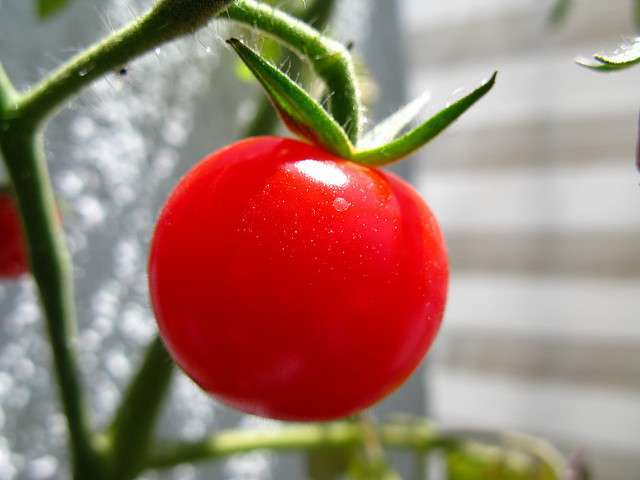
Cold nights are increasing in frequency now that we are into October. If you
have tomatoes, you may have some that are approaching maturity.
Leave them on the vine until mature or until a frost is forecast.
Tomatoes will ripen off the vine but must have reached a certain phase of
maturity called the ‘mature green stage.’ Look for full-sized tomatoes with
a white, star-shaped zone on the bottom end of the green fruit.
When harvesting fruit before a frost, separate tomatoes into three groups
for storage: those that are mostly red, those that are just starting to
turn, and those that are still green. Discard tomatoes with defects such as
rots or breaks in the skin. Place the tomatoes on cardboard trays or cartons
but use layers of newspaper to separate fruit if stacked. Occasionally a
tomato may start to rot and leak juice. The newspaper will keep the juice
from contacting nearby or underlying fruit. Store groups of tomatoes at as
close to 55 degrees as possible until needed. (Ward Upham)

Fall Planting of Asparagus & Rhubarb
We sometimes receive questions as to whether asparagus or rhubarb can be
moved in the fall. Though these crops are traditionally transplanted in the
spring (mid-March to mid-April), a fall move can be successful. Wait until
the top has been browned by frost and then cut back to the ground.
Prepare the soil and fertilize as you would in the spring. See
http://www.ksre.ksu.edu/bookstore/pubs/mf319.pdf for more detail on
asparagus and http://www.ksre.ksu.edu/bookstore/pubs/ep99.pdf for more
information on rhubarb.
Water well after planting to insure good root/soil contact. Mulching would
be helpful on the rhubarb to prevent the plant from heaving out of the soil
during the winter but asparagus requires no such treatment as it is planted
much deeper.


By: Ward Upham

Kansas farm to school month showcases agriculture education and fresh foods efforts

0

MANHATTAN, Kan. – Amongst rotary hydroponics filled with growing greens and vertical gardens hydrated by aquaponics, Maize High agriculture education and culinary program students mingled with state and national leaders in agriculture, education and nutrition services. Kansas Gov. Sam Brownback proclaimed October as Kansas Farm to School Month and Oct. 6-10 as Kansas Farm to School Week.  This morning leaders took student-led tours of the Maize USD 266 Farm to School and culinary programs to learn more about food education.

Kansas Department of Agriculture Assistant Secretary Jake Worcester was joined by Kansas Interim Commissioner of Education Brad Neuenswander, U.S. Department of Agriculture (USDA) Food and Nutrition Services (FNS) Regional Administrator Darlene Barnes, as well as other state and national officials and Maize High students to recognize the growing number of diverse farm to school programs in Kansas.

“All across the state, KDA Farm to School sub-grantees areselecting food production systems that fit best into their program to serve students, while also educating students about the importance of agriculture and nutrition.” KDA Assistant Secretary Worcester said. “The Maize High agriculture education and culinary programs prove that when we allow students to utilize their talents, great things happen.”

The event included a student-led tour of the Maize Farm to School program which incorporates several different food production methods, including hydroponics and aquaponics. Culinary program students gave event attendees a tour of their kitchen facilities and explained the value of culinary education.

At Maize High, student ideas are turned into reality in the Career & Technical Education programs. Stylan Roberts, Senior at Maize High and Maize FFA Chapter President enjoys seeing his classmates’ model drawings come to life. “We can do this ourselves, we can grow our own food and sustain ourselves. It’s wonderful to see younger students become inspired to engage with agriculture,” Roberts said.

Guests enjoyed a meal that included greens from the Maize Farm to School program which were also served in the cafeteria that day. Nearly all the ingredients were locally sourced for the menu which included sweet and sloppy joe on whole wheat bun, cucumber and onion salad, roasted vegetables, spring salad mix with balsamic vinaigrette, and juicy apple crisp with honey whipped cream. The meal was developed and prepared by Maize culinary program students with a little help from event guests. Alongside students, event attendees helped harvest the greens and prepare the salad for lunch.

Maize USD 266 is one of eight recipients of the KDA Farm to School sub-grant awarded this spring. Sub-grants are derived from the grant KDA received from the USDA in the fall of 2013 to support efforts to connect school cafeterias with local farmers and ranchers through the Farm to School program.  The purpose of the grant is to expand the prevalence of fresh, local foods in school cafeterias and bolster agriculture and nutrition education.

“I am so impressed with Kansas and their Farm to School activities,” USDA FNS Regional Administrator Barnes said. “So far, more than 34 percent of Kansas schools are participating in Farm to School and they are mainly buying local produce to increase the fruits and vegetables served in school meals.  Because Kansas just got a USDA Farm to School grant, I know that more schools will get involved and help healthy habits take root.”

For more information about KDA Farm to School, please visit agriculture.ks.gov/farmtoschool or contact KDA Education and Events Coordinator, Nellie Hill at [email protected] or 785-564-6756.

Downtown Hutchinson soup and chili festival 2014

0

SATURDAY OCTOBER 25, 2014

11:30 AM UNTIL 2:00 PM (OR UNTIL THE FOOD IS GONE)


SPONSORED BY DOWNTOWN HUTCHINSON

AND FIRST NATIONAL BANK OF HUTCHINSON


The deadline for registering to cook is this Friday, October 10, 2014. 


Register by clicking here, or by calling or emailing Eric Steinle at 662-3331 or [email protected].


There’s a $350 cash prize! We will award Downtown Hutchinson gift certificates for best costumes and the best decorations! In addition, your chili/soup booth will be given vouchers from these generous sponsors to help make your chili/soup:

Smith’s Market – 20% off all ingredients

Berridge IGA – 20 cents per pound off ground chuck

Jackson Meat – 20 cents per pound off hamburger

The Hot Spot – 25% off all spices, sauces, and mixes


See the 2014 Rules by clicking here.


The participants are the ones that make this festival fun, so don’t miss out on a great time in Downtown Hutchinson! Thank you for helping us make this years Soup and Chili Festival a success!


Sponsored by Downtown Hutchinson, First National Bank of Hutchinson, The Hot Spot, Smith’s Market, Berridge IGA, Jackson Meat, Dollar Sense, PrairieLand Partners, and Stutzman’s Refuse