Thursday, January 15, 2026
Home Blog Page 86

Welcome Baby Brooklyn and Happy 10th Anniversary Tim and Elizabeth

0

Lovina’s Amish Kitchen
Lovina Eitcher,
Old Order Amish
Cook, Wife &
Mother of Eight

Today, August 14th, ten years ago we prepared for our first born’s wedding. What a change it was to have the first of our children to move away from home. As a mother I relied a lot on my oldest child and I could always depend on her. I had a hard time accepting this change. I am truly thankful she married a loving, kind man that has brought her much joy and happiness in the five years they dated and then ten years of marriage. They were blessed with four sweet children, Abigail Elizabeth age 8 (9 on September 10th), Timothy Josiah age 6, Allison Lovina age 5 and Andrea Ruby age 3. Happy anniversary Tim and Elizabeth! May God grant you many more happy, healthy years together!

Last night we attended the annual church picnic. It was held by our neighbors this year. Every year neighbor Joas deep fries fish that he caught. He loves to fish, and this helps use up his supply. Everything else is brought in. On the menu besides fish were three different casseroles, baked beans, a variety of salads and desserts, coffee and water. All but three of our church families attended. Croquet and volleyball were played after supper. A bouncy house was set up for the younger children to bounce around in. Our church district has twenty two families in it. 

School doors open for eight of our grandchildren on August 18th. They are all excited and were able to meet their teacher at the open house last night. Abigail and Kaitlyn will be in the third grade. Jennifer and Isaiah will be in second grade. Timothy (T.J.) will be in first grade. Ryan, Curtis, and Allison will be in kindergarten. Abigail was extra excited to find out her teacher shares the same first and middle name as herself, Abigail Elizabeth. 

Kaitlyn will also celebrate her 9th birthday on the first day of school, August 18th. It’s so hard to believe how the grandchildren are growing up so fast. Although Kaitlyn joined our family later in life she has won over our hearts. She is an active little girl. 

Recently we found our horse Midnight, age 10, lying dead in the field. What a shock! She was the horse Joe and I took everywhere for the last eight years. It means a lot to have a well-trained horse that you can depend on. Joe trained her for buggy at 2 years old. She was a challenge to train but Joe enjoyed that. He always trained all our horses but now health doesn’t allow him to. We weren’t sure why she died as it didn’t show like she struggled at all. The vet said he thinks it was a heatstroke since it was during the week where it was so hot and humidity was high. She had plenty of shade and water and our other horses were fine. A man from our church is training Midnight’s 2 year old colt Jett. After he has her trained for the buggy we will drive him. We hope he will be as safe and sound as his mother was. We will miss her. 

This week we have been busy canning peaches. Daughters Verena, Loretta, Lovina and I canned forty-nine quarts and froze some. Over three bushels of red haven peaches were given to us from neighbors, Joas and Susan who have over thirty peach trees. We really appreciated it. Peaches aren’t cheap to buy so that was a treat to us. 

On Sunday church services will be held at son Joseph and Grace. This is their first time hosting church services. Tomorrow I will bake ten loaves of wheat bread to take there for church. 

This is now Monday and I ended up asking the neighbor ladies to bake my bread. I spent Thursday night to Saturday night at the hospital with my daughter Lovina and Daniel. 

I am excited to announce the birth of their first child born August 16th at 2:03 p.m. Brooklyn Nyah weighed 5 pounds and 6 ounces and is 19 inches long. Daniel and Lovina and baby Brooklyn just arrived home. I can’t wait to go over and see her again. She is such a sweetie. It will be nice having her just across the road. 

Until next week…

God bless!

EASY PEACH CREAM PIE

3 cups fresh peaches, peeled and sliced

1 (9-inch) pie crust (unbaked)

2 eggs

1 cup sugar

1/4 cup flour

dash of salt

1 cup heavy cream.

1 teaspoon vanilla

Place peaches in the pie crust. Beat eggs slightly in a bowl; blend in sugar, flour, and salt. Stir in cream and vanilla; blend well. Pour over peaches. Bake at 375 degrees for 40 to 50 minutes, or until the center shakes slightly when moved.


Lovina’s Amish Kitchen is written by Lovina Eicher, Old Order Amish writer, cook, wife, and mother of eight. Her three cookbooks, The Cherished Table, The Essential Amish Cookbook, and Amish Family Recipes, are available wherever books are sold. Readers can write to Eicher at Lovina’s Amish Kitchen, PO Box 234, Sturgis, MI 49091 (please include a self-addressed stamped envelope for a reply); or email [email protected] and your message will be passed on to her to read. She does not personally respond to emails.

Just a Little Light: “Make It Do It Again, Grandma!”

0

Dawn Phelps
Columnist


It was a Wednesday, a day that was busier than we had expected.  That morning, as usual, I made “the list” of things I needed to accomplish that day.  

I met with some friends about mid-morning—an enjoyable time.  Then, a little after twelve noon, my husband Tom and I headed to a nearby town for errands and to buy a few groceries.  We are aware of the need to not dilly-dally, since we both needed to get back to Miltonvale for meetings that evening.  

All went well, and we were soon headed toward home.  We were only a few miles from the turnoff to our little town when we spotted a potential problem!  That’s when I saw the arm over the railroad track ahead of us begin to slowly drop.  I thought, “Oh, no!” 

My heart sank because I knew a train would soon be crossing the highway ahead of us.  And when I saw the nose of the train enter the crossing, it was not moving very fast!  I said to Tom, “I hope there are not a hundred cars”—that’s sometimes the case for the trains out our way.  

I nervously looked at my watch, knowing I needed to get a couple of things done at my shop before the meeting, and I also needed to put away groceries.  I was not interested in counting the train cars—I just wanted to spot the caboose so we could get moving again.  

While watching the cars slowly lumber down the track, we talked about our options.  There was a dirt road that turned to the right just ahead of us, but we knew the train was probably long enough to block another crossing to the south anyway.  

So, we sat and waited and watched, mostly watching for the caboose.  As we watched, we talked about another time I had watched a slow-moving train with our youngest grandson, Will Thomas, as the train moved along the track in Miltonvale.  Will was about three at the time, and getting to watch a train was a treat for him.  

We kept Will on Tuesdays, and he loved going to Sr. Citizens with us for lunch.  After lunch, Will enjoyed watching a few of the guys play pool.  He was supposed to sit in a chair a little distance from the pool table, but before long, he would quietly move closer to the pool table for a better look.

After a bit, I decided it was time to take Will home, but Tom stayed.  Just as Will and I were leaving, we could hear a train in the distance coming down the track.  The railroad track is in full view of the Sr. Citizen’s building, and we soon saw the arm slowly drop down, blocking the track for vehicles.   

Since Will and I were not in hurry, I pulled the car up to a safe distance from the track and put the car in park.  Will wanted to count the cars, so I counted, “One, two, three, four, five, six, seven, eight….”

Like on that recent Wednesday, the train was not moving very fast.  “Nine, ten, eleven, twelve, thirteen….”  After many more train cars, the caboose finally appeared.  Finally, the end of the train!

As the arm over the track was going up, Will piped up with, “Make it do it again, Grandma!”  I inwardly smiled, amused that Will thought that as a grandma I could actually conjure up another train for him watch, just so we could count the cars again!  He must have thought I have some kind of super-grandma power!

I tried to explain to Will that trains only come through Miltonvale a couple of times a day, and that I could not make another train come through.  But it was interesting that in Will’s little mind, he thought I might make it happen!  

Will’s remark stuck with me through the years, kind of reminding me of the Serenity Prayer “to accept the things I cannot change. . . and the wisdom to know the difference.”  

As we grow older, we realize there are things we cannot change.  For instance, we cannot go backward in time and live our childhoods again; we can only live forward.  And just like with Will’s train that day, we only get to live life once.

There is a quote by a Greek philosopher that compares time to a river.  It says, “Time, like a river, is a continuous flow that carries us forward with each moment passing and never returning.”  Time goes by quickly.  No rewinds.  No replays.

But the good news!  We have “today!”  So, make your “list” and live each day thoughtfully and deliberately, and make every moment count.  

Pretty soon that old “caboose” will coming down the track, and even grandmas can’t make life do it again!  


[email protected]

Lettuce Eat Local: One Of The Melon Reasons To Love

0

Amanda Miller
Columnist
Lettuce Eat Local

“Always buy the watermelon.”

The podcast host I was listening to was sharing a collection of listeners’ advice and tips for summer, and up until this point I had been feeling fairly meh about most of the ideas. There was some good content, but most felt more applicable to different families, stages, and environments.

But these few words, as simple and non-life-altering as they were, resonated in my soul. Yes, I thought, now that is wisdom! 

It provided both confirmation of our current habits and renewed commitment to our future habits. I don’t want to say we buy a watermelon every single time we see one…but also we might. If a summer day goes by that we don’t eat at least a few bites of watermelon, it feels like deprivation. We are so attached to a norm of constant watermelon that I never even put a lid on the container in the fridge; we need straightforward access. Ain’t nobody got time to open lids. 

Though the phenomenon is fortunately rare, I know people exist who “don’t prefer” watermelon. In fact, I know a few of them personally — and though it’s difficult, through the largesse of my heart, I remain civil with them. Perhaps even genuinely friendly! Even so, I always feel a sense of shock and dismay at such culinary desolation. Can you even have summer without watermelon?

I asked Benson how he feels about people who don’t like watermelon. His immediate answer, with a smirk: “Not good.”

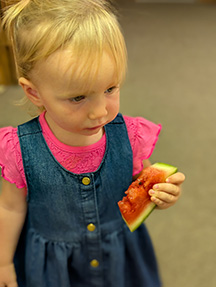
But at least that leaves more for us. There is nothing that can hydrate my children quite so well as watermelon (except maybe Brian’s gatorade that they pilfer), and considering that it’s 92% water, that makes sense. It’s pretty obvious on mouths and fingers if the kids have been eating things like chocolate or cheetos; watermelon has its own distinct tell. Although, while I was referencing the over-hydration effect, I guess watermelon is also very obvious on their faces, hands, and generally whole bodies, as well as the entire surrounding area. Everything, and I do mean everything, gets remarkably sticky. 

Banishing the watermelon-eating to the outdoors helps the floor, at least. Although on our farm, that can get a little interesting: the hens are free-range, and there may be nothing more enticing to a chicken than melons. Kiah is barely above eye-level with the chickens, and we have over 50 of them. That girl is tough, but I’m not sure even she could stand her ground if the ladies saw her holding a slice. 

Fortunately, watermelon is one of the few foods that has a built-in safeguard for melon-loving poultry. My kids might eat all trace of red, yet only sometimes are they dedicated enough to chomp far into the white and never into the green, so there’s always a load of rind treats for the hens. 

As a side note, chickens are definitely not the only animals to adore watermelon, so if you need a quick pick-me-up sometime, look up animals eating watermelons. Benson went through a phase of wanting to daily watch a clip of zoo animals, from turtles to bears to hippos, chowing down on watermelons. It was oddly satisfying. 

Another of watermelon’s amazing traits is that to serve it, all you do is cut it. Right, there are all sorts of things you can do with watermelon, and you can be sure I’ve experimented with lots. But in the end, I just want watermelon. If you volunteer to bring watermelon somewhere, no one asks how you’re going to prepare it — it’s watermelon, and we eat it with joy. 

That is, if you have one. So remember, always buy the watermelon.


Cubed Watermelon

This is cheating to call this a recipe, I’ll admit. But it’s also The Thing we do with watermelon! Since slicing is serving, the way you cut up a watermelon can really change the experience of eating it. I find it charming how many different styles people choose to get watermelon ready, both their end goal shape and their way of getting there. I could almost write another article about that…in fact maybe I will. After I clean up another round of watermelon sticky.

Prep tips: you can use a similar method to de-rind cantaloupes and honeydews. 

a watermelon of your choice; chilled

optional but unnecessary: flaky salt; fresh key/lime juice; tajin; crumbled feta; minced mint or basil

Rinse off the watermelon, then place on a large (preferably rimmed to catch the juice) cutting board. Using a large sharp knife, cut off both poles of the melon, then stand upright on a now-flat end. Cut off the rind by slicing down along the curve, rotating the melon as you cut off the slabs of rind. Once you’ve removed all the rind, set the watermelon down on a side, and slice it into 1” wheels. Set the wheels down flat, and cut in a crosshatch pattern into cubes — l like them large bitesize to minimize juice run. Try not to eat it all right away. 

KU News: KU receives $1M to expand technology access for Kansans with disabilities

0

From the Office of Public Affairs | https://www.news.ku.edu

Headlines

KU receives $1M to expand technology access for Kansans with disabilities

LAWRENCE — Supporting and improving quality of life among Kansans with disabilities is the aim of a project at the KU Life Span Institute, which has been awarded $1 million by the Kansas Department for Aging and Disability Services. The supportive technology grant will help meet a state goal to become a “technology first” state, a national designation researched and developed by longtime KU disability data scientists. Through a variety of in-person and online activities planned for late summer and fall, it will involve Kansans with disabilities and their families from across the state.


Blake Wilson selected as next director of KU Law’s Wheat Law Library

LAWRENCE — The University of Kansas School of Law has selected Blake Wilson to be the director of the Wheat Law Library. Wilson has served in a variety of roles since joining the law library in 2007. His appointment as director became effective May 25.


KU faculty members selected for 2025-26 senior administrative fellows cohort

LAWRENCE — A University of Kansas program with a commitment to faculty development has announced its newest cohort. The Senior Administrative Fellows Program, which began in 1993, cultivates the leadership skills and organizational know-how of tenured faculty through a yearlong exploration and mentoring curriculum.


KU Department of Chemistry announces 2025 awards and scholarships

LAWRENCE — The Department of Chemistry at the University of Kansas has announced the recipients of awards and scholarships for the spring and summer 2025 semesters, as well as the 2025-26 academic year. The department will distribute more than $472,000 in awards and scholarships. Recipients include students from Lawrence, Lenexa, Liberal, Olathe, Overland Park, Salina, Shawnee, Spring Hill, Stilwell, Topeka and Wichita and from Kansas City and Lee’s Summit, Missouri.


Full stories below.


————————————————————————


Contact: Jen Humphrey, Life Span Institute, 785-864-6621, [email protected]
KU receives $1M to expand technology access for Kansans with disabilities

LAWRENCE — Supporting and improving quality of life among Kansans with disabilities is the aim of a project at the KU Life Span Institute, which has been awarded $1 million by the Kansas Department for Aging and Disability Services (KDADS).

The supportive technology grant will help meet a state goal to become a “technology first” state, a national designation researched and developed by longtime KU disability data scientists. The grant is one of three totaling $2.6 million that KDADS recently awarded to Life Span Institute researchers for projects that support Kansans with disabilities across not only technology use and access, but also employment and health care navigation.

Shea Tanis, KU associate research professor and director of the State of the States in Intellectual and Developmental Disabilities Project, together with Abby Azeltine and Thomas Manthey, co-directors of Assistive Technology for Kansans (ATK), will lead the $1 million technology project. Through a variety of in-person and online activities planned for late summer and fall, it will involve Kansans with disabilities and their families from across the state.

Tanis said that becoming “technology first” means transforming the systems to ensure people with disabilities have access to the technologies they need and want to support meaningful participation, social inclusion, self-determination and quality of life.

“The University of Kansas is the entity that defines and measures technology first nationally,” Tanis said. “Kansas has been identified as an ‘intermediate state’ based on their current progress. This new partnership will develop the tools and resources needed to reach the technology first ‘advanced state’ benchmarks.”

For more than 40 years, the federally funded State of the States project has tracked the public spending invested in intellectual and developmental disabilities (ID/DD) services nationwide and distributed data, analysis and trends. ATK, which is also federally funded, has a statewide infrastructure that aims to increase access to technology for all individuals with disabilities.

Through the grant, scientists and staff with both projects will conduct research, develop resources and talk directly with people who are using or seeking greater access to technology, or are among people employed to help support people with disabilities.

Activities include:

An online survey of 500 state residents, designed through prior research to be cognitively accessible, which will provide a baseline of understanding technology needs and barriers.
Training sessions for targeted case managers across the state and establishing a professional development group that will be focused on supporting individuals with disabilities to access and use technology to meet their individual goals.
Development of a statewide advisory council and convening a think tank event in Lawrence, planned for September 2025.
Adding 300 prioritized assistive technology devices to demonstration sites in Topeka, Salina, Oakley, Garden City and Wichita and Parsons, which are existing locations that offer ATK technology support and access.
Offering virtual workshops for individuals with disabilities across the state, focused on key areas such as technology needs for housing, daily living, memory, communication and employment.
An in-person Assistive Technology Fair will be held 10 a.m. to 2 p.m. Sept. 9 at the Topeka & Shawnee County Public Library to allow individuals with disabilities, professionals, service providers and advocacy groups from across the state to explore and discover assistive technology (AT).

The project affirms the role of technology to improve quality of life, which has been well documented by researchers and by the federal government. “Technology first” was listed as one of six principles for high-quality home and community-based services in a 2024 federal report, which cited research by the State of the States project.

“While efforts across the U.S. were already scaling up, the COVID-19 pandemic forced the community to think differently about the ways in which services and supports were provided to people with disabilities and their families,” Tanis said. “Technology solutions allowed for greater autonomy of individuals with disabilities, cost savings and program efficiencies.”

Manthey said that ATK’s longtime experience and statewide infrastructure made it a good fit to partner with the State of the States in advancing technology first in Kansas.

Azeltine added, “ATK strives not only to help individuals across the lifespan identify funding for assistive technology, but also to ensure everyone has the knowledge and resources needed to make informed decisions about assistive technology, empowering them to live as independently as possible.”

-30-

————————————————————————

For every $1 invested in KU, taxpayers gain $2.90

in added tax revenue and public sector savings.


https://economicdevelopment.ku.edu/impact

————————————————————————


Contact: Casey Bacot, School of Law, [email protected]
Blake Wilson selected as next director of KU Law’s Wheat Law Library


LAWRENCE — The University of Kansas School of Law has selected Blake Wilson to be the director of the Wheat Law Library. Wilson brings nearly two decades of experience at KU Law to the role, having served in a variety of positions since joining the law library in 2007. His appointment as director became effective May 25.

“We’re pleased that Blake has been elevated to the director position,” said Dean Stephen Mazza. “His long history with the Wheat Law Library puts the institution in a great position moving forward.”

During his tenure, Wilson has held titles including instructional librarian, IT librarian, faculty services librarian and, most recently, assistant director. Wilson served as interim director until taking on this new role. His background spans technical services, reference, circulation and information technology.

“In many ways, I’ve held just about every type of position possible in a law library, which gives me a broad perspective on how all the pieces fit together to support students, faculty and the mission of the law school,” Wilson said. “It’s been a privilege to grow with this institution and now to serve as its director.”

Wilson steps into the role with a vision to strengthen the library’s core services while positioning it for future growth in digital access, legal research instruction and inclusive service. In the short term, he said he aims to ensure students, faculty and researchers have seamless access to the resources and support they need. Long term, he said he plans to expand the library’s digital collections, deepen engagement with faculty research and help prepare students for a profession increasingly shaped by technology and information literacy.

Wheat Law Library’s mission is to support the study, teaching and resource needs of the KU Law community. The library’s resources comprise nearly 400,000 volumes, including microforms, more than 4,000 journals and advanced digital legal research resources. Its services include reference, teaching and other bibliographic assistance.

“The library has been through quite a lot of change recently. Since May 2022, we’ve seen the departure of three staff members who, collectively, had approximately 80 years’ experience working at Wheat Law Library. In fact, Blake and I are the only members of the current library staff who have been here longer than three years,” said Melissa Doebele, Wheat Law Library’s technical services manager. “With Blake’s knowledge of the law school, the library and its staff, I think we all know we’re in good hands. I fully expect him to excel in his new role.”

One of the initiatives Wilson said he is particularly excited about is the hiring of a new electronic services and emerging technologies librarian, a role that will bolster the library’s ability to support digital scholarship and legal research innovation. He also plans to enhance outreach efforts by building stronger connections with student organizations and faculty and strengthening collaboration with KU Libraries.

“What inspired me to take this next step in my career was the opportunity to serve a community I deeply value and to shape the future of legal information services at a school I care about,” Wilson said. “As someone who has worked closely with students, faculty and staff at KU Law, I’ve seen firsthand the impact that a responsive, forward-thinking law library can have. Stepping into the role of director felt like a natural extension of my commitment to access, innovation and collaboration in legal education. I’m excited to build on the Wheat Law Library’s strong foundation while leading it into its next chapter.”

-30-

————————————————————————

Research at KU powers 54 active startups

with more than half based in Kansas.


https://ku.edu/distinction

————————————————————————


Contact: Elizabeth Barton, Office of Faculty Affairs, [email protected]
KU faculty members selected for 2025-26 senior administrative fellows cohort

LAWRENCE — A signature University of Kansas program with a commitment to faculty development has announced its newest cohort. The Senior Administrative Fellows Program, which began in 1993, cultivates the leadership skills and organizational know-how of tenured faculty through a yearlong exploration and mentoring curriculum.

Ten KU faculty members have been selected to participate in the Senior Administrative Fellows Program for the 2025-2026 academic year.

This year’s participants:

Carissa Cascio, professor of psychology and senior scientist at the KU Life Span Institute
Claudia Dozier, professor and chair of applied behavioral science
Scott Hefty, professor and chair of molecular biosciences
Ward Lyles, professor of urban planning and Indigenous studies
Ashley Muddiman, associate professor of communication studies
Markus Potter, artistic director and associate professor of theatre & dance
Panying Rong, associate professor of speech-language-hearing
Arvind Tripathi, professor of business
Nilou Vakil, associate professor of architecture
Amber Watts, associate professor of psychology.

“The Senior Administrative Fellows Program provides a forum for our faculty to explore academic leadership with others from across campus who are also actively considering how they might contribute to leadership,” said Amy Mendenhall, vice provost for faculty affairs and a past senior administrative fellow. “By meeting and hearing from a range of campus administrative leaders, the fellows gain a valuable and broad perspective on how various leadership roles function in a major, public research university.”

The program is led by Mary Banwart, associate vice provost for faculty development, mentoring and growth. The class of fellows is selected from applications and nominations solicited in the spring semester of the previous academic year.

“Senior Administrative Fellows is designed to help us meet our mission of growing faculty leadership in the development of an exceptional learning community,” Banwart said. “By hearing from administrators, developing their leadership skills and capacities, and networking and developing connections across the university, SAFs prepares our faculty leaders to make a meaningful impact in their departments, units and across KU.”

The Senior Administrative Fellows Program has an established record of success. Many participants have gone on to lead programs at KU and elsewhere. More information on this year’s participants is available online.

Several current and former presidents/chancellors, provosts, vice provosts, deans, associate deans, interim deans and chairs and directors at KU have participated in the program. Applications for the 2026-2027 cycle will open in early spring.

-30-

————————————————————————

Each of Kansas’ 105 counties receives KU Medical Center outreach.


https://ku.edu/distinction

————————————————————————


Contact: Angie Erdley, Department of Chemistry, 785-864-6749, [email protected]
KU Department of Chemistry announces 2025 awards and scholarships

LAWRENCE — The Department of Chemistry at the University of Kansas has announced the recipients of awards and scholarships for the spring and summer 2025 semesters, as well as the 2025-26 academic year. Nearly 80 of the department’s top students were recognized at the annual awards and scholarships recognition ceremony for their academic, research and teaching achievements.

Among the recipients were the department’s graduate summer scholars, who received scholarships to advance their doctoral research over the summer 2025 term.

In total, the department will distribute more than $472,000 in awards and scholarships to undergraduate and graduate students this year.

The department held its annual awards and scholarships recognition ceremony May 10 to honor the students. In addition to presenting awards and scholarships, 27 students graduating with bachelor’s degrees in chemistry were recognized, six of whom received departmental honors. The celebration welcomed several special guests, including Chemistry Alumni Advisory Board members visiting for their annual meeting, emeritus faculty, donors, department staff and faculty, and the family and friends of the honored students.

These awards and scholarships are only made possible due to the generosity of the department’s donors.

Student from Kansas and from the Greater Kansas City area are listed below. Some students received more than one award or scholarship. See a complete list of recipients online.

2025 Chemistry Undergraduate Awards & Scholarships for Freshmen, Sophomores and Juniors

Leah Messerly, Lenexa, Owen W. Maloney Scholarship
Gracie Oppeau, Spring Hill, Owen W. Maloney Scholarship
Jonathan Winnerman, Olathe, Drs. Bijan & Mary Taylor Amini Scholarship
Nina Chieu, Lawrence, Michelle & A.C. Buchanan Scholarship
Dakota Schrempp, Topeka, Michelle & A.C. Buchanan Scholarship
Corbin Fairchild, Lawrence, Kenyon Latham Opportunity Award
Milo McKay, Lawrence, Walter Gubar Memorial Scholarship
Jaden Riddle, Topeka, Walter Gubar Memorial Scholarship
Mei Ling Upp, Lee’s Summit, Missouri, Walter Gubar Memorial Scholarship
Aubrey Sanchez, Lenexa, Floyd & Ruth Fassnacht Memorial Scholarship
Nicole Giam, Overland Park, Emily V. Berger Award
Delara Mafi, Lawrence, Emily V. Berger Award
Meredith Goldstein, Overland Park, Jo A. & Judith Beran Chemistry Scholarship
Noah Tucker, Lenexa, Roger Munsinger Scholarship
Raina Fair, Lawrence, Leland & Jill Weigel Scholarship
Allison Babbit, Lawrence, Leland & Jill Weigel Scholarship
Ian Shire, Lawrence, Jacob Kleinberg Award
Darya Moiny, Stilwell, Leonard V. Sorg Scholarship
Patryk Hupert, Lawrence, Burton & Cheryle MacKenzie Scholarship
Ethan Le, Wichita, James P. & Sharon A. Elrod Scholarship
Mike Kim, Overland Park, John R. Shapley Award for Excellence in Research.

2025 Chemistry Undergraduate Awards for Seniors

Hannah Chern, Shawnee, Frank Newby Physical Science Award
Audrey Rips-Goodwin, Overland Park, Frank Newby Physical Science Award
Stanslaus Kariuki, Overland Park, Ted M. Gardiner Award and Gini Adams Research Award in Analytical Chemistry.

2025 Chemistry Undergraduate Top Senior Awards

Celine Khalife, Wichita, Wakarusa Valley ACS Section Award
Trisha Nair, Overland Park, American Institute of Chemists Award
Brandon Nguyen, Liberal, Alpha Chi Sigma Award
Cecilia Paranjothi, Lawrence, Richard J. Bearman Chemistry Award.

2025 Chemistry Undergraduate Research Support for Summer 2025

Raina Fair, Lawrence, Jack & Carolyn Landgrebe Summer Undergraduate Research Scholarship
Patryk Hupert, Lawrence, Stephen C. Glover Summer Undergraduate Research Scholarship

2025 Chemistry Undergraduate Bricker ChemScholars

Corbin Banninger, Salina
Nina Chieu, Lawrence
Corbin Fairchild, Lawrence
Raina Fair, Lawrence
Stanslaus Kariuki, Overland Park
Audrey Rips-Goodwin, Overland Park
Aubrey Sanchez, Lenexa

2025 Chemistry Undergraduate Kansas ChemScholars

Trisha Nair, Overland Park
Brandon Nguyen, Liberal
Cecilia Paranjothi, Lawrence.

2025 Chemistry Graduate Awards & Scholarships

Grant Arehart, Lawrence, Cornelius McCollum Research Scholarship
Fynn Cooper, Lawrence, Burton & Cheryle MacKenzie Scholarship
Alex Ervin, Lawrence, Drs. Walter & Roy Cross Memorial Award
Stephanie Pham, Kansas City, Missouri, Steve & Susan Snyder Chemistry Award

2025 Chemistry Graduate Summer Scholars

Abigail Kerr, Kansas City, Missouri, Lee Summer Scholar
Stephanie Pham, Kansas City, Missouri, Marsi Summer Scholar.

-30-

————————————————————————


KU News Service

1450 Jayhawk Blvd.

Lawrence KS 66045

[email protected]

https://www.news.ku.edu


Erinn Barcomb-Peterson, director of news and media relations, [email protected]


Today’s News is a free service from the Office of Public Affairs

KU News: Kansas educators explore the future of learning through AI

0

From the Office of Public Affairs | https://www.news.ku.edu

Headlines

Kansas educators explore the future of learning through AI

LAWRENCE — What if schools could harness the full potential of artificial intelligence, technology and data to reimagine teaching and learning? That’s the vision behind the Center for Reimagining Education (CRE) and its partnership with school districts to help educators lead the transformation of how students learn and how teachers teach. Last week, 30 educators from six Kansas districts, including in Butler and Jefferson counties, participated in Professional Learning and Collaboration Days hosted by CRE.

Matching skills with jobs in mutual fund industry leads to higher risk-adjusted performance, study finds

LAWRENCE — A University of Kansas professor of business is co-author of a new paper titled “Finding your calling: Matching skills with jobs in the mutual fund industry.” The researchers identified instances when this matching happens for fund managers, then studied the benefits. Professor Gjergji Cici advocates for CEOs of companies both in and out of the financial industry to create structures or processes that provide more opportunities for their employees to find roles or tasks that best match their skills.


Full stories below.


————————————————————————


Contact: Chance Dibben, Achievement & Assessment Institute, [email protected]
Kansas educators explore the future of learning through AI

LAWRENCE — What if schools could harness the full potential of artificial intelligence (AI), technology and data to reimagine teaching and learning? That’s the vision behind the Center for Reimagining Education (CRE) and its partnership with school districts to help educators lead the transformation of how students learn and how teachers teach.

“One of the great ironies is that schools are oftentimes critiqued, and the solution is to just do more of the same and thinking that’s the way things will get better,” said Rick Ginsberg, co-founder of CRE and dean of the School of Education & Human Sciences. “We’re encouraging educators to change the way we do things.”

Amid growing national conversations about AI in classrooms, Kansas educators are taking action. Last week, 30 educators from six Kansas districts participated in Professional Learning and Collaboration Days hosted by CRE, a center within the Achievement & Assessment Institute at the University of Kansas.

These events are part of CRE’s statewide effort, which includes three cohorts made up of nine districts across eight counties. Rather than asking educators to travel, CRE staff go directly to schools throughout the year, offering in-person coaching and collaboration tailored to each cohort’s unique goals for reimagining teaching and learning with AI. CRE staff also provide online meetings and coaching throughout the year.

“We want to learn how to use it, teach our kids how to use it and give them a step ahead of everybody else,” said Deanna Herrin, a math teacher from Buhler High School. “I’m really looking forward to being able to get the students to direct their own learning by using the tools.”

CRE staff traveled to Meriden and Augusta to connect with educators like Herrin looking to demystify AI. At the events, district superintendents and teachers discussed their unique goals, challenges and strategies to reimagine education. The events also offered time for reflection and cross-district collaboration.

“We are preparing our kids for their future and not for our current present,” said Dan Wessel, superintendent of Oskaloosa Public Schools. “Kids tomorrow aren’t going to be the same as they are today.”

Brad Kempf, superintendent of the Jefferson County North school district, emphasized the importance of AI in preparing students and teachers for the future of education.

“I think in public education, we need something to ignite our instruction and to ignite our kids to be better prepared for the future,” Kempf said. “I think an AI tool for the teachers is just as important as for the kids to save time, meet all kids’ needs and provide them with varied experiences within education.”

CRE will continue to connect with districts through ongoing coaching, resources and personalized support after the events. In September, educators will reconvene to hone in on what they want to accomplish together.

“Our goal is to use AI as a lens to help schools think through how we personalize education,” said Bart Swartz, director of CRE. “When we do personalize education, the way we teach will look different, but we’ll unlock new possibilities for students and their teachers.”

-30-

————————————————————————

Each of Kansas’ 105 counties receives KU Medical Center outreach.


https://ku.edu/distinction

————————————————————————


Contact: Jon Niccum, KU News Service, 785-864-7633, [email protected]
Matching skills with jobs in mutual fund industry leads to higher risk-adjusted performance, study finds


LAWRENCE — “Matchmaker, matchmaker, make me a match”: As the lyrics to the classic musical emphasizes, finding the right match is a key goal for most people. Businesses are no different. And when the skills of an employee don’t fit the parameters of the job, both parties can’t operate at their highest level of productivity.

“When employees start their careers, the jobs or positions that best match their skills are unknown to both the employees and employers,” said Gjergji Cici, the Koch Professor in Business Economics at the University of Kansas.

“By having the employees try out different jobs, both parties gradually learn about the employees’ skill profile, and at the end of this learning-by-trying process, the employees arrive at jobs that best match their skills.”

Cici explores this topic in his new paper titled “Finding your calling: Matching skills with jobs in the mutual fund industry.” Exploiting unique features of the mutual fund industry, the researchers identified instances when this matching happens for fund managers and then studied the consequences. The article appears in Management Science.

Co-written by Mario Hendriock and Alexander Kempf of the University of Cologne, Germany, the paper finds that when fund managers are matched, they deliver a significantly higher risk-adjusted performance. Companies use this information to maximize value by increasing assets under the management of these managers and by collecting higher fees from these funds.

“A mutual fund manager invests in accordance with a pre-specified style, which we think of as equivalent to a job. Each investment style largely determines the investment universe and, consequently, the skills needed to invest in that universe,” he said.

For example, the most relevant skills of a fund manager operating under a value style mandate revolve around understanding the value of assets in place and the cash-flow generating capabilities of companies in the near future. Whereas a growth manager’s skills revolve around understanding the growth opportunities that the company has, which take a longer time to realize. A growth manager, as compared to a value manager, is equipped to assess outcomes with a higher level of uncertainty.

“While managers can learn style-specific skills through training, some of these skills are arguably of an innate nature given what we know from previous research,” he said. “We conclude that a fund manager is ‘matched’ to an investment style when, after trying different investment styles, the manager returns to a previously tried style.”

To gather this information, Cici’s team identified when such managers are matched to investment styles and then examined how their performance changed after that point in time — in comparison to other managers from the same investment firm who were not matched to styles. They also used a similar approach to examine how firms exploit the knowledge that a particular fund manager was now matched and operating at a higher level of productivity.

“What surprised me most was the realization that fund managers do not know what style best suits them at the onset of their careers,” Cici said.

That realization came into focus when Cici read David Epstein’s 2019 book titled “Range: Why Generalists Triumph in a Specialized World,” which describes how some of the top musicians experimented with different instruments or music styles before finding the one that best fit their talent, after which point they excelled.

“Similarly, some of the best athletes experimented with different sports until they found the sport they were best at,” he said. “All these examples have a common theme: discovering what individuals are good at is not clear from the beginning and requires trial and error, which, of course, takes some time.”

Could companies in non-financial-based industries use these same strategies to match employees’ skills with jobs that best fit those skills?

“Absolutely,” he said.

“Non-financial firms could rely on a similar learning-by-trying process to boost productivity of their employees. The caveat is that this process might be easier to formalize in larger firms, where the different types of jobs are more clearly defined or where there are many divisions with clearly defined functional boundaries.”

A native of Albania who is in his eighth year at KU, Cici researches the behavior and incentives of professional money managers. His past work involving mutual funds studies the human capital of these managers and how investment companies utilize it and fund investors benefit from it.

“I would encourage CEOs to create organizational structures or processes that provide more opportunities for their employees to find the roles or tasks within the organization that best match their employees’ skills,” Cici said.

“For example, Fidelity, one of the largest mutual fund companies in the U.S., has a formal rotational program, allowing their analysts or junior portfolio managers to rotate through different sector funds. This provides training opportunities for their junior portfolio managers but also a chance for them to find a style that best matches their skills. Perhaps more companies could use such programs.”


-30-

————————————————————————


KU News Service

1450 Jayhawk Blvd.

Lawrence KS 66045

[email protected]

https://www.news.ku.edu


Erinn Barcomb-Peterson, director of news and media relations, [email protected]


Today’s News is a free service from the Office of Public Affairs