Thursday, January 15, 2026
Home Blog Page 87

KU News: Art historian brings to light Korean Buddhist temple design, decoration

0

From the Office of Public Affairs | https://www.news.ku.edu

Headlines

Contact: Rick Hellman, KU News Service, 785-864-8852, [email protected]
Art historian brings to light Korean Buddhist temple design, decoration

LAWRENCE — Eighteenth-century Buddhist monks in the Korean countryside took advantage of the artistic freedom that distance from the capital granted them to create immersive temple environments that elevated the spiritual lives of worshippers.

Maya Stiller, associate professor in the Kress Foundation Department of Art History at the University of Kansas, focuses on one detail of this — the roof-supporting brackets and their artistic adornment — in her latest article, “Carpenter-Monks as Crafters of Chosŏn Architecture: Bridging Sacred and Secular Spaces,” in the Journal of Korean Religions.

She said the piece could be considered a first draft of a chapter of her forthcoming book project on Chosŏn Buddhist temple art and architecture more broadly.

“This is going to really break ground on a new topic,” Stiller said. “Because my work explores temple architecture and mural painting through a highly interdisciplinary lens, I draw not only on art and architectural history but also on Buddhist poetry, royal court records and even performance traditions like ritual music and theater. By bringing these diverse sources together, I look at how temple spaces were not just religious but cultural centers that reflected the visual, literary and spiritual life of their communities.”

Stiller said that, like their contemporaries in Europe during Baroque or Rococo periods, Korean Buddhist artisan-monks believed that, when it came to worship structures, more is more, not less. Secular architecture in realms controlled by the royal court tended to be austere, influenced by Confucian notions of modesty. Not so Buddhist architecture out in the provinces.

“This is an area that scholars in Buddhist studies haven’t really explored,” Stiller said. “Their focus tends to stay on the religious side of things. My work expands that scope by examining how religious and secular architecture intersected. I have found that there was a significant amount of overlap and interaction between the two, but there are also some key differences, and in this article, I am bringing those relationships to light.”

Stiller said, “As long as it didn’t pose a threat to royal authority, the carpenter-monks working in the provinces had a great deal of freedom. They could build whatever they wanted and how they wanted it, as long as they had the materials and funding. And they really made use of that freedom. By the late 18th into the 19th century, temple architecture becomes incredibly vibrant and decorative. You start seeing elaborate bracket arms with intricate carvings of lotus flowers, dragons and phoenixes. It’s full of movement and life.

“When I was doing fieldwork, I was just stunned by the energy of these places. The royal palaces are impressive in scale, but the intensity and vibrancy you feel inside a Buddhist temple hall is something else entirely.”

Imagine, she said, being a peasant in 18th century Korea.

“You share a small, thatched-roof hut with three generations of your family, scraping by on just enough rice, beans, some vegetables, maybe an egg or two, and, if you’re lucky, a bit of meat once or twice a year,” Stiller said. “And then you visit the temple, and it is the complete opposite of your daily life. The space is expansive, and roof-tiled buildings with their tall ceilings feel majestic, bursting with color and filled with sacred images like bronze statues that shine like gold. Maybe you attend a ceremony, and the monks begin to play their drums, cymbals and bells, and music fills the space. It becomes kind of a spiritual cleansing and a moment of emotional release, a real escape from the weight of everyday survival.”


-30-

————————————————————————


KU News Service

1450 Jayhawk Blvd.

Lawrence KS 66045

[email protected]

https://www.news.ku.edu


Erinn Barcomb-Peterson, director of news and media relations, [email protected]


Today’s News is a free service from the Office of Public Affairs

Kansas scientists put AI to work in the fight to save the Flint Hills tallgrass prairie

0

Wildflowers bloom on a grassland near Manhattan, the Konza Prairie Biological Station. Some trees can be seen in the distance. Keeping trees and shrubs at bay is part of prairie conservation.

Trees and shrubs are invading prairies, hurting the wildlife and making it harder to ranch. Yet it’s hard to know the full extent of the problem, so Kansas State University found a way to map it out on the cheap.

Kansas State University scientists are enlisting the help of artificial intelligence in the effort to conserve what’s left of North America’s shrinking grasslands.

Zak Ratajczak, an assistant professor and grassland biologist, says K-State scientists have trained a computer model to map in detail different kinds of woody vegetation affecting prairies, such as the aggressively spreading evergreens called eastern red cedars.

“You have to give it lots of samples,” Ratajczak said. “Then it figures out what the general characteristics are of eastern red cedar based on height and how it absorbs and reflects different types of light back to the camera.”

The K-State team uses high-resolution imagery and data captured by airplanes and feeds it into the model, which can distinguish between deciduous trees, shrubs and eastern red cedars.

They used open-source machine learning and publicly available aerial data. Ratajczak and graduate student Brynn Noble laid out the project in the July issue of the journal Remote Sensing.

The U.S. Department of Agriculture and the National Science Foundation use planes to gather detailed data that they then make available for free to the public.

The National Science Foundation plane has camera equipment that takes in 1,000 wavelengths of light. It also sweeps the grassland at the Konza Prairie Biological Station with lasers in thousands of frequencies that bounce off the ground and return to the plane’s sensor. This allows K-State to build a three-dimensional map of the vegetation.

The Konza station is an 8,600-acre tallgrass property near Manhattan used for long-term research.

“ We visited the (National Science Foundation) plane that gathers the data and it’s really impressive,” Ratajczak said. “They do a lot of the hard steps and then we get all this data for free.”

K-State scientists built their model using the free coding language R, frequently used by scientists for data analysis. They trained it by giving it many aerial images of each type of vegetation.

The scientists then had the model try to identify further images on its own, and they double-checked whether the model was interpreting the images correctly. The model gave the right answer more than 97% of the time.

The K-State team has focused so far on the Konza property. But it hopes to expand the work — mapping out the prevalence of deciduous trees, eastern red cedars and shrubs across the Flint Hills tallgrass region.

This would help them see the full extent of the problem.

For decades, woody plants have been spreading across the Great Plains, to the point that they are transforming grassland into woodland and shrubland. Scientists in Oklahoma have dubbed the phenomenon the Green Glacier.

Common invaders in the Flint Hills include eastern red cedars, wild plum, roughleaf dogwood and smooth sumac. (These last three are shrubs or thickets.)

The Green Glacier is fueled by a host of human changes to the Great Plains since European colonization of North America.

A few examples include planting millions of trees in grasslands since that time and severely reducing the application of fire that Native Americans had long used to support grasslands.

Additionally, the realities of modern-day landownership pose a challenge. The continent’s remaining grasslands are divided among many different landowners with varying priorities for how to use the land and varying capacities for maintaining it.

Another key change is the increase of carbon dioxide in the atmosphere since the Industrial Revolution. This helps woody plants grow faster on prairies, shading out grasses around them and surviving prescribed burns.

Mapping woody plants in great detail could help pinpoint how much forage for cattle and bison is lost each year to this transformation.

Already, scientists have estimated that the Flint Hills would grow about a billion more pounds of grass annually if not for trees and shrubs overtaking so much space.

K-State’s use of machine learning could also help researchers better track the relationship between this habitat transformation and declining grassland bird species, such as grasshopper sparrows and eastern meadowlarks.

Those species disappear from areas of grassland once low levels of shrubs and trees have invaded.

Eventually, K-State scientists hope that their advancements in mapping out woody plants with AI will help conserve swaths of grassland currently free of woody plants but likely to face that threat in coming years.

“One of the things we are thinking about using this for is early detection and intervention,” he said.

Nearly one-third of North America was once grassland. More than half of it disappeared for development such as row crops, cities and suburbs. And for tallgrass prairie — the kind of grassland in the Flint Hills — the statistics are even worse. Scientists estimate that less than 5% of the continent’s tallgrass remains.

The Flint Hills is the biggest remaining stretch of tallgrass prairie. That’s another reason for the urgency to deal with shrubs and trees there.

Some parts of the Flint Hills are already awash in these plants, but other areas still have a chance to proactively hold the hardest-to-control woody species at bay.

“ If you can catch encroachment (the spread of woody plants) when it’s in the early stages,” Ratajczak said, “it’s potentially easier to either halt or reverse using prescribed fire.”

Celia Llopis-Jepsen is the environment reporter for the Kansas News Service and host of the environmental podcast Up From Dust. You can follow her on Bluesky or email her at celia (at) kcur (dot) org.

The Kansas News Service is a collaboration of KCUR, Kansas Public Radio, KMUW and High Plains Public Radio focused on health, the social determinants of health and their connection to public policy.

Kansas News Service ksnewsservice.org.

Are you an Old Fisherman…Take the Test

0

Well, yet another birthday has come-and-gone. It seems that since I’ve turned 70, my “check engine light” has come on and refuses to go out. It flickers on-and-off occasionally, but never goes completely off. Don’t get me wrong, at 74, I’m blessed more than many, and I praise God for that, but it seems like I daily feel like the proverbial “old fisherman,” and I’ve devised a questionnaire so you can see if you too fit into that category. So take the test;

You’re probably an old fisherman if you still smell like Ben Gay even after you’ve cleaned your fish.

If you waste countless hours of prime fishing time reeling and casting, reeling and casting, because you can’t remember whether or not you just re-baited your hook, you’re probably an old fisherman.

If, after reaching quickly under the boat seat for the dip net, you’ve found yourself holding your cane instead, you’re probably an old fisherman.

If you have ever started to hold the line between your teeth only to discover you’ve left your teeth at home at home, you’re probably an old fisherman.

If removing that occasional fishbone from your teeth can now be accomplished by removing your teeth and tapping them on the table, you just might be an old fisherman.

If you’re shore lunch now includes a tall, cool thermos of Metamucil and a box of prunes, you’re probably an old fisherman.

If your fishing buddies are now more than happy to take you along to their secret “honey holes” because they are confident you’ll never remember where you were anyway, you’re probably an old fisherman.

You’re probably an old fisherman if your wife now begs to go fishing with you because she’s afraid you’ll forget your way back home (you should feel lucky she wants you back home).

You’re probably an old fisherman if your favorite fishing chair is now one of those fancy walkers with a seat on it, and you are relegated to fishing from the boat dock because that’s the only place level enough to park it, or if you recently removed a seat from your boat to make room for your walker.

You just might be an old fisherman, if to you, the letters GPS mean Gotta’ Pee Soon

It’s easy for anyone to drive off with their coffee cup sitting on the roof or the bumper of the pickup, but if you have gotten to the lake and turned around to back your boat down the boat ramp only to discover the boat was still parked in the driveway at home, you’re an old fisherman.

And finally, I’m sure you’re an old fisherman if your eyesight has gotten so dim that you now haul home all the carp you catch because you mistake them for trophy bass…Continue to Explore Kansas Outdoors!

Steve can be contacted by email at [email protected].

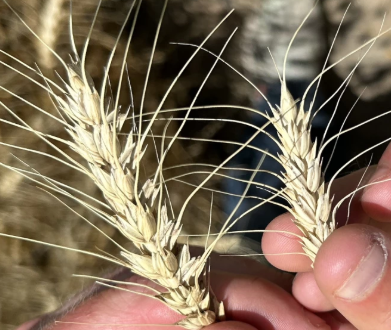
New wheat hybrids are on the horizon and Kansas farmers are among the first to test them

0

Kansas is an important “breadbasket” state because of its massive wheat production, but in recent years that’s been changing. With poor profits and drier climates, wheat has been harder to manage. New innovations could rejuvenate the economy and production of the wheat state.

It was 1874 when a large influx of Russian immigrants settled in Kansas bringing with them a hard red variety of wheat.

This wheat variety grew well in the harsh summers and dry winters.

Hard red winter wheat swallowed the Plains, and when you drive across Kansas in June you see it turn the land gold. Kansas has even been known in the past as the “breadbasket of the world.”

Today, Kansas embraces its wheat identity, and still is one of the top wheat producing states. But wheat acres have continued to trend downward, falling away to other crops like corn and sorghum.

For over a century, wheat hasn’t changed too much from when it first took over. Other crops have been improved and hybridized. But scientists now think hybrid varieties will create a new wheat era.

Agronomist Logan Simon wipes his brow with a cloth as he walks through test plots used to experiment with corn, cotton and wheat just outside Garden City.

The success of Kansas agriculture relies on research like this.

“It gives us some greater optimism as we move into a potentially drier future,” Simon said.

Hybrid varieties can bring better bread to your stores, healthy livestock that you eat and biofuels for your cars. And it is becoming increasingly crucial as climate change produces challenging environments for Kansas farmers.

These hybrids usually take good traits from different varieties of a crop and combine them to make a plant that’s healthier, hardier or produces more, even in harsh environments.

But it hasn’t been so easy with wheat. Scientists have racked their brains trying to make better wheat hybrids. The plant’s physiology makes hybridizing wheat difficult.

Katherine Frels has worked for years in wheat breeding at the University of Nebraska. She said people witness the scientific success of agriculture without even realizing it.

“Whatever crop they’re looking at as they go to church, go to the grocery store. Someone had to develop that variety,” Frels said.

Farmers have had innovations in corn hybrids since the 1930s. Soybeans followed shortly in the 1940s. Since corn was hybridized, farmers’ yields have increased about 700%, going from 26 bushels per acre to 183 bushels.

But even with the advent of fertilizers and pesticides, wheat has barely doubled its yields in that same time.

With corn, to make hybrids simply cut off the tassel at the top which produces pollen and plant it with another variety to cross the two.

The problem is wheat pollinates itself, which has made creating hybrid varieties nearly impossible.

Frels has worked on a lot of potential solutions, like chemically sterilizing the plant. She said from their research, out of 1700 wheat hybrid variety trials, there is a yield increase on average.

Universities aren’t alone. Seed companies are also diving in as well, studying how to make enough hybrid wheat seeds so it’s consistently available.

Corteva is a global agriculture company that has recently announced a breakthrough with their wheat hybrids.

Jessie Alt is the lead wheat breeder at Corteva. Hybrids have consumed most of her career, and it’s been a challenge.

Back in 2018, after decades of research, scientists mapped out the genome of wheat. That allows people like Alt to find ways to stop wheat from pollinating itself and breed it to make unique hybrids.

“It has been the most exciting thing of my career,” Alt said. “Like, we can do this.”

Alt said combining different field tools such as drones and understanding genetics have allowed for more hybrid innovations on a larger scale.

What this breakthrough means for Kansas farmers is potentially 20% higher yields in water stressed environments, which will be critical as the Ogallala Aquifer runs dry and farmers switch to non-irrigated crops once their water pumps fail.

It will also help farmers transition more smoothly to limited irrigation, while still producing a profitable crop.

Wheat hybrids could use less water, fertilizer or herbicides, and result in a product with more fiber and protein.

But farmers will need to be able to see and feel the crop if they are going to take a chance on it.

“Kick the tires, if you will,” said Jason Gaeddert, a farmer from Buhler, Kansas.

Corteva used Kansas for 70% of their test plots, one of them being on Gaeddert’s land. He said that the hybrid wheat has looked good, and even produced higher yields. He wants to see how much better that wheat will handle dry times when the rains don’t come.

“If it can handle that stress better, then you’re going to clearly get a better yield or better quality product. Then, that becomes more profitable,” Gaeddert said.

Corteva hopes to roll out hybrid wheat on the markets in 2027. But there is a problem with wheat hybrids on the horizon. They will be pretty pricey, and in order to change agriculture, farmers have to actually use the seed.

Farmers are able to salvage wheat seed from harvest, saving some money the next planting season.

With hybrids, the seed won’t be reusable because the offspring won’t be the same as the parents. Can the hybrids make farmers enough money to justify the increased cost?

Gaeddert said he will gladly spend more money to make more money. Other farmers might feel the same.

Mike Krieghauser is an agronomist for Pioneer, a seed brand of Corteva. He works with farmers in northwest Kansas.

Despite the financial challenges for farmers, Krieghauser is optimistic they’ll adopt hybrid wheat.

“I mean, it’s wheat. It should be the easiest adopting hybrid thing that we’ve ever done in the history of agriculture,” he said.

Calen Moore covers western Kansas for High Plains Public Radio and the Kansas News Service. You can email him at [email protected].

The Kansas News Service is a collaboration of KCUR, Kansas Public Radio, KMUW and High Plains Public Radio focused on health, the social determinants of health and their connection to public policy.

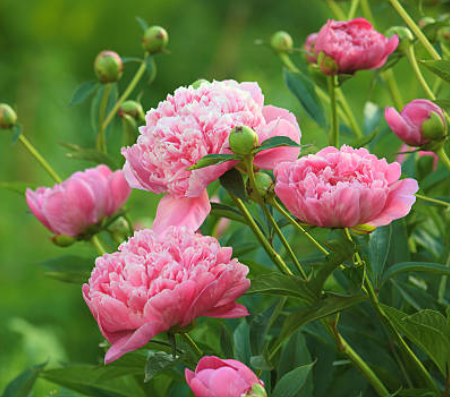
Dividing Peonies

0
If your peonies didn’t bloom as expected this year it’s possible they need to be divided. Peonies don’t require dividing often, but doing so periodically can promote healthier plants. You also get the benefit of increasing your plant collection.
Cut stems just above the soil surface. Dig up the entire root system and remove the soil from the roots. Divide the root clump into small sections using a sharp knife. Each section should have three to five buds and healthy roots. Sections with fewer buds will take longer to bloom.
Choose a planting location that receives sunlight for at least half of the day. Dig a hole large enough that the roots and buds will be covered by one to two-inches of soil. Plants buried too deep may not flower. Backfill and water thoroughly. Space dwarf peonies at least two-feet apart and standard peonies four-feet apart.
It may take a couple of years for the divided plants to return to full bloom productivity. Kansas’ winters have periods of freezing and thawing which can uproot plants. Protect newly divided peonies, by covering them with a layer of straw, leaves or compost after the soil freezes.