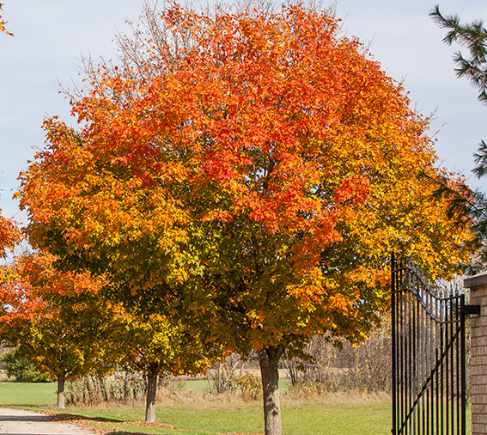
Since mid-July, I’ve noticed something strange in several maple trees I’ve driven by: their leaves are starting to show fall color! Sometimes it’s just the tips of the branches turning red or yellow; other times, it’s concentrated in one section of the canopy. It’s eye-catching, but also a little concerning. After all, it’s not supposed to look like October out there.
Extension’s Yard and Garden News gives some reasons why trees may seem to turn color earlier than expected in the August garden checklist. There are some benign reasons for color changes as well as indicators that something may be stressing your tree.
Early color could be a stress signal
Though some maple varieties turn color earlier than others, when maples start changing color in midsummer, it may be about the health of the tree. Trees respond to stress by shedding leaves or shifting pigments, trying to conserve energy and protect themselves.
Too much of a good thing?
This year, one major stressor stands out. This summer’s excessive rains could be the culprit in turning our trees early.
Maple’s shallow root systems, combined with saturated soils, can cause problems. Maples are especially sensitive to standing water, which can quickly stress their roots.
When roots sit in soggy soil for too long, they can’t get the oxygen they need. That leads to poor nutrient uptake, and the tree may respond by dropping leaves or changing color—much like it would in fall, but for all the wrong reasons.
Other stress factors to watch for
While rain is a big player this season, it’s not the only one. Maples are sensitive to a range of environmental challenges:
Drought and heat: Dry spells can dehydrate leaves, especially during hot, windy days.
Nutrient deficiencies: Low nitrogen or other key nutrients can slow chlorophyll production, revealing reds and yellows.
Compacted soil: Heavy foot traffic or construction can compress soil, limiting root function.
Pests and diseases: Fungal infections like anthracnose or verticillium wilt, or insect damage, can cause localized leaf discoloration and drop.
What you can do to help
Start by checking your soil. Is it soggy? Bone dry? Somewhere in between? Mulching can help regulate moisture, but make sure it’s not piled against the trunk — think donuts, not volcanoes. If you’re seeing standing water, consider improving drainage or gently aerating the soil.
A soil test can also help pinpoint nutrient issues. And if you suspect disease or pests, it’s worth calling in a certified arborist for a closer look.
Don’t panic, but don’t ignore it
Early leaf color doesn’t mean your tree is doomed. It could be a heads-up that something’s off, and with a little care, most maples bounce back.
So next time you see a red leaf fluttering down in mid-summer, don’t reach for your pumpkin spice latte just yet. Your tree might just be asking for a little help.
Erica Schlender reveres this ground, homesteaded by her great-great-grandfather, where he put down roots that continue to anchor her.
She thinks of the effort that each generation of her family poured into this soil near Moundridge, raising crops and children and tending it not just for the moment but for the future.
And she thinks about the house she wants to build here and the children she wants to raise here, while continuing the farm for generations.
“It’s the generations before that keeps me passionate,” says Schlender, who lives in Burrton.
She welcomes their wisdom. “They survived the Great Depression, they survived all these difficulties in their lifetime, and we’re just facing similar difficulties in our lifetime,” Schlender says. “You just look to the older generation for the inspiration to put one foot in front of the other and keep trying.”
Schlender is reflective of a trend that emerged in the most recent Census of Agriculture in Kansas: a growing number of young farmers and women in agriculture. There were more than 34,000 female producers in Kansas in 2022, up nearly 2,000 over 2017.
The census, completed every five years, was released last year. Most of the report reflects a continuation of recent trends in Kansas – including a couple of red flags that could cripple the state’s future growth, an industry official warns.
Kansas continues to lag well behind other states in internet access to rural areas, and significant roadblocks inhibit younger people from going into farming.
Nevertheless, the report reflects subtle changes involving just who is a farmer in Kansas and how that can strengthen the state’s agriculture in a time of significant uncertainty.
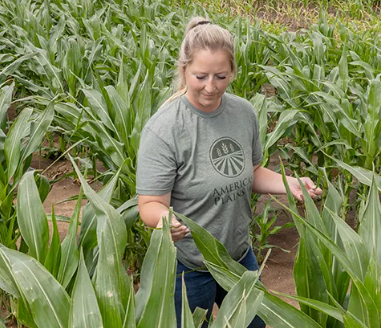
When Melissa Nelson got into crop research 10 years ago, she was one of the only women at conferences.
“Now the industry is a lot more saturated with women, and that’s amazing to see,” says Nelson, who farms with her husband near Great Bend. “Women are definitely taking a bigger role in the decision-making.”
As a result, she says, “you’re seeing specialty crops, … you’re seeing diversification.”
She is not shy about trying new things.
“I will grow anything if you can grow it in Kansas,” she says with a laugh.
The Nelsons currently grow corn, wheat, soybeans, milo (grain sorghum) and industrial hemp for fiber production.
A short drive away, Christa Milton farms about 600 acres in Stafford and Barton counties. She puts much more emphasis on the role she fulfills rather than her gender.
“I’m definitely proud to be a woman in agriculture,” Milton says. “But for me, I just want to be known as just a farmer.”
Schlender, who works as an agronomist in central Kansas, voiced similar sentiments.
“Of all the customers and the farmers that I meet with, there’s only been one that made me feel like I belonged in the kitchen,” she says. “When you get that, it pushes me to prove them wrong. I want to prove to these farmers that women are just as capable of farming this ground and making the decisions. It just drives you.”
Her family’s land is all in dryland crops now, Schlender says, and they hope to eventually work cotton into their crop rotation – like many of the farmers in her customer base.
“Cotton is more drought resistant,” Schlender says. “Farmers are starting to branch out into other crops to produce better in these drought conditions.”
Schlender and Milton were able to get into farming as young adults because of their families, but those who do not have family connections to a farm have a difficult time getting a foot in the door – and that is one of two red flags Mark Nelson noted when reviewing the agriculture census.
“The capital requirements of starting a farm are so high, and there’s tremendous barriers to entry,” says Nelson, director of commodities for the Kansas Farm Bureau and no relation to Melissa.
Milton agrees. Having access to collateral for loans is difficult for those wanting to get started in farming, she says – and that’s if loans are available at all.
“If someone was wanting to get into farming without growing up in it, like I did, it would be really hard,” she says.
Maybe their experiences and knowledge cause them to view things differently, but even with all the challenges agriculture faces, Milton and Schlender are optimistic about the future.
One of the reasons for that is because they are seeing farmers open to changing how they do things so they can protect their land and ensure profitability.
Farmers are increasingly interested in soil health, for now and for the long term.
Melissa Nelson poses the challenge in the form of a question: “What are we doing to maximize our acres on minimal inputs, which I think is very critical to success?”
One of Schlender’s agronomy customers is doing all he can to improve the health of the soil on his land, she says.
“His drive is to make sure that his grandsons have a farm that they can turn to,” she says, “and keeping it alive and thriving.”
Broadband access ‘pretty woeful’
But some farms are still waiting for access to a technology that’s taken for granted in urban areas. According to data collected in 2022 and released last year, more than 20% of Kansas farms still did not have internet access. That is the other red flag Mark Nelson raised when reviewing census data.
“I don’t want to call it a crime, but that’s terrible,” says Nelson. The census, which has been conducted since 1840, collected more than 6 million data points about farms and ranches, including farm size, demographics and the production of crops and livestock.
That data showed the number of Kansas farms with internet access grew by 3% since the last census, to 79%.
“That’s pretty woeful,” Nelson says. “We’ve got to redouble our efforts to get adequate funding and get better rural broadband.”
Kansas has made improving broadband infrastructure more of a priority in recent years. The Eisenhower Legacy Transportation Program, approved by the Kansas Legislature in the 2020 session, allocated $5 million a year for the first three years of the plan and then $10 million annually through the remainder of the program’s 10-year lifespan, for a total expenditure of $85 million.
The Strengthening People and Revitalizing Kansas task force allocated $60 million of federal dollars earmarked for coronavirus-related costs for expanding connectivity around the state, including $10 million aimed specifically at coverage for low-income residents.
According to the USDA’s National Agricultural Statistics Service, Kansas in 2023 ranked among the highest in the country for farms with broadband service, at 63% – well above the national average of 51%.
As of early 2025, the Kansas Office of Broadband Development has 86 active projects under way through nine different programs, worth nearly $662 million. Another $451 million in federal dollars through the Broadband Equity Access and Deployment program will be awarded this year.
Those figures do not include the private investment made by locally owned rural broadband companies and cooperatives, says Jill Kuehny, chief executive officer of KanOkla Networks in Caldwell.
“The productivity of a single farmer in the middle of Kansas is more tech-savvy and tech-needy than 10,000 people in New York City,” Kuehny says. “The automation of heavy mechanical lifting and 24/7 zero fatigue is a game changer” because it reduces physically demanding work.
Kuehny estimates the state is within 5% of the population being fully built out – but not 5% percent of the land mass.
“It’s always the last 5% that’s the most difficult and expensive, which is why it hasn’t been done,” she says. “Nothing is cheap and easy about broadband. Just like the last few decades, the least populated counties will be last to be built because the cost is so high.”
Those costs “may unfortunately keep these sparsest of areas further behind forever,” she says. “If fiber optic isn’t built … in this small window of time, it never will.”
That would mean the most remote areas of the state “can never catch up.”
Broadband access is crucial not just so farmers’ children can study and they can perform daily tasks, Nelson says. The emergence of precision agriculture allows farmers to increase yields and reduce water use by measuring soil health and moisture content down to less than an acre – but that requires consistently downloading vast amounts of data and processing it.
“Western Kansas has found new innovations in ratcheting down their water use with good data and automation – hopefully not too late to salvage the (Ogallala) aquifer – and will need high density fiber-optic connectivity closer together to maintain efficiencies,” Kuehny says.
Fear of one bad year
Increasing productivity is vital, agriculture officials say, as the number of acres available for farming continues to shrink. There were 44.7 million acres in 2022, down nearly a million acres from five years earlier and 2.5 million from 2002.
Agriculture remains a significant component of the Kansas economy, generating a market value of $24 billion in 2022. Kansas is No. 1 in the nation in both winter wheat and sorghum production and No. 2 in beef cattle production.
Corn generated $3.4 billion in commodities sold, second only to wheat.
“You make money growing corn,” says Jennifer Ifft, associate professor, and extension specialist in agriculture policy at Kansas State University. “Corn has made people a lot of money.”
Huge feedlots in southwest Kansas need a lot of corn to feed all those cattle. But corn needs a substantial amount of water, and that is depleting the Ogallala aquifer.
“Everyone’s complaining about how farmers are stuck in corn and soybeans, but there’s no incentive for us to grow anything else,” says Nick Vos, who farms about 1,000 acres in Stevens County in southwest Kansas and in Texas County in the Oklahoma Panhandle.
He is easily the smallest farmer in the area, he says, and he must rely on a hotspot to get internet access. The average farm in his area consists of 8,000 to 12,000 acres.
Wheat prices were so low last year, Vos says, that farmers who were looking at only the second good yield in 14 years never took it to harvest because they would lose money. They leased their fields for cattle grazing.
With interest rates and grain prices where they are, Vos says, “all it takes is one bad year and you have a really big problem. And that’s why I don’t think the current scenario is as sustainable as people think.”
Many others are concerned as well.
“The cattle industry is at an all-time high – if you’re in cattle, you’re making a lot of money,” says Rick McNary, who founded Shop Kansas Farms and is now an agricultural consultant who lives in Potwin. “But the commodity crops are entirely different.
“I’m talking to six-generation farmers that are quite concerned. Input prices are up. And with everything that’s going on with our world, there’s a lot of uncertainty.”
According to the American Farm Bureau Federation, farm bankruptcies across the United States jumped 55% in 2024, to 216. Nearly one-third of the bankruptcies were filed in the Midwest. Ten were filed in Kansas, tying it with New York for the seventh-most in the nation.
Early indications for 2025 are foreboding: Bloomberg Law reports that bankruptcies are trending still higher this year.
‘Cotton is coming’
In an effort to stay afloat, more and more farmers are trying to think outside the box, Vos says, by looking at regenerative agriculture and vertically integrated markets, “where we can grow a product and sell it three different ways.”
For the last few years, Vos has used biochar – charcoal produced from plant matter – to increase water filtration, water capacity and add nutrients to the soil.
Regenerative agriculture is being encouraged all over the nation to protect water sources, and Kansas is seeing an increase in its deployment.
Land planted in cover crops grew to more than 767,000 acres in 2022, an increase of 38% over 2017. Market forces and water issues figure to push those numbers higher in the years ahead.
“The feed yards want more forage production” to feed their herds, Ifft says. “That’s what they tell us.”
They can readily ship in more corn as needed, she says, but shipping in forage is more difficult. Crop insurance is available for forage crops, she says, but many farmers are not familiar with it. And habits can be hard to break.
“People are still making money doing corn,” she says.
Triticale – a hybrid of wheat and rye that can deliver strong yields even during droughts – is becoming more popular as a dryland option in a crop rotation. Fewer than 150,000 acres of triticale was planted across Kansas in 2015, according to data provided to the K-State Extension Service. By 2021, the year before the latest Census of Agriculture was conducted, that number had nearly doubled to 281,000 acres.
The demand for forage crops such as triticale and alfalfa will only grow with the arrival of commercial dairies in Kansas. Twin Circle Dairy south of Lewis will have 23,700 head of cattle on site when it reaches full production. More commercial dairies are likely to migrate to Kansas as well, Ifft says.
Adapting to changing markets and weather patterns has always been a crucial aspect of agriculture. Cotton was once the king of the South, but it is gaining popularity in the Sunflower State after finding a base in Texas, Oklahoma and New Mexico.
“Cotton is coming,” Ifft says. “If we get enough growers, we’ve got to support them” with effective policies and guidelines.
There were more than 300 cotton farmers in Kansas in 2022, nearly double the number from just five years earlier and three times the total in 2007.
Increasing yields and discovering ways to use less water are cornerstones of the research being conducted by the Kansas Water Office on more than a dozen research farms. The work is a continuation of research conducted by K-State for several years at 15 Water Technology Farms around the state.
Western Kansas farms focused on water conservation efforts, while research farms in the eastern part of the state were exploring ways to improve soil health and improving filtration, says Jonathan Aguilar, a water resource engineer at Kansas State. Mobile drip irrigation, soil moisture probes and irrigation scheduling systems were among the measures being tested on those farms.
“Of all the customers and the farmers that I meet with, there’s only been one that made me feel like I belonged in the kitchen. When you get that, it pushes me to prove them wrong. I want to prove to these farmers that women are just as capable of farming this ground and making the decisions. It just drives you.”
Erica Schlender, farmer near Moundridge
Adjusting to restrictions
The increase in cover crops has coincided with a decrease in irrigated land across Kansas, according to the census. There were 2.3 million acres of irrigated land in the state in 2022, a decrease of nearly 200,000 acres from 2017.
Farmers in the Rattlesnake Creek drainage basin in central Kansas have begun irrigating less as part of a compromise with the U.S. Fish and Wildlife Service. The agency manages the Quivira National Wildlife Refuge in Stafford County, which is a key stopping point for migratory birds.
Irrigation along Rattlesnake Creek over the past several years was blamed for greatly reduced water flows in the Rattlesnake and reduced inflows to the marsh. A state report found that the refuge received less than its legal share of water about two-thirds of the time between 2008 and 2021.
Because the refuge’s water right takes preference legally over many upstream irrigation wells, farmers feared losing significant income. But voluntary measures by farmers to ensure the refuge receives sufficient water have exceeded goals, so the fish and wildlife service backed off on pressing for its allotment.
Many farmers in the area have applied for multiyear flex accounts, says Milton. Such an account allows a water right holder to exceed their annual authorized water quantity in any given year, but restricts total pumping over a designated five-year period.
“You can throw a corn or soybean crop on there that uses a lot of water the first two years” and then rotate to dryland crops the last three years of the contract,” Milton says.
Farmers are adjusting their water plans and crop rotations with those restrictions in mind.
“Right now, cattle prices are really good, so we’re looking at maybe expanding the cattle herd if we can,” says Milton, whose family has been farming in the area for several generations.
Even with all of the challenges and uncertainties on the horizon, Milton says she’s “very optimistic” about the future of agriculture in Kansas.
“I feel like I’m still young enough to be excited and I might have that rose-colored glasses on,” she says, “but I’m just still excited about farming and being able to make it happen for myself.”
Stan Finger is a longtime correspondent for The Journal known by many readers for a distinguished career reporting for The Wichita Eagle. He frequently covers communities across the state on topics such as housing, economic development and broadband. Photo by Jeff Tuttle.
HONORING the historical significance of KANSAS AGRICULTURE — Celebrating RURAL AMERICAN VALUES, and — Preserving HERITAGE TRACTORS for future generations.
Governor Laura Kelly, the Kansas House Legislature, the U.S. Congress, the City of Hutchinson, and countless other dignitaries and associations have officially recognized and supported this Vintage Tractor Ag Heritage Day.
Antique Tractors from the Great Plains Antique Tractor Club will be on display August 22, 2025 at the Hutchinson, KS Post Office along with The Hutchinson, KS Fire Dept., hoisting a large US. Flag from its Ladder Truck. A parallel event will be held August 22, 2025 in Bird City, KS by the Tri-State Antique Engine & Threshers Association at the Thresher Museum. Get all the details at TalkingTractors.com
Obtain your USPS Pictorial Postmark. The United States Postal Service is proudly supporting Antique Tractor Preservation Day, with an exclusive, limited-time only Pictorial Postmark, to be made available starting August 22, 2025. Patrons who want a Postmark may visit the Hutchinson, KS Post Office in person, or request via Mail Order by: Affixing stamps to any envelope or postcard, placing the envelope or postcard in a larger envelope and addressing it to: Pictorial Postmark, TalkingTractors.com Station, 128 East 1st Ave., Hutchinson, KS 67501-9900.
A Special Podcast Show with Michael Hinton, who has the heart & passion to keep the ag industry heritage alive through his work in getting not only an official Antique Tractor US Postal Service Pictorial Postmark, but also an Official Proclamation for the Annual Kansas Antique Tractor Preservation Day on August 22. He is leading the way in ensuring that America’s Rural Heritage is recognized and protected with his efforts. You have to listen to the full interview!
Hosted by renowned Farm Broadcaster / Agricultural News Reporter, Lorrie Boyer. Lorrie is the distinguished recipient of the 2023 [NAFB] National Association of Farm Broadcaster of the Year Award.
In this column I’m going to reveal a secret that may destroy my career as a cow columnist. It’s so bad that my fellow cowboy friends may boot me from their ranks. My wife says I should just hobble my lip and never reveal my secret but I think I’m being dishonest in not leveling with you.
So here goes.
I can’t eat beef that I raised. Just can’t do it. No, I’m not a vegetarian or a vegan and I’ve never eaten a Beyond Beef burger or a fake piece of Impossible beef. No cheeseburgers without beef for me. Here’s the thing: I could always eat lambs and hogs I raised and in fact, I quite liked them. One of my biggest projects in the FFA was raising cute little white bunny rabbits for meat and I had no trouble whacking them on the neck and I found them to be quite tasty. I’m NOT kept awake at night by nightmares of those bunnies looking at me with their cute little pink eyes.
In FFA I even raised a couple Mallard ducks that I named Chester and Charley. I know the old adage that says you’re not supposed to name an animal you intend to eat but those two ducks were the best comedians in the barnyard and they gave me many hours of enjoyment just watching them. A smile comes to my face even now when I think of them. And yet I had no trouble gobbling them down and let me tell you, beef is the only thing better than duck with a little orange sauce.
I hate to admit this but we also raised lots of chickens both for their meat and for their eggs but this isn’t the big admission I mentioned at the start of this column. I gagged down the tough hens but I refused to eat their eggs. To this day if I see someone break the yellow yoke of an egg and mix it with perfectly good potatoes, ham and pancakes, it’s enough to make me spew.
I’ve gobbled down trout I caught and had no trouble eating anything I hunted but I do admit that that I don’t relish eating deer meat. It’s not because I melt like a snowflake when I gaze into deer’s sad eyes, it’s just that I don’t care for venison. To me it’s almost as bad as eating liver which is the single worst tasting thing I’ve ever eaten in my life except for lima beans. Yuck!
As a kid I was raised on one acre of ground which I transformed into a huge garden. While I’m not a big fan of radishes, beets and turnips I didn’t hear them scream when I jerk them from the ground. And I don’t dislike every tuber as I absolutely LOVE potatoes. And to this day I still have a wonderful taste left in my mouth by home-grown sweet corn, cantaloupe, broccoli and green beans. There’s no better refresher in the world than home-raised cold tomatoes with salt on them.
Yet I couldn’t eat any of the steers I raised… and I absolutely love beef. Even as a rancher later in life I much preferred my neighbor’s beef to that of my own and I think there’s something wrong with me psychologically that I can’t enjoy beef from cattle I raised. Is it just because I’m a big old pansy or is there something mentally wrong with me? Could I be I crazy?
I decided to seek professional help. I’ve never understood the difference between a psychologist and a psychiatrist but I took advantage of the fact that a psychologist moved close by. One day I casually asked her about my beef-eating problem but she said she was not the one to ask as this was beyond her realm of study. “But based on what I’ve observed just watching you from afar,” she said, “and now hearing this about you, my professional opinion is that yes, you are nuttier than a wood rat and belong in an insane asylum. And not just because you can’t eat your own beef. But just to make sure I think you should see a psychiatrist.”
“But what’s the difference between a psychiatrist and a psychologist?” I asked.