Thursday, January 15, 2026
Home Blog Page 89

Lettuce Eat Local: It’s Snack To School Time

0

Amanda Miller
Columnist
Lettuce Eat Local

All the pencils, crayons, and notebooks are on sale again — it must be time for school to start again. Backpacks all over the country are getting pulled out of the closet and stocked with new materials; lunchboxes too are being taken out of storage and returning to their heyday. 

Kids (and parents) are also being tugged out of their summer schedule, or lack thereof. While I don’t quite have school-age children yet, I’m sure the force of that tug varies greatly between households: perhaps some kids have been champing at the bit and need only to be released to fly schoolward, while others have watched the days go by on the calendar with a broad sense of impending doom. 

Parents probably have varying emotions as well, not necessarily matching those of their offspring. Some can’t wait to get back into a routine and drop the kids off every morning, while others lament saying goodbye to the last vestiges of summer vacation and more time with their family. Or, if homeschooling, there might be even more time spent together, just in a different context — again, this might be approached with excitement or gloom. Possibly, a combination of all of the above.

Regardless of emotional status, everyone’s still gotta eat, and school is hard work. We don’t talk about after school snacks for nothing. 

By the time I type in “aft—,” my Pinterest search engine is already filling in the rest of the phrase, even though this is the first time I’m looking it up. The idea is easy and nutritious finger foods that can be made quickly or ahead of time, so they can be ready for kids in their ravenous post-academic state to either grab or make on their own. Classic combinations like apples & peanut butter, cheese & crackers, and yogurt & fruit feature prominently, as do things like smoothies, muffins, granola bars, and wraps. 

Maybe I’m still a kid at heart/stomach, since all those sound great to me. 

And while I didn’t anticipate it quite yet, our household might fall into the after-school-snackers category this year after all. While I keep saying that we don’t have to make school decisions yet, I’m realizing my time in this stage is increasingly limited. My son apparently keeps growing, and is becoming alarmingly close to needing a more formalized educational approach. Brian and I continue to consider different options, but at this point we plan to homeschool, for the lower grades at least. I was homeschooled all twelve years, and I loved it; we’ll see what feels right for Benson as time goes on. Before switching majors in college, I was on track to get my degree in Early Education, as I’ve always loved little kids and teaching. 

I could get so excited about teaching my own kids — and it seems Benson is down with that idea, at least for the moment. He’s actually almost a little too excited, if I can say that out loud. This week we found a kindergarten workbook someone had given us, and he has been obsessed with it. He got up before he’s supposed to a few days, so he could do workbook. We walk in the door from being somewhere and he heads straight over to the workbook. I had to stop multiple times while writing this to help him do some more workbook. What am I supposed to do, tell him no let’s stop learning?! What a sweet conundrum. 

It won’t last, so I’m trying to run with the momentum while it’s here. Some of it’s pretty hard for him, but we plow through it anyway. Fortunately, I can still lure him away from the pages with food, which is good because kids aren’t the only ones who need after school snacks. 


Blender Chia Pudding

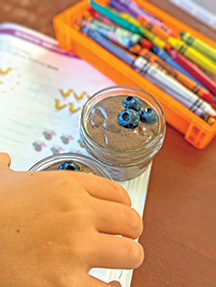
Pudding is one of my major standbys, and it works well for an after school snack, ticking all the boxes of simple, nutritious, kid-friendly, and even good both right now and made-ahead. Chia seeds have such an oddly delightful thickening capability, and while you can make an easy pudding just by mixing the ingredients, I prefer a smooth, blended style. Hey, that’s not too bad,” Benson declared after a tester bite. Without any awareness of what my article was about, he grabbed his crayon and his spoon turned this into a during-school snack.

Prep tips: chia seeds get very sticky with time, so try and wash your equipment right away. This makes about 3 cups of pudding.

2 ½ cups whole milk

½ cup chia seeds

½ cup blueberries, plus more for topping

⅓ cup cocoa powder

¼ cup almond butter

6-8 dates, pitted

dash salt

Whisk milk and chia seeds; let sit about half an hour or until the chia has soaked up some of the milk. Transfer to a blender container, add remaining ingredients, and blend until smooth. Pour into individual containers (we like jars, of course) and refrigerate until snacktime — or eat right away.


 

Verena’s wedding cake

0

Lovina’s Amish Kitchen
Lovina Eitcher,
Old Order Amish
Cook, Wife &
Mother of Eight


Hello readers! This is Lovina’s daughter Verena. Daniel Ray is outside weed whacking and I have all my work caught up so I decided to write Mom’s column. 

I have not had time to be “bored” yet since my wedding which I’m okay with. Daniel Ray and I live in part of my parent’s pole barn. We like our little part and it is nice to be so close to Mom. It’s been a few times I have needed ingredients for something I needed to bake or cook and I haven’t had it on hand so I can go ask the neighbor. If Mom doesn’t have something, most likely Loretta or Lovina will. Ha 

Loretta, Lovina, and I have had our share of fun already living this close by each other. We like to go on our walks or maybe I should say our strolls. Loretta and I on our mobility scooters and Lovina on her powered wheelchair. Loretta hooks the wagon behind her scooter with her three children sitting inside the wagon. We like when the irrigation system has water going across the road and we act like young children again going back and forth underneath it. Haha This always excites Loretta’s children. They love it!

Married life has been treating me very well so far. I’m a happy married woman and I have a cheerful, ornery man as my husband. There’s never a dull moment with him. He can be such a character. At night, once everything is settled down and there is no more work to be done, Daniel Ray and I love to play Phase 10. We have played many, many rounds of that and have not found it boring yet. I guess we will see if it stays that way. Haha Daniel Ray loves to help me in the kitchen and I’m very okay with that. Cooking and baking doesn’t always come easily from a mobility scooter but it doesn’t stop me from trying. I have always enjoyed working in the kitchen and trying new recipes.


Daniel Ray and I get up at 3:30 AM and I pack his lunch for work. He doesn’t want much for lunch so it is really easy to pack his lunch. He leaves around 4:00 and most times I go back to bed. It depends if I go over to stay with my sister Loretta or not. Sometimes I don’t have to go to Loretta’s until 5:00 or after. 

All of us sisters are planning on spending the day at Mom’s tomorrow. I’m looking forward to that. We haven’t done that in a while due to it being so busy for everyone. I’m sure the house will be full of chattering while everyone wants to tell their newest news. A lot of times, we end up goofing off together and create so many funny memories. Mom always makes us such a big tasty breakfast and then she does the same again for lunch. I’m excited to get more cuddles from my sister Susan’s newborn Sharlene. 


I always enjoy seeing all my nieces and nephews. They know how to brighten my day. I bought toys for whenever they come over to visit me. I don’t want them to be bored at Aunt Verena’s house. Every time I babysit, the new toys entertain them and it makes my babysitting job so much easier. The older ones love to paint when they come here and they always paint me pictures and ask me to hang them on the fridge and of course, I do just that.

 Well, you all take care and God bless! 

PEACH BREAD

3 cups fresh peaches, peeled and chopped
6 tablespoons sugar
2 cups all-purpose flour
1 teaspoon baking soda
1/4 teaspoon salt
1 teaspoon cinnamon
1/2 cup vegetable shortening
1 1/2 cups sugar
2 large eggs
1 teaspoon vanilla
1 cup coarsely chopped nuts

Preheat the oven to 325 degrees. In a small bowl, combine the peaches and 6 tablespoons of sugar and set aside. In another small bowl, combine the dry ingredients, mix well, and set aside. In a large mixing bowl, cream together the shortening and 1 1/2 cups sugar. Add the eggs and vanilla and beat until well blended. Alternately, add the peach and flour mixtures to the egg mixture and beat until smooth. Fold in the nuts and pour the batter into a greased and floured loaf pan. Bake until golden brown, about 55 minutes. Turn out on a rack to cool. This makes 1 medium loaf.

Lovina’s Amish Kitchen is written by Lovina Eicher, Old Order Amish writer, cook, wife, and mother of eight. Her three cookbooks, The Cherished Table, The Essential Amish Cookbook, and Amish Family Recipes, are available wherever books are sold. Readers can write to Eicher at Lovina’s Amish Kitchen, PO Box 234, Sturgis, MI 49091 (please include a self-addressed stamped envelope for a reply); or email [email protected] and your message will be passed on to her to read. She does not personally respond to emails.

KU McNair Scholars present original research at summer symposium

0

Contact: Chance Dibben, [email protected]
KU McNair Scholars present original research at summer symposium
LAWRENCE — Sixteen undergraduate students from the University of Kansas shared their original research at the McNair Scholars Summer Research Symposium. The event marked the culmination of months of dedicated scholarly work and mentorship. Hosted by the KU TRIO McNair Scholars Program, the symposium highlights student-driven inquiry and offers a preview of the next generation of researchers.

“This symposium is more than a presentation — it’s a celebration of research, development of researcher identity and joy of scientific discovery,” said Mulubrhan Lemma, director of the TRIO McNair Scholars Program. “Our students start by learning how to ask meaningful questions, and by the time they present, they’re contributing insights to their fields. It’s a powerful transformation.”

That transformation often begins with uncertainty and grows through experience. Gilbert Barranca, a civil engineering student from Topeka, did not consider research until a mentor encouraged him to apply to McNair. His project compared roundabouts in Lawrence and rural Topeka to examine how driver behavior differs across settings.

“It’s pushed me in ways I didn’t expect,” Barranca said. “I’ve learned a lot, and I’m excited to keep going.”

The Center for Educational Opportunity Programs (CEOP), a center within the Achievement & Assessment Institute (AAI) at KU, leads the TRIO McNair Scholars Program. The program prepares undergraduates for graduate study through research, mentorship and academic development.

A key milestone in the program is the McNair Scholars Summer Research Symposium. Students begin developing proposals in a spring seminar and spend the summer transforming their ideas into full research projects with support from dedicated faculty mentors. This year’s cohort represented fields ranging from public policy and linguistics to microbiology and transportation systems, with each project reflecting students’ intellectual curiosity and personal goals.

Natalia Lopez-Rios, a linguistics major from Wichita, centered her project on bilingual language development, exploring how children understand specific words in English and Spanish.

“It’s exciting because I get to interact with my community and have them participate in the research,” Lopez-Rios said. “Being part of this group has deepened my motivation and enriched my research experience.”

Mentorship is a cornerstone of the experience. Each student is paired with a faculty member in their discipline and receives wraparound support from the McNair program, ensuring they receive comprehensive guidance throughout the process. For Meghan Arias, a microbiology major from Olathe studying an antiviral host protein, mentorship was crucial in navigating academic research.

“McNair strikes the perfect balance,” Arias said. “They throw you into research where you have to figure things out on your own, but they also provide the mentorship and technical support to help you succeed.”

The program’s holistic support is intentional, said Monica Martinez, assistant director of the TRIO McNair Scholars Program.

“We don’t just prepare students to do research,” Martinez said. “We prepare them to thrive in spaces that weren’t necessarily built for them. They leave McNair not just with a project, but with a sense of agency, confidence and belonging in higher education.”

McNair also helps students reimagine what’s possible in their academic lives. For Gerardo Fornoza, a political science major and returning adult learner, that meant seeing graduate school as something within reach.

That shift began when Maggie Borders, assistant director for TRIO SES + STEM, asked if he’d ever considered grad school.

“I told her, ‘No, that’s not for someone like me,’” Fornoza said. But with her encouragement, he applied to the McNair Scholars Program and was accepted.

As a McNair Scholar, Fornoza explored how political partisanship shapes public opinion on social programs. He worked under the mentorship of Kevin Mullinix, associate professor and undergraduate director in political science, who helped refine and guide his research. Mullinix had once served as a graduate McNair mentor over a decade ago and brought that experience full circle in supporting Fornoza’s growth.

“McNair helped me turn a broad idea into a real, manageable project,” Fornoza said.

Now in its 30th year at KU, the McNair Scholars Summer Research Symposium continues to serve as a gateway for students to discover their potential — not just as scholars, but as future leaders in their fields.

McNair Scholars Summer Research Symposium participants

Sumaya Ahmed, Overland Park
Meghan Arias, Olathe
Hildana Ayana, Lenexa
Gilbert Barranco, Topeka
Daniella Beers, Junction City
Gerardo Fornoza, Wichita
Madison Knoll, Wichita
Natalia Lopez-Rios, Wichita
Esperança Monteiro Henson, Rio de Janeiro, Brazil
Sophia Nevarez, Norfolk, Virginia
Levi O’Connor, Louisburg
Josh O’Connor, Louisburg
Selena Reno, Kansas City, Missouri
Giselle Sandoval Morales, Topeka
Andrew Stumblingbear, Crookston, Minnesota
Bethel Yigezu, Olathe

-30-

————————————————————————


KU News Service

1450 Jayhawk Blvd.

Lawrence KS 66045

[email protected]

https://www.news.ku.edu


Erinn Barcomb-Peterson, director of news and media relations, [email protected]


Today’s News is a free service from the Office of Public Affairs


KU News: Water history exhibit grand opening at El Quartelejo Museum in Scott City

0

From the Office of Public Affairs | https://www.news.ku.edu

Headlines

Water history exhibit grand opening at El Quartelejo Museum in Scott City
Using a variety of multimedia components, a collaborative exhibit from the Kansas Geological Survey and Groundwater Management District 1 combines the scientific study of water and local history to show the story of water use in western Kansas. “History of Scott County Irrigation and the Ogallala Aquifer” opens Aug. 16.


Dole Archives, American Congress Digital Archives Portal partners awarded funding to expand portal, add civic and history education initiatives
The allocation will allow staff at the Robert and Elizabeth Dole Archives and Special Collections to digitize and contribute to the portal more items from the congressional archives of Sens. Bob and Elizabeth Dole, as well as expand the Institute’s K-12 civics and history education programs and outreach throughout Kansas.

Full stories below.

————————————————————————

Contact: Sunday Siomades, [email protected]
Water history exhibit grand opening at El Quartelejo Museum in Scott City
SCOTT CITY — El Quartelejo Museum, in collaboration with the Kansas Geological Survey and Groundwater Management District 1, will open its newest exhibit, “History of Scott County Irrigation and the Ogallala Aquifer,” on Aug. 16.

Using a variety of multimedia components, the exhibit combines the scientific study of water and local history to show the story of water use in western Kansas.

“The exhibit focuses on farming outcomes, water resources, management and education to illustrate the irrigation history of Scott County and the High Plains of western Kansas,” said Stephanie Fisher, El Quartelejo Museum director. “Its goal is to highlight primary sources, photographs and interactive educational elements.”

Sunday Siomades, who interned with the museum through the University of Kansas’ Museum Studies program, designed the exhibit.

“The design of the exhibit seeks to connect visitors with water history in tactile, immersive ways to demonstrate how communities interact with the natural environment,” said Siomades, who is studying geology and science communication through the KU Department of Geology and the Kansas Geological Survey.

The exhibit begins with early Scott County irrigation in the 1650s and moves through time to the management practices and water science that define present-day agriculture. Scott County’s cattle industry — the fourth highest in the nation — relies heavily on groundwater. Consequently, the status of the Ogallala aquifer, which provides this essential water resource, is especially relevant to the county.

Exhibit visitors will learn about historical innovations (and innovators) in irrigation, explore the science of aquifers and groundwater and watch water flow through the decades right under their feet.

The installation represents locality-driven science outreach designed to equip visitors of all ages with the historical and scientific background to discuss community water resources. Katie Durham, GMD1 manager, said the district sees education and outreach as critical components in protecting groundwater for future generations.

“Sharing the history of irrigation in our district helps us all to understand where we’ve been, the challenges we face and why the progress being made is so important to our communities, culture and economy,” she said.

In conjunction with the new exhibit, the KGS plans presentations, educational games, and activities for the public beginning at 10 a.m. at the museum. A ribbon-cutting ceremony for the exhibit will take place at 2 p.m. The schedule of events is available online.

“I’m so grateful to the museum for providing the KGS with this opportunity,” said Blair Schneider, KGS science outreach manager and exhibit contributor. “I hope that this project paves a pathway for the KGS to partner with more community museums across the state.”

The “History of Scott County Irrigation and the Ogallala Aquifer” joins a variety of paleontological and anthropological exhibits featured at El Quartelejo Museum and Jerry Thomas Gallery and Collection on topics ranging from Kansas’s prehistoric inland sea to Native American history to modern municipal development.

About the Kansas Geological Survey
The KGS is a nonregulatory research and service division of the University of Kansas. KGS researchers study and provide information about the state’s geologic resources and hazards, including groundwater, oil and natural gas, critical materials and earthquakes.

-30-

————————————————————————

The official university account for X (formerly Twitter) is @UnivOfKansas.

Follow @KUnews for KU News Service stories, discoveries and experts.


————————————————————————


Contact: Jackson DeAndrea, 785-864-4900, [email protected]
Dole Archives, American Congress Digital Archives Portal partners awarded funding to expand portal, add civic and history education initiatives

LAWRENCE — The Robert J. Dole Institute of Politics at the University of Kansas — one of three founding members of a national consortium of congressional archives created in 2021 and based at West Virginia University Libraries — will receive up to $200,000 in federal funding to expand the utility, usability and capacity of the American Congress Digital Archives Portal in the next phase of its development.


The allocation, a portion of $1.5 million in total funding, will be distributed by the National Historical Publications and Records Commission. It will allow staff at the Robert and Elizabeth Dole Archives and Special Collections to digitize and contribute to the portal more items from the congressional archives of Sens. Bob and Elizabeth Dole, as well as expand the Institute’s K-12 civics and history education programs and outreach throughout Kansas.


“Growing the portal from an idea five years ago to where it is today – nearly 7,500 items from 20 collections at six partner institutions digitized and available online – has been incredibly gratifying,” said Sarah Gard, senior archivist and head of collections at the Dole Institute. “These collections are vital for understanding Congress and our democracy. We are really excited about bringing these resources to new audiences and expanding our educational outreach throughout Kansas to K-12 audiences.”


Unlike presidential papers or similar government records, congressional collections are geographically dispersed across the nation at institutions of all shapes and sizes. Scholars, educators, students and the general public have open access through the portal to thousands of civically important primary resources created by the legislative branch and about public policymaking throughout the 20th and 21st centuries. This includes documents, photos and audiovisual materials.


Going beyond the study of Congress and its role in American government, the value of these archives lies within their capacity to illustrate the country’s social, cultural and political development narratives.


The award will support digitization of selected materials from the Dole Archives, including creating full-text transcripts of manuscripts and audiovisual materials, which will make them accessible online for researchers with disabilities.


Funding will also support the installation of a new digital repository for digitized materials, allowing the Dole Archives to quickly make more content available to researchers. In this phase of the project, all member institutions will contribute more than 8,000 manuscripts, audiovisual assets and photographs.


Additionally, the award supports the Dole Institute’s civic education initiatives, which annually reach thousands of students across Kansas. Over the next year, the Institute is hosting workshops for students participating in the National History Day contest, providing them opportunities to develop and enhance their presentations using materials from the Institute and other institutional project partners.


The Dole Institute is partnering with WVU Libraries and other institutions that hold congressional archives, including the Carl Albert Congressional Research and Studies Center at the University of Oklahoma, the Dirksen Congressional Center, the Richard B. Russell Library for Political Research and Studies at the University of Georgia, and the University of Hawaii Manoa Library.


For more information about the American Congress Digital Archives Portal or the Congressional Archives Education Project, visit congressarchives.org.


About the Dole Institute

Inspired by the leadership legacies of Sens. Bob and Elizabeth Dole, and the enduring civic contributions of the Greatest Generation, the Dole Institute of Politics strives to promote a new era of leadership that uses politics to bring people together through opportunities that emphasize bipartisan cooperation, public service and civic education and engagement.

-30-

————————————————————————


KU News Service

1450 Jayhawk Blvd.

Lawrence KS 66045

[email protected]

https://www.news.ku.edu


Erinn Barcomb-Peterson, director of news and media relations, [email protected]


Today’s News is a free service from the Office of Public Affairs

Cell Phone Fiasco

0
Thayne Cozart
Milo Yield

Cell phones and smart phones have become absolutely necessary to many rural folks for them do their jobs or run their businesses.

One such person is ol’ Hawlin G. Raines — an independent, mostly day-trip trucker, who transports soybeans, corn, wheat and other agricultural commodities to various grain elevators and feedstuff manufacturers. He gets his jobs and coordinates all the times and delivery information via his smart phone.

Well, recently, he upgraded his phone to the newest expensive model. Everything wuz working well for him until one day when he delivered some soybeans to the grain dump at a nearby livestock ration formulator.

While Hawlin wuz dumping his load, something went wrong under his semi and he crawled under to fix the problem. While under his rig, he (of course) got a phone call that he answered by extracting his new phone from its holster.

When the call ended, he stuck the phone into his shirt pocket. But, while crawling out from under his rig, he hit his head and when he reflexively jerked back, he caught a glimpse of his expensive new smart phone eject from his shirt pocket, right into the flow of unloading soybeans, and in an instant disappear down into the murky depths of the dump chute.

Hawlin knew he wuz in a fix. He knew he couldn’t find his lost phone. So, he immediately went to the store where he bought his new phone because he knew he’d insured it. Well, it turns out that he had, but (of course) it would be three days before he could get a replacement phone.

Facing the knowledge that he’d could lose significant money in three days if he had no smart phone, Hawlin bit the bullet and bought another expensive phone.

When he got home, the feed mill folks where he’s lost his first phone, got in touch with him and said that when they’d run the soybeans into the processor, a debris mesh had caught his …… no, not his expensive phone, but its screen saver instead.

The mill said they’d keep watching to see if Hawlin’s smart phone got screened out of the soybeans, but Hawlin is highly doubtful that will happen.

I guess the lesson from Hawlin’s experience is be cautious about putting your cell phone in your shirt pocket.

***

School started locally this week, so the Old Geezer Gossip Group’s conversations one morning wuz about our experiences riding school busses back in our elementary and high school days.

Several stories got told, but here’s the best one. Arch wuz riding his school bus when one ornery kid got into a loud argument with the bus driver about the kid staying in his seat and picking on the younger kids.

Now remember this wuz back in the days when a school bus driver has absolute authority over his passengers. So, when his argument with the ornery kid reached a its highest pitch, the bus driver ordered the kid off the bus, so he could walk all the way home.

And, that’s what happened. As he exited the bus, the driver told the kid he’d take it up with his parents. The kid retorted, “Go ahead.”

But, then the episode took a humorous bent. The kid hadn’t walked far, when a neighbor picked him up and took him to his home.

But, the kid didn’t go to straight into his home. Instead, he lingered next to the road. Then when his bus drove buy, there stood the kid smiling from ear to ear and waving happily at his disciplinarian bus driver.

***

That story about ornery kids made my fishing buddy, Castin Crankitt, recall the time at his home back in Minnesota when two ornery neighborhood kids came into Castin’s mom’s kitchen and browsed around for something sweet to eat.

They discovered a chocolate bar on the top shelf of the kitchen and devoured it. A few hours later, the young thieves came down with an unexpected case of diarrhea.

Seems they’d stolen and eaten an entire bar of Exlax. Sometimes, experience is a nasty, but humbling, teacher.

***

An agribusinessman decided to celebrate his anniversary with his wive by taking her to an upscale steak house for a celebratory meal.

They both ordered mouth-watering steaks, but when their waiter arrived to deliver their meal to their table, the wife noticed that the waiter had his finger draped over her steak.

When he sat down her plate, the waiter said, “Here you go, ma’am, enjoy.”

“Are you crazy’?” the wife said. “Your hand’s been on my steak!”

“Well, excuse me!” the waiter snapped back. “You’d rather it fell on the floor again?”

***

The topic of drinking energy drinks arose recently at our old geezer group. A few said they needed energy drinks on occasion so they could finish a task.

That’s when I interrupted and said, “Well, I need an energy drink to keep me awake until time for my early afternoon nap!”

***

Words of wisdom for this week: “It’s not old age that makes us forgetful. It’s just too much stupid stuff to remember.”

Have a good ‘un.