Become certified to teach fishing techniques in Kansas during one-day course
PRATT – The Kansas Department of Wildlife, Parks and Tourism (KDWPT) will host an Angler Certification Course Dec. 6 for anglers wishing to teach fishing techniques in Kansas. The class will be held from 9 a.m. – 1 p.m. at the Greenbush Camp and Retreat Center, 947 W 47 Hwy, Girard, KS 66743. There is no cost to attend, however the class will be limited to the first 40 registrants. Lunch will be provided.
The program has certified 230 instructors, including nearly 100 Kansas school teachers, in its first year and a half alone. This year, angler education instructors and KDWPT employees held 135 events ranging from fishing derbies and casting events, to community outreach and aquatic education in the schools programs. Certified instructors have donated 1,100 hours of their time to this successful program which has reached nearly 60,000 participants and counting. These volunteer hours translate not only to a public awareness and appreciation of natural resources, but to money reimbursed back to Kansas for aquatic education supplies (fishing poles, lures, fish trading cards, etc.) and towards enhancing the state’s fisheries’ resources.
Apart from becoming a certified angler education instructor, attendees will also be given valuable information regarding working with children, sample curriculums, and tips for preparing a class or clinic. Other subjects covered in the four-hour class include current fishing regulations, species identification, fishing ethics, equipment, knot-tying, casting, fish habitat, aquatic nuisance species, and conservation practices.
Kansas offers some of the best public fishing opportunities in the nation, and this is just one more way for anglers to pass on their passion for fishing to those who may have yet to experience Kansas fishing.
Anglers interested in registering for the December 6 class are encouraged to sign up by visiting www.fishingsfuture.org and clicking “upcoming events,” then “Kansas Angler Education Training Program.”
For more information, contact Fishing’s Future coordinator Kevin Reich at [email protected] or by phone at (785) 577-6921.
Melissa Bess, Nutrition and Health Education Specialist, Camden County; Edited by Jessica Kovarik, RD, LD, former Extension Associate, University of Missouri Extension
Thanksgiving is usually one of those holidays where second helpings are a must. Some Thanksgiving meals can equal the amount of calories and fat we need in an entire day, or even more. Moderation, not deprivation, is the key to a happy and healthy Thanksgiving! Here are some ways to make your Thanksgiving feast healthier.
Plan ahead and search online for healthy Thanksgiving recipes. You will find many healthier versions of traditional dishes in which the fat is reduced but the flavor is retained. See the Healthy Habits recipes on MissouriFamilies.org for healthy recipes. The fun part will be seeing if anyone can even tell the difference.
Enjoy turkey. With the skin removed, turkey has a good amount of protein and little fat or saturated fat. Dark meat has more fat than white meat. Roast or bake instead of frying.
Eat sweet potatoes. Sweet potatoes are a rich source of potassium (can help lower blood pressure), vitamin A, beta carotene (both vitamin A and beta carotene help with healthy vision), vitamin C (an antioxidant, protective against diseases), and fiber (promotes a healthy digestive system and may prevent diseases). Try to limit or avoid using brown sugar, marshmallows and butter on sweet potato dishes. Use other seasonings such as cinnamon, ginger or orange rind for flavor. Or try a new recipe for a savory sweet potato dish, rather than a sweet one.
Try a different type of pumpkin dessert instead of pumpkin pie. Pumpkin has similar nutrients to sweet potatoes. Make a pumpkin custard or pumpkin pudding using ginger or cinnamon for flavor.
Use evaporated skim milk instead of regular evaporated milk in recipes. This applies to many dessert recipes.
Representatives of Wichita State University and Westar Energy held a dedication ceremony today for an expanded and updated laboratory where WSU College of Engineering students learn about power systems.
The facility in Wallace Hall has been named the Westar Energy Lab to recognize the utility’s pledge of $125,000 to support the lab over a five-year period. The funds are being used to buy new equipment and tools to teach students about smart grids, synchrophasors, power quality and advanced system modeling, among other facets of electrical engineering.
“This support from Westar Energy is a wonderful example of how our corporate friends are willing to invest in educational excellence so that students are fully prepared to succeed in their chosen fields upon graduation,” said Elizabeth King, president and CEO of the WSU Foundation.
The lab will give WSU engineering students real-world experience with equipment relevant to today’s electric industry, said Kelly Harrison, vice president for transmission at Westar Energy.
“Westar Energy is delighted to partner with Wichita State University on the addition of this power systems lab to its engineering program,” Harrison said. “Partnerships like this between a Kansas-based business and an institution of higher learning help ensure that the technical skills students are acquiring align with the needs of businesses like Westar’s.”
John Watkins, chair of the WSU Electrical Engineering and Computer Science Department, thanked Westar Energy for its contribution.
“As the lab will be used in a broad range of electric energy classes, it will provide many students more hands-on experience,” Watkins said. “It is truly preparing our students for work in the power industry of the 21st century.”
Adapted by Jessica Kovarik, RD, LD, former Extension Associate; Based on material by Susan Mills-Gray and Tammy Roberts, MS, RD, LD, Nutrition and Health Education Specialists, University of Missouri Extension
When cooking a turkey, there is usually leftovers. With a little creativity and safe food handling, you can enjoy turkey-based meals with little preparation and cooking.
Anytime you prepare, cook and store food, you must practice safe food handling methods to be sure your leftover turkey is safe to eat. During mealtime, do not let the turkey sit out for more than two hours after it has been cooked. For safe storage, remove the stuffing and de-bone the turkey. Store the turkey in shallow containers in the refrigerator because shallow containers allow the turkey to cool faster, preventing growth of harmful bacteria.
Unless you freeze the leftovers, be sure to use the turkey and stuffing within 3-4 days. Leftover gravy should be used within 1-2 days. Other cooked dishes can be stored up to 4 days.
Frozen leftovers should be stored at 0 degrees Fahrenheit or below and used within 3-4 months. Turkey that is in gravy or broth, or other cooked turkey dishes can be frozen for 4-6 months. Stuffing and gravy can keep up to 1 month in the freezer.
Marking your leftovers with the date and name of the item will help you keep better track of them.
Lastly, when you reheat the turkey, stuffing or gravy, make sure it reaches a temperature of at least 165 degrees.
Here are a few ideas for using your leftover turkey…
Students at Kansas State University are working to make the campus more sustainable by converting used cooking oil from campus dining facilities into biodiesel to fuel many campus vehicles and landscaping equipment.
Students at Kansas State University are working to make the campus more sustainable by converting used cooking oil from campus dining facilities into biodiesel to fuel many campus vehicles and landscaping equipment.
Converting cooking oil into fuel – the Biodiesel Initiative at Kansas State University allows for collaboration among many campus departments and industry organizations
MANHATTAN, Kan. – The sound of a diesel engine is distinct. Sure, some are louder than others, and diesel enthusiasts can usually recognize the differences in sound between Cummins and Powerstroke engines, for example, when driving down the road.
One Cummins engine in particular, housed in a maroon Dodge Ram 2500 Heavy Duty truck on the Kansas State University campus, operates using a renewable fuel called biodiesel. Students, faculty, staff and visitors might meet the truck occasionally as it makes the rounds to pick up used cooking oil from residence hall dining facilities and the K-State Student Union.
The unique truck, which down the sides reads, “Powered by Biodiesel,” serves as the flagship for a major sustainability project at K-State, the Biodiesel Initiative. The waste oil goes to a conversion lab at the K-State Recycling Center, where students turn it into biodiesel for use in other K-State diesel trucks and landscaping equipment.
“We have a number of diesel trucks on campus that consume our biodiesel, and other smaller engines can use it as well,” said Ron Madl, K-State emeritus research professor of grain science and a leader of the Biodiesel Initiative.
According to the National Biodiesel Board (http://www.biodiesel.org/what-is-biodiesel/biodiesel-basics), biodiesel can be made from a diverse mix of feedstocks that include recycled cooking oil, soybean oil and animal fats. Because recycled cooking oil is the input at K-State, people who eat fried foods on occasion in one of the campus dining facilities contribute in a small way to the university’s sustainability.
Experiential learning
Madl wanted to get students more involved in research centered on sustainability when he served as co-director for K-State’s Center for Sustainable Energy (http://cse.ksu.edu). The K-State 2025 visionary plan (http://www.k-state.edu/2025/) also emphasizes sustainability planning as a way to help K-State become a top-50 public research university.
“All universities need to teach our young people how we can have a smaller footprint going forward,” Madl said. “Getting them involved in recycling—how we do it chemically and how we do it economically—is important.”
About two years ago, Madl established a biodiesel conversion lab from scratch with funding help from the Kansas Soybean Commission, the industry organization that also provided the Dodge truck for waste oil pick-up and salary support for student workers to run the lab.
The students represent many different majors, including grain science, biological and agricultural engineering, chemical engineering, chemistry and biochemistry. Together, they formed the Biodiesel Club that is currently supervised by Dan Higgins, professor of chemistry at K-State. Club members get hands-on experience in the conversion lab and learn about the process of making biodiesel.
“These students get great experience in understanding how processes operate with responsibility and maintaining safety,” Madl said. “Students can leverage this experience in their future careers and are setting an example about sustainability across campus.”
Rachel DeMyers, a junior chemical engineering major at K-State, is the current project manager for the lab but has been involved in the Biodiesel Initiative since the beginning.
“I like the hands-on experience and learning how to problem solve,” DeMyers said. “I was able to get an internship going into my junior year, which isn’t common, because I had confidence in my ability and leadership experience with this project.”
Joshua Benton, also a junior chemical engineering major, is the process lead in the lab. He enjoys working with students who have different backgrounds and skill sets.
“Everyone brings something different to the table,” Benton said. “One of our members is an English major, so she’s always on top of writing proposals and forming the charter for our group.”
DeMyers and Benton said students must go through a semester of safety training before working in the lab, and at least two students must be present when making biodiesel at all times.
Processing and using biodiesel
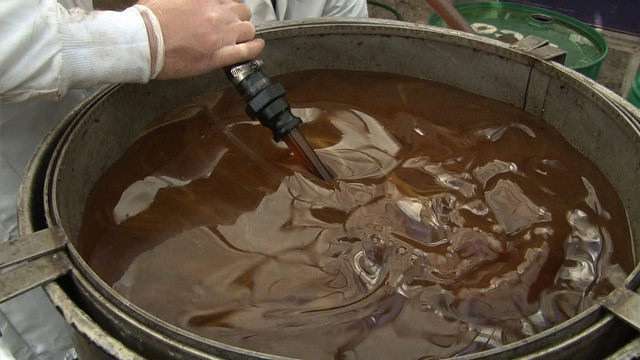
Once the students collect the waste oil at different locations on campus, they bring it to the conversion lab and test the quality of the oil, Madl said. The oil must have the right chemistry—a certain level of moisture and a low free fatty acid content—for a good reaction. The students then filter out the solid particles, such as leftover French fries.
When the oil meets those requirements, it goes into a reactor and is converted to 100 percent biodiesel, or B100. Then it’s blended with petroleum diesel to get B20, or 20 percent biodiesel, which is used to fuel many of the campus vehicles.
“I estimate that we will produce between 1,500 and 2,500 gallons of B100 per year,” Madl said. “We convert at least 50 gallons of waste oil per week in eight months of the year, as we shut down for the summer and during winter holidays.”
The lab wasn’t completely quiet the last two summers, however, as K-State professor of chemical engineering Keith Hohn has supported the initiative by providing National Science Foundation (NSF) Research Experiences for Undergraduates (REU) students to work on research projects in the conversion lab.
Another K-State faculty member, Ed Brokesh, recently became involved in the Biodiesel Initiative as well. As an instructor in biological and agricultural engineering, he uses biodiesel produced on campus to show students how it operates in their tractors compared to petroleum diesel. The students run engine performance tests to make the comparison.
“The students often hear and read about biodiesel but never actually get to see it in use,” Brokesh said. “Basically, there’s not much of a difference in the fuels. They both operate and perform the same way. One just happens to be out of petroleum, and one is out of soybean or other organic materials to create biodiesel.”
Brokesh said producing the fuel is one thing, but it is important to study the fuels and how they interact with different engines. Through research knowledge, he and his students can educate consumers—farmers in particular—about using biodiesel.
In addition to the Kansas Soybean Commission, other sources of financial support include the K-State Provost’s Academic Excellence Fund and a NSF grant awarded to K-State’s Department of Industrial and Manufacturing Systems Engineering that relates to cooperative research on sustainability, Madl said. Because the university does not have to purchase as much diesel fuel, it credits the conversion lab for the amount saved in fuel costs to help support the lab’s needs.
Sidebar: The Sustainable Campus: Looking to the Future
One of the latest equipment purchases for the biodiesel conversion lab at Kansas State University could help the university become even more sustainable in the future, said Ron Madl, K-State emeritus research professor of grain science and a leader of the Biodiesel Initiative.
“An issue that you have with biodiesel is about 20 percent of the production volume generated from our reactor is a waste product that has to be disposed of,” he said. “It is mostly glycerol, but there is methanol unused from the reaction itself. As a result, we’ve purchased a piece of equipment that will give us the ability to purify glycerol and separate it from the methanol. The methanol is then put back into the reactor for the next time we run a reaction, so we’re recycling the menthol and getting more use of that chemical.”
The purified glycerol, then, has another value, he said. K-State students are currently researching how to convert the glycerol into an industrial degreaser that K-State Facilities could possibly use internally.