It is time for the 2026 Harvey County Home and Garden Show! We have a great lineup of educational speakers, events and exhibitors for this year. It will be held at the Dyck Arboretum in Hesston on March 21 and 22, 2026. Come participate in our kid’s activity, door prizes, garden seminars and more at the beautiful arboretum!
2026 Harvey County Home and Garden speaker schedule!
Saturday, March 21, 2026
9:00 am Stride With Purpose, Walk With Joy
10:00 am How To Evade Chigger Bites
11:00 am Do Not Allow Ants To Get Into Your Pants: How To Deal With Ants In The Home
1:00 pm Pruning with Purpose
2:00 pm Pruning Fruit Trees
3:00 pm Creating an Edible Planter for Your Porch
4:00 pm Preparing Your Garden Spot
Sunday, March 22, 2026
1:00 pm Tree Care with TLC
2:00 pm Sensory Gardens That Make Scents
3:00 pm Landscape Design 101
4:00 pm Rain Barrels
Admission to this event is $1.00, under age 18 is free. Be sure to check it out!
Nothing says simplicity like cooking inside a foil pouch. This past week I prepared 2 meals, totally different, inside an aluminum foil pouch. Easy clean-up and most generally; a great meal! You can keep these meals extremely simple or take them to an entirely new level.
With St. Patrick’s Day just around the corner this is a great time to chat a bit about the perfect foil pouch for March. (I always do my cabbage inside a foil pouch.) (Cook the brisket, trim it down, and place it in with the cabbage.)
Instead of a regular recipe this week I’m going to simply outline my two meals from this past week. The first was a cabbage & potato pouch. The second was a bit more spiced up with a chicken pouch dinner served over well seasoned Basmati Rice. Perhaps the best part of cooking inside a foil pouch is how wonderful clean-up can be. Those who work full-time will enjoy the fact they can come home, quickly put the pouch together, slide it in the oven, moving on to another project in the 40-50 minutes it takes to bake, As you plan your pouches try to cover vegetables, fruits and meats in one
meal.
Here is the first foil pouch, we’ll call it #1:
Sliced Cabbage
Sliced red potatoes, skins left on
Turkey spiced kielbasa sausage
Sliced Onions
Seasoning
3-5 tablespoons butter
Vegetable Spray
Large piece of foil for the pouch
Oven set at 350 degrees for about 50 minutes
Foil Pouch #2:
2 chicken breasts
Sliced peppers and onions
Chunk pineapple
Vegetable Spray
Seasonings of choice
Chinese sauce by P.F. Chang
Large piece of foil for pouch
Oven set at 350 degrees for about 45-50 min.
With this pouch I prepared Seasoned Basmati Rice.
There will be plenty of juices to ladle over the rice.
Consider cooking rice in stock for enhanced flavor
Place chicken, seasonings, vegetables & fruit in
pouch, followed by a good covering of the chosen sauce.)
Seal and bake.
In each foil pouch you are going to prepare the amount that you need to serve for dinner &/or for leftovers.
This past weekend my good friend, Lucy, called to rub it in that she was having homemade rice pudding for dinner. I gave her a very hard time, because it made me hungry for my grandmother’s rice pudding with raisins. I don’t know what your mind is thinking, but as soon as she presented what she made I could taste my grandmother’s on my palate. You got it, I’ll be making rice pudding this week.
Here are a couple of tips for you: As we get closer to Easter, remember to get your eggs at least a couple of weeks BEFORE Easter dinner! This way they will be much easier to peel. Also; before you boil your eggs for the holiday remember to flip them over in the carton a few hours before you boil them. This will help to center the yolks so they are not sitting at the end of the egg.
Best decaffeinated coffee, Starbucks, hands down.
Tastes like it is caffeinated!!!
Time to enjoy a hot chocolate before I call it a night. Simply yours, The Covered Dish.
Back when my wife and I hunted together more, we’d often pass the hours spent in a hunting blind by making up animal conversations for various situations. On a fall turkey hunt years ago, we had our hunting blind set up near an old feedlot. The owner had round bales stored there and a tractor path wound around through the bales. The turkeys followed the tractor path through the bales and into the pasture surrounding the old feedlot. We put a couple hen turkey decoys just across the fence into the pasture and settled into our blind amongst the bales. The resident cattle soon came to see what was up, and became enamored with the decoys. You could almost sense their thoughts, so we named the cows Clara, Elsie, Audrey and Bessie, and imagined their conversation going something like this; “They look like turkeys, but they sure don’t move much,” Clara thought starring at the decoys. Elsie added “Turkeys stink but these things smell like tractor tires or something. Let’s all run at them and see if they scatter and make those same funny noises turkeys make when we almost step on them.” Audrey weighed in “No, I’m pretty sure they aren’t real turkeys – if they were they’d be eatin’ corn out of our poo right now.” Bessie said “Girls I’ve got an idea – let’s all back up and try to pee on them and see if they run like they usually do.”
Perhaps the funniest animal conversation we ever conjured up came about at an old farmstead where we used to hunt deer. The abandoned farmyard sits back a long lane and we’d park our pickup there and walk to the nearby deer blind. We know deer routinely wonder through the farmyard and around the old buildings, so we tried to imagine how they would react to our truck sitting there if they wandered through as we sat in the blind. Here was the scene: One morning as we sit there in our deer blind, two deer, Bucky and Chloe wonder through and come upon our pickup in the drive. “See Bucky,” Chloe states “I told you I smelled them again.” Bucky rests his chin on the hood of the pickup and replies “Yup, sure enough. Hoods still warm, they’re here somewhere.” “What doofuses,” Chloe retorts with disgust as she turns and begins to walk away. Meanwhile Bucky jumps up and sprawls out across the hood of the pickup with his front legs sticking out in front of him and his back legs out behind him, rolls his eyes back into his head and hangs his tongue out the side of his mouth. “Chloe hears the
commotion, and just as she turns around Bucky calls out “Ohhhhh Chloe, they got me!” “You get off there this instant,” Chloe scolds. “That’s not funny at all anymore, especially after you got shot in the butt last season!”
The nursing/retirement home where I used to work has two dementia units and I often marveled at the strange things the residents there with dementia would say and think. Making up animal conversations may see pretty weird and even goofy, but I can only hope that filling my mind with silliness like that now, will help me ramble on about silly stuff like that when I get dementia rather than being mean & nasty and cussin’ all the time! Continue to Explore Kansas Outdooprs!
Congress may use the farm bill to save Food for Peace, a foreign food assistance program with a Kansas legacy that President Donald Trump’s administration largely shuttered.
Food for Peace program was a part of the U.S. Agency for International Development before Trump and billionaire Elon Musk started shutting down the agency in February 2025. At the time, Musk led the Department of Government Efficiency and called USAID “beyond repair” and “hopeless” before announcing “we spent the weekend feeding USAID into the wood chipper.”
A year later, Congress may take action to bring the program back by using the farm bill to transfer Food for Peace to the U.S. Department of Agriculture. A temporary agreement is allowing that work to start back up.
Nick Levendofsky, executive director of the Kansas Farmers Union, said the move would benefit sorghum farmers.
“It’s my hope that with Food for Peace coming back under the USDA now, that eventually we can build that market back up and get more grain sorghum out to people who need it all over the world,” he said.
“But it’s going to take time. It’s going to take a long time to get the logistics all straightened out and and build up all of the capacity that’s needed. It takes a lot of people, a lot of logistics, to get food from Kansas to a port and then on to wherever it needs to go, and everything that goes on in between and after the fact. It’s going to take lots of time to get to get back to where it was just a year ago.”
What is Food for Peace and its Kansas history?
Since the 1950s, Food for Peace has used America’s agricultural surpluses to fight world hunger, expand international trade and advance foreign diplomacy.
The idea started in 1953 with Cheyenne County farmer Peter O’Brien, who shared it at a local Farm Bureau meeting. Fellow Kansan U.S. Sen. Andy Schoeppel sponsored the legislation, which was signed by President Dwight D. Eisenhower, another Kansan, in 1954.
Another Kansan, U.S. Sen. Bob Dole, authored an amendment in 1966 where American farmers, dubbed the “Bread and Butter Corps,” would travel to developing countries to teach them skills for growing crops.
“This constructive use of U.S. farm abundance is one of the most inspiring activities ever undertaken by any country in world history,” Dole said in an undated quote, according to the Robert J. Dole Institute of Politics at the University of Kansas. “The program has helped the U.S. maintain its position as the world’s leading exporter of food and fiber and shares U.S. abundance with friendly peoples abroad, effectively supplementing world agricultural trade.”
Kansas grain sorghum farmers affected by Food for Peace
Under Trump and Musk, the Food for Peace program was largely shut down by the closing of USAID and reorganization of some components under the U.S. Department of State.
“Food for Peace has kind of still been ‘alive’ — I like to say it’s been on life support over at the State Department since it was cut a year ago,” Levendofsky said.
There was one big shipment a year ago, but “since then, though, those shipments have been few and far between,” Levendofsky told The Capital-Journal before traveling to Washington, D.C., as a State of the Union guest of U.S. Rep. Sharice Davids, D-Kansas.
“This has been an area of frustration because of the fact that this program is so important for so many Kansas farmers,” Davids said.
The loss of Food for Peace has especially affected farmers who grew grain sorghum, which is also known as milo.
“There’s piles and piles and piles of grain sorghum all over western Kansas because they’ve filled up all their storage and the next thing that they can do is just pile it up on the ground and maybe throw a tarp over it,” Levendofsky said.
Kansas is the leading producer of grain sorghum in the country, accounting for a little more than half of the harvest nationwide in 2024, according to the latest data from the Kansas Department of Agriculture. The 182 million bushels of production statewide that year — which was the third-most of any crop behind corn and wheat — had a value of $739 million.
“Grain sorghum was a major commodity that got shipped out of Kansas. … That was going to places like Africa, where it’s a staple of their diet, other places all over the world,” Levendofsky said.
Without the same volume of Food for Peace shipments, “The market then dropped significantly for grain sorghum.”
“Since then, the price for grain sorghum has hovered right around the $3 per bushel mark for about the last year,” Levendofsky said. “That’s not enough to cover the costs of inputs. It’s not enough to cover really anything.
“There have been some expanded markets for grain sorghum, primarily in the pet food industry, but I think at the end of the day most farmers would like to see a better price and a better market for that grain sorghum, and what better market than to send it to hungry people all over the world.”
He said India could be a good market for American sorghum, “but we’ve tried for 25 years to get our foot in that door and it’s not been easy.” China has been a major consumer, but “with the trade war there, they’re no longer purchasing as much grain sorghum.”
Congress has moved to save Food for Peace
Shortly after the Trump administration largely shuttered USAID and Food for Peace, members of Congress moved to save the international food assistance program.
Mann told The Capital-Journal last year that the farm bill could be a route for saving Food for Peace.
“The concept of taking American grown — Kansas grown — ag products and sending it to mouths that otherwise aren’t able to eat in the world, it’s very important that we do that,” Mann said in a March 26 interview. “I support it. It’s good for our farmers, good for our shippers, good for the mouths that received it. It’s also very important for soft diplomacy.”
Kansas’ U.S. senators and a member of the state’s congressional delegation are asking the federal government to step in with assistance for farmers and ranchers impacted by recent wildfires.
In a letter sent to U.S. Department of Agriculture Secretary Brooke Rollins, U.S. Sens. Jerry Moran and Roger Marshall, along with U.S. Rep. Tracey Mann, urged immediate action to support those affected by fires that swept across several Kansas counties.
“We write today to request that the U.S. Department of Agriculture take immediate action to support those affected by the devastating wildfires that recently swept through Kansas,” the delegation wrote.
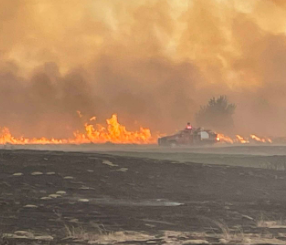
According to the letter, wildfires burned thousands of acres across Clark, Comanche, Finney, Rawlins, Seward and Stevens counties. The fires destroyed fencing and hay supplies and led to significant livestock losses.
The lawmakers said the damage has placed “extraordinary strain” on farmers, ranchers and rural communities that were already facing economic challenges.
Kansas producers often rely on fencing to manage grazing operations and protect herds, and the loss of hay supplies can create immediate feed shortages. Lawmakers noted that livestock losses and forced sales at reduced prices can have long-term financial consequences for producers.
The delegation pointed to changes made following the 2017 wildfires in Kansas, when Moran worked to secure adjustments to USDA disaster programs. Those changes included removing payment limits for livestock losses and allowing compensation for animals sold at reduced prices due to disaster conditions.
The lawmakers are asking USDA to use existing disaster assistance authorities to provide relief and to ensure programs are implemented in a way that meets the needs of impacted producers.
No timeline for potential federal assistance has been announced.