
Tuesday, March 31, 2026
Home Blog Page 22

K-State meteorologist advises Kansans on dangers of severe weather

0
Spring marks the peak season for dangerous storms, Redmond says.

Kansans are encouraged to review their severe weather plans during Severe Weather Awareness Week, set for March 2-6, with a statewide tornado drill scheduled at 10 a.m. CST (9 a.m. MST) Wednesday, March 4.

The annual campaign is designed to remind residents of the state’s wide range of weather hazards and the importance of preparation, said Chip Redmond, a meteorologist at Kansas State University.

“Severe Weather Awareness comes in a multitude of forms,” Redmond said. “In Kansas, we get pretty much every variety of severe weather.”

Spring marks the peak season. Heavy rain, flooding, tornadoes, hail, wind and lightning all become more frequent, especially in May. Activity typically increases in April and gradually declines through June and July, though severe weather can occur year-round.

“We’re slowly entering that time of the year where you need to know these hazards,” Redmond said. “You need to build situational awareness on what you’re going to do if these hazards do occur or are predicted.”

Kansas experienced an unusually quiet tornado year in 2025. According to the National Centers for Environmental Information, the state reported 30 tornadoes, well below the 1950-2020 average of 61 and sharply lower than the 69 reported in 2024. No fatalities or injuries were reported. The most active day was May 18, when 20 tornadoes touched down.

While tornadoes often draw the most attention, Redmond said they are only part of the severe weather threat.

On average, Kansas records nearly 300 reports of severe hail — stones at least 1 inch in diameter — each year. Larger hail, though rare, can be as destructive as a tornado. Damaging winds, including those associated with squall lines, can reach speeds up to 100 mph and affect large regions.

Heavy rain and flash flooding also pose significant dangers.

“Never drive through flooded roads. Turn around,” Redmond said. “You don’t know what’s underneath that water.”

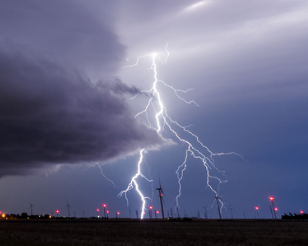
Lightning is another often-overlooked hazard. Nationally, lightning kills dozens of people each year, sometimes in groups seeking shelter under trees. Redmond said the safest option during a thunderstorm is to go indoors, avoid windows and stay away from plumbing and electrical appliances until the storm passes.

Preparation begins with reliable information, he said. The National Weather Service website, weather.gov, local news outlets and weather radios provide dependable updates. Smartphone apps can be helpful but may fail during power outages or if cell service is disrupted.

“Everyone’s got a cell phone now, and there’s many, many ways to get information,” Redmond said. “But you need to know their limitations as well.”

He recommends having multiple ways to receive warnings, including a battery-powered weather radio. Residents also should familiarize themselves with maps and radar so they can better understand where storms are in relation to their location.

Having a plan is equally important. The safest indoor shelter is a basement or a windowless room on the lowest floor, such as an interior bathroom. Families should practice drills and designate meeting places in advance.

An emergency go-bag should include a flashlight, snacks and a battery-powered radio with fresh batteries. Items to comfort children, such as games, also can be helpful.

Planning is especially important for those who may be away from home when storms develop. Redmond advises monitoring forecasts before traveling and identifying sturdy shelter options along the route.

“If it’s a really high-end severe weather day, you’re going to hear about it,” he said. “Have a plan and be ready to enact it.”

Severe Weather Awareness Week offers an opportunity to review those plans and take part in the statewide drill, reinforcing what Redmond calls the most important step: “Have multiple ways of getting severe weather warnings in Kansas and then be able to enact on them and take proper shelter.”

Putting On The Dog

0
lee pitts

The biggest change in the animal world during my 74 years has been our attitude towards dogs. It’s now a common sight to see dogs running around with people chained to them whose sole purpose is to pick up the dog’s poop.

You see more jet-setting dogs in airplanes whereas 60 years ago you often heard of pets flying in the baggage compartment and freezing to death. Today in order for a dog to fly it must be in a kennel that’s large enough for the dog to stand up, sit down, turn around and roll over. This is more space than the passengers get. After a tiring flight the dog can get an at-home neck and shoulder massage or acupuncture. It can even go to a spa (dogs are more spa oriented than cats). There’s now an entire industry of dog clippers who can make a poodle look like a topiary hedge in some billionaire’s botanical garden.

I have a friend who owns a chain of pet stores that offers self-service bathing facilities for dogs. I don’t think I’ve ever washed any of my dogs more than three times in their life and when I did it was probably because they tangled with a skunk. I never could see the point in washing a dog only to see it roll in a pile of cow manure afterwards.

It used to be that the social order of dogs was determined by how high on a fence post or utility pole they could pee, whereas now social status amongst dogs is determined by their name. Seventy years ago dogs were given simple monikers like Lady, Spot, Bear, Blue, Buddy or Bandit. Fido was the perfect name for a dog, Fido meaning ‘faithful’ in Latin. When’s the last time you heard of a dog named Fido? Nowadays they are more apt to have registration papers with names like Benjamin Rock-a-feller III or Queen Amanda of Omaha. Even common mutts are now called Britney, Brandy, Buffy or Snoop Dog.

Growing up I can’t remember seeing a dog being pushed in a baby carriage or in a doggie trailer pulled by a bicycle. Nor was I ever invited to a dog’s birthday party. You didn’t kiss your dog back then because you knew what your cowdog had been eating and that a dog’s mouth was one big Disneyland for bacteria. Now people take their dogs everywhere with them. It’s a common sight to see dogs in restaurants and I was shocked the first time I saw a dog in a grocery store. Dogs are even welcomed inside banks… just as long as they don’t leave a deposit.

It takes a lot more money now to raise a dog than it used to. I saw one estimate that said it cost $10,000 over the course of a dog’s life of 11 years. I bet I’ve had over 10 dogs in my life and I only paid cash for one of them. Dogs used to be given away and if yours had pups before you could get her spayed it was very hard to find homes for all the pups. Now a good cowdog can cost $12,000 and most dogs in the classified ads are offered for between $500 and $2,500.

You can’t let a dog like that sleep on an old tarp so now almost every dog has a bed that’s bigger than the one I had as a child. Another high cost of raising a dog is the special food they’re now fed. As a youngster we bought dog food in 50 pound sacks of Purina Dog Chow which was always stacked in the front of the grocery store. Now most folks buy dog food at stores that specialize in more expensive dog food and our pets are healthier and live longer as a result.

History is being repeated with these cute little purse dogs that sit on their matron’s lap. In the Victorian era in Europe it was a big status symbol for socialites to have the most expensive dog sit on the grand dame’s lap. This is where we get the phrase ‘putting on the dog’. Just once I’d like to see one of these high society snobs with a $16,000 snarling Australian Shepherd cowdog in her lap.


Alaska’s Cold, Cold Ground

0

Dawn Phelps
Columnist

From Dawn Phelps.  My 96-year-old Uncle Cleve Humphrey from Alabama wrote this descriptive story of a moose hunt with my little sister Joan in Alaska in 1986.  Enjoy. 


It has been a tradition for the Humphrey family to have a reunion in June of each year.  Although Joan lived in Fairbanks, Alaska, for a big part of her life, it was a long way from Santa Fe and Water Valley, Tennessee, where her daddy grew up.  But Joan nearly always made a point to attend the reunions.  She and her husband Dan attended the reunion in 1986, and she knew that hunting was one of my chief hobbies since I had grown up on a large acreage in Tennessee where hunting was something a boy could enjoy.  I was always intrigued by Alaska, and Joan knew that.  At the 1986 reunion she told me that if I would visit Fairbanks, she and Dan would take me on a moose hunt.  What greater adventure would a hunter want?  I said, “You’d better be careful in telling me that; I just might take you up on your offer!”—and so I did!  


Joan made nearly all the arrangements.  She helped secure the plane tickets, helped obtain hunting permits, and advised me on clothing.  She even purchased rubber hip boots for me because she said I would need them.  I arrived in Fairbanks on September 5, after a flight over quite a bit of scenic Alaska.  Joan had plans in place for the hunt, and we left Fairbanks on September 6.  Dan had customized a Chevrolet van.  It had four-wheel drive, huge tires, elevated suspension for great ground clearance, and bunks for at least three people.  It towed a large flatbed trailer on which we loaded two Honda three-wheeler ATVs, a small cargo trailer for towing behind a three-wheeler, a 30-gallon container of gas, and many other items for an extended hunt.


We drove the Alaska Highway from Fairbanks, southward to Delta Junction, then Richardson (Highway 4) further southward to near Paxson, only a short distance from the Trans-Alaska oil pipeline.  We then drove to the pipeline, which in most places has a wide cleared right-of-way.  There we parked the flatbed, unloaded it, and headed to our remote camp site.  Dan worked for a company, maintaining equipment at remote stations, so he obviously had observed the good places to hunt moose!


I had never been on an ATV in my life, but they assigned one to me, told me how to operate it, and had me drive it in circles in the right-of-way.  With that little training, and wearing our hip boots, we headed eastward toward the Gakona River, fed by the Gakona Glacier, on the south rim of the Alaska Range.  We went upstream, in and out of a creek, Dan driving the van, Joan on a three-wheeler towing the small cargo trailer, and me following on my three-wheeler—as if I knew what I was doing!  


What a journey!  At many places, bright red (spawning) sockeye salmon in the creek ran out of the way of our vehicles.  Then after traveling several miles on rough trails, we arrived at our remote camp overlooking the Gakona River.  The terrain was rolling hills, covered by brushy growth of cranberries, alders, and other vegetation.  We spent the night there.  The next day, the 7th, we went on our first hunt.  We left camp on a rough trail (if you can call it that!), heading downhill toward the river.  Dan and Joan were riding double on one three-wheeler, with me following.  In some instances, there was a big rock or a ditch in our path, but we did our best to avoid them. 


We would stop and glass (look through binoculars) for moose.  First, we spotted 4-5 caribou on a distant knoll.  What a sight!  Next, we spotted a group of moose (again, 4 or 5) going uphill away from the river area.  They disappeared into thick growth.  At least one appeared to be a bull, legal for taking (3 points on at least one eye guard).  I volunteered to follow their trail and flush them out.  In one way, it was a high point of the hunt!  Their trail was fairly easy to follow.  


I was amazed at how they could negotiate the heavy growth.  Several times I had to duck my head to go under downed growth, but the moose simply stepped over (5 to 6 feet high)!  After following the trail for several hundred yards, I heard two shots.  Dan’s rifle put a bull moose down uphill from where the moose entered the thick growth.  (Our armaments included a .300 Winchester Magnum and a 7mm Remington Magnum.)  At this point the work began.  Moose are huge animals!


We brought the three-wheelers within proximity of the kill.  Joan had prepared for field butchering a moose, with all the necessary supplies: knives, plastic sheeting to lay on the ground to keep the meat clean, meat bags, etc.  We only had to backpack the meat a short distance to load the three-wheelers.  While my memory is hazy about some details, I distinctly remember that I towed the small cargo trailer loaded with meat on our way back to our jumping off point on the pipeline.  At a particularly difficult point on the trail—a steep slope, the upper rear wheel hit a rock, and the vehicle turned over, but I was not injured.  The vehicle, however, was twisted 90 degrees relative to the cargo trailer, but we succeeded in getting everything upright and straightened out, and we came on out.


We drove back to Fairbanks that night and spent the next day finishing the butchering of the moose.  They told me the meat would be mine, and that it would be hard frozen for shipment when I was ready to return to Alabama.  The next day, September 9, we returned to the pipeline parking area and immediately mounted the three-wheelers heading south along the pipeline right-of-way.  We had gone about one mile when we spotted moose crossing from our left to our right, and there was a legal bull moose!  I quickly dismounted and got off a good shot before he could exit the right-of-way!  This gave us a clear area to dress him out and a good route back to the van.  I insisted that I do the dirty work, since I had shot the moose.  Again, I marveled at how large the Alaskan moose can be.  They can get up to 2,000 pounds, although this one was not that big.  I distinctly remember that I had to insert my arm up my shoulder to remove the entrails!  We returned to Fairbanks that same day with our second kill!


On my return flight home, I was able to count the frozen meat as excess baggage which was not expensive at that time.  But when I arrived in Huntsville, the meat could not be found.  I informed the personnel that it was frozen meat and that it would spoil if not found quickly.  That night, at about midnight, I got a call informing me that the meat had been found, and I promptly picked it up.  Joan and Dan could not have been nicer to me.  They were better than professional guides!  Today, a similar guided hunt would probably cost $15,000, not counting incidental expenses.  Joan was a real trooper, one of the finest people I have ever known.


Note from Dawn.  So there you have it, the description of a real moose hunt in Alaska told by Uncle Cleve, Joan and my retired lawyer uncle from Alabama.  

[email protected]

Managing Fertilizer Price Volatility Through Efficient Nutrient Management

0
Kansas Wheat

Contact: Marsha Boswell, [email protected]

For the audio version, visit kswheat.com

Kansas wheat farmers are watching their input costs closely, with fertilizer being one of the biggest expenses. With global supply issues and changing demand affecting prices, this article looks at how farmers can manage risk by using careful nutrient management and Wheat Rx strategies.


On a recent episode of Wheat’s On Your Mind, Corey Rosenbusch, president and CEO of The Fertilizer Institute, outlined how fertilizer markets are shaped by geopolitics, energy supply and international demand. Nitrogen production depends heavily on natural gas, and when Europe lost access to Russian gas, much of its nitrogen production shut down. Trade flows shifted, markets tightened and prices responded.


The United States is relatively strong in nitrogen production but still imports key products. Potash remains largely import-dependent, and phosphate markets are influenced by global suppliers and export decisions. Big buyers like India can affect global prices with just one purchase, and China’s fertilizer policies can have wide effects.


Kansas wheat farmers can’t control these global factors, but they can make decisions about how they manage their fields.


“There’s no better time to be a good steward of your fertilizer,” Rosenbusch said. “Now’s the time to really tighten the belt and look at some of those good stewardship things, because you can’t control, as a grower in Kansas, what China’s going to do, what Russia’s going to do.”


This focus on stewardship ties in with Wheat Rx, a partnership between Kansas Wheat and K-State Research and Extension. Wheat Rx is designed to help farmers grow high-quality winter wheat in Kansas in a cost-effective and sustainable way. The program highlights the importance of timing nutrients, setting realistic yield goals and making management decisions that fit Kansas conditions.


Research shows there is flexibility in when to apply nitrogen. Studies in the Wheat Rx series found that winter wheat can bounce back from early nitrogen shortages if nitrogen is available around the jointing stage. In some cases, applying nitrogen later led to better yields than applying it before planting.


This flexibility gives farmers more choices when fertilizer prices are high. Rather than applying all the nitrogen at once, they can watch how the crop is doing, estimate yield potential and adjust their fertilizer use as needed. Tools like remote sensing and in-season checks can help make these decisions even better.


Wheat also helps make the whole farming system more efficient. According to Wheat Rx, wheat residue protects the soil, cuts down on water loss and keeps soil temperatures steadier. Standing stubble can catch snow and boost soil moisture for the next crop. These benefits help maintain nutrient efficiency over time.


“Winter wheat can handle early nitrogen deficiency and recover well,” the Wheat Rx publication notes, underscoring the crop’s management flexibility and resilience.

Kansas winter wheat harvested area has declined at an average rate of about 1.9 percent per year since 2005, according to data cited in the Wheat Rx series. Even so, research continues to document agronomic, ecological and economic benefits of including wheat in cropping systems.


Global fertilizer markets may keep changing due to world events, but decisions about efficiency are made locally. For Kansas wheat farmers planning their fertilizer programs this season, Wheat Rx provides research-based advice to help balance profit and sustainability. Learn more at kswheat.com/kansas-wheat-rx.