Saturday, February 28, 2026
Home Blog Page 631

A people amendment

0
john marshal

When the echoes faded and the dust had settled in Philadelphia in 1787, the United States had a Constitution. From May into mid-September that year, the founders debated the afflictions of a weak central government under its Articles of Confederation. They agreed to a new document, a Constitution which set out how America would be governed.
The people would rule. Not the Army or the police, the Speaker of the House or even the president. The people would govern by way of their elected legislators and appointed services. That was the order then and the way it is supposed to work now.
Critical to our Constitution are the initial ten amendments, a bill of rights. The First Amendment is generally the most publicized and often the most misunderstood.
For example, in September 1987, a special “Congress” was organized in Philadelphia to observe the Constitution’s 200th birthday and to celebrate the First Amendment. At the same time, a poll from George Gallup found that most Americans didn’t know what the First Amendment was.
Decades later, a lot of us still don’t.
A Kansas judge recently sanctioned a police-state raid in Marion to search the local newspaper office and the homes of its editor and a local councilwoman. The affidavit for the raid’s “search warrant” was a mash of rumor, intimation and vengeful innuendo, a script reminiscent of a Gestapo playbook.
*
The First Amendment is the one that guarantees us the right to speak our piece, to print what we like, to have meetings, to believe as we choose. All of those good things are supposed to be done without any interference, government or otherwise.
It’s a pity that the majority of Americans had never heard of such a basic law. Perhaps Gallup hadn’t asked the question the right way. Nonetheless, not much has changed in 37 years or 237 years. Too many Americans still misunderstand this law or remain unaware of it.
The best thing to come out of the Philadelphia Congresses – the first one, and the one 200 years later – was the effort to get everyone involved. Some people who do know about the First Amendment think it was put there on behalf of people who own newspapers or radio and television stations and that’s all. It was put there for all of us, and when it gets dented, we all get hurt.
It may tick off editors when one of their reporters gets kicked out of a school board meeting so members can talk in secret, but the real losers are the people who pay for their schools and send children there.
The First Amendment is a People Amendment, not a Free Press Amendment. Not altogether.
We’ve learned a lot about the Constitution, the Bill of Rights and the First Amendment over the past two centuries and more. Our continuing education has at times come the rough way – in bloody protests, vicious rebukes – or the litigious way, in court.
*
The First Amendment may acquire new angles and take on new technologies but its guarantee – freedom to speak, to think, to meet – must remain timeless. It must remain a force.
It must resist the fakery of firebrands who bleat “fake news” at the drop of a fact, just as it persevered in the face of goons who sought to incinerate newspaper offices for daring to publish the truth.
With today’s digital deluge, anything – anything at all – can be published in an instant and palmed off as valid. The Amendment allows us the privilege to sit back and say: How nice, is it true?
This is how our society is to be free indeed, and not managed. We must continue to guard against efforts to distort the First Amendment or pervert its purpose, for the obvious reason that the next step is enslavement of the people.


Lettuce Eat Local: Brining home the bacon

0

Amanda Miller
Columnist
Lettuce Eat Local

Like with parents of any child, Brian and I are not always sure where some of Benson’s phrases or actions come from. Shoot, we don’t even exactly know how he got his blue eyes and blond hair, considering we both have brown eyes and brown hair. The magic of recessive genetic traits.
Speaking of magic as of this past week, suddenly his new thing is: “Let me show you a magic trick!” I think I said that to him once, although he started saying it himself after spending an evening with cousins, so maybe they taught it to him? At any rate, it feels out of the blue.
After his declaration, Benson will then proceed to do some strange stretching move, climb onto a stepstool in a weird way, or most often, perch with one foot on a chair rung and the other on the bookshelf ledge — whatever it is, executed with all the finesse and confident enthusiasm a two-and-a-half-year-old body can muster. While the “trick” itself may be underwhelming, the grin that accompanies it isn’t, and it’s impossible not to applaud generously.
My cuteness levels are nowhere near Benson’s, so I won’t expect similar applause, but I feel like I’ve found my own magic trick that I want to show you. Roasted chile mayonnaise, ta-da! I’ll save my bow for after you’ve tried it.
I’ve long felt that mayo has a magical aura to it; a creamy emulsion of previously very disparate ingredients that can transform a dish with even just a dollop of its velvety richness. (And although its name would suggest it belongs here, I am a mayonnaise snob and I do not categorize Miracle Whip in the same mystical way.) And while mayo is remarkable on its own, flavor additions only make it more so. I’ve found most of my favorites while making sushi: adding just a few things to mayonnaise to make it Japanese kewpie-style, wasabi, or sriracha.
But now I have a new favorite, at least currently. Kind of like Benson’s magic tricks, I’m not sure if I saw chile mayo somewhere or if I just made it up, but here it is. The concept is quite simple — I added a little sugar and rice vinegar like I do for that addictive kewpie mayo, and chopped grilled poblano peppers. The spicy earthiness of the poblanos melds with the tangy luxuriousness of the mayonnaise, all of it brightened by the acid and deepened by the grill char. I’m unfortunately not kidding when I say sometimes I don’t even look for a vehicle and just eat it on a spoon.
That said, it’s probably better with things. Slathered on grilled zucchini slices or roast chicken, stirred into scrambled eggs or tomato soup, spread on biscuits or a grilled cheese sandwich.
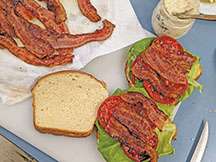
Its highest calling, however, may be as a component in BLTs. I tried it in preparation for a monthly class I teach in Arlington, and oh. my. goodness. Technically it may have just been all the other lovely fresh ingredients — soft homemade bread and juicy garden slicing tomatoes and crispy farm-raised bacon — but I had to put my BLT down after my first bite to take it all in and savor the magic. Brian even commented on how incredible the sandwich was, and while I’m not usually a bacon person (gasp!), I was quite pleased there was plenty left of everything for another meal or two. It might even be worth it to smell up the kitchen again frying up more bacon if necessary.
And if that’s what roasted Chile mayo can do, that’s quite a magic trick.

You don’t really need a recipe for BLTs, but they are just such a perfect vehicle for this spicy mayo that I couldn’t help but tag it along. Since the ingredients are so simple, make sure you use quality ones. Draining the tomato slices keeps you safe from a soggy sandwich, which in my book is another magic trick. The mayo can be made a week in advance, but of course your sandwich needs to be eaten immediately after assembly for best results.
Prep tips: use any Chile of your preference, but remember, use mayo and not miracle whip.

1 cup mayonnaise
1-3 grilled or broiled Chiles (poblano, hatch, Anaheim, jalapeño…), chopped
splash of rice wine vinegar
pinch of salt and sugar
thick slices of fresh tomato
good bread
lettuce leaves
crispy bacon

Mix mayo and Chiles (deseed the Chiles, or don’t add them all if it’s seeming too spicy). Add in vinegar and salt to taste; refrigerate. Set tomato slices on a paper towel and sprinkle with salt. Let dry a bit. Lightly toast the bread (decide if you’re doing open- or closed-face sandwiches). Assemble sandwich in this order: bread, mayo, lettuce, tomato, bacon. Eat.


Exploring No Deposit Slot Bonuses in Canada’s Online Casinos 2023

0

The trend of offering no deposit bonuses in Canadian online casinos has been gaining traction, especially for slot machine enthusiasts. These bonuses provide an excellent opportunity for players to embark on their gaming journey without initial investments, while still maintaining the potential to earn actual profits. This article delves into the unique characteristics of slots that come with no deposit bonuses.

Canadian Casinos with No Deposit Slot Bonuses

A variety of Canadian online casinos are now offering players the chance to enjoy slot games with the added benefit of no deposit bonuses. We explore why these bonuses are not just appealing but also beneficial to players.

The Appeal of No Deposit Bonuses

No deposit bonuses slots https://casinozeus.net/online-slots/no-deposit have become a magnet for casino players due to several compelling reasons:

  1. Zero Financial Risk: Players can engage in slot games without any financial commitment.
  2. Opportunity to Win Real Money: The chance to earn real money without initial deposits enhances the appeal.
  3. Testing the Waters: These bonuses allow players to evaluate and experience the casino and its slot games without monetary stakes.
  4. Simple Claiming Process: Typically, claiming these bonuses is straightforward, often only requiring registration.

Slot Games Featuring Registration Bonuses

Highlighting Casinos with Registration Bonuses for Slot Games

This section lists and details Canadian casinos that offer no deposit bonuses upon registration, specifically for slot machines. The table below provides a quick and informative overview.

Table of Casinos with Slot Registration Bonuses

Casino Name Available Slot Selection Bonus Offer
Big Win Casino Extensive variety of slot games $15 bonus on account creation
Classic Spin Casino Traditional and modern slot games 25 free spins, no initial deposit
Themed Slots Paradise Diverse themed slot machines $7 bonus funds upon joining

Conclusion

The landscape of no deposit bonuses in Canadian online casinos, particularly for slot machines, is both inviting and lucrative for players. These offers pave the way for risk-free gaming experiences, allowing players to explore diverse slot options and potentially accumulate winnings without any investment. Whether a beginner or an experienced gambler, these bonuses are an excellent gateway to the thrilling world of online slots, offering a chance to test game mechanics and enjoy various themes and styles with no financial risk.

KU News: New grasp of key COVID-19 protein may lead to a live-attenuated vaccine effective against more variants for longer

0

From the Office of Public Affairs | http://www.news.ku.edu

Headlines

New grasp of key COVID-19 protein may lead to a live-attenuated vaccine effective against more variants for longer
LAWRENCE — Research from the University of Kansas just published in Proceedings of the National Academy of Sciences could hasten development of a new class of vaccines aimed at SARS-CoV-2, the virus that causes COVID-19. Anthony Fehr, associate professor of molecular biosciences, led research into a protein dubbed “Mac1,” which has intrigued molecular bioscientists as an antiviral target because it’s known to help confer virulence, or the power to cause disease.

School of Engineering establishes virtual institute to combat cyber threats
LAWRENCE — A new virtual institute established at the University of Kansas School of Engineering will train the next generation of military and civilian leaders to better combat the growing threat of cyberattacks and protect the electromagnetic spectrum (EMS). The complexity and diversity of modern communication systems — such as 5G and 6G networks — as well as artificial intelligence and electronic warfare systems present daunting challenges in protecting networks from cyberattacks, said Fengjun Li, KU professor of electrical engineering & computer science.

Authors try to simplify difficult aspect of Russian language
LAWRENCE — Together with two native Russians, Stephen Dickey, professor from the Department of Slavic, German & Eurasian Studies, has written a new book that explores and allows mid- to advanced-level Russian language learners to practice verbal aspect, which has no equivalent in English. “It’s a book about a very stubborn part of Russian grammar,” Dickey said. The book is part of KU’s Libraries’ free, online Open Textbooks initiative, and the authors have been promoting its availability at a series of national and international teachers’ conferences.

Full stories below.

————————————————————————

Contact: Brendan M. Lynch, 785-864-8855, [email protected]
New grasp of key COVID-19 protein may lead to a live-attenuated vaccine effective against more variants for longer
LAWRENCE — Research from the University of Kansas just published in Proceedings of the National Academy of Sciences could hasten development of a new class of vaccines aimed at SARS-CoV-2, the virus that causes COVID-19.

Anthony Fehr, associate professor of molecular biosciences, led research into a protein dubbed “Mac1,” which has intrigued molecular bioscientists as an antiviral target because it’s known to help confer virulence, or the power to cause disease. Results have spurred several groups, including the Fehr lab, to begin developing novel inhibitors of Mac1.

“We’ve built up a body of literature showing this gene is critical for the virus to cause disease,” Fehr said. “To better understand this protein, we use what’s called reverse genetics, where we can delete or mutate this gene so it no longer functions in the context of the actual virus. While we’ve done this in a lot of different coronaviruses, we hadn’t actually explored this in SARS-CoV-2 until just recently. This paper really describes our efforts to get rid of this protein Mac1 in SARS-CoV-2 and really see what’s happening.”

Studying how SARS-CoV-2 behaved in mouse models, Fehr’s collaborator at Oklahoma State, Rudra Channappanavar and his group, found that without Mac1, the virus barely had an impact on the health of mice.

“If you look at the mouse data, we find that every mouse survived and showed no real signs of disease when they were infected with the virus without this gene, whereas when we give mice the normal virus — we would call it the ‘wild-type’ virus — every mouse dies,” Fehr said. “So, there’s a huge discrepancy in the ability of those viruses to cause disease. These results further demonstrate that Mac1 is a strong target for the development of novel antiviral therapies.”

What’s more, Fehr and his co-authors found the virus, without the Mac1 protein, induced a robust initial immune response in mice, the kind of biological response researchers look for in a vaccine target.

“That first response you have to a virus, called an innate immune response, is dramatically increased in this infection,” said the KU researcher. “When we infect the mice, this further improves the adaptive immune response, which is that T- and B-cell response we get that produces antibodies and antiviral T-cells later on — that can really protect us from future disease.”

Fehr and Channappanavar have already shown that prior infection with the attenuated virus can be protective for mice from a future infection.

“Right now, we’re really looking at further developing this virus into a live attenuated vaccine for SARS-CoV-2, and we’re working on different strategies with minor modifications to this virus to make it even better,” he said. “We think this is a great start to developing a vaccine that we think would have longer lasting immunity.”

Fehr said such a vaccine could be administered intranasally, targeting the lung, giving it advantages over today’s recommended vaccine regimen based on mRNA technology.

“One of the major problems with the current vaccines is that we give them in your arm — when you give a vaccine in your arm or your muscle, you don’t really get great immune responses in your lungs,” he said. “We think that live-attenuated vaccines given intranasally can improve that response.”

Additionally, live-attenuated COVID-19 vaccines could last longer than current vaccines requiring boosters.

“I don’t want to dis mRNA vaccines — they’re great,” Fehr said. “But they’re not particularly long-lasting. We’re finding their immunity wanes over the course of time. Live-attenuated viruses have been around for decades, and many of them are very effective and last very long. We can get a lot of live-attenuated vaccines as children, and we never have to take them again because they last our lifetime.”

According to Fehr, a live-attenuated vaccine would target parts of the virus more likely to remain the same from variant to variant.”

“All the current vaccines out there are really focused on a small portion of that spike glycoprotein that’s on the outside surface of the virus,” Fehr said. “There are a lot of parts of that that don’t change, and they’re sensitive to the current vaccines. But if there are changes in the spike protein, will those vaccines keep working? Mostly, they do. But some of them do lose efficacy.”

Fehr said a whole-virus vaccine, like the one his lab is investigating, could target regions of the genome that don’t change from variant to variant.

“It could reduce what I call ‘variant chasing’ that we have with a lot of our different vaccines now,” he said. “Hopefully this approach targeting the Mac1 could be beneficial in preventing disease from future variants.”

Fehr’s KU collaborators were lead author Yousef M. Alhammad, a former postdoctoral researcher, along with postdoctoral researcher Srivatsan Parthasarathy, doctoral students Joseph O’Connor, Catherine Kerr and Jessica Pfannenstiel; and Robert Unckless, associate professor of molecular biosciences, Edward & Thelma Wohlgemuth Faculty Scholar and director of the KU Center for Genomics. They were joined by co-authors Roshan Ghimire, Debarati Chanda, Caden Miller, Sunil More and Rudragouda Channappanavar from Oklahoma State University and Sonia Zuniga and Luis Enjuanes of the National Centre for Biotechnology, Campus Universidad Autónoma de Madrid in Spain.

“I’m really proud of this group. We all came together, worked really hard and produced some really great science,” Fehr said.

The work was funded at in part by grants from the NIH and with significant support from the Chemical Biology and Infectious Disease COBRE at KU, led by Scott Hefty, professor and chair of molecular biosciences at KU, and startup funds from KU and Oklahoma State University.

-30-
————————————————————————
The official university Twitter account has changed to @UnivOfKansas.
Refollow @KUNews for KU News Service stories, discoveries and experts.


————————————————————————

Contact: Cody Howard, 785-864-2936, [email protected]
School of Engineering establishes virtual institute to combat cyber threats

LAWRENCE — A new virtual institute established at the University of Kansas School of Engineering will train the next generation of military and civilian leaders to better combat the growing threat of cyberattacks and protect the electromagnetic spectrum (EMS).

KU received a two-year, $1.5 million grant from the Department of Defense to establish the program, known as the Virtual Institutes for Cyber and Electromagnetic Spectrum Research and Employ, or VICEROY, Virtual Institute. The grant is overseen by the Griffiss Institute, which is a nonprofit talent and technology accelerator for the Department of Defense and an international network of academic, government and industry partners.

Fengjun Li, KU professor of electrical engineering & computer science and lead researcher for the VICEROY Virtual Institute, said the complexity and diversity of modern communication systems — such as 5G and 6G networks — as well as artificial intelligence and electronic warfare systems present daunting challenges in protecting networks from cyberattacks.

“We must manage and allocate scarce spectrum resources, detect and counter sophisticated signal jamming and interference, and maintain reliable and secure communication in contested environments,” Li said. “Successfully tackling these challenges requires education, training, research and teamwork across many disciplines.”

KU will partner with researchers at Ohio State University and Purdue University Northwest to develop new cybersecurity courses and curriculum to support more than 30 students each year across three universities.

The VICEROY Virtual Institute will officially launch in fall 2023. It will offer an augmented curriculum that enhances existing education in cyber and EMS operations through hands-on training, research-oriented experiential learning and several scholarships. The VI will provide four augmentation programs, including:

1. Cybersecurity theories and practices
2. Cyber and EMS operations
3. Data science in cyber and EMS applications
4. Strategic foreign language proficiency in Chinese
5. In addition, it will offer two special education and training programs for developing cyber talent and qualified cyber instructors in the form of summer camps, workshops and seminars.

“Equipping the future generation of military and civilian leaders with essential skills in cyber and EMS security through experiential learning is becoming more crucial in our interconnected society,” Li said. “Developing a pipeline of future cyber leaders is critical to these efforts and a key goal of this program.”

The KU School of Engineering has a long history as a national leader in cybersecurity and electromagnetic spectrum research. The federally funded Institute for Information Sciences (I2S) has researchers developing technology in the areas of cybersecurity, computing, communications, bioinformatics, signal processing and sensors. I2S is also home to cybersecurity research at KU and is continuously supported by the university.

-30-
————————————————————————
Subscribe to KU Today, the campus newsletter,
for additional news about the University of Kansas.

http://www.news.ku.edu
————————————————————————

Contact: Rick Hellman, 785-864-8852, [email protected]
Authors try to simplify difficult aspect of Russian language

LAWRENCE – Stephen Dickey has specialized in the thorny problem of aspect – which has challenged linguists and learners of Russian around the globe — when it comes to the proper usage of verbs in the Russian language.

“I have researched this category as a linguist for a few decades, but I’ve never written any instructional material for it until now,” said Dickey, professor in the University of Kansas Department of Slavic, German and Eurasian Studies.

Together with two native Russians – KU doctoral student Kamila Saifeeva and KU doctoral graduate Anna Karpusheva, Dickey has written a new book titled “Russian Aspect in Conversation.” Published earlier this year, it is part of KU’s Libraries’ free, online Open Textbooks initiative, and the authors have been promoting its availability at a series of national and international teachers’ conferences.

It’s not a course textbook, Dickey said, but rather a complementary work that explores and allows mid- to advanced-level Russian language learners to practice verbal aspect.

“It’s a book about a very stubborn part of Russian grammar,” Dickey said.

That’s because, Dickey said, there is no equivalent in English.

“The category that we’re talking about is more or less on a par with English ‘was reading’ versus ‘read,’ ” Dickey said. “So you’ve got one verb form that refers to a completed action, and then you’ve got another verb form that refers to an action that’s ongoing. And any time a Russian uses a verb, they have to make this choice. So we rarely say ‘be reading’ as a command to somebody. We will say ‘read this’ and ‘read that.’ But Russians will say the equivalent of ‘be reading’ all the time.”

These Russian verbal categories are known as “perfective” verbs for actions that are or have been completed, and “imperfective” verbs for actions that are or might be ongoing.

“The mind-bending part of this is that it is more about reference,” Dickey said. “The difference between these two forms in Russian is kind of like the meaning of saying ‘the book’ versus ‘a book’ or ‘books.’ It’s about specific things versus nonspecific things.

“And if you think that this doesn’t make any sense, you’re in good company, because we just don’t think about verbal actions as being specific versus nonspecific. They take that kind of referential opposition and they lay it onto the verbs. And then you have the ‘read’ form, which is specific, versus ‘is reading’ or ‘be reading,’ or what have you, which is the nonspecific one. And it is extraordinarily difficult for people to get.

“There are people who do speak Russian for decades and don’t perfect it, and that is really the impetus for this book.”

It’s a crucial thing for approaching fluency, Dickey said.

He and his colleagues created a book with some brief introductory material and a series of more than two dozen practice modules to help students get it.

“You read a series of dialogues, and then you answer multiple-choice questions about them … that are designed to get you thinking about what is the relationship between the speaker and the hearer in the dialogue, and what the speaker wants to accomplish,” Dickey said.

Choosing the correct answer gets the student a confirmation with a gold star appearing on the screen/page. If they choose the wrong answer, the text lets them know that, too, and they can try again to get it right. Each module concludes with some explanatory material, summing up the section.

Dickey said while working with a teacher’s guidance would obviously be helpful, the book is designed to be able to be used independently by students. Moreover, he said, students can dip in and out of the book, taking on one bite at a time.

“That’s the challenge,” he said. “To take to take what is ultimately a very difficult category and break it down so students can acquire it and use it.”

Dickey said that since the book was published earlier this year, he and his co-authors have been promoting its availability at a series of national and international teachers’ conferences.

-30-

————————————————————————

KU News Service
1450 Jayhawk Blvd.
Lawrence KS 66045
Phone: 785-864-3256
Fax: 785-864-3339
[email protected]
http://www.news.ku.edu

Erinn Barcomb-Peterson, director of news and media relations, [email protected]

Today’s News is a free service from the Office of Public Affairs

Horticulture 2023 Newsletter No. 34 

0
https://hnr.k-state.edu/extension/info-center/newsletters/index.html
Blog Post: http://www.ksuhortnewsletter.org
Video of the Week: Fertilize for a Healthy Lawn
https://kansashealthyyards.org/all-videos/video/fertilize-for-a-healthy-lawn
REMINDERS
•           Light pruning of shrubs and trees where 10% or less of the plant is removed can be done any time of year.  Heavier pruning should be done in the spring if possible.
•           Fertilize strawberry bed for added flower bud development and larger crop next year.
•           Too late to spray for bagworms but can pull them off and dispose of them if practical.
TURFGRASS
Fall Lawn Seeding Tips
            The keys to successful lawn seeding are proper rates, even dispersal, good seed to soil contact, and proper watering. Evenness is best achieved by carefully calibrating the seeder or by adjusting the seeder to a low setting and making several passes to ensure even distribution. Seeding a little on the heavy side with close overlapping is better than missing areas altogether, especially for the bunch-type tall fescue, which does not spread.   Multiple seeder passes in opposite directions should help avoid this problem.
            A more serious error in seeding is using the improper rate. For tall fescue, aim for 6 to 8 pounds of seed per 1,000 square feet for new areas and about half as much for overseeding or seeding areas in the shade.
            Kentucky bluegrass has a much smaller seed so less is needed for establishment.  Use 2 to 3 pounds of seed per 1,000 square feet for a new lawn and half that for overseeding or shady areas.
            Using too much seed results in a lawn more prone to disease and damage from stress. The best way to avoid such a mistake is to determine the square footage of the yard first, and then calculate the amount of seed. Using too little seed can also be detrimental and result in clumpy turf that is not as visually pleasing.
            Establishing good seed to soil contact is essential for good germination rates. Slit seeders achieve good contact at the time of seeding by dropping seed directly behind the blade that slices a furrow into the soil. Packing wheels then follow to close the furrow. The same result can be accomplished by using a verticut before broadcasting the seed, and then verticutting in a different direction a second time.
            Core aerators can also be used to seed grass. Go over an area at least three times in different directions, and then broadcast the seed. Germination will occur in the aeration holes. Because those holes stay moister than a traditional seedbed, this method requires less watering.
            If the soil that has been worked by a rototiller, firm the soil with a roller or lawn tractor and  use light hand raking to mix the seed into the soil. A leaf rake often works better than a garden rake because it mixes seed more shallowly.
            Water newly planted areas lightly, but often. Keep soil constantly moist but not waterlogged.  During hot days, a new lawn may need to be watered three times a day. If watered less, germination will be slowed. Cool, calm days may require watering only every couple of days. As the grass plants come up, gradually decrease watering to once a week if there is no rain. Let the plants tell you when to water. If you can push the blades down and they don’t spring back up quickly, the lawn needs water. Once seed sprouts, try to minimize traffic (foot, mower, dog, etc.) seeded areas receive until the seedlings are a little more robust and ready to be mowed. Begin mowing once seedlings reach 3 to 4 inches tall. (Ward Upham)
Overseeding a Lawn
            Tall fescue lawns that have become thin over the summer can be thickened up by overseeding during September. Start by mowing the grass short (1 to 1.5 inches) and removing the clippings. This will make it easier to achieve good seed-soil contact and increase the amount of light that will reach the young seedlings.
            Good seed-soil contact is vital if the overseeding is to be successful. Excess thatch can prevent seed from reaching the soil and germinating. Normally we want 1/4 inch of thatch or less when overseeding. If the thatch layer is 3/4 inch or more, it is usually easiest to use a sod cutter to remove it and start over with a new lawn. A power rake can be used to reduce a thatch layer that is less than 3/4 inch but more than a quarter inch.
            Once thatch is under control, the soil should be prepared for the seed. This can be done in various ways.   For small spots, a hand rake can be used to roughen up the soil before the seed is applied.
            A verticut machine has solid vertical blades that can be set to cut furrows in the soil. It is best to go two different directions with the machine. A slit seeder is a verticut machine with a seed hopper added so the soil prep and seeding operation are combined. Another option is to use a core aerator.
            The core aerator will punch holes in the soil and deposit the soil cores on the surface of the ground. Each hole produces an excellent environment for seed germination and growth. Make three to four passes with the core aerator to ensure enough holes for the seed. Using a core aerator has the additional benefit of reducing the amount of watering needed to get the seed germinated and growing. Aeration also increases the water infiltration rate, decreases compaction, and increases the amount of oxygen in the soil.
            Of the three methods, I prefer the slit seeder for obtaining good seed/soil contact.  However, if watering is difficult, core aeration may be a better option.  Regardless of method used, fertilizer should  be applied at the rate suggested by a soil test, or a starter fertilizer should be used at the rate suggested on the bag. (Ward Upham)
Give Cool-Season Grasses a Boost
            September is almost here and that means it is prime time to fertilize your tall fescue or Kentucky bluegrass lawns. If you could only fertilize your cool-season grasses once per year, this would be the best time to do it.
            These grasses are entering their fall growth cycle as days shorten and temperatures moderate (especially at night). Cool-season grasses naturally thicken up in the fall by tillering (forming new shoots at the base of existing plants) and, for bluegrass, spreading by underground stems called rhizomes. Consequently, September is the most important time to fertilize these grasses.
            Apply 1 to 1.5 pounds of actual nitrogen per 1,000 square feet. The settings recommended on lawn fertilizer bags usually result in about 1 pound of nitrogen per 1,000 square feet. We recommend a quick-release source of nitrogen at this time. Most fertilizers sold in garden centers and department stores contain either quick-release nitrogen or a mixture of quick- and slow-release. Usually only lawn fertilizers recommended for summer use contain slow-release nitrogen. Any of the others should be quick-release.
            The second most important fertilization of cool-season grasses also occurs during the fall. A November fertilizer application will help the grass green up earlier next spring and provide the nutrients needed until summer. It also should be quick-release applied at the rate of 1-pound actual nitrogen per 1,000 square feet. (Ward Upham)
Power Raking and Core-Aeration
            September is the optimum time to power rake or core-aerate tall fescue and Kentucky bluegrass lawns. These grasses should be coming out of their summer doldrums and beginning to grow more vigorously. This is a good time to consider what we are trying to accomplish with these practices.
            Power raking is primarily a thatch control operation. It can be excessively damaging to the turf if not done carefully. For lawns with one-half inch of thatch or less, I don’t recommend power raking but rather core aeration. For those who are unsure what thatch is, it is a springy layer of light-brown organic matter that resembles peat moss and is located above the soil but below the grass foliage. Power raking pulls up an incredible amount of material that then must be dealt with by composting or discarding.
            Core-aeration is a much better practice for most lawns. By removing cores of soil, core-aeration relieves compaction, hastens thatch decomposition, and improves water, nutrient, and oxygen movement into the soil profile. This operation should be performed when the soil is just moist enough so that it crumbles easily when worked between the fingers. Enough passes should be made so that the holes are spaced about 2 to 3 inches apart. Ideally, the holes should penetrate 2.5 to 3 inches deep. The cores can be left on the lawn to fall apart naturally (a process that usually takes two or three weeks, depending on soil-type), or they can be broken up with a power rake set just low enough to nick the cores, and then dragged with a section of chain-link fence or a steel doormat. The intermingling of soil and thatch is beneficial to the lawn. (Ward Upham)
ORNAMENTALS
Dividing Peonies
             Though dividing peonies is not required, it can increase bloom production, reduce diseases and provide more peony plants free! If you choose to divide your peonies, it needs to be done this time of year.
            Begin by cutting the stems just above the soil surface. Dig up the entire root system and remove the soil from the roots. Divide the root clump into small sections using a sharp knife. Ensure each section has three to five buds as well as healthy roots. It may take a couple of years for the divided peony plants to return to full bloom productivity. If there are fewer buds on each division it may take three years for the plant to bloom at all.
            Choose a planting location that receives sunlight for at least half of the day. Dig a hole large enough to fit the roots of the divided peonies so the buds will be covered by one to two-inches of soil. Plants buried too deep may not flower. Backfill and water thoroughly. Space dwarf peonies at least two-feet apart and standard peonies four-feet apart.
            The winters in Kansas have periods of freezing and thawing which can be destructive to plants. Soil that freezes and thaws repeatedly can uproot plants that are not deeply rooted. This is called “heaving.” To protect the newly divided peonies, add a layer of straw, leaves or compost after the soil freezes. (Cynthia Domenghini)
                                                            VEGETABLES
Preparing the Vegetable Garden for Next Year
            Put in the work now for a productive garden next year. Before removing plants, make a sketch of the vegetable layout. This will come in handy when you’re planning the layout for the next garden if you choose to rotate your crops.
            Remove debris from plants that are done producing. Compost debris that is disease-free. For smaller gardens, manually remove weeds. Larger gardens may require tilling. If so, avoid tilling while the soil is saturated as this breaks down the structure.
            A cover crop can be planted to return nutrients to the soil during this off season. Cover crops also reduce soil erosion and improve the quality of the soil. Small grains such as wheat should be seeded at 3/4 to 1 pound of seed per 1,000 square feet from mid-September to late October. Spring oats can also be seeded until mid-September but the rate should be 2 to 4 pounds per 1,000 square feet. Spring oats will die back in the winter and can be tilled under in the spring. Daikon radishes are another good cover crop because the large taproot penetrates the hardpan. After the radishes die back in the winter, the loosened soil is better able to retain water.
            Hairy vetch, alfalfa and sweetclover are legumes which means they also fix nitrogen. Seed these cover crops at a rate of ¼ to ½ pound of seed per 1,000 square feet of garden. Hairy vetch and alfalfa can be seeded from mid-August to late September while sweetclover should be seeded only until early-September. (Cynthia Domenghini)
MISCELLANEOUS
Composting Tips
1. Turn the pile at least once a month to rotate materials from the center and promote decomposition. The pile will heat up as it decomposes and cool as decomposition slows.
2. Create a depression in the top of the pile to allow water to collect and slowly seep through the layers of the mound.
3. When deciding where to establish a compost pile, look for a water source. Proximity to supplemental water will allow you to keep the pile wet even during periods of drought which is important for efficient decomposition.
4. Smaller materials decompose faster. When possible, shred materials before adding them to the compost heap. This is especially true for “browns” such as dry leaves and twigs.
5. Fats and meats should not be added to the compost. They will attract wildlife.
6. Grass clippings from a lawn treated with crabgrass killer should not be composted. If crabgrass preventer or dandelion killer has been used on the lawn, the clippings can be composted after the third mowing. (Cynthia Domenghini)
Contributors:
Cynthia Domenghini, Instructor ([email protected])
Ward Upham, Extension Associate ([email protected])
Division of Horticulture
1712 Claflin, 2021 Throckmorton
Manhattan, KS 66506
(785) 532-6173
For questions or further information, contact: [email protected] OR [email protected]
This newsletter is also available on the World Wide Web at:
http://hnr.k-state.edu/extension/info-center/newsletters/index.html
The web version includes color images that illustrate subjects discussed. To subscribe to this newsletter electronically, send an e-mail message to [email protected] or [email protected] listing your e-mail address in the message.
Brand names appearing in this newsletter are for product identification purposes only. No endorsement is intended, nor is criticism implied of similar products not mentioned.
K-State Research and Extension is committed to making its services, activities and programs accessible to all participants. If you have special requirements due to a physical, vision or hearing disability, or a dietary restriction please contact Extension Horticulture at (785) 532-6173.
Kansas State University Agricultural Experiment Station and Cooperative Extension Service K-State Research and Extension is an equal opportunity employer.  Issued in furtherance of Cooperative Extension Work, Acts of May 8 and June 30, 1914, as amended. Kansas State University, County Extension Councils, and United States Department of Agriculture Cooperating, Ernie Minton, Dean.