Saturday, February 28, 2026
Home Blog Page 632

KU News correction: Partners announced for KU initiative to move toward rightful presence in regular education classrooms

0

From the Office of Public Affairs | http://www.news.ku.edu

Correction

Editors: A news digest sent earlier today included a story about the SWIFT Education Center that was previously published in October 2022. KU News Service has uploaded and published the correct story, available below.

Contact: Nicole Perry, SWIFT Education Center, 785-864-3391, [email protected], @SWIFTSchools
Partners announced for KU initiative to move toward rightful presence in regular education classrooms

LAWRENCE — Working with the U.S. Department of Education, Office of Special Education Programs, the National Center on Inclusion Toward Rightful Presence at SWIFT Education Center, based at the KU Life Span Institute, has selected four state education agencies as partners on a project directed toward creating changes in systems, policies and practices at 32 schools. The center will partner with the Delaware Department of Education; New Mexico Public Education Department; Orange County Department of Education on behalf of California Department of Education; and Wisconsin Department of Public Instruction to implement inclusive practices and policies in the four states.
Each state education agency was selected for its high level of commitment to and progress toward inclusion of students with disabilities. The partners in turn will each select and support two school districts and eight schools, for a total of 32 schools, to increase belonging and learning opportunities for those students who are now segregated from general education.
“These partnerships will make changes in systems, policies and practices that result in meaningful engagement in general education for students traditionally kept at the margins of school,” said Amy McCart, KU research professor and co-director of SWIFT. “This includes students with the most significant disabilities who benefit from intensive support when receiving high-quality academic instruction aligned with general education standards, delivered among peers in the same grade-level classroom.”
The center chose each partner based on its commitment to the project’s goal to build equitable educational systems for students, families and communities. Their past work in this area includes:
1. Delaware Department of Education, which emphasizes whole-child Multi-Tiered System of Support (MTSS) with embedded Universal Design for Learning (UDL) for environments that support all learners. Literacy programs, such as the Delaware Early Literacy Initiative, promote evidence-based literacy instruction, including strategies to teach reading to students with significant cognitive disabilities.
2. New Mexico Public Education Department, which has a robust structure to support Multi-Layered System of Supports (MLSS) implementation, including cross-district professional learning communities and implementation coaches. A strong support system is currently in place for students with high-incidence disabilities and is ready to extend to students with less frequently seen needs.
3. Orange County Department of Education, which participates in a statewide program for implementing MTSS with a whole-child approach, with embedded UDL, and are also well-positioned to extend their systems to students currently participating in separate educational programs.
4. Wisconsin Department of Public Instruction, which has initiatives in place to increase the placement of students with disabilities into the general education setting, including a robust statewide coaching structure and the expertise and commitment to leverage implementation science. The state infuses equity throughout their frameworks and systems, with a focus on equitable access, opportunity and outcomes experienced by learners who are systemically marginalized in the state’s schools.
“We are honored to have partners who have committed to work in deep and meaningful ways to change the system of support for students with intensive cognitive needs,” McCart said. “These dynamic learners offer so much, and we are excited to see how effective instructional support within general education will not only change their outcomes, but also provide lasting systems for those learners who come next.”
SWIFT technical assistance providers will collaborate to support the state partners’ systemic and sustainable changes and will monitor the states’ progress toward implementation through regular assessment. The results will demonstrate how to effect change toward inclusive reform in school systems.
A previously announced federal grant established the National Center on Inclusion Toward
Rightful Presence to partner with local and state education agencies to support educators and their students as they move beyond inclusion in schools and classrooms, to co-created systemic conditions for rightful presence.

-30-
————————————————————————

KU News Service
1450 Jayhawk Blvd.
Lawrence KS 66045
Phone: 785-864-3256
Fax: 785-864-3339
[email protected]
http://www.news.ku.edu

Erinn Barcomb-Peterson, director of news and media relations, [email protected]

Today’s News is a free service from the Office of Public Affairs

KU News: KU will host Women in the US Intelligence Community conference

0

From the Office of Public Affairs | http://www.news.ku.edu

Headlines

New $10 million grant to promote equity leadership and educator well-being
LAWRENCE — The SWIFT Education Center, part of the Life Span Institute at the University of Kansas, was awarded a $10 million federal grant to promote equity leadership and educator well-being among educational leaders in Black, Hispanic and Native American communities. School leaders’ professional learning will focus on developing student social and emotional competencies as well as ways to promote the well-being of educators.

KU will host Women in the US Intelligence Community conference
LAWRENCE — The Intelligence Community Center for Academic Excellence (IC CAE) at the University of Kansas will welcome women from the U.S. intelligence community for a conference from 1 p.m. to 5 p.m. Aug. 30 at the Jayhawk Welcome Center. The program is free and open to the public, but registration is requested.

KU Common Book Program announces 2023-24 events
LAWRENCE — The University of Kansas Common Book Program will host a slate of activities and events surrounding the 2023-24 Common Book selection, “Parable of the Sower,” by American science fiction writer Octavia Butler. These include author and artist talks, panel discussions and Common Book marathon reading.

Timothy Paulson to serve as director for University Press of Kansas
LAWRENCE — The University Press of Kansas board of trustees, composed of provosts from each of the six Kansas Regents institutions, has appointed Timothy Paulson as director of the University Press of Kansas. Paulson will succeed Mike Haddock, who has served as interim faculty director of UPK since July 2022. Paulson currently serves as general manager at Brentwood Studios, a media production company based in Nashville, Tennessee.

Trans identity and Catalan independence share key perspectives, research finds
LAWRENCE – When Marta Vicente was researching various aspects of transgender identity, one surprising word kept coming up: colonialism. Her new article “Rethinking Identity: Transgender Studies and Catalan Independence” finds trans people and those who favor Catalonia’s independence from Spain often express their identities as being political bodies that seek recognition as autonomous entities. “There’s a sense of breaking free from subordination of political powers,” said Vicente, a professor of history and of women, gender & sexuality studies at the University of Kansas.

Full stories below.

————————————————————————

Contact: Nicole Perry, SWIFT Education Center, 785-864-3391, [email protected], @SWIFTSchools
New $10 million grant to promote equity leadership and educator well-being

LAWRENCE — The SWIFT Education Center, part of the Life Span Institute at the University of Kansas, was awarded a $10 million federal grant to promote equity leadership and educator well-being among educational leaders in Black, Hispanic and Native American communities.
The three-year award comes from the Supporting Effective Educator Development (SEED) program, Office of Elementary and Secondary Education, Department of Education. SWIFT will provide for principals and leadership teams professional learning and networking opportunities with historically Black, Hispanic-serving and Tribal university faculty to foster a more diverse educational workforce. School leaders’ professional learning will focus on developing student social and emotional competencies as well as ways to promote the well-being of educators.
“We are at a moment in education when many pressing concerns converge. We face an urgent need to make transformative changes in our systems to bring equity, safety, security and freedom into education, and at the same time our educators are facing intense burnout due to multiple and overlapping crises,” said Amy McCart, research professor and SWIFT co-director. “We have to offer educational leaders the strategies they need to both make change for their students and support their own well-being.”
In addition to McCart, the project is being led by SWIFT’s Dawn Miller, associate director of partner engagement and systems design; Melinda Mitchiner, associate director of partnership development and business operations; and J. Hoon Choi, assistant research professor and associate director of research and evaluation.
The project will support over 50 principals and their leadership teams in schools that serve Black, Hispanic and Native American communities. Partner schools and districts will be San Diego (California) Unified Schools, Cumberland County (North Carolina) Schools, Sunnyside (Arizona) Unified Schools, Millington (Tennessee) Municipal Schools, Green Dot Charter Schools (Memphis, Tennessee), Perea Elementary (Memphis, Tennessee) and Arrow Academy of Excellence (Shelby County, Tennessee).
-30-
————————————————————————
The official university Twitter account has changed to @UnivOfKansas.
Refollow @KUNews for KU News Service stories, discoveries and experts.


————————————————————————

Contact: Mike Denning, Office of Military Graduate Programs, 785-864-1684, [email protected]
KU will host Women in the US Intelligence Community conference
LAWRENCE — The Intelligence Community Center for Academic Excellence (IC CAE) at the University of Kansas will welcome women from the U.S. intelligence community for its first event this academic year from 1 p.m. to 5 p.m. Aug. 30 at the Jayhawk Welcome Center.
The Women in the U.S. Intelligence Community conference will feature officials from the CIA, FBI, the U.S. Cyber Command and Department of Energy. Following the conference introduction by Barbara Bichelmeyer, KU provost and executive vice chancellor, discussions will include:
1. Cynthia Storer, veteran CIA senior terrorism analyst, and Beth Bailey, KU Foundation Distinguished Professor of History, who will discuss Storer’s role for “Sisterhood: The Women Who Tracked Bin Laden.”
2. Jeanette Milazzo, assistant special agent in charge of the FBI Kansas City office, and Hannah Britton, KU professor of political science and of women, gender & sexuality studies, who will discuss FBI’s efforts to counter human trafficking in the heartland.
3. Following the keynote interviews, Storer and Milazzo will join Lindsey Maier and Candy Smith, U.S. intelligence officers from the Department of Energy and Army, respectively, for a moderated roundtable on the representation of women in the intelligence community. Jorhena Thomas, a veteran FBI senior leader and current director with the nonprofit girlsecurity, will serve as moderator for the panel.

The program is free and open to the public, but registration is requested.

The IC CAE program is a workforce development program funded by Office of the Director of National Intelligence for the purpose of increasing diversity within the U.S. intelligence community. KU is partnered with minority-serving institutions Dodge City Community College, Garden City Community College, Seward County Community College and Kansas City Community College, which comprise the Kansas consortium. For more information about the KU IC CAE program, visit https://iccae.ku.edu/.

-30-
————————————————————————
Subscribe to KU Today, the campus newsletter,
for additional news about the University of Kansas.

http://www.news.ku.edu
————————————————————————

Contact: Wendy Conover, KU Libraries, [email protected], @KULibraries
KU Common Book Program announces 2023-24 events

LAWRENCE — The University of Kansas Common Book Program will host a slate of activities and events surrounding the 2023-24 Common Book selection, “Parable of the Sower,” by American science fiction writer Octavia Butler.
Students, faculty and staff across the university are encouraged to engage with this important book and participate in the conversations and activities taking place around campus throughout the academic year. Prior familiarity with the book is not required to join in the events.
Free copies of “Parable of the Sower,” are available via the request form for classes or personal use. Books can be picked up at Watson or Anschutz libraries, or access the book online through KU Libraries.

Common Book events in connection with “Parable of the Sower” will take place across campus during the 2023-24 school year. The events page on the Common Book website will be updated throughout the fall and spring semesters.

View the KU Common Work of Art: “Parable of the Sower: Oya’s Dream”
Through Jan. 7, 2024, Spencer Museum of Art
Each year the Spencer Museum selects a work of art to provide a visual pairing with KU Common Book. This year’s KU Common Work of Art, “Parable of the Sower: Oya’s Dream,” by Fahamu Pecou, is featured in the Spencer’s fall exhibition “Black Writing,” which explores the power, politics and complexities of language in contemporary Black culture, a collaboration in celebration of the 40th anniversary of KU’s History of Black Writing program.

Black Forager
7 p.m. Sept. 6, Liberty Hall, 644 Massachusetts St.
The Commons hosts Alexis Nikole Nelson (@BlackForager) at Liberty Hall.

Slow Art Sunday: “Parable of the Sower: Oya’s Dream”
2-3 p.m. Sept. 10, Spencer Museum of Art
Slow Art Sundays allow you to spend time getting to know one great work of art through relaxed contemplation and guided conversation. September’s Slow Art Sunday focuses on “Parable of the Sower: Oya’s Dream.”

“Saving the World Through Science and Fiction,” exhibition opening
Oct. 5, Haricombe Gallery, Watson Library 3 West
The Haricombe Gallery on Watson Third Floor West hosts two major collaborative exhibitions per year with a keynote speaker and reception marking the exhibition’s debut. Explore the gallery at your leisure throughout the semester or visit online.

“Saving the World Through Science and Fiction,” discussion panel
Oct. 12, Haricombe Gallery, Watson Library 3 West
As an extension of the Haricombe Gallery on Watson Third Floor West, a panel of scholars will present their work in this public event.

Edwards Campus book discussion, “Parable of the Sower Debrief”
4:30-6 p.m. Nov. 14, KU Edwards Campus Hawk’s Nest
Join Student Services and DEI Initiatives for a welcoming and cozy night to discuss the book and the importance of Butler’s work. RSVP for this event.

Marathon reading of “Parable of the Sower”
10 a.m.-5 p.m. Nov. 29 and 10 a.m.-3 p.m. Nov. 30, Spencer Museum of Art
Participate in a live marathon reading of “Parable of the Sower” to experience Butler’s world-building within the “Black Writing” exhibition. You may sign up to read here. Copies of the book will be available. Sponsored by the Spencer Museum of Art, History of Black Writing, KU Common Book Program, Hall Center for the Humanities, Department of English and Gunn Center for the Study of Science Fiction.

Artist talk: Fahamu Pecou on creating “Parable of the Sower: Oya’s Dream”
4-5 p.m. Nov. 30, Spencer Museum of Art
Join Pecou as he discusses the KU Common Work of Art. The work symbolizes the new beginnings that emerge when one embraces the inevitability of change.

Author visit by N. K. Jemisin
7:30 p.m. April 25, 2024, Woodruff Auditorium
New York Times bestselling writer N.K. Jemisin, who composed the preface to the most recent edition of “Parable of Sower,” is an acclaimed science fiction and fantasy author, winning the prestigious Hugo Award three times in a row (the first author in history to do so). Come hear Jemisin read from her “Broken Earth” trilogy and speak about the influence of “Parable of the Sower” and Butler on her work.
The KU Common Book program is a campuswide initiative that fosters critical thinking and generates opportunities for shared experiences and conversation about topics and issues of significance in today’s world. The program is presented via partnership among KU Libraries, the Hall Center for the Humanities and the Division of Academic Success.

-30-
————————————————————————
Don’t miss new episodes of “When Experts Attack!,”
a KU News Service podcast hosted by Kansas Public Radio.

https://kansaspublicradio.org/when-experts-attack
————————————————————————

Contact: Savannah Rattanavong, Office of the Provost, 785-864-6402, [email protected], @KUProvost
Timothy Paulson to serve as director for University Press of Kansas
LAWRENCE — The University Press of Kansas board of trustees, composed of provosts from each of the six Kansas Regents institutions, has appointed Timothy Paulson as director of the University Press of Kansas.
Paulson will succeed Mike Haddock, who has served as interim faculty director of UPK since July 2022. Paulson currently serves as general manager at Brentwood Studios, a media production company based in Nashville, Tennessee.
“I’m thrilled to join the press and contribute to its ongoing success on behalf of the consortium universities and in service to its community of scholars and authors,” Paulson said.
As director, Paulson will serve as a focal point for organizational decision-making, strategic development and public outreach for the press. Paulson brings more than 20 years of experience in media and publishing to the press. He begins his new role Oct. 1.
Paulson will work closely with staff, editorial board members, authors, scholars and reviewers to acquire and publish scholarly and regional books. Among other responsibilities, Paulson will collaboratively develop strategies to build the publishing program of the press and promote the press to the faculty at consortium universities and other constituent groups.
“On behalf of the trustees, we are excited to have Tim join the University Press of Kansas as its next director,” said Charles Taber, chair of the UPK board of trustees and Kansas State University provost and executive vice president. “His years of leadership experience in media publishing and production will fuel the press’s continued growth and pursuit of knowledge.”
From small nonprofit publishers to multinational media companies, Paulson has held varied leadership positions, including in trade, academic and educational categories. In his most recent role, Paulson oversaw the strategy and execution of product, marketing and distribution activities for Brentwood Studios.
He previously served as vice president and publisher at HarperCollins Christian Publishing, where he oversaw the publication of multiple New York Times bestsellers, as well as general manager at Kalmbach Media. Paulson spent most of his career at 1517 Media, where he led several strategic growth initiatives, business acquisitions, market expansion efforts, new digital platform strategies and the creation of an award-winning animation studio.
Paulson earned a master’s degree in business administration from St. Cloud State University, a master’s degree in divinity from Luther Seminary and a bachelor’s degree in religion from Saint Olaf College.
The University Press of Kansas was founded in 1946 and represents the six state universities in Kansas: Emporia State University, Fort Hays State University, Kansas State University, Pittsburg State University, the University of Kansas and Wichita State University. The press is located in KU’s West District and functionally operates as a department of KU, while being governed by the board of trustees.
The press has more than 3,000 published books to its credit and publishes about 45 new books annually. The press specializes most broadly in history in addition to regional titles.

-30-
————————————————————————
The official university Twitter account has changed to @UnivOfKansas.
Refollow @KUNews for KU News Service stories, discoveries and experts.


————————————————————————

Contact: Jon Niccum, KU News Service, 785-864-7633, [email protected]
Trans identity and Catalan independence share key perspectives, research finds
LAWRENCE – When Marta Vicente was researching various aspects of transgender identity, one surprising word kept coming up: colonialism.
“There’s a sense of breaking free from subordination of political powers,” said Vicente, a professor of history and of women, gender & sexuality studies at the University of Kansas.
“That’s really interesting because of the political component but also the geographical component; colony has to do with the landscape and the state. Yet colony is also about the body.”
Her new article “Rethinking Identity: Transgender Studies and Catalan Independence” finds trans people and those who favor Catalonia’s independence from Spain often express their identities as being political bodies that seek recognition as autonomous entities. By merging trans and independence narratives, she provides a new perspective on notions of identity as they apply to discussions over national sovereignty. Her piece is published in Catalan Review.
The Catalan independence movement is a political movement that seeks national sovereignty for the area known as Catalonia, which lies on the northeast part of the Iberian Peninsula. Barcelona is the capital of this region.
“It has some political autonomy, but it’s not a separate country. People who support the independence movement are seeking for it to become a separate country with its own government,” she said. “For comparison, it’s somewhat similar to the Quebecois minority in Canada or Scottish independence in the U.K.”
For trans people in this region, the geography of the body runs parallel to the geography of the nation — and both are connected to emotional processes difficult to pin down. Vicente notes that debates over identity, its meaning, prominence and recognition have proven central in both transgender and Catalan independence narratives.
Is the concept of identity more important now than it’s ever been before?
“I think this has always been important, but now it’s even more so because so many people are testing the boundaries of identity assigned to individuals at birth and in childhood. Historically, there has always been a search for one’s true, authentic identity. Now it’s more visible with modern means of communication, like social media, where you can discuss that in the public sphere,” she said.
This has compelled many people to now rethink concepts of what identity truly means.
“Like the sovereignty of the body goes beyond the personal body into the geographical body,” she said. “I see these all as connected.”
Vicente first became intrigued by this correlation when analyzing the emotional component of identity.
“What makes this particularly thought-provoking is that when it’s emotional, it becomes invisible to the eye. And if it’s invisible, then establishing someone’s identity is very difficult,” she said.
A native of Barcelona, Vicente has been at KU since 1997. She is the author of “Debating Sex and Gender in Eighteenth-Century Spain” (Cambridge, 2017), and of the articles “The Medicalization of the Transsexual: Patient-Physician Narratives in the First Half of the Twentieth Century” and “Transgender: A Useful Category? Or, How the Historical Study of ‘Transsexual’ and ‘Transvestite’ Can Help Us Rethink ‘Transgender’ as a Category.” Her expertise focuses on queer studies, queer theory, feminist history and sexuality.
“I’ve been working on trans studies for eight years, but in the back of my mind, there is always a sense of, ‘I’m not a trans person. I’m not part of that community,’” she said. “But I am part of this Catalan independence movement. So I can claim a personal connection to this one.”
She hopes the article can help people see trans not as something isolated, but as part of a changing political environment that we are all living in and experiencing.
Vicente said, “In a way, how individuals are seeking to obtain sovereignty over their own bodies is not so different from nations who are seeking the same thing.”
-30-
————————————————————————

KU News Service
1450 Jayhawk Blvd.
Lawrence KS 66045
Phone: 785-864-3256
Fax: 785-864-3339
[email protected]
http://www.news.ku.edu

Erinn Barcomb-Peterson, director of news and media relations, [email protected]

Today’s News is a free service from the Office of Public Affairs

KU News: Spencer Museum exhibition features Kansas artists who investigate nature

0

From the Office of Public Affairs | http://www.news.ku.edu

Headlines

Contact: Elizabeth Kanost, Spencer Museum of Art, 785-864-0142, [email protected], @SpencerMuseum
Spencer Museum exhibition features Kansas artists who investigate nature
LAWRENCE — The exhibition “Reading the World,” which showcases how artists from Kansas and beyond explore forces of nature, opens Aug. 26 at the Spencer Museum of Art at the University of Kansas. Together the works displayed prompt viewers to consider their own encounters with the natural world as well as their ecological and political contexts.
Four of the featured artists are based in Kansas. Lisa Grossman’s “Floodplain Scrolls” use LiDAR (Light Detection and Ranging) map images to document the migration of the Kansas River over time. An installation of hand-dyed silk pieces by Marie Bannerot McInerney, associate professor of fiber at the Kansas City Art Institute, moves in response to airflow and visitors passing through the gallery. Lilly McElroy, assistant teaching professor in the KU School of Architecture & Design, presents a series of playful photographs that capture her ongoing struggle to control the sun. Erin Wiersma, associate professor of drawing and painting at Kansas State University, created two large-scale works by rubbing, dragging and pushing large pieces of paper on the Konza Prairie after a prescribed burn, resulting in unique portraits of the landscape.
The exhibition also includes a video work by Cannupa Hanska Luger (Mandan, Hidatsa, Arikara, Lakota) that documents his “Mirror Shield Project” at Oceti Sakowin Camp in 2016. In the video Indigenous peoples and allies protesting the Dakota Access Pipeline hold mirror shields above their heads and move in a river- or serpent-like formation.
Joey Orr, Spencer Museum curator for research, said that the artworks featured in “Reading the World” come from larger bodies of work that demonstrate the artists’ ongoing inquiries into how we understand the natural world around us.
“This exhibition does a great job of bringing together how ecological themes are navigated by regional artists in conversation with works from other national contexts, as with the work of Cannupa Hanska Luger,” Orr said.
The exhibition is inspired by a partnership between the Spencer Museum’s Arts Research Integration program and Huixuan Wu, former associate professor of aerospace engineering in KU’s School of Engineering. Like the work of the artists in the exhibition, Wu’s research addresses natural phenomena that can be difficult to interpret. Through his work in experimental fluid dynamics, Wu uses imaging technology to identify natural forces that can’t be seen by the naked eye. “Reading the World” is funded by his CAREER award from the National Science Foundation.
“The universe, our human life, everything is neither determinant nor random. There is a balance. If I have a pattern, I can try and analyze the pattern, and that tells us something about this complexity. We can see these things playing out in the sciences and the works of art in the exhibition,” Wu said.
“Reading the World” will remain on view at the Spencer Museum in the Marshall Family Balcony through Jan. 7, 2024. Admission to the Spencer Museum is free.
-30-

————————————————————————

KU News Service
1450 Jayhawk Blvd.
Lawrence KS 66045
Phone: 785-864-3256
Fax: 785-864-3339
[email protected]
http://www.news.ku.edu

Erinn Barcomb-Peterson, director of news and media relations, [email protected]

Today’s News is a free service from the Office of Public Affairs

KU News: James Webb Space Telescope survey reveals fewer supermassive black holes than presumed

0

From the Office of Public Affairs | http://www.news.ku.edu

Headlines

James Webb Space Telescope survey reveals fewer supermassive black holes than presumed
LAWRENCE — A University of Kansas survey of a swath of the cosmos using the James Webb Space Telescope has revealed active galactic nuclei — supermassive black holes that are rapidly increasing in size — are rarer than many astronomers had assumed previously. The findings, made with the JWST’s Mid-Infrared Instrument (MIRI), suggest our universe may be a bit more stable than was supposed.

Feloniz Lovato-Winston to become next director of KPR and Audio-Reader
LAWRENCE — An experienced leader with expertise in fundraising and community engagement will serve as the next director of Kansas Public Radio and Audio-Reader. Feloniz Lovato-Winston brings more than 13 years of experience in radio and reading services, most recently as the major gifts and corporate sponsorships coordinator for KPR. Her new role begins in September.

Trina Spencer named director of KU’s Juniper Gardens Children’s Project
LAWRENCE — Trina Spencer, who researches the promotion of academic language of young children with and without disabilities, will lead Juniper Gardens Children’s Project at the University of Kansas, one of 12 research subcenters at the KU Life Span Institute. Spencer brings an extensive record of federally funded research to Juniper Gardens, a center focused on children’s social well-being and academic achievement based in Kansas City, Kansas.

Full stories below.

————————————————————————

Contact: Brendan Lynch, KU News Service, 785-864-8855, [email protected], @BrendanMLynch
James Webb Space Telescope survey reveals fewer supermassive black holes than presumed

LAWRENCE — A University of Kansas survey of a swath of the cosmos using the James Webb Space Telescope has revealed active galactic nuclei — supermassive black holes that are rapidly increasing in size — are rarer than many astronomers had assumed previously.

The findings, made with the JWST’s Mid-Infrared Instrument (MIRI), suggest our universe may be a bit more stable than was supposed. The work also gives insights into observations of faint galaxies, their properties and challenges in identifying AGN.

A new paper detailing the JWST research, conducted under auspices of the Cosmic Evolution Early Release Science (CEERS) program, was made available today on arXiv in advance of formal peer review publication in the Astrophysical Journal.
The work, headed by Allison Kirkpatrick, assistant professor of physics & astronomy at KU, focused on a long-studied zone of cosmos dubbed the Extended Groth Strip, located between the Ursa Major and Boötes constellations. But previous examinations of the area relied on a less powerful generation of space telescopes.
“Our observations were taken in last June and December, and we were aiming to characterize how galaxies looked during the heyday of star formation in the universe,” Kirkpatrick said. “This is a look back in time of 7 to 10 billion years in the past. We used the mid-infrared instrument on the James Webb Space Telescope to look at dust in galaxies that are existing 10 billion years in the past, and that dust can hide ongoing star formation, and it can hide growing supermassive black holes. So I carried out the first survey to search for these lurking, supermassive black holes at the centers of these galaxies.”
While every galaxy features a supermassive black hole at the middle, AGN are more spectacular upheavals actively drawing in gases and showing a luminosity absent from typical black holes.
Kirkpatrick and many fellow astrophysicists anticipated that the higher-resolution JWST survey would locate many more AGN than a previous survey, conducted with the Spitzer Space Telescope. However, even with MIRI’s boost in power and sensitivity, few additional AGN were found in the new survey.
“The results looked completely different from what I had anticipated, leading to my first major surprise,” Kirkpatrick said. “One significant revelation was the scarcity of rapidly growing supermassive black holes. This finding was prompting questions about the whereabouts of these objects. As it turns out, these black holes are likely growing at a slower pace than previously believed, which is intriguing, considering the galaxies I examined resemble our Milky Way from the past. Earlier observations using Spitzer only allowed us to study the brightest and most massive galaxies with rapidly growing supermassive black holes, making them easy to detect.”
Kirkpatrick said an important mystery in astronomy lies in understanding how typical supermassive black holes, such as those found in galaxies like the Milky Way, grow and influence their host galaxy.
“The study’s findings suggest that these black holes are not growing rapidly, absorbing limited material, and perhaps not significantly impacting their host galaxies,” she said. “This discovery opens up a whole new perspective on black-hole growth since our current understanding is largely based on the most massive black holes in the biggest galaxies, which have significant effects on their hosts, but the smaller black holes in these galaxies likely do not.”
Another surprising outcome was the lack of dust in these galaxies, said the KU astronomer.
“By using JWST, we can identify much smaller galaxies than ever before, including those the size of the Milky Way or even smaller, which was previously impossible at these redshifts (cosmic distances),” Kirkpatrick said. “Typically, the most massive galaxies have abundant dust due to their rapid star formation rates. I had assumed that lower mass galaxies would also contain substantial amounts of dust, but they did not, defying my expectations and offering another intriguing discovery.”
According to Kirkpatrick, the work changes understanding of how galaxies grow, particularly concerning the Milky Way.
“Our black hole seems quite uneventful, not displaying much activity,” she said. “One significant question regarding the Milky Way is whether it was ever active or went through an AGN phase. If most galaxies, like ours, lack detectable AGN, it could imply that our black hole was never more active in the past. Ultimately, this knowledge will help constrain and measure black hole masses, shedding light on the origins of black holes growing, which remain an unanswered question.”
Kirkpatrick recently earned significant new time on JWST to carry out a larger survey of the Extended Groth Strip field with MIRI. Her current paper included about 400 galaxies. Her upcoming survey (MEGA: MIRI EGS Galaxy and AGN survey) will include about 5,000 galaxies. The work is planned for January 2024.
-30-
————————————————————————
The official university Twitter account has changed to @UnivOfKansas.
Refollow @KUNews for KU News Service stories, discoveries and experts.


————————————————————————

Contact: Joe Monaco, Office of Public Affairs, 785-864-7100, [email protected], @UnivOfKansas
Feloniz Lovato-Winston to become next director of KPR and Audio-Reader
LAWRENCE — An experienced leader with expertise in fundraising and community engagement will serve as the next director of Kansas Public Radio and Audio-Reader.
Feloniz Lovato-Winston has been named the next director of KPR and Audio-Reader and will begin her new role in September.
Lovato-Winston brings more than 13 years of experience in radio and reading services, most recently as the major gifts and corporate sponsorships coordinator for KPR, where she manages a portfolio of more than 300 mid-to-major donors and corporate sponsors while partnering with KPR staff to enhance the station’s connections with the community it serves. She has also served as director of development for both organizations and has been able to develop strong relationships with supporters and advocates.
“We are delighted to welcome Feloniz as the next director of KPR and Audio-Reader,” said Joe Monaco, associate vice chancellor for public affairs for the University of Kansas. “Felly’s combination of experience, talent and vision set her apart and make her a terrific fit for this role. We are excited about the future of Kansas Public Radio and Audio-Reader under her leadership.”
Lovato-Winston replaces outgoing director Dan Skinner, who is retiring after eight years as the director of KPR and Audio-Reader and 50 years in the radio industry.
“I’m incredibly honored to have been selected for this position,” Lovato-Winston said. “Kansas Public Radio and Audio-Reader provide vital access to news, information and cultural experiences. The dedication and passion of the staff and volunteers have been a source of inspiration for me over the years, and I’m excited to continue to work with such a talented group in my new role as director.”
Kansas Public Radio, a 22-time Kansas Association of Broadcasters Station of the Year, broadcasts on multiple frequencies across east, central and southeast Kansas and northwest Missouri and also operates KPR2, a news-talk station. KPR carries programs from National Public Radio – including “Morning Edition,” “All Things Considered” and “Wait…Wait…Don’t Tell Me” – as well as regional news. Listeners can also hear a diverse selection of music throughout the day, including classical during the week, jazz every evening, as well as bluegrass and the popular “Retro Cocktail Hour” every weekend. KU owns the station’s broadcasting license, granted by the Federal Communications Commission, and operates KPR as part of KU’s outreach and service mission.
The Audio-Reader Network is an audio information service for individuals who are blind, visually impaired or print disabled, serving Kansas and western Missouri. With the help of many dedicated volunteers, they provide accessible audio versions of newspapers, magazines and books on the air, over the internet, by telephone and via smart speakers, 24 hours a day. Services are free of charge to anyone who is unable to read standard printed material.

-30-
————————————————————————
Don’t miss new episodes of “When Experts Attack!,”
a KU News Service podcast hosted by Kansas Public Radio.

https://kansaspublicradio.org/when-experts-attack
————————————————————————

Contact: Jen Humphrey, Life Span Institute, 785-864-6621, [email protected], @kulifespan
Trina Spencer named director of KU’s Juniper Gardens Children’s Project
LAWRENCE — Trina Spencer, who researches the promotion of academic language of young children with and without disabilities, has been named director of the Juniper Gardens Children’s Project at the University of Kansas, one of 12 research subcenters at the KU Life Span Institute.
Spencer brings an extensive record of federally funded research to Juniper Gardens, a center focused on children’s social well-being and academic achievement based in Kansas City, Kansas.

Her work applies aspects of behavior, language, psychology and education to the development and assessment of tools that promote early literacy, language and reading comprehension.
“Dr. Spencer is a great fit for the directorship of the Juniper Gardens center,” said John Colombo, director of the Life Span Institute. “Her science is rigorous, and it readily translates to educational and clinical practice. Her focus on partnerships and collaboration make a wonderful continuation to the history of community-engaged research at Juniper Gardens.”
Spencer’s work has evaluated the feasibility, efficacy and sustainability of interventions, including Multi-tiered Systems of Support, or MTSS, models for schools. She has led creation of tools such as a language intervention curriculum called Story Champs, a multi-tiered Spanish-English curriculum for preschoolers whose primary language at home is Spanish, and an augmented and alternative communication storytelling program in South Africa, where she was a Fulbright Scholar at the University of Pretoria. There she also developed ECHO Autism – South Africa, a virtual learning network of providers offering real-time access to autism and behavioral experts.
In addition to her role as director at Juniper Gardens and senior scientist at the Life Span Institute, Spencer will hold a faculty appointment in the KU Department of Applied Behavioral Science and a courtesy appointment with the KU Department of Speech-Language-Hearing. She earned a doctorate in disability disciplines and a master’s degree in school psychology, both from Utah State University.

-30-
————————————————————————

KU News Service
1450 Jayhawk Blvd.
Lawrence KS 66045
Phone: 785-864-3256
Fax: 785-864-3339
[email protected]
http://www.news.ku.edu

Erinn Barcomb-Peterson, director of news and media relations, [email protected]

Today’s News is a free service from the Office of Public Affairs
Flint Hills Rodeo stays in the saddle

0

The oldest consecutive event of its kind in Kansas, the Flint Hills Rodeo ticks on almost constantly, like a fully wound watch. It carries on, rain or shine, and it’s a study in holding to purpose amid change.

Drops of rain splatter on wooden bleachers and gravel roads, on horse trailers, horses and people.

The drops come gently at first, then more and more abundantly. Within a minute, a downpour is encompassing Strong City. Buildings within the small community along U.S. Highway 50 in Chase County are tinged a darker shade by brief heavy rains, the result of pop-up thunderstorms feeding off late spring humidity. Dogs bark as thunder rumbles through the verdant Flint Hills.

Moody shifts in weather can’t deter townsfolk and travelers alike from setting up camp along Cottonwood Avenue, Strong City’s main drag. On this day, they’re saddling up to celebrate a time-tested Kansas tradition that’s well-known among amateur and professional cowpokes alike.

Some years it rains all three days of the Flint Hills Rodeo, according to Mike Holder, who served on the rodeo board of directors for 27 years before becoming a lifetime board member.

“We’re in the middle of the Flint Hills,” Holder says as he sits on the dance floor at the rodeo grounds on the north side of town. His voice is graveled, his blue eyes kind. “This is cattle country.”

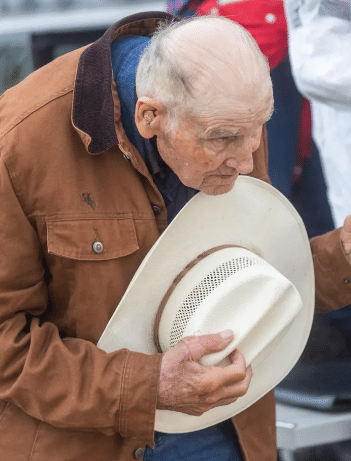
On the opening night of the Flint Hills Rodeo, Tex Junker, 86, of Roggen, Colorado, stood at attention as the national anthem was played. Junker started competing in the rodeo in 1956 and hasn’t missed one since. (Credit: Jeff Tuttle)

In the 1930s, Chase County rancher Emmett Roberts staged pasture rodeos on his farm west of Strong City. In 1937, he held his first organized rodeo event. The following year, Roberts teamed up with his son, Ken, and son-in-law Eddie Boysen, to host what they called the First Annual Chase County Rodeo. In 1939, the event was renamed the Flint Hills Rodeo.

It’s been going nearly continuously ever since. (The only year it was canceled was 2020, because of the pandemic.) Held the first weekend in June, the rodeo is still billed as “the oldest consecutive rodeo in Kansas.” The same arena and rodeo grounds that were built for the event back in 1948 remain in use today.

On the final day of the rodeo, the community celebrates with a parade leading south from town along Kansas 177 two miles to Cottonwood Falls. The liquor store, train depot and antique gas station downtown are popular spots for revelers to gather; a few rowdier participants prep water balloons for unsuspecting parade entrants.

Chase County Sheriff Jacob Welsh led this year’s parade, followed by emergency vehicles and work trucks, their passengers tossing candy as they drove by. Local Shriners performed tricks on Honda three-wheelers and squealed the tires on their tiny chopper bikes. Horses ridden by smiling and waving cowboys and cowgirls trotted down the street. More sweet treats were thrown from parade sponsor floats. Children watching roadside quickly snatched them up to add to their goody collections.

Then the onslaught began. The crowd, which banked water balloons in between games of cornhole, began using them, hurling aquatic grenades over people watching the parade. Some balloons landed with great effect, splashing against county firetrucks with a thump and a spray onto the pavement. At least one balloon careened into a car to douse its occupants.

Even chaotic merriment has rules. The rowdies knew better than to drench the driver of an immaculate 1967 Pontiac GTO. Other drivers, including some who weren’t trying to be part of the parade, didn’t get a pass.

From the skies, more water comes.

Rodeo organizer Cheryl Bailey laughed as she sought shelter from the rain for her and her ATV under the dance floor. Bailey’s grandfather helped build the bleachers that rodeogoers still sit on. Her family has been involved in the event for about 80 years.

“My dad was up here pulling ropes in the stripping chute,” Bailey says. “My mom was always helping. My grandpa always helped with stuff.”

Bailey has served on the Flint Hills Rodeo board for about 25 years.

“Her family’s been involved (in the rodeo) forever,” Holder says, “and that’s part of what helps keep an event like this going.”

Bailey, Holder and the roughly 200 other

volunteers who fan out across the rodeo grounds before, during and after the show work together every year to make sure the rodeo continues its legacy. There are no weather delays – except if there’s lightning in the area – and no rescheduling or postponing events. The rodeo carries on, rain or shine.

This year turned out to be a rainy one. Another deluge soaked the rodeo grounds as cowboys herded goats and calves into their pens ahead of the children’s competitions. The arena was mostly mud by the time the main event began. Some years, that’s just how it goes.

Holder admits that some years are better than others regarding ticket sales and attendance, but there’s a hearty core of people who attend, no matter the weather forecast. Rodeo competitors hold the event in high regard, seldom failing to mention how much fun it is to be part of a longstanding tradition.

Holder says there’s a thread of leadership embedded within the Flint Hills Rodeo, directly related to its homegrown origins.

“Leadership comes from ownership,” Holder says. “If you help build it, well, then you feel like you’re a part owner of it.”

As reported in the Kansas Leadership Center Magazine.