
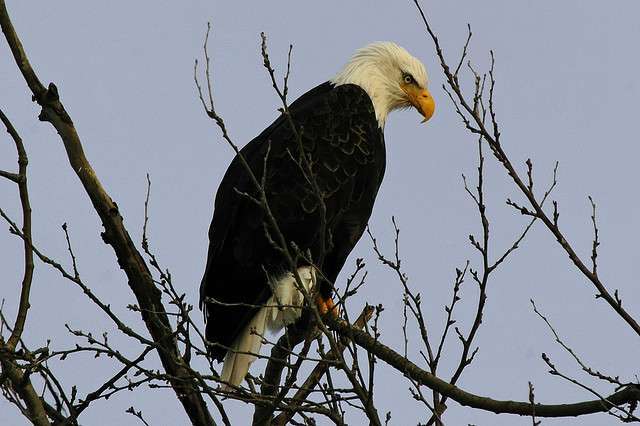
On June 20, 1872 the Great Seal of the United States was adopted, sporting the bald eagle at its center, and for the past 150 years the bald eagle has served as the living symbol of freedom, courage, strength, spirit, independence and excellence, all the things America stands for. June 20, was proclaimed nationwide American Eagle Day as a way to celebrate the bald eagle, Americas living symbol of freedom and to bring attention to its dramatic recovery from the brink of extinction. In honor of that, here are some bald eagle facts and trivia.
In the early 1960’s the bald eagle population in the lower 48 states had dropped to less than 500 nesting pairs, and in 1967 they were classified as endangered. In 1995, bald eagles were moved up to a list of threatened species, and today, thanks to conservation efforts there are estimated to be nearly 138,000 bald eagles in those same 48 states. Kansas Dept of Wildlife and Parks, (KDWP) estimates there to be 137 nesting pairs here in Kansas, and several thousand bald eagles spend time in Kansas each winter. The best time to view bald eagles in Kansas is from November through February, and the best viewing is near any of our large lakes and reservoirs and anywhere along the rivers.
Bald eagles often build nests 50 feet or more off the ground. Nests are not particularly pretty, resembling a haphazard pile of sticks. The same pair uses the same nest year after year, making them larger each time, and after several years a bald eagle nest can easily be the size of a small room. The largest eagle nest ever recorded was in Florida and measured 9 ½ feet across, was 20 feet high from top-to-bottom and weighed an estimated 4500 pounds. A female bald eagle lays from 1 to 3 pure white eggs once per year in the spring. When I still lived in Ohio there were numerous active eagle nests along Lake Erie, and a game warden friend of mine was in charge of overseeing those nests. He had hours of amazing video of them checking the nests and the chicks in them each spring. They did it by helicopter using 3 people; the pilot, a second person who was lowered from the helicopter down into each nest and a third person as a lookout, constantly watching the sky for the adult eagles to prevent them from flying into the helicopter blades, killing the eagle and crashing the helicopter in the process.
The majority of the bald eagle’s diet is fish and waterfowl, so when things freeze solid in the winter up north, the eagles migrate south to find open water where they can still fish. Even when our Kansas reservoirs freeze over, the rivers feeding each reservoir still offer open water. Kansas ice fishermen often leave a few carp or other rough fish on the ice for the eagles. The huge influx of waterfowl through Kansas each winter is also a big draw to eagles. From their vantage point 1,000 or more feet above the ground an eagle’s miraculous eyes can spot prey over a 3 square mile area.
Sadly, it seems American Eagle Day gets very little publicity. At a time such as this, with all the negativity about our country, all the internal division and all the other insane and Godless things the USA celebrates, there would seem to be no better time than now to find something to bring us together as Americans. So, on June 20,th take a little time to celebrate the tenacity of our national symbol the bald eagle, and to ask God to come back into our lives and to occupy the place He deserves here in what is still the best country in the world.
Steve can be contacted by email at [email protected].
American Eagle Day
Long-range profit

Country Medicine (2)

In late April, Kansas News Service reported on our ailing rural health care with focus on the hospital in Arkansas City ‒ not quite what “rural” means in the state’s wide western stretch, but rural enough. Farm country depends on this hospital 45 miles south of Wichita.
The hospital’s CEO, Jeff Bowman, said SCK Health lost $3 million last year and continues to lose about $250,000 a month. To save the hospital, Bowman and other hospital officials propose to close part of it. The idea is to shutter the inpatient unit and become a “rural emergency hospital”, an upscale clinic that provides only emergency and outpatient services.
Left alone to confront the problem, rural communities must find ways to manipulate the system. With a “rural emergency” designation, the Arkansas City hospital could qualify for more than $3 million in federal subsidies, and a five percent increase in Medicare payments.
To save part of a hospital, patients in southern Kansas sick enough to be admitted in Arkansas City must find a bed in, say, Wichita. Imagine the dilemma out west, where there are few cities even the size of Arkansas City (pop. 11,7000) or Wellington (7,600) and medical care, emergency or otherwise, is distant. In the land of few doctors and fewer clinics, serious help can be 50 or 100 miles away.
Arkansas City is not alone. The Center for Healthcare Quality and Payment Reform, a non-profit think tank, reports that Kansas per-capita leads America in the number of struggling rural hospitals. More than 80 of the state’s 104 rural hospitals are losing money. Half of them or more are at risk of closing. Five have closed since 2010.
The trouble stems chiefly from population decline. The 2020 census told a story of rural loss, especially in the west, where some populations dropped from ten to 16 percent in counties that had already lost thousands in previous decades. In central and southeast Kansas, similar declines.
As populations drop, hospitals and clinics wither, and doctors and nurses and the personnel who support them go away.
-0-
The opening page of the Kansas Hospital Association website features the flash of a “KanCare Expansion Ticker.” It’s a running total of federal funds Kansas has forfeited since January 2014, the state’s first opportunity to expand its Medicaid (KanCare) program. The Ticker cycles rapidly, dollar-by-dollar ‒ $100 every four seconds, $1,500 every minute.
Last week, the mounting total approached $6.4 billion.
Topeka and Washington jointly finance KanCare, which provides health coverage for about 400,000 Kansans ‒ children, pregnant women, individuals with disabilities and the elderly. All are poor.
Adults with children are eligible, but only if they make less than starving wages ($9,500 for a family of four). Adults childless aren’t eligible for coverage, no matter their income. About 150,000 Kansans ‒ rural and urban ‒ are left without coverage, and health care.
Kansas is one of 10 states that still refuse to expand Medicare, which would cost about $1.3 billion annually. The federal government would cover 90 percent of that, with the state’s share at between $34 and $42 million per year.
Without expansion, many hospitals and clinics will go deeper in debt or close.
-0-
Rural health care is the great afterthought in American politics, something for farm country to worry about. In Kansas, it is a Republican afterthought.
One poll after the next says 70 to 80 percent of Kansans, rural and urban, favor KanCare expansion. The Kansas Hospital Association, administrators, physicians, business leaders and government officials have repeatedly advocated expansion.
The Kansas House in 2019 passed a measure to expand Medicaid but Senate Republican leaders refused to allow the Senate to debate it. Since then, nothing.
Rural Kansas provides the Republican majorities of both chambers.
Five metropolitan counties elect 76 of the 125 members of the House, but it’s a deadlock, 38 Republicans and 38 Democrats. The other 100 counties elect two Democrats and 47 Republicans ‒ a rural majority that provides domination for House Republicans, 85-40.
The pattern holds for the 40-member Senate. Democrats are from metropolitan counties. The Republicans’ 29-11 majority includes ten rural Republicans who tilt the senate’s power balance. These Republicans might use their collective power for something their constituents need and want. So far they acquiesce, bowing to urban bosses who take their marching orders from distant cause lobbies and think tanks.
A lot of Kansans, rural and urban, need affordable health care. Opportunity has been knocking for nine years. Why wait for it to knock again?
Day 2, Kansas Wheat Harvest Report
Editor’s Note: The next harvest report is scheduled to be published on June 20, 2023.
Contact: Marsha Boswell, [email protected]
For audio file, please visit kswheat.com.
This is day 2 of the Kansas Wheat Harvest Reports, brought to you by the Kansas Wheat Commission, Kansas Association of Wheat Growers, Kansas Grain and Feed Association and the Kansas Cooperative Council.
Wheat harvest has been marching on for nearly two weeks in Cowley County, with numerous interruptions from rain, reported Kevin Kelly, general manager of Two Rivers Coop in Arkansas City. Harvest started in the area around June 7 and quality appears to be good with proteins in the 14 percent range.
Kelly said test weights are starting to decline slightly, due to most producers cutting their best fields first, but are still averaging 59 to 60 pounds per bushel. Overall, harvest results are dependent upon when the crop was planted — earlier-planted wheat has not fared as well as later-planted fields. While it was dry for a long period after the first of the year, the area did catch a few rains when the crop was filling, contributing to better-than-expected quality.
The co-op expects to take in about half the wheat of a five-year-average for wheat harvest, and harvest in the area is about 20 percent complete. Kelly said most of that will be processed domestically at U.S. flour mills, due to the need for bushels and a strong U.S. dollar that disincentivizes exports.
Just three counties to the west in Barber County, farmers are sending in quite a few samples, but moisture remains at 15 to 16 percent, according to Sarah Dodge, grain merchandiser with Farmers Coop Equity Co., in Isabel and Medicine Lodge. Producers are hoping this week’s hot and windy weather will mean harvest will be in full swing soon.
While the Medicine Lodge area did receive close to an inch from every storm system that has come through in the last few weeks, the rain is too little, too late to help the wheat crop in the area. Farmers are now seeing weeds that have popped up in the fields. Spotty hail damage added insult to injury for some.
“A little damage goes a long way in this poor crop,” Dodge said.
Dodge reported the 10-year-average for the co-op’s intake is a little over three million bushels. Last year wasn’t even half and this year if the co-op sees one million bushels, it would be a welcome surprise. Still, some producers are hopeful for some decent fields left standing, with the best expected to average 35 to 50 bushels per acre. Most of that wheat is likely headed up to flour mills near Kansas City, but Dodge is holding out for quality data before contracting.
Spotty, scattered rains late in the season is also the drumbeat across Wilson County in southeast Kansas. Nicole Small, who farms near Neodesha, said the first measurable rain came in May, when parts of the area got up to 5.8 inches of rain, while farms just eight miles away are still rated in D4 (exceptional) drought.
Small and her family expect to cut 800 of the 1,000 acres they planted to wheat this year, noting that the wheat was planted into milo stalks and partially grazed due to a shortage of forage. Those who have received moisture are battling seeps in the field with standing water and green sucker heads that make harvest a slog.
They have cut 200 acres so far with results all over the board. Yields for their fields are around 45 bushels per acre with acceptable test weights, while some neighbors are reporting upwards of 60 bushels per acre and others much lower.
Variability will continue to be a theme for the 2023 Kansas wheat crop as harvest continues to expand out from the southern central and southeastern portions of the state.
The 2023 Harvest Report is brought to you by the Kansas Wheat Commission, Kansas Association of Wheat Growers, Kansas Grain and Feed Association and the Kansas Cooperative Council. To follow along with harvest updates on Twitter, use #wheatharvest23. Tag us at @kansaswheat on Facebook, Instagram and Twitter to share your harvest story and photos.
###
Written by Marsha Boswell
Wheat Scoop: Dive into the wheat world this summer with the “Wheat’s on Your Mind” podcast
Contact: Marsha Boswell, [email protected]
For audio version, visit kswheat.com.
Whether it’s cutting in the combine, driving truck or rolling along in the tractor, Kansas producers can catch up on the latest wheat industry news with the “Wheat’s on Your Mind” podcast from Kansas Wheat.
“If you are looking for educational and entertaining coverage, check out ‘Wheat’s on Your Mind,’” said Aaron Harries, podcast host and Kansas Wheat vice president of research and operations. “We’re showcasing wheat stories for an array of audiences from across the supply chain, providing perspectives on how the wheat industry has grown, what the world of wheat looks like today and the future of wheat in Kansas.”
In Episode 1 and Episode 2 — One in a Brazillion, Harries sits down with one of the most recognizable voices in Kansas wheat-related meetings — Dr. Romulo Lollato, associate professor of wheat and forage production at Kansas State University. The pair chats about Lollato’s childhood in Brazil, where his passion for extension work really took hold and how he ended up at Oklahoma State then eventually here at K-State.
Episode 3 — Creating a Powerhouse: Jagger Wheat with Dr. Rollin Sears features the wheat breeder responsible for one of the most prolific wheat varieties — Jagger. Learn how the variety came to be, as Sears walks through the history of K-State wheat breeding.
Speaking of wheat breeding, Episode 4 — Yield vs. Protein: Breeding For Both, features a pair of wheat geneticists — Dr. Mary Guttieri, research geneticist with USDA’s Agricultural Research Service, and Dr. Allan Fritz, head of wheat breeding at Kansas State University. The dynamic duo team up to explain how yield and protein duke it out and what wheat breeders are doing today to create a variety that’ll reverse that.
Following the thread of K-State research, K-State College of Agriculture Dean, Dr. Ernie Minton, joins Episode 5 — Ernie Minton: The Land Grant Revamp to give listeners the rundown on what the plan for the future of K-State College of Agriculture looks like, including all the new, updated buildings in the works.
Taking a mental trip across the globe, Episode 6 — Aussie Wheat? He’s Your Guy – Guy Allen sits down with Harries to discuss Australian wheat production, marketing and trading. Together, they compare production between U.S. and Australia and discuss agricultural issues of the land down under.
Continuing to follow how wheat flows around the world, Episode 7 — This Little Grain Went to the Market: Wheat Trade with Dalton Henry has the Vice President of Policy for U.S. Wheat Associates joining the podcast to discuss trade policy — the technicalities and the practical impacts of policy.
The podcast would be remiss not to talk about the weather this year. Take a look back at the past few dry years in Episode 8 — How ‘bout this weather? With Christopher Redman. The Kansas Meosnet network manager gives his perspective on how the current weather patterns came to be — and you can rate his predictions for this summer and fall.
And as the Kansas wheat harvest kicks off, Episode 9 — More than just an estimate with Dave Green, Wheat Quality Council, sheds light on the history of U.S. wheat and why quality has only been cast in the spotlight more and more.
Kansas Wheat will be promoting individual episodes on the organization’s social media channels, but listeners should subscribe so they don’t miss any of the excitement. Listeners can tune in wherever they listen to podcasts, including Apple or Spotify. Or check out the podcast’s website at wheatsonyourmind.com.
###
Written by Julia Debes for Kansas Wheat
