

EquiFest Of Kansas To ‘Celebrate’ With ‘One-Of-A-Kind’ Horses And Country Music Evening Of Entertainment
A “Celebration” within a major celebration “Best” describes the Thursday evening, March 16, program during EquiFest of Kansas.
At the Saline County Livestock Expo Center and Tony’s Pizza Events Center (TPEC), March 16-19, EquiFest features everything horses.
“Expanded to four days this year, EquiFest will be extraordinarily special,” promised Justine Staten, Kansas Horse Council (KHC) executive director.
Serving the Kansas equine industry with leadership direction through education, promotion, and advocacy, KHC sponsors EquiFest as its main fundraiser.
“We predict ‘Celebration’ to be the most unique first-of-its-kind compilation of entertainment for horse enthusiasts,” Staten declared.
It’ll be a collaboration of Staten and Jennifer Gatrel, Cowgill, Missouri, beginning in TPEC Arena at 6 o’clock.
Program features liberty horsemanship Patrick Sullivan, Pegasus Riders, singer Gary Pratt, cowboy-actor Caleb Martin, singer-songwriter Savanna Chestnut, American Freedom Riders, Mustang champion Angeline Saliceti, and Western dressage Cyndi Harris.
“We are excited that Geff and Dawn Dawson will serve as announcers, play-by-play so to speak, for the program,” Staten said. “They are well-known throughout the Midwest for cowboy music, poetry, and storytelling to provide colorful commentary during the ‘Celebrate’ presentations.”
Gatrel has been obsessed with creating equestrian productions since childhood. She grew up and became a leader of Rodeo Kids, a large horse youth group performing acts around the country.
“Her favorite time of the year was the ‘Home Show’ where the horseback kids performed a full-length show,” Staten noted. “Jennifer worked at the legendary Dixie Stampede and loved the magic of entertaining and telling a story with horses.”
Later, Gatrel had a trick riding troupe offering custom event openings and riding, even had three years organizing ostrich racing.
Patrick Sullivan’s Modern-Day Horsemanship facilitates the connection between horse and human beyond the competition arena, Gatrel said.
“Old school horsemanship is combined with leadership techniques of today building solid foundation for every horse discipline,” according to Gatrel.
“Through a deeper connection between horse and human, Modern Horsemanship is encouraging the trust that enables healing, growth, and leadership.” Sullivan will also conduct several additional demonstrations during EquiFest.
“The Pegasus Riders are composed of two 12-year-old equestrian performers and their seven equine partners,” Gatrel said. “They specialize in trick riding, roman riding, dance, and equestrian liberty.”
Staten acknowledged, “These multi-talented kids have performed alongside the nation’s leading equestrian performers offering dynamic acts stunning audiences around the world.”
The Pegasus Riders will also present several additional colorful, action-filled personalized programs during EquiFest.
Gary Pratt is a National Cowboy & Western Heritage Wrangler Award winning cowboy and western singer, Gatrel pointed out.
“He is a songwriter, historian, storyteller, and accomplished guitarist who draws upon his military and ranching experience.” she said. Pratt’s diverse background is said to offer authentically classic performances for audiences of all ages.
“Caleb Martin is known for his natural acting talent, likable personality, and outstanding work ethic.” Gatrel said. “This has quickly earned him a great reputation among many professionals in the film industry.”
Martin has ridden horses since a young age, is an experienced professional horseman, and a winning rodeo team roper. “Recently, Caleb used his horse riding, musical vocals, and stunt skills in a prequel to the television show Yellowstone,” Staten noted.
Savanna Chestnut is a country music singer from Americus, who was a Team Blake contestant on The Voice television show. “She grew up singing in a family-owned bar and became a professional nostalgic country singer after high school,” Gatrel said.
“A Flint Hills native, Savanna’s voice is as clear and country as the prairie sky she grew up under,” Staten said. “Her singing and songwriting reflect her heartfelt, no-frills character.”
With a number of recordings along with songwriting awards, Savanna Chestnut will sing with backup from The Farm Hands Band.
Seven young cowgirls form The American Freedom Riders Drill Team from North Central Kansas. “They host fundraisers throughout the year representing the men and women who have fought for our great country,” Gatrel said.
“These cowgirls love riding and supporting our country,” Staten noted. “It’s their way of giving back to the families who lost a loved one and those fortunate to return home.”
The drill team will also be performing opening ceremonies for the EquiFest Ranch Rodeo performances Friday and Saturday evenings, March 17-18.
From Topeka, Angeline Saliceti and her Mustang Samson are both 16-years-old. “They have collected numerous state, region, national, and world titles in the most diverse performance competitions,” Gatrel pointed out.
Samson is from Wyoming’s Green Mountain Herd Management Area and was adopted from the Hutchinson Correctional Facility in 2012. “Both horse and owner then just six-years-old have accomplished so much as a unique team featured in worldwide media,” Staten said.
Specializing in Western dressage and working equitation, Cyndi Harris and her husband operate Antelope Creek, a horse facility at Udall. They board horses and Cyndi trains and gives lessons to students who have a wide variety of interests.
“Cyndi was born with a passion for horses. and has had an eclectic equine experience,” Staten said. “She has always used the elements of dressage in her training feeling that dressage is the foundation for every discipline.”
“About 50-percent of the ‘Celebration’ music will be sung live at the event,” Gatrel promised. “There will be fog, theatrical lighting, beautiful costuming, and talented equine and human performers.”
Staten acknowledged, “Jennifer Gatrel loves collaboration with talented horse people, and storytelling using the shared love of the horses. She believes a great show makes the audience feel a wide range of emotions from fear, love, joy, and even sadness.”
“We are so excited about the EquiFest ‘Celebration’ as a special new spectator attraction nobody wants to miss,” Staten invited.
“This extraordinary display of equestrian and musical talents showcases various arts and skills. A drill team, trick riding, Roman riding, liberty, Western dressage, and freestyle set to music, live and recorded,” Gatrel promised. “It’s a night of theatrical magic performances by talented equestrians and musicians a presentation only happening Thursday evening, March 16, at 6 o’clock.”
Actually, there will be even an advance EquiFest program with a breakaway roping clinic all-day Wednesday, March 15, at 8 o’clock, Staten pointed out.
More about the “Celebration” and complete EquiFest of Kansas schedule with details can be found at www.equifestofks.com.
+++30+++
CUTLINE
Top left to right, Patrick Sullivan, Pegasus Riders, Gary Pratt, Caleb Martin, Savanna Chestnut, American Freedom Riders, Angeline Saliceti, and Cyndi Harris will present ‘Celebrate’ opening night at the EquiFest of Kansas in Salina, March 16-19. Bottom right, Dawn and Geff Dawson will serve as announcers, play-by-play color-commentary, for the theatrical magic performances by talented equestrians and musicians.
Celebration Of Life For 101-Year-Old Rancher, War Veteran, Community Servant Phil George

“I can’t grieve. Phil had such a good life, got to do everything he wanted, a loving family, strong faith, a long life. How can I grieve?”
When sympathies were being expressed to Julia George after the passing of her husband of 73 years, she responded without remorse.
That positive feeling of heartfelt faith was reshared by an overflowing-church of family, friends, and neighbors at his life’s celebration.
Philip Woodbury George, 101-years-old, passed away February 12, in Emporia, with sacred memories February 25, at the Lebo Methodist Church. Julia George, 95, was in the front pew.
While funerals are generally intentionally sad occasions, this was not like that. Apparent laughter, grins and nodding smiles were commonplace as family, compadres, fellow-veterans, clergy shared remembrances of Phil George serving others.
Pastor Lori Schwilling concisely summarized best. “Once upon a time, a farm boy named Phil married a farm girl named Julia. They turned a schoolhouse into a farm home with beloved children of God lovingly caring for livestock and land. Phil now has a new home in Heaven to live happily ever after.”
Grandchildren reflected memories of “Papa” and recited Bible passages symbolizing the Phil George life.
Psalm 23: “The Lord is my shepherd; I shall not want…” Psalm 101: “I will sing of your love and justice; to you, Lord, I will sing praise…” Romans 14: “As for the one who is weak in faith, welcome him, but not to quarrel over opinions…” Romans 8: “There is now no condemnation for those who are in Christ Jesus…”
Common thread among his beloved grandchildren’s reflections. “Papa was patient, humorous, a storyteller with the strongest love for God, Grandma Julia, family, and his livestock.”
Born September 14, 1921, Phil grew up at Sunbyrne Farm on the Osage and Coffey counties line east of Lebo.
Second oldest of Frank and Harriet George’s four children, Phil attended the one-room Elmwood School and was active in 4-H. He graduated from Lebo High School in 1939 and started studying agriculture at Kansas State University.
Just before his junior year, Phil enlisted in the U.S. Navy in part out of respect for his high school friend. Harold “Skinny” Spatz was serving in the Army Air Corps and volunteered for the Doolittle Raid on Tokyo. That resulted in Spatz being captured, tortured, and ultimately executed after his plane crash landed in occupied China.
During World War II, Phil participated in multiple significant battles even sinking the Japanese battleship Yamato, biggest in the world. He flew more than 25 missions with the first flights to return over mainland Japan after the Doolittle Raid.
For his combat service, Phil earned the Air Medal, Gold Star, Distinguished Flying Cross, and Presidential Unit Citation.
“Probably now, one of the last great heroes of World War II has slipped into history,” said friend, fellow-veteran (serving in Vietnam) Jim Whitaker. “Phil George flew his plane #129 off the brand-new USS Hornet CV12 for the rest of the war after the original USS Hornet CV8, Skinny Spatz’ boat, was sunk during the Battle of Santa Cruz in Solomons.
“I was honored to escort Phil to Kansas City where he repeated war stores tempered with a few farm tales for more than three hours. Audience members corralled him in the aisle afterwards wanting more stories,” Whitaker noted. “Phil never forgot anything that happened to him after third grade and could repeat it verbatim, what a fabulous storyteller.”
At the celebration and later the Phil George grave, Whitaker placed a Soldier’s Cross on black granite with rifle bayonet centered in the gold star honoring the deceased veteran.
After the war, Phil George came back to college, was on the livestock judging team, and graduated with an animal husbandry degree in 1947. He returned to the farm and married Julia Gardner, Hartford farm girl who graduated with a degree in home economics.
His old Elmwood School building was purchased and converted into a residence for the couple, their three sons, Jay, Phil, Vern, and daughter Frances.
Dedicated first to family and faith, Phil was a rancher who served the community, an especial proud American Legion member. He had the honor of carrying the United State flag from horseback in the Memorial Day and Fourth of July parades annually with the last time when Phil was 99-years-old.
Devoted to the ranch operation, Phil had a Hereford cowherd and raised Quarter Horses ridden for handling cattle. In recent years, it was common to see Phil sitting straight in the saddle horseback checking pastures or moving cattle almost daily.
Nephew pastor George Pasley reflected. “Uncle Phil knew his whiteface cows each by name, his labor of love. Phil was their shepherd as God is our shepherd.”
Spending time assisting his uncle in earlier years, Paisley insisted, “Uncle Phil was the hardest worker I’ve ever known. He just wore me out trying to keep up with him.
“I heard a lot of memorable stories from Uncle Phil, but not nearly all of them. He lived 37,000 days and could remember what happened just about every day.”
The George family has had land along Frog Creek since the 1880s with multiple generations of neighbors helping one another. Eldest son Jay insisted, “Dad served God as a steward of the land, grass, water, livestock with the strongest work ethic.”
Still, Phil George wasn’t the most organized farmer, according to namesake son Phil. “Dad would lose something and spend half a day trying to find it. Dad really didn’t know how to build fence, so cows would often get out, He’d get them in, patch the fence with baling wire, and not think any more about it.”
Yet, middle-son Phil credited, “Dad lived through 18 presidents, 26 governors, 16 Kansas senators, 56 supreme court justices… From no phone to cellphone, Model-T to four-wheel drive pickup, Dad saw more changes than others ever have or will.”
Faith, family, and community “were important to Dad,” emphasized son Vern. “He never had problems with people. Dad knew everybody and loved every one of them.”
An avid sports fan, Phil grew up listening to baseball on the radio. He celebrated his 100th birthday by attending a Kansas City Royals baseball game.
Recovering after hip surgery, Phil’s main concern when a grandson visited was getting the television tuned for the Super Bowl. Sadly, Phil George with family beside him passed away that morning before being able to watch the football game.
Special celebration music was Home On the Range by Steve Sergeant and How Great Thou Art by Martin Jones. Recording of “Grandpa” by The Judds was played. Congregation joined in singing appropriate hymns from sheet music.
More than anything else, Phil liked to visit with everybody about everything. Whatever the occasion, Phil was the last to leave, always caught up in remembering and relating stories of bygone days.
The funeral director pointed out, “This is probably the first time Phil George has not been the last one out of the church” There were 11 casket bearers and 23 honorary bearer’s indicative of the vast family and friendships of Phil George.
Appropriately, a cowboy carrying the American flag was mounted on a ranch stallion leading the cemetery procession. Two mounted outriders followed, one leading a saddled riderless horse. Phil’s boots were reversed in the stirrups representing a fallen leader looking back on his troops for the last time.
A draft horse team drawn box wagon carried Phil George in a flag draped casket to Lincoln Cemetery.
Military graveside service included gun salute and taps by American Legion and Navy flag presentation for Phil George’s final resting.
“Amen” seeming most appropriate was repeated by the large gathering celebration.
+++30+++
CUTLINES
Philip Woodbury George, 101, Lebo rancher, war veteran, community leader, passed into eternal life February 12, 2023
Married more than 73 years, Julia and Phil George are in the portrait displayed during his life celebration which Julia, 95, attended.
Proud of serving in the Navy during World War II, Phil George remained active supporting the nation’s freedoms. As an American Legion leader, on horseback Phil traditionally carried the American flag in local parades the final time when he was 99-years-old.
Four horses led the Phil George funeral procession to Lincoln Cemetery at Lebo. The American flag bearer was followed by two mounted riders and Phil’s riderless horse with the veteran’s boots reversed in the stirrups representing a fallen leader looking back on his troops for the last time. A draft team horse-drawn box wagon carried Phil George in a flag draped casket to his final resting place.
Family and friends gathered as bearers carried the American flag draped casket with Phil George from the draft team drawn box wagon for interment at Lebo’s Lincoln Cemetery.
Friend Vietnam War veteran Jim Whitaker provided this photo of Phil George difficult to view at the left inspecting his World War II Navy airplane #129 on the USS Hornet after typhoon damage.
Jay George, right, oldest son of Phil George, accompanied the team drawn box wagon carrying his Dad to final resting in Lincoln Cemetery. (Jim Whitaker photo)
Appropriately a patriotic celebration as flags blew brilliantly in the wind as Phil George funeral procession arrived at Lincoln Cemetery. (Jim Whitaker photo)
A horse-drawn box wagon carried Phil George into Lincoln Cemetery with American flags brilliantly blowing the warm winter day’s wind. (Jim Whitaker photo)
A Solder’s Cross was placed beside the coffin during the Phil George Life Celebration and then at his Lincoln Cemetery gravesite by friend Jim Whitaker.
There were 11 casket bearers and 23 honorary bearers for the Phil George Life Celebration at Lebo. (Jim Whitaker photo)
Lettuce Eat Local: A stretching experience
Amanda Miller
Columnist
Lettuce Eat Local
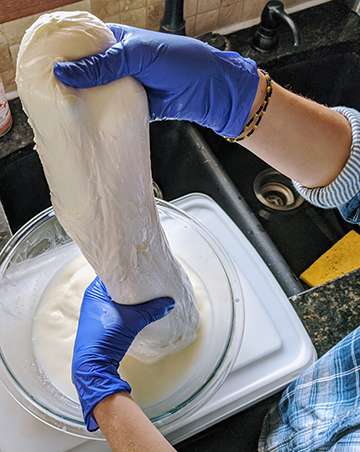
Stretch, twist, stretch again, fold, turn, relax. While this could sound like a yoga routine or a post-exercise cooldown, it can also be a description of the way I form and finish up my homemade mozzarella.
Or at least, it’s supposed to be. It is every time I make it at home, when no one is watching and counting on beautiful fresh cheese. But last week, with a dozen people paying rapt attention, of course things had to go very differently.
I used to teach lots of cooking classes as part of my job, so when I was asked by the local recreation committee to teach a cheese-making class, I was all for it. I love teaching, and my goodness I love cheese and any excuse to make and share it.
Growing up, I was used to my mom making lots of things at home, like bread, yogurt, granola, etc. But the idea of making cheese never crossed my mind — that is, until I married a dairy farmer and moved close to the family farm. My dad always worked for non-profits, so there was a “milk quota” in our house, especially during the teenage years with two brothers; it was such a shock to my system to have a 2000 gallon tank of milk at my disposal that my dairy creativity lost its cap. (Although “at my disposal” is not exactly how Brian would describe its availability, that’s how it felt to me.)
Suddenly I realized there are lots of things I could make, with a little investment of time, trial and error, and “free” milk. Let’s just say it’s even easier now that we live in the farmhouse and I can walk right across the lane with my kettle of milk, instead of requiring Brian to drive countless gallons of milk home. It’s a good thing his pickup is trash anyway, because those couple milk spillages did not make things better.
So I’ve thoroughly enjoyed being able to experiment with and expand on my dairy repertoire. But mozzarella remains one of my favorite cheeses to make, partially because it’s so familiar and so delicious, but also because it’s just plain fun. Making cheese always has its tangible “wow” moments — cutting the curd, realizing you just made CHEESE, eating your masterpiece — but mozzarella also offers a uniquely tactile experience. It’s one of the types of cheese you have to actually stretch and pull, and that process is strangely spellbinding. I’ve had to train myself to stop long before I feel done, so that the mozz stays creamy and soft, instead of letting myself go to town and stretch it until it releases too much whey, losing that distinctive texture.
All that to say, the stretching is the best part of homemade mozzarella (except for the eating). I feel like I have perfected the process over years of making it, so I was shocked and mortified in class when I reached into the pot of whey to pull out the stretch-ready mass of cheese…and came up with handfuls of crumbly little curds. No matter what I tried in order to fix it, that cheese was not about to stretch and string and form. The only thing I can figure out is that I pasteurized the milk for class in case anyone was squeamish about raw cheese.
But if I’ve learned anything from teaching cooking classes, it’s that people are generally so kind and forgiving. I hate to give them opportunity to prove it, but all I can do is own up to my mistake, rename the dish, and feed them something else delicious.
And if I’ve learned anything from making cheese, it’s that you can still eat flops. In fact, out of the slew of cheeses I brought to try, the class voted the failed cheese (dubbed “mozzacotta”) the best-tasting of the bunch.
Stretch, twist, stretch again, fold, turn, relax. While this could sound like a yoga routine or a post-exercise cooldown, it can also be a description of the way I form and finish up my homemade mozzarella.
Or at least, it’s supposed to be. It is every time I make it at home, when no one is watching and counting on beautiful fresh cheese. But last week, with a dozen people paying rapt attention, of course things had to go very differently.
I used to teach lots of cooking classes as part of my job, so when I was asked by the local recreation committee to teach a cheese-making class, I was all for it. I love teaching, and my goodness I love cheese and any excuse to make and share it.
Growing up, I was used to my mom making lots of things at home, like bread, yogurt, granola, etc. But the idea of making cheese never crossed my mind — that is, until I married a dairy farmer and moved close to the family farm. My dad always worked for non-profits, so there was a “milk quota” in our house, especially during the teenage years with two brothers; it was such a shock to my system to have a 2000 gallon tank of milk at my disposal that my dairy creativity lost its cap. (Although “at my disposal” is not exactly how Brian would describe its availability, that’s how it felt to me.)
Suddenly I realized there are lots of things I could make, with a little investment of time, trial and error, and “free” milk. Let’s just say it’s even easier now that we live in the farmhouse and I can walk right across the lane with my kettle of milk, instead of requiring Brian to drive countless gallons of milk home. It’s a good thing his pickup is trash anyway, because those couple milk spillages did not make things better.
So I’ve thoroughly enjoyed being able to experiment with and expand on my dairy repertoire. But mozzarella remains one of my favorite cheeses to make, partially because it’s so familiar and so delicious, but also because it’s just plain fun. Making cheese always has its tangible “wow” moments — cutting the curd, realizing you just made CHEESE, eating your masterpiece — but mozzarella also offers a uniquely tactile experience. It’s one of the types of cheese you have to actually stretch and pull, and that process is strangely spellbinding. I’ve had to train myself to stop long before I feel done, so that the mozz stays creamy and soft, instead of letting myself go to town and stretch it until it releases too much whey, losing that distinctive texture.
All that to say, the stretching is the best part of homemade mozzarella (except for the eating). I feel like I have perfected the process over years of making it, so I was shocked and mortified in class when I reached into the pot of whey to pull out the stretch-ready mass of cheese…and came up with handfuls of crumbly little curds. No matter what I tried in order to fix it, that cheese was not about to stretch and string and form. The only thing I can figure out is that I pasteurized the milk for class in case anyone was squeamish about raw cheese.
But if I’ve learned anything from teaching cooking classes, it’s that people are generally so kind and forgiving. I hate to give them opportunity to prove it, but all I can do is own up to my mistake, rename the dish, and feed them something else delicious.
And if I’ve learned anything from making cheese, it’s that you can still eat flops. In fact, out of the slew of cheeses I brought to try, the class voted the failed cheese (dubbed “mozzacotta”) the best-tasting of the bunch.
Marinated Mozzarella Bites
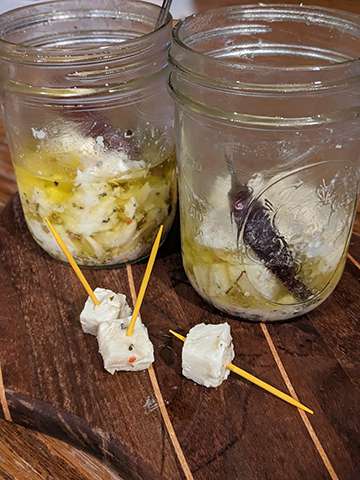
I can’t give you a recipe for homemade mozzarella due to its length, but I can give you a way to use storebought fresh mozz. Though of course I’m very partial to homemade, any cheese will shine when given a treatment like this! These flavor-packed cubes can be a fancy appetizer, or a make-ahead easy afterschool snack. Serve alone, with crackers, and/or on skewers with cherry tomatoes and fresh basil.
Prep tips: you can use whatever herbs and spices you want, but you do need to use fresh mozzarella, instead of “regular,” so that it can soak up the flavored oil.
1 pound fresh mozzarella, cut into 1” cubes
1 t salt
½ T lemon juice
2 garlic cloves, sliced
any combination of fresh or dried herbs
peppercorns and red pepper flakes to taste
olive and vegetable oil
Dump the seasonings and herbs into the bottom of a wide-mouth glass pint jar, fill the jar halfway with cubed cheese, shake it to distribute the seasonings (lid on!) and add the remaining cheese. Slowly pour some of both oils into the jar until it covers the mozzarella.
Lid tightly, shake, and chill. Allow to marinate for at least one day, rotating/shaking every so often to integrate the flavors. Bring to room temperature before serving.
Hutchinson Atwoods gearing up to open

After lots of stops and starts due to supply chain issues, the Atwoods in Hutchinson is getting ready to open this spring.
Atwoods is a family-owned and operated company with stores in Arkansas, Kansas, Oklahoma, Missouri and Texas. The ranch and home retail chain expects to open their 75th store in Hutchinson by mid to late April.
“We are extremely excited and look forward to the opportunity to serve Hutchinson and the surrounding communities,” said Michael Noak, a company spokesperson for the Enid, Oklahoma-based Atwoods.
Atwoods is going into the defunct Kmart store at East 30th Avenue and Lorraine Street. The store will be selling clothing, foot wear, lawn and garden items, automotive supplies, hardware, power equipment and pet supplies in its 56,000 -square-foot showroom.
“(We) carry everything that a family needs,” Noak said. “Whether working in the backyard or someone running a full ranch, Atwoods has it all.”
Like any other business, the new store needs workers.
“We are looking to employ over 50 team members and are actively hiring,” Noak said.
Interested applicants can apply at atwoods.com.
Kmart built the 87,000-plus-square-foot store in 1974. The store closed during the summer of 2016. It was one of almost 70 stores that closed that year.
Other Atwood stores in Kansas are in Andover, Derby, Park City and Salina. Atwoods helps community non-profits raise funds through their Saturday hot dog events.
