Friday, March 13, 2026
Home Blog Page 769

Farm2U makes the ag connection for Hutch kids

0

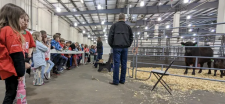
Keeping over 350 third-graders interested and engaged is no small feat, but the Reno County Farm Bureau Association’s annual Farm2U event does just that.On Monday, March 20, 10 Hutchinson and South Hutchinson schools brought their third-graders to the Prairie Pavilion at the state fairgrounds. The day was filled with presentations from local producers, with the goal of connecting the children back to agriculture, or as the program description says helps “educate the young consumers of our products about WHAT we do and HOW we do it, to help provide the Four F’s [food, fiber, fuel, pharmaceutics] here at home and around the world.”In their school group, the kids got about three hours to rotate through six sessions and lunch. Subjects included grains and elevators, farm equipment, all the good things that come from beef, sheep shearing, and how pizza gets from farm to table, as well as a mobile dairy exhibit. Lunch was pizza, to help bring things full circle.

“There is a real disconnect from agriculture in our communities as more and more people are multiple generations removed from the farm,” said Austin Schweizer, Farm Bureau board president. “Much of the simple knowledge that we as farmers take for granted isn’t known by these kids. Helping the kids understand where their food comes from and the important role that agriculture plays in our county and state is the goal.”Michelle Pitts, county coordinator at the Farm Bureau, is excited for kids to learn tangible things, things as simple yet as memorable as “what the Kansas skyscrapers (grain elevators) are all around town.”As the Wiley Elementary group finished up at the transportation and elevator session after getting to stick their hands in tubs of millet, corn and wheat, several kids enthusiastically designated “the thingamajig!” (the model of the grain elevator) as the “coolest” thing they saw that day. One dreamed, “If I could have one in my house….”

The initial reactions to the sheep-shearing demonstration weren’t quite as positive — lots of “Eww! Gross! Oh my gosh!” — but as soon as they got to feel the wool and see that the sheep was fine after its “haircut,” their tone changed completely. The beef cow and calf got lots of awws, as did the giant farming equipment in a different way.“I really want them to understand where their food is coming from,” said Schweizer, “so that when they sit down to a meal they start to think about where the food came from and the farmer or farmers that helped grow and produce it.”Pitts agreed. “I hope the event will plant a seed in the students’ minds of what agriculture is and how important it is by how it touches their lives every day.”

Ten Rules for Planting Trees      

0

  Before you begin spring landscaping, here are some tips on planting trees.

  1. Select the right tree for the site. To avoid serious problems, choose trees that are adapted to your location. Consider whether the tree produces nuisance fruit or if there are disease-resistant varieties available. For example, there are a number of crabapple varieties that are resistant to apple scab and rust diseases. Also consider the mature size of a tree to be sure you have enough room. Seehttps://hnr.k-state.edu/extension/info-center/recommended-plants/index.html or ask a local nurseryman for suggestions for trees adapted to your area.
  2. Keep the tree well watered and in a shady location until planting. When moving the tree, lift it by the root ball or pot and not by the trunk.
  3. Before planting, remove all wires, labels, cords or anything else tied to the plant. If left on, they may eventually girdle the branch to which they are attached. The root flare (point where trunk and roots meet) should be visible. If it isn’t, remove enough soil or media before planting so that it is.
  4. Dig a proper hole. Make the hole deep enough so that the tree sits slightly above nursery level. Plant the tree on solid ground, not fill dirt. In other words, don’t dig the hole too deep and then add soil back to the hole before placing the tree.

The width of the planting hole is very important. It should be three times the width of the root ball. Loosening the soil outside the hole so it is five times the diameter of the root ball will allow the tree to spread its roots faster.

  1. Remove all containers from the root ball. Cut away plastic and peat pots; roll burlap and wire baskets back into the hole, cutting as much of the excess away as possible. If you can remove the wire basket without disturbing the root ball, do it. If roots have been circling around in the container, cut them and fluff them out so they do not continue growing so that they circle inside the hole and become girdling roots later in the life of the tree.
  2. Backfill the hole with the same soil that was removed. Amendments such as peat moss likely do more harm than good. Make sure the soil that goes back is loosened – no clods or clumps. Add water as you fill to ensure good root to soil contact and prevent air pockets. There is no need to fertilize at planting.

 Note: Adding organic matter to larger area than just the planting hole can be beneficial, but it must be mixed in thoroughly with the existing soil and should “feather out” toward the outside edge of the area. This should be done before the planting hole is dug.  Adding amendments to just the planting hole in heavy soil creates a “pot” effect that can fill with water and drown your new tree.

  1. Don’t cut back the branches of a tree after planting except those that are rubbing or damaged.  The leaf buds release a hormone that encourages root growth. If the tree is cut back, the reduced number of leaf buds results in less hormone released and therefore fewer roots being formed.
  2. Water the tree thoroughly and then once a week for the first season if there is insufficient rainfall.
  3. Mulch around the tree. Mulch should be 2 to 4 inches deep and cover an area two the three times the diameter of the root ball. Mulching reduces competition from other plants, conserves moisture and keeps soil temperature closer to what the plants’ roots prefer.
  4. Stake only when necessary. Trees will establish more quickly and grow faster if they are not staked. However, larger trees or those in windy locations may need to be staked the first year. Movement is necessary for the trunk to become strong. Staking should be designed to limit movement of the root ball rather than immobilize the trunk. Ward Upham, Extension Agent

Asparagus

0

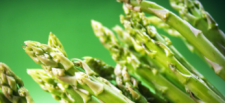
Asparagus is a perennial vegetable with three primary parts: the fluffy top is called the fern; the crown is the part just beneath the soil and the roots extend down from the crown. Each spring new edible spears (stems) emerge from the crown. To promote growth this season, last year’s stems and ferns needs to be removed now.

Old spears and ferns can be removed by hand or by gently tilling or mowing, using caution not to damage the crowns. Burning is another option if it is safe and legal to do so.

Asparagus spears emerge from early to mid-April in Manhattan but earlier in southern Kansas and later in northern Kansas.

Fertilize asparagus after the harvest, as needed, based upon a soil test. General recommendations are to apply 1 to 2 pounds of 10-20-10 or 11-15-11 fertilizer per 20 feet of row. If only nitrogen is needed, apply 1 pound of 16-0-0 or ½ pound of 30-4-5, 27-3-3 or similar fertilizer per 20 feet of row. Most of these high nitrogen fertilizers are lawn fertilizers but can be used for this crop as long as they don’t contain a weed preventer or killer. Water in the fertilizer application with ¼ inch of water.   (Cynthia Domenghini)

Controlling Weeds in Home Garden Asparagus Beds

The best time to control weeds in asparagus is early spring before the asparagus emerges. A light tilling (or hoeing) that is shallow enough to avoid the crowns will eliminate existing weeds. Many gardeners like to mix in organic matter during the same operation.

 Herbicides can be used before asparagus emerges as well. Glyphosate (Roundup, Killzall) will kill weeds that are actively growing, and the preemergence herbicide trifluralin can be used to kill weed seeds as they germinate. Trifluralin is found in several products, but not all of them list asparagus on the label.  Those that do have asparagus on the label include Miracle-Gro Weed Preventer Granules and Monterey Vegetable and Ornamental Weeder.  Mulch can also be used to keep weeds from invading.

 No herbicides can be used during harvest. The end of harvest presents another opportunity.  Remove all fern and spears and apply glyphosate (Roundup) to control virtually all of the weeds present.  After the harvest season is past and the asparagus starts to regrow, options are limited. Products that contain sethoxydim can be applied to asparagus to kill annual grassy weeds such as crabgrass. Sethoxydim has no effect on broadleaves including asparagus. Two sethoxydim products available to homeowners and labeled for asparagus are Monterey Grass Getter and Hi-Yield Grass Killer. With broadleaves, the only option is to pull them and look forward to next year.

Ward Upham, Extension Agent

Help for Vegetable Gardeners   

0

Kansans that are new to vegetable gardening often don’t know how much of each crop to plant. K-State Research and Extension has a publication that can help. The “Vegetable Garden Planting Guide” gives information on the size of planting needed per person and the average crop expected per 10 feet. Also included is a garden calendar highlighting suggested planting dates and expected harvest dates. Crop specific information is detailed including days to germinate, plants or seeds needed per 10 feet of row, depth of planting, spacing within the row and spacing between rows. You can find the publication at your  local county extension office or online at: http://www.ksre.ksu.edu/bookstore/pubs/mf315.pdf .  If you don’t know the location of your county extension office, see http://www.ksre.ksu.edu/Map.aspx.

Another, more in-depth publication titled the “Kansas Garden Guide” is also available. Newly updated, this 202-page publication has sections on planning a garden, composting, improving soil, seeding and planting, garden care, watering, planting gardens for fall production, insect and disease control, container gardening, season extension and harvesting and storing. This is followed by an extensive section on how to grow specific vegetables and herbs. You may access a free PDF copy of this publication at http://www.ksre.ksu.edu/bookstore/Item.aspx?catId=534&pubId=8219 .  A “for pay” print copy will be provided in the future.  Check the above link for availability of the print copy and price. These publications can also be useful for experienced gardeners.

Ward Upham, Extension Agent

Presentation Explores the Story of Kansas During the Civil War

0

Lyons, Kansas – The Rice County Historical Society/Coronado Quivira Museum in Lyons, Kansas will host “The Civil War in Kansas,” a presentation and discussion by Will Haynes on Sunday, March 26 at 1:30 p.m.at the Coronado Quivira Museum, 105 West Lyon, Lyons, Kansas. Members of the community are invited to attend the free program.

For Kansans, the violent guerrilla warfare between proslavery and antislavery forces known as Bleeding Kansas foreshadowed the national Civil War to come. From 1861-65, the border struggle continued to heat up as Kansans fended off Confederate attacks, accepted the formerly enslaved into their communities, and engaged in bitter political debates. Men of all backgrounds—white, black, and Native American—served in uniform, while women managed farmsteads and formed societies to help the needy. This talk presents the story of Kansas during the Civil War and how it helped shape the state’s image for years afterward.

Will is the director of engagement and learning for Watkins Museum of History in Lawrence, Kansas. He earned a PhD in history from the University of Kansas and has contributed to public history projects involving the New York Times, the Truman Library Institute, and the Kansas City Public Library.

“The Civil War in Kansas” is part of Humanities Kansas's Speakers Bureau and “21st Century Civics,” a collection of resources that invite Kansans to participate in community discussions and learn more about the history of American democracy and the shared responsibilities of citizenship.

“21st Century Civics” is made possible with support from “A More Perfect Union: America at 250,” an initiative of the National Endowment for the Humanities. Support for “The Civil War in Kansas” has been provided by the Freedom’s Frontier National
Heritage Area.

Contact the Rice County Historical Society at 620 257-3941 for more information. The program is made possible by Humanities Kansas. Humanities Kansas is an independent nonprofit leading a movement of ideas to empower the people of Kansas to strengthen their communities and our democracy. Since 1972, our pioneering programming, grants, and partnerships have documented and shared stories to spark conversations and generate insights. Together with our partners and supporters, we inspire all Kansans to draw on history, literature, ethics, and culture to enrich their lives and serve the communities and state we all proudly call home. Visit humanitieskansas.org.