Recently I attended the American Farm Bureau Federation’s Fusion Conference, which is a joint event between the Women’s, Programing & Education, and Young Farmers & Ranchers committees, in Jacksonville, Fla. One of my Collegiate Farm Bureau students won the state discussion meet and competed in the national event.
In addition to coaching, I was a workshop presenter on the topic of work-life balance, with a former YFR leader from Florida that I am friends with.
As I was packing to leave for the event, Marc and I were discussing my planned agenda for the event and I mentioned the workshop with my friend Morgan. Marc got a slightly confused look on his face and asked, “Do I know this Morgan?”
That’s what is funny about the relationships we build at these events. Someone I have only known a few years, visit with at an occasional national event, and am friends with on Facebook feels like so much more than just a professional acquaintance. Morgan and I have a connection through our jobs, mutual respect as leaders and a shared understanding of our industry and lifestyle. Our friendship is easy because our lives are very similar.
I also caught up with my college advisor from California, who I rarely get to see in person and is probably the most impactful mentor of my life. I visited with a fellow presenter who I have judged with in the past and respect tremendously. The conference organizer is a friend with whom I have a long professional and personal relationship. I am motivated and encouraged by time shared with my “far-away friends.” I come home with an enthusiastic and renewed sense of purpose.
Great people are one of the reasons I love attending these conferences. In addition to seeing old friends, I love getting to know new people with interesting backgrounds, listen to the perspectives of speakers and learn what is happening in other places. The information gained through new connections increases my knowledge, challenges my current views and often helps me find new solutions for problems I wrestle with at home.
Early in my career, I remember discussing as a board member whether or not to support a staff member’s request to attend a national conference. The board was divided in support of professional development verses funding constraints. The decision eventually came down to the board chair, who chose to approve the request.
He told the group, “One of the most valuable things I have done in my career is attend conferences and meetings. I have always come away better and think there is tremendous value in participating.”
Coming back better is one of the reasons we step outside our normal zones. I recently read that one of the most accurate predictors of career attainment is continuous learning and skill development. People who never stop growing are better off that people who were rose to top positions early career and maintained that position.
There is tremendous value and opportunity that comes when you attend events like conferences, seminars and conventions. Sometimes you have to step away from your normal circle of interaction to find new and interesting things to bring back.
If you have the chance to attend a conference or event, especially in a different part of the country, I hope you will embrace the opportunity, find people who make you better and gather lots of ideas that you can bring home to make your world just a little bit better.
A researcher at basketball powerhouse the University of Kansas, who took part in the Big Dance during his college years, is available to discuss the NCAA Tournament and scientific concepts related to the game of basketball with the media.
Dimitrije Cabarkapa, director of basketball research at KU’s Jayhawk Athletic Performance Laboratory, studies what makes successful basketball players. From biomechanics to strength and nutrition, Cabarkapa and colleagues research the common traits among successful basketball players at all levels from amateur to professional. Their findings can help coaches advance training designs to better prepare players or on-court competitive demands and scholars to better understand the physical and physiological demands of the game. He can discuss the tournament, the mechanics of proficient basketball shooters, the importance of shooting efficiency and rebounding for winning, the importance of strength and power on determining the competitive level of play, playing in the tournament and more.
“Basketball is one of the most popular international sports, and the NCAA Tournament brings even more viewers to the game,” Cabarkapa said. “I was fortunate enough to play in the NCAA Tournament, and even though I’m not playing anymore, I stay close to the game and every day get to learn more about what makes a successful basketball player. We’ll be seeing the best on the court, and they will undoubtedly reflect what the sports science is showing us to be critical characteristics of good basketball teams and players.”
Cabarkapa, a forward on the 2013 James Madison University team that played in the tournament, now conducts research at KU, home to the 2022 national champion Kansas Jayhawks. The Jayhawk Athletic Performance Laboratory, part of the Wu Tsai Human Performance Alliance, uses innovative technology such as 3D markerless motion capture systems to analyze the shooting mechanics of basketball players. Along with colleagues, he has published research examining biomechanical differences between proficient and nonproficient shooters, showing that players with greater lower body strength and power are more likely to have professional careers, the link between breakfast and basketball shooting performance and more.
When George W. Miller left his home state of Kentucky in 1869, he likely never dreamed of one day overseeing a huge Oklahoma Ranching empire, or that his sons would place the family name on a pioneering Wild West Show, but as it turned out, the visionary and ambitious Miller and his sons did just that.
George Washington Miller was born into a prosperous farming family on February 22, 1841, near the town of Crab Orchard, an early pioneer station on the Wilderness Road in the rolling hills of central Kentucky. Even though Kentucky was a so-called neutral state, Miller considered himself a true southerner and backed the Confederacy. Throughout his life he referred to the War Between the States as “The War of Northern Aggression.”
In 1866, twenty-five-year-old George married nineteen-year-old Mary Ann “Molly” Carson, his second cousin and stepsister. They tried to make a go of the plantation he had purchased from his grandfather, but Post-Civil War Reconstruction made for difficult times in loyalty-divided Kentucky, especially for men like Miller. The loss of slaves, among other things, gave rise to the decision to leave his home state for California and a new life as a rancher and farmer, and in 1869, Miller, his wife, their daughter and infant son, Joseph Carson Miller, departed Kentucky for the far West.
A winter stop-over in the southwest Missouri town of Newtonia introduced Miller to the cattle industry. He was fascinated, and instead of going on to California, he spent the next thirty years trail driving and raising cattle in Kansas, Indian Territory and Oklahoma.
Miller began his ranching career near Baxter Springs, Kansas, in 1871 as the partner of Texas cattleman Lee Kokernut. By then Baxter Springs had become the first Kansas Cowtown with a railroad line direct to the main shipping point at Kansas City, Missouri. Miller and Kokernut used the “Reverse LK” cattle brand and held pasture in southeastern Kansas and northeastern Indian Territory. By the mid-1870s young Joe Carson Miller, the oldest son, was starting to “cowboy” with his dad, and in 1878 a second son, Zachery Taylor, was born. The following year Miller moved his family from Newtonia to a ranch at Baxter Springs, and soon started leasing sixty thousand acres of range in the pasture-rich Cherokee Outlet of Indian Territory, dividing his holdings into two ranches. The Outlet’s northern most pasture was called “Deer Creek,” located along a creek so named and near where the town of Deer Creek was later established. The southern pasture, known as “Salt Fork,” was south of the Salt Fork River near present-day Lamont, Oklahoma.
By 1880 George Miller bought out Lee Kokernut, and moved all ranching operations into the Outlet. In the years that followed, he drove most of his cattle from Texas up the Chisholm Trail, then northeast along the “Arkansas City Freight Road” to where the “Hunnewell Trail” branched north near present-day Lamont. The “Hunnewell Trail” ran almost directly between Miller’s two pastures and on to Hunnewell, Kansas, just across the Indian Territory border.
When Hunnewell was first platted in 1880, Miller bought ninety-four acres of land west of town where he built loading pens, shelters and other facilities making Hunnewell his principal trail driving destination and railroad shipping point. To conduct his cattle business, Miller required a large heard of horses and kept a full-time crew year-round in Hunnewell to care for the stock coming in off the trail. Between drives, the crew busied themselves with breaking and caring for new horses that were shipped in to replenish his herd.
In those early days, the 101 Ranch bought most of its supplies in Hunnewell which had one of the biggest outfitting stores in southern Kansas. The structure was built with heavy plank floors so that a cowboy could ride his horse right into the building, buy his goods and leave by another door. The sturdy structure, now long-gone, was located across the street south of the three-story Hunnewell House Hotel.
It was during this period of Miller’s ranching in the Cherokee Outlet that he first employed the “101” brand. Years later, the family recalled that John Hiatt, a range-hand and nephew to George Miller, “built the brand fire that burned the first ‘101’ on a cow.” Miller made up several irons, some for branding the cow’s horn, others for conventional branding on the hide.
According to John Hiatt’s memoirs, the “101” brand had nothing to do with the amount of land the Miller’s eventually owned, a misconception that came about in later years. Rather, the brand dates to a much earlier time and was derived from George Miller’s unique way of punishing his wild, drinking-prone cowhands. Hiatt said the “101” mark was first used on a cattle drive north from San Antonio. He explained that “when the boys arrived in town, they were in the habit of getting falling down drunk, usually at their favorite San Antonio saloon named the ‘101.’’’ Rounding up his bunch to work the next day after their first hell-raising night in town was difficult and time-consuming for Miller, and it usually involved the local police, court fines and several trips back and forth to town gathering his men before they could begin their drive back north. Miller came up with a plan for payback and told the boys, “When I’m through you’ll wish you’d never seen the ‘101’ because I’m gonna’ make you put it on every cow I own!” That was the beginning of the “101” brand, not only on livestock but just about everything else that belonged to the Millers.
On September 9, 1881, a third son, George Lee Kokernut Miller, was born to George W. and “Molly” Miller at the family home in Baxter Springs. Later that year, Miller decided to move closer to his ranch holdings in the Cherokee Outlet and bought a home in Winfield, Cowley County, Kansas. Although the Millers appreciated the cultural and social activities in Winfield, they kept their children out of public schools, tutoring their three boys and sister Alma, at home, but Joe and Zack spent most of their time working cattle their father.
The elder Miller, then in his early forties, personally watched over his cattle holdings and often lived with his crew in their first ranch headquarters along the Salt Fork River. About 1880 they built a combination cabin and dugout that consisted of three rooms, and with it a branding pen, storage for feed corn, and a crude horse barn. Miller’s day-to-day work on the cattle range was illustrated by a Winfield Courier newspaper article dated November, 1883. It reported a “cattle thief was caught by George W. Miller about twelve miles west of Wichita.” Miller trailed the man from the Outlet and “followed him around the country until he finally caught up with him.” Miller “pulled his Winchester,” said the newspaper, and took him to jail. It concluded that, “George is a good thief catcher.”
In 1893, shortly before the Cherokee Outlet opened to settlement on September 16, Miller began leasing thousands of acres of additional pasture along the Salt Fork River on the Ponca Indian Reservation. The lease price was only a penny per acre; a superb deal made possible because the Miller family had been friendly to the Ponca Tribe for years. They had helped feed the Poncas when the tribe was first forced into Eastern Indian Territory a few years before, and, ultimately helped them negotiate with the government for more suitable reservation land in the Cherokee Outlet. Thus, leasing reservation land to the Millers was an easy choice for Ponca leader White Eagle, and by 1902, Miller had 50,000 acres in pasture and under cultivation. A year later, the federal government began allowing the Poncas to sell land to the Millers. That, along with other negotiated purchases from the Otoe, Pawnee and Osage tribes, eventually allowed the 101 Ranch to extend into parts of four Oklahoma counties, establishing what we know today as the sprawling 101 Ranch on land then actually owned by the Miller family.
As it happened, George Miller never saw his ultimate vision for the ranch, including the landmark home that came to be called the “White House.” On April 25, 1903, he died of pneumonia in a crude dugout the Millers then used as their new ranch headquarters. His wife had the ranch turned into a trust with Joe as chairman and Zack and George as the only other members. The sons divided responsibilities with Joe running the overall operations and farming, Zack controlling the livestock, and George handling the finances.
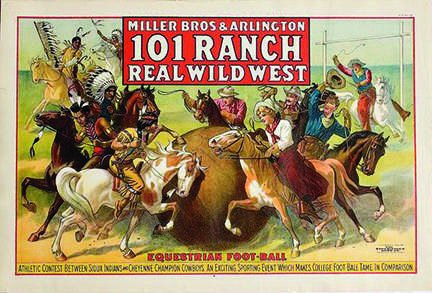
With their father gone, the sons continued his vision, ultimately building the 101 Ranch into a highly diversified farm and stock raising complex that was supported by its own on-site electric plant, a cannery, a dairy, a tannery, a store, and several different mills. In 1905, the forward-thinking brothers ventured into show business by staging a Wild West exhibition and rodeo at the 101 Ranch. The Miller “Midas Touch” had struck again, and the exhibition evolved into the World famous 101 Wild West show.
The vision of George W. Miller and his sons will be celebrated Friday and Saturday March 24 & 25, 2023, in Blackwell, Oklahoma during the annual 101 Ranch Western Memorabilia Show. The event at the Kay County Fairgrounds Livestock Center features 101 Ranch and Wild West Show artifacts as well as other Western memorabilia for viewing or sale including original cowboy gear, firearms, assorted antiques, rare photos and ephemera.
The show, presented by the 101 Ranch Collectors’ Association, is open to the public Friday 1 pm to 6 pm and Saturday 9am to 4pm.
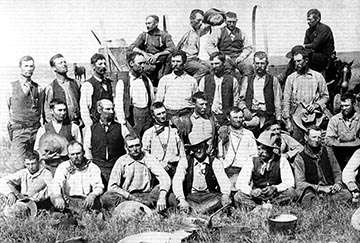
101 Ranch cowboys in the Cherokee Outlet during a roundup in 1890.
This is probably going to become one of my most intriguing columns. You can thank my dad, Jerry, for the content, well, I should be saying inspiration. I introduced Thuringer to my immediate family around 2010. Everyone ate it, comparing it to summer sausage and I continued to purchase it, every so often.
Recently I introduced it to my dad. Now he has small Ziploc bags of it in his freezer for snacking. I couldn’t believe my dad, at the wonderful age of 91, had never heard of it, let alone passed it across his palate.
Prepare for a journey back to the 15th century, yes my friends, it goes that far back. Actually additional research shows this old fashioned German meat was used before World War II. There are varying articles regarding how it is served and prepared. In the old days it was served mostly cold, and not hot. Times change and it becomes smoked like summer sausage. When canning was a prominent way of preserving this sausage was made into patties and preserved.
What goes in Thuringer? Usually a mix of beef & pork, both very well ground, and often made from the poorer cuts of meat. Many times it was seasoned with salt, smoked bacon, coriander, caraway, marjoram, pepper and even unique ingredients like lemon. It started in a Germany region called Thuringer. The original name was: ‘Thuringer Bratwurst’ because it was actually made into a sausage style much like a brat. They were cooked on a grill or stove much like folks do today. However like different types of pasta, the presentation of thuringer changed through the years, in this nation we usually see it in a presentation like summer sausage. You can even make it fresh at home like a sausage patty. In the old days the curing time was about a month.
Thuringer was sold raw in markets and you took it home to cook. Usually it was basted with beer on both sides. In the home or on a grill you are encouraged to cook it on low/medium heat because high heat will cause all the fat content to dry out. Remember when the liquid is removed from fat cells salt will take its place, which can enhance flavor. I make this comment because a local friend commented when she cooks Thuringer the salt comes to the top. One thing to remember about Thuringer is it has a higher fat content than other cured meats so it could go bad at a faster rate. Always read the expiration label on this product. If it’s close to expiration, slice it and freeze, like my dad does. Also you will find the carbohydrates much lower in this form of sausage.
If you’re smoking the sausage yourself hardwoods are recommended, especially beech or oak. Germans usually serve their thuringer with cabbage dishes.
One factor I find very interesting is the fact that it contains very few artificial ingredients and its low on preservatives and chemicals. Perhaps this is another good reason to make your own summer sausage. (It’s the reason I do) Do consider removing the casings on your thornier, it can be tough and it doesn’t always contain healthy things.
Whether you are making a summer sausage or thuringer there is going to be salt. This lowers the PH level in meats of this nature, which helps prevent bacteria. Remember you don’t use regular salt for this type of meat, usually its curing salts.
If you make your own summer sausage and prepare it using liquid smoke I highly encourage you to go on line and purchase an organic liquid smoke. NO nitrates and it’s so much better for you. You might want to get 2 bottles because there are lots of places you could put liquid smoke, especially if it’s good for you. *Hint
I like it in my baked beans.
There is a subject on something called: ‘cutter phosphate’ I would like to address briefly. I don’t think it is used as prominently today as it was in times past. It was added to older meats mixed with ice to restore the binding ability. Which is lost as a meat ages. (We could chatter on this subject for a very long time.)
OK, how much does it cost and where do I get it? The last few times I purchased Thuringer in a market, I have paid very low prices like 3.99 lb. However that was usually in a Mennonite or Amish market. At a local grocery store within 8 miles from my home it is currently selling for 13.99 a lb. I know, shocker isn’t it?
Actually the first time I had Thuringer was from our local Harter House Market here in the Ozarks. The guys at the meat counter knew me well because of my culinary work at Silver Dollar City. They enjoyed teaching meats and introducing me to new things.
Recipe? I don’t have one yet! I’m going to let you go on line and pick one you like. What I might do here is give you a little comparison to my summer sausage recipe. I’m not going to give all the instructions we’re just going to study amounts
as if I were writing a Thuringer recipe, keyword IF!!!
Summer Sausage
5 lbs. ground chuck
5 teaspoons curing salt
4 teaspoons ground mustard
4 teaspoons pepper
3 teaspoons garlic salt or powder
1/2 teaspoon cayenne pepper, could omit
7 teaspoons liquid smoke
Full recipe in my first cookbook
I think if I used some pork my Summer Sausage would be moister.
Keep in mind if you’re just making Thuringer patties you don’t want to use curing
salt, perhaps just a teaspoon or two of regular salt. You can always create your own sausage patties at home, with your favorite mixes of spices. My mom used to do so with fresh turkey all the time. Deer hunters you will also find Thuringer recipes using your fresh venison.
Well, I told you this column would be different. Now you’ll have to go find some Thuringer and try it! Simply Yours, The Covered Dish.