Sunday, March 15, 2026
Home Blog Page 807

Kansas Technology Company Viaanix Announces New Technology for Agriculture Industry pplications

0

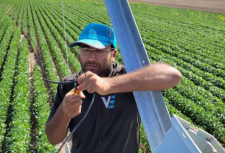
Viaanix, an emerging technology company located in downtown Wichita, is
proud to announce the successful development of groundbreaking technology and the intent to move to market.

Over the past decade, Viaanix has invested heavily in the development of state-of-the-art
software that can best be described as a universal translator for communication data, such as Bluetooth, cellular, GPS, RF, and more. This software sets Viaanix apart in the industry and has positioned the company to rapidly become a leader in IoT solutions.

As a proud Kansas tech company, Viaanix is committed to investing in the community and
technology development. With a unique combination of hardware and software experts under one roof, Viaanix sets itself apart from other related businesses that focus heavily on either software or hardware. This gives Viaanix flexibility to rapidly prototype and create original equipment in-house, setting them apart from competitors.

The company’s future plans include continued investment in the Wichita area and technology development; to meet the ever-evolving needs of the IoT industry, and to help ensure Kansas keeps its seat in the technology industry.

We are thrilled to be located in Wichita, Kansas and bring emerging technology to the
Midwest, said Jatin “Jay” Talreja, CEO of Viaanix. Our investment in the community and
technology is a testament to our commitment to excellence and our dedication to serving the needs of our clients.

Kansans should feel proud to have such a forward-thinking technology company in their midst. Viaanix is a shining example of the Midwest ability to compete and lead in the technology industry.

For more information on Viaanix, please visit www.viaanix.com.

Youth Lawn Mowing Clinic

0

Wednesday March 15, 2023

Two Sessions:  9:20 a.m.-11:30 a.m. & 1:20 p.m.-3:30 p.m.

 Sedgwick County Extension Education Center, 4-H Hall

7001 W. 21st North, Wichita, KS 67205

 WICHITA – Two sessions of the Youth Lawn Mowing Clinic will be held at the Sedgwick County Extension Education Center at 21st and Ridge Road in Wichita on Wednesday, March 15th, 2023. The first clinic will be held in the morning, from 9:20 a.m. – 11:30 a.m., and the second clinic will be from 1:20 p.m. – 3:30 p.m. in the afternoon. The clinics are designed to assist youth in learning the basics of safely running a lawn mowing business and earning summer income.

 Information presented will acquaint youth with the different types of lawn grasses that grow in our area and how to properly care for each type. In addition, the training will familiarize youth with knowledge of lawn mower safety, lawn mower maintenance, and the business skills necessary in order to run their own successful lawn mowing business.

 The cost is $10.00 for registration through March 3rd, or $15.00 after that date. Space is limited so please register early, as classes do fill up. Register online at www.sedgwick.ksu.edu/events.

 Who should attend:  Any youth in grades 5-9 who wants to learn a way to earn summer income or gain lawn mower safety knowledge.

Two sessions will be offered:

The morning session will run from 9:20 a.m. – 11:30 a.m.; Check-in starts at 9:00 a.m.       

The afternoon session will run from 1:20-3:30 p.m.; Check-in starts at 1:00 p.m.

 Graduation: While attending the clinic, each youth will receive a lawn care information packet, business cards, and safety equipment. At the conclusion of each clinic, a short graduation ceremony will be held and each participant will receive a certificate of completion.

 The Youth Lawn Mowing Clinic is sponsored by K-State Research & Extension – Sedgwick County and the Sedgwick County Extension Master Gardener Volunteers. 

 Register online at www.sedgwick.ksu.edu/events. The early registration deadline is March 3, 2023. For more information, call 316-660-0100.

Pruning Overgrown Apple Trees  

0

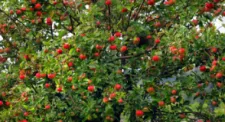
Apple trees that are not pruned for several years will often produce so many branches that little energy is left for fruit production. Overgrown apple trees are also difficult to harvest and spray. Gardeners who have such a tree are often at a loss as to how to get it back in shape.

Often the best recommendation for such a tree is to make one pruning cut at ground level and start over with a new tree. However, trees may have sentimental value that will make

revitalization worth the time and effort. Realize that this will be a multi-year process because no more than 30 percent of the tree should be removed in one year. Here are some steps to follow:

  1. Remove all dead wood. This does not count toward the 30 percent.
  2. Remove suckers from the base of the tree.
  3. Choose approximately six of the best branches to keep as scaffold branches. Remove all others.

Branches should be cut flush to the branch collar without removing the collar. The collar is the natural swelling that occurs where a branch connects to the trunk or to a larger branch. Removing the collar would leave a larger wound that would take additional time to heal.

Do not paint wounds. Wounds heal more quickly if left open.

Candidates for removal include branches with narrow crotch angles, which are more likely to break in wind and ice storms, and those that cross branches that  you will save. This may be all that is possible the first year if the 30 percent threshold has been reached.

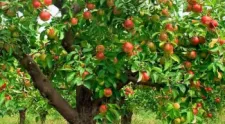
  1. Thin the branches on each scaffold branch. Remove crowded branches to open up the tree to light and allow humidity to escape. Shorten each scaffold branch by cutting back to a side branch. When you are through, the tree should have enough wood removed so that a softball can be thrown through the tree.

 Severe pruning often will cause an apple tree to produce vigorous side shoots from the trunk called suckers. Main branches will also produce water sprouts that grow straight up. The suckers and water sprouts should be removed throughout the growing season so the center of the tree stays open.  Do not wait until spring to prune out water sprouts and suckers as this will stimulate the tree to produce more.   Removing water sprouts and suckers is the most time consuming and difficult practice necessary to bring an overgrown apple back into shape.

Ward Upham, Extension Agent

Pruning Fruit Trees 

0

Fruit trees can be pruned from now through March as long as the wood isn’t frozen. Following are some general recommendations on pruning mature fruit trees followed by more specific instructions on each species.

 General Recommendations

– Take out broken, damaged or diseased branches.

– If two branches form a narrow angle, prune one out. Narrow angles are weak angles and tend to break during wind or ice storms.

– Take out all suckers. Suckers are branches that grow straight up.  They may originate from the trunk or from major branches.

– If two branches cross and rub against one another, one should be taken out.

– Cut back or remove branches that are so low they interfere with harvest or pruning. If cutting back a branch, always cut back to another branch or a bud. Do not leave a stub.

– Cut back branches to reduce the total size of the tree, if necessary.

– Thin branches on the interior of the tree.

Follow the steps above in order but stop if you reach 30% of the tree.

Specific Instructions

Peach and Nectarine: Peach and nectarine require more pruning than any other fruit trees because they bear fruit on growth from the previous year. Not pruning results in fruit being borne further and further from the center of the tree allowing a heavy fruit crop to break major branches due to the weight of the fruit. Prune long branches back to a shorter side branch.

 Apple: Apples tend to become overgrown if not pruned regularly. Wind storms and ice storms are then more likely to cause damage. Also, trees that are not pruned often become biennial bearers. In other words, they bear a huge crop one year and none the next. Biennial bearing is caused by too many fruit on the tree. Though pruning helps, fruit often needs to be thinned as well. The goal is an apple about every 6 inches. Spacing can vary as long as the average is about every 6 inches.

Cherry, Pear, Plum: Light pruning is usually all that is needed. Simply remove branches that are causing or will cause a problem according to the general recommendations above.

For more detail on all aspects of fruit tree pruning, see the following two publications:

   MF3450 “Pruning Apple and Pear Trees” at https://bookstore.ksre.ksu.edu/pubs/MF3450.pdf

   MF3451 “Pruning Peaches, Plums, Cherries and Other Stone Fruits” at https://bookstore.ksre.ksu.edu/pubs/MF3451.pdf

Ward Upham, Extension Agent

Fruit Trees to Plant?

0

If you’re pondering that question, here are some comments on fruit trees commonly grown in Kansas. Fruit trees are a long-term investment requiring careful thought before purchase. Begin by choosing fruit you will eat, not fruit that appears attractive in the catalog. Other considerations are outlined below. Space doesn’t allow for a complete list in this newsletter. For more choices, go to the publication “Small- and Tree-Fruit Cultivars” at http://www.ksre.ksu.edu/bookstore/pubs/MF1028.pdf  You may also request this publication from your local K-State Research and Extension office.

Apples: Though we can grow a wide variety of apples in Kansas, pest-free fruit requires an extensive spray program. Apples are normally sprayed from March (dormant spray) until about two weeks before harvest. Sprays from April on throughout the growing season are applied at least every two weeks.  As an alternative to many sprays, bagging can be used.  See https://www.youtube.com/watch?v=sbbmgJ5F1wc for more information.

You need two different varieties of apples to produce fruit. Recommended varieties include Jonathan, Gala, Empire, Delicious, Golden Delicious, Jonagold, and Granny Smith. Recommended apples that are disease resistant include William’s Pride, Enterprise, Priscilla, and Redfree. Planting disease-resistant apples will reduce, but not eliminate, the need for pesticide applications. None of the apple varieties listed above are resistant to the summer apple diseases sooty blotch and flyspeck. It may be necessary to periodically apply a fungicide in the summer to suppress these fruit blemishing diseases. Also, all of the varieties listed will require protection from codling moth and other insect pests. The codling moth larva is the most common “worm” in the apple.  Bagging will eliminate the need to spray for diseases and insects on the fruit once the fruit is bagged.

Cherries: Sweet cherries (such as Bing) are not well adapted to Kansas, but sour (pie) cherries are. Cherries are borne in June, so relatively few sprays are needed. Many years you may get by with no sprays at all. Only one tree variety is needed for fruit on sour cherries. Recommended sour cherries are Montmorency, Meteor, and North Star. The latter two are genetic dwarfs with Meteor reaching 10 to 14 feet and North Star growing to 8 to 10 feet.

Apricots: Apricot trees are quite ornamental, which is fortunate because late spring frosts usually eliminate fruit. On average, assume you will get fruit about once every 5 to 10 years. Portions of western Kansas may see fruit only once every 30 years. Almost all varieties of apricot are self-fruitful. Recommended varieties include Moorpark, Goldcot, Manchu, and Superb.

Peaches: Usually a relatively short-lived tree (10 to 12 years) that needs a great deal of pruning to keep productive. Peaches have the same problem with late frosts that apricots do but may not be quite as sensitive. Only one tree is needed for fruit. Try Intrepid, Contender, Redhaven, Harken, and Reliance. Intrepid blooms later than other peaches and blooms are much more frost resistant.

Pears: Pears are tough and are often one of the few trees that survive on an old homestead.  Though trees should be sprayed, the chance of getting good fruit without spraying is much better than it is with apples. Usually, two trees are needed to get fruit. Proven pears include Seckel, Moonglow, and Duchess.

To learn how to control fruit pests see our publications page for fruit at https://hnr.k-state.edu/extension/horticulture-resource-center/publications/publications/food-crops/fruits-and-nuts.html    Scroll down to “Spray Schedules.

Ward Upham, Extension Agent