
“The horse business has many definitions and can go a wide variety of directions.”
Horses are an addiction for certain people who feel they can’t be without them. Sometimes, it seems an inherited trait as children often have parents with deep fondness for horseflesh.
People can become enthusiastic about horses at any age in life. But most others wanted and enjoyed horses from early childhood.
Studies have long proven therapeutic benefits of horses physically and mentally. Working with horses is exercise for the body and the mind improving health.
Today, horses are generally a hobby and often a very expensive one. Still for others and a much smaller number, horses are a lucrative profession.
Breeders raise horses to sell, and trainers teach both horses and riders. Cattlemen use horses for checking, doctoring, and gathering cattle.
Rodeo competitors ride horses in their professional sport. Traders buy and sell horses as a fulltime enterprise. Occasionally, hobbyists participating in horse shows have profitable returns.
In more than six decades, every one of those horse endeavors has been tried in some form or another. With limited financial success, it’s generally been enjoyment handling horses, hobbyist rather than business entrepreneurship.
Example is breeding horses to raise and sell. That began with Spot the mare bred in the second year of horse ownership. She produced a filly who was trained and sold for a small profit.
Foals have been raised nearly every year since. Goal at one point was to have 40 foals born annually, but it didn’t grow to that point. Two dozen was likely the largest number in one year.
Never a dedicated bloodline geneticist breeder, babies for 25 years were sold in the ranch production sale featuring “The Cowboy’s Kind.” Although not bringing large amounts, they did help pay down some land and other operating debts.
Like all commodities, which horses really are, the market deteriorated so work involved in production lost the romance. Still, the mares were heartfelt part of the ranch whether profitable or not.
Nine mares were retained to raise foals which were for a decade given away by personal choice.
Horse demand has come back, so horses are again a profession. Five foals were raised this year and sold for small income.
Reminded of Ruth 4:7: “This is how they handled official business regarding matters of property.”
+++ALLELUIA+++
XVI–48–11-27-2022
Turning Back To Business
Story with a moral
Recently, while down-sizing my life, sorting through a stack of folders I ran across a bunch of “Ruff Times,” an economic newsletter published back in the 1980s by Howard Ruff. I can’t even remember why I kept them.
Mr. Ruff has long passed from the scene, and his newsletter ceased publication decades ago, so I decided to shred the newsletters to add to my growing compost pile.
I’d forgotten that some of the newsletters contained nuggets of wisdom, subtle laughs, or insightful stories with a moral to them. That’s when I spied one of his newsletters with just such a nugget.
I decided to republish it, with due credit, because our nation’s current fiscal malaise is quite similar to the one it was suffering through back in the days of the 1980s farm and financial crisis. So, here’s the story:
“It came to pass that two young cattle mites fell in love, and after a short courtship married and settled down. They found a large, old, fat, docile bull for a home.
“Theirs was truly an ideal life. Food, shelter, and warmth were provided at no cost. There was a free and comfortable housing unit in every wrinkle and hair follicle. Life was sweet and easy. All they did was eat, sleep, play and multiply. Freedom from want and fear had been attained. They and their offspring enjoyed the abundant life — never giving the old bull, their benefactor, a second thought.
“However, eventually, the old bull, became sore-footed, short-toothed, and unable to forage well. Gradually he grew weak and weary. Unable any longer to support the hungry and rapidly multiplying free-loading population of mites, he finally staggered off into a pasture gully and went hooves-up.
“Within hours, consternation was aroused among the mites. They held meetings protesting that the economic system had let them down. Some even threatened to change their vote in the next mite election. There was some talk of filing a class-action lawsuit suing the dead bull for lack of cooperation.
“Alas, many of those panicky parasites perished on the old bull’s decaying carcass. Others, bitter in spirit, and growing physically weak, trudged off into the cruel world and died freezing or starving. Others trying to thumb a ride on another bull to no avail.
“None of them thought of creating a productive society of mites capable to providing all of life’s needs for generations.
“Moral of the story: There is no substitute for self-reliance, individual striving, and thrift to provide for your needs.
***
An elderly rancher, ol’ A. S. Toote, was approaching his 90th birthday. His family put on a great birthday party for the wise old gent.
One of the post-cake-and-candle activities was for each of his grandkids to ask him one question about his life — and then video his answer for posterity.
He easily answered questions about his family and personal history. But, then one grandkid asked a question that caused ol’ Grandpa to pause and think.
The question wuz: “What would you say is the greatest progress that’s been made during your lifetime?”
He wrinkled his brow, scratched his head, pursed his lips and answered, “From the things folks now call good clean fun, I’d say it’s when the straight and narrow path was widened to a 12-lane highway.”
***
Here’s a story about an elderly rural driver. A farm lady, in her advancing years, drove her a big, new expensive pickup into a big city to do some early Christmas shopping. She was trying to back into a parallel parking space, and having some difficulty doing so, when suddenly a young man in a fancy, expensive small sports car zoomed into the parking space ahead of her.
The lady angrily asked why he had intruded so rudely when he could tell she was trying to park there.
His response was simply a smug, “Because I’m young. I’m quick. I’m in a hurry. And, I have important business to attend to .”
The young man then entered the store. When he came back out a few minutes later, he found the farm lady using her big new pickup as a battering ram, backing up and then ramming it into his car.
He angrily asked her, “Why are you wrecking my car?
Her tart response was simply, “Because I’m old. I’m rich. I’m not in a hurry. And you need a lesson in manners and I’ve got the time and inclination to teach you!”
***
I’m writing this column with a heavy heart. I just finished writing a eulogy for one of my very best friends, ol’ P. C. Cilpusher from northwest Arkansas. That is the pseudonym I gave long ago to Jerry Stafford — my accountant, financial guru, and best-ever hunting companion. Complications from Parkinson sent Jerry over his final horizon last week. He’s pushed his last pencil.
Living long is a blessing, but one of it’s curses is watching my friends pass from the scene one by one. That curse is somewhat offset by all the wonderful memories my friends leave with me.
“So long, Jerry, ol’ buddy, ol’ pal. The ethereal bird-fields beckon.”
***
Words of wisdom for the week, also from the old Ruff Times newsletter: “It doesn’t do the sheep much good to pass resolutions on vegetarianism when the wolves are of a different opinion.” Have a good ‘un.
The Eight-County Message
The November election dust has settled to reveal another uneasy shuffling of Kansas politics and culture. Many eyes were on the race for governor; the incumbent, Laura Kelly, a moderate Democrat, defeated challenger Derek Schmidt, the state’s attorney general, who campaigned from the Republican right.
Kelly’s margin was 20,000 votes in more than 960,000 cast for her and Schmidt. Two other candidates, Dennis Pyle and Seth Cordell, received 30,000 votes.
Kelly carried only eight counties, but by 113,000 votes, a margin so large that she could lose the other 97 counties by 93,000 votes and still win overall.
In that eight-county election, Kelly carried Sedgwick (50 to 47 percent); Johnson (59-39), Douglas (75-23), Shawnee (60-38), and Wyandotte (68-29 pct.).
Other pro-Kelly margins were in Geary (51-46 pct.), Riley (59-38) and Lyon (54-44 pct.) Counties.
Sixty percent of the ballots for Kelly and Schmidt were cast in those eight counties.
Kelly received 70 percent of her statewide 492,000 vote in those eight counties, while Schmidt got less than half (49 percent) his 471,000 statewide vote.
*
The Kansas population and vote have shifted to Wichita- Sedgwick and the metropolitan northeast, but the state’s most populous territories are hardly firebrand liberal encampments. Their voting reflects a yearning for moderation. It seems to reflect the Kansas legacy incubated in progressive movements of William Allen White and Gov. Henry Allen more than a century ago.
They helped to advance the reforms of Teddy Roosevelt and William Howard Taft, both Republicans. The movement would, among other things, improve labor laws, bust the oil and banking trusts, achieve a more regulated commerce, campaign for public health, women’s suffrage, and blueprints for better air and rail transit, for state and federal highways, and a system of national parks.
These and other reforms were based on a conviction that government can help communities be more livable and citizens to have better lives. This was a social conviction; the early advocates happened to be Republicans. The politics wrapped around this tenet would shift and bloat from one party to another over time. But the goal held for moderate, equitable progress.
Today, the Democrats seem to hold the more traditional approach while Republicans squabble over their degrees of extreme. The outcome over the past 20 years shows Democrats have won four of six elections for governor – Kathleen Sebelius in 2002 and 2006, Laura Kelly in 2018 and 2022.
In-between (2010-’17), the Brownback darkness, a period of avarice and corruption, fiscal lunacy and a state near bankruptcy. A legacy of inclusive and moderate change had been shunted over for pious fever dreams that had little to do with the hopes and worries of the citizenry.
*
Kansas now appears to have an eight-county legislature. Nearly two-thirds of members of the House of Representatives and state Senate come from those counties. Of the 125-member House, only 13 are from rural western counties; one is a Democrat. Six of 40 senators, all Republicans, are from the west.
The Democrats gained one House seat in the election, for a total 40 members. Republicans elected 85, a veto-proof majority.
The Senate’s 11 Democrats are from six counties: Johnson (3 senators), Sedgwick (2); Douglas (2); Wyandotte (2); Leavenworth (1) and Riley (1).
Democrats in Johnson County won three House seats and hold 16 of the county’s 27 House districts.
This shift is more cultural than political. Voters in Johnson and other Kelly counties seem to believe that Republican campaigns have lost touch with primary concerns of communities – among them, the high cost of health care, stronger schools, better roads and bridges, a stable economy.
And personal liberty. They resented the strictures of the Republicans’ proposed constitutional amendment to remove abortion rights. This was government overreach, a view shared statewide.
Republican campaigns moved far to the right with an invasive vision that alienated even their own voters.
As of September, for instance, Johnson County listed more than 457,000 registered voters – 192,800 Republicans; 149,300 Democrats; 111,400 unaffiliated; and 3,600 Libertarians. Turnout in November was 260,000 (57 percent). Kelly received 152,000 votes in that county, and from more than Democrats.
Republicans talked about Biden, Pelosi, socialist Democratic threats. Kelly talked of an improved Kansas economy, adequate finance for public schools, improving and expanding health care, cutting the cost of drugs and health insurance, maintenance for roads and bridges, more jobs – matters of common concern. This appealed greatly in the eight counties. It is at work in others.
Party politics may head way right or far left, but most Kansans are, at base, measured and practical. In eight counties and beyond, they seek balance and equity in their lives and from their government.
Kansas Has Six Qualifiers For The National Finals Rodeo
Six professional rodeo competitors from Kansas have qualified for the National Finals Rodeo (NFR).
In Las Vegas, Nevada, December 1-10, 2022, the NFR features the top 119 contestants in the Professional Rodeo Cowboys Association (PRCA).
Contestants in the 10-day competition will be vying for coveted gold buckles and a share of the $10.257 million purse.
Jess Pope, Waverly, heads into the NFR second in bareback bronc riding with $159,259 winnings this year. Just ahead of the Kansas cowboy is Cole Reiner, Buffalo, Wyoming, with $160.971.
Tanner Brunner, Ramona, comes into the NFR steer wrestling in tenth place with $96,271 won this year. Steer wrestling event leader is Stetson Jorgensen, Blackfoot, Idaho, with $134,661.
Jake Long, Coffeyville, is second in the world team roping heeling standings with $130,332. Junior Nogueira from Brazil is at top of the heeling winnings with $227,878.
Two Kansas bull riders have qualified for the NFR. Trey Holston, Fort Scott, is 11th with $108,892, just ahead of J.R. Stratford, Byers, in 12th with $107,061.
Stetson Wright, Milford, Utah, heads the bull riding standings with $320,599, and is second in saddle bronc riding with $193,120. Totaling those event rankings puts Wright first in the PRCA all-around standings with $378,340.
Beau Peterson, Council Grove, goes into the finals 11th in the breakaway roping list with winnings of $56,086. Martha Angelone, Stephenville, Texas, is winning the breakaway roping to date with $109,097.
Cooper Martin, Alma, was just a few dollars shy of another NFR qualification in tie-down calf roping placing 16th with $101,392. The top 15 money winners at the end of the 12-month season ending September 30, 2022, qualify for the NFR.
Placing 15th for the year in calf roping was Kincade Henry, Mount Pleasant, Texas, with $101,946. Shad Mayfield, Clovis, New Mexico, is leading the calf roping going into the NFR with $203,508.
Cole Patterson, Pratt, ended the steer roping season ranked second in the world with $117,036. His dad, Rockery Patterson, was 18th for the year with $37,060.
Pope won the bareback bronc riding average at the 2021 NFR for the second year in a row, with 873 points on 10 head. Pope finished the 2021 season with $340,499 and finished a career-best second in the world standings.
Pope was third in the 2020 world standings with $220,029. He won two go-rounds and placed in six go-rounds winning his inaugural NFR average with $170,417 earnings.
Partnering with Clay Tryan, Long finished sixth in the 2021 world team roping heeling standings with $199,062. Earning $103,836 at the 2021 NFR, Long placed in five 2021 NFR go-rounds and split the seventh go-round win. Long’s professional rodeo career earnings are $2.05 million.
+++30+++
CUTLINES
Jess Pope, Waverly, heads into the National Finals Rodeo second in bareback bronc riding with $159,259 winnings this year.
Jake Long, Coffeyville, is second in the world team roping heeling standings with $130,332 on the way to the National Finals Rodeo.
Texas Cowboy Boots Reigning Kansas’ Champion
Into Second At World Steer Roping Championship
By Frank J. Buchman
Kansas was forced to take a seat behind Texas at the recent world championship steer roping in Mulvane, Kansas.
J. Tom Fisher, Andrews, Texas, was crowned world champion steer roper at the Professional Rodeo Cowboys Association (PRCA) climax event.
Reigning world champion Cole Patterson of Pratt was the 2022 world reserve champion steer roper.
Unable to qualify for competition at for this year’s championship, Cole’s dad Rocky Patterson finished the year in 18th place.
This was a moment J. Tom Fisher replayed in his head thousands of times, according to PRCA Rodeo.
Having a chance to become the world champion steer roper in the final of the National Finals Steer Roping (NFSR).
Well, the stage wasn’t too big for Fisher who won the tenth go-round with an electric 9.5-seconds run. That gave him his first career gold buckle.
Fisher earned $10,160 for the round victory. Most importantly, he finished third in the average with a 111.2-seconds time on nine head and collected another $19,884.
J. Tom Fisher finished atop the PRCA yearend steer roping standings with $123,477. Reigning world champion Cole Patterson was second with $117,036.
“This is a lifelong dream,” said Fisher, 37. “This is the best day of my life. My brother Vin is an amateur mathematician and he had it figured out. I needed to win at least third in the final round and Cole not place.
“I had to stay third in the average. I knew I had a great steer because Cash Myers tied him in 9.7-seconds in the fifth go-round. I just wanted to be a little off the barrier, blast him on the ground, and that’s the way it worked out.”
Patterson needed to finish third or better in the final go-round to claim his second world crown.
However, Patterson stopped the clock in 11.0-seconds, which tied for seventh in the round and out of the money. A third-place check or better was needed by Patterson in the final go-round since he was out of the average.
“This is just incredible,” Fisher said. “I.ve worked at this every day the last 20 years. You dream about having a chance to win the round to win the world. I’m just very blessed that this all worked out.”
The coveted gold buckle was a long time coming for the Fisher family. Father Dan has 16 NFSR qualifications, Vin has 19, and J. Tom has 10. Finally in 2022, the family left with a gold buckle.
Vin has been second in the steer roping world standings two times in 2015 and 2019, and Dan was reserve world champion in 1996.
“Getting this gold buckle after all those NFSR qualifications in my family is incredible,” J. Tom said. “In the 1990s, you tried to be reserve because Guy Allen was going to win. There was nothing you could do about it. So, this never seemed like it could be a reality until seven or eight years ago.”
Fisher was riding Gump, 20, a horse his brother Vin had previously ridden at the NFSR. Vin set the record for the fastest ever NFSR 8.2-seconds run riding Gump in 2020 at Mulvane.
“I traded for Gump this September, and I won the first two rodeos I was on him in Henryetta, Oklahoma, and Abilene, Texas,” J. Tom said. “He’s just the easiest horse I have ever ridden or done anything on. Gump is such an awesome horse.”
Scott Snedecor came in to the NFSR as the season leader and finished fourth in the world standings with $109,286.
Cody Lee won the average with a 123.3-seconds on 10 head, earning $30,349, and finished third in the world $113,096. This is the third NFSR average crown for Lee, who won in 2016 and 2018.
J. Tom Fisher came to the 2022 NFSR fifth in the world standings. He reached the steer roping pinnacle thanks to earning $64,575, the most of any competitor at the NFSR. He placed in six rounds and won Round 5 and Round 10.
“This is just a dream for me. It’s like hitting a three-pointer to win the NBA championship,” Fisher said. “This is so incredible.”
Clay Long, sixth in the world with $96,560, won the Dixon McGowan Award for being the highest-ranked first-time NFSR qualifier. The award memorializes McGowan, who died at age 23 in an automobile accident in 1997.
Martin Poindexter won the Legacy Steer Roping championship with $10,149, as he edged Corey Ross who came in with $9,392.
In 2021, Cole Patterson won his first steer roping world championship in record-setting fashion. He finished the season atop the world standings with $190,242, a single-season steer roping earnings mark.
Patterson also earned a National Finals Steer Roping record $85,726. He won the 2021 average with 97.7-seconds on nine head.
His dad Rocky Patterson won world steer roping championships in 2009-10, 2012 and 2016. The Pattersons became the third father and son to win steer roping world titles. They join John McEntire (1934) and Clark McEntire (1956-57 and 1961), and Charles Good (1975) and Gary Good (1979).
Rocky Patterson has career steer roping earnings of more than $1.63 million. Qualified for his 27th National Finals Steer Roping last year, Rocky finished 10th in the world standings with $63,029. He earned $18,895 at the 2021 NFSR and finished sixth in the average.
+++30+++
CUTLINE
Cole Patterson, Pratt, is the reserve world champion steer roper in the Professional Rodeo Cowboys Association.
Esther J. Doerksen
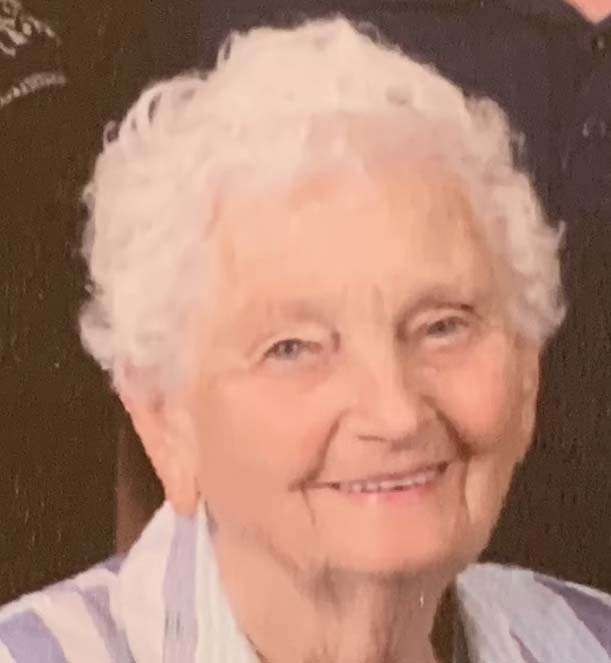
Esther J. Doerksen, 86, died November 26, 2022, at Hutchinson Regional Medical Center.
She was born Esther Jane Westfahl on 10 April 1936, in rural Burrton, Reno County, Kansas, the daughter of George C.W. and Mary Jane Fryar Westfahl. She attended VanSickle Grade School in Valley Township and graduated from Haven High School in 1954.
A lifetime rural Burrton, Reno County resident, Esther was born and raised in the same house where she spent most of her adult years. She married Harold J. “Bob” Doerksen on 29 September 1957 at Pleasant Grove church in Valley Township. They celebrated their 50th anniversary in 2007, two months before Bob passed away.
Esther loved life on the farm. In addition to farming, she enjoyed raising peonies for over 30 years, driving a Haven school bus for 20 years and making quilts for her kids and grandkids. She was passionate about genealogy and had been researching the Westfahl family since her grade school years.
She was preceded in death by her husband Bob; her parents; a brother, Warren Westfahl; and two sisters, Dorothy Klein and Mildred Phemister.
Survivors include: five daughters—Cindy Daly and husband Terry, Las Vegas; Melinda Beaty, Hutchinson; Brenda Blackburn and husband Tim, Olathe, KS; Beverly Carlson, Roeland Park, KS; and Julia Doerksen, Hutchinson; five grandchildren—Tim Wiseman (Renee), Lisa Meissner (Jason), Andrew Blackburn (Rebecca), Elyssa Gavin (Xavier) and Christian Blackburn (Talia); and nine great-grandchildren—Will and Jesse Meissner, Lucas, Lex and Lily Wiseman, and Boston, Ellis and Lilla Blackburn. She also leaves behind her beloved dog Goldie, as well as 3-4 cats, depending on what strays show up on any given day.
Funeral arrangements are pending, with services planned at Elliott Mortuary in Hutchinson, KS. Casual clothing (jeans, etc.) is encouraged for those who attend the service, as it was Esther’s dress code of choice, and she wants you to go right back to work after the service. Burial will be in Valley Township Cemetery, near Haven in Reno County, following the service.
Memorials may be sent to Pleasant Grove United Methodist Church at 11303 E Longview Rd in Burrton, KS or Cause for Paws at P.O. Box 1391 in Hutchinson, KS.
Personal condolences may be sent to www.elliottmortuary.com.
