Wednesday, January 14, 2026
Home Blog Page 57

Water, waste and wicked problem: How K-State research helps protect and save the Ogallala Aquifer Inbox

0
Meeting the needs of Kansas communities has always been at the heart of Kansas State University’s mission as a land-grant institution.
In the case of Prathap Parameswaran and his carefully assembled, cross-disciplinary research team—spanning K-State and three partner institutions across the High Plains — their work to scale up a circular waste-recovery system could have an immediate impact on Kansas communities by literally turning animal waste into valuable resources, particularly water.
If successfully implemented by the end of the four-year project, the system would mark an important step toward addressing the complex challenges surrounding the Ogallala Aquifer, the region’s primary groundwater source.
“I think the 800-pound gorilla in the room is the depletion of the Ogallala aquifer,” said Matt Sanderson, professor of sociology, anthropology and social work at K-State and member of the project’s research team. “In that context, you’re dealing with a wicked problem, and not wicked in a moral sense, but in one that doesn’t have easy solutions. It only has tradeoffs, and trying to optimize remaining use of that water. This technology clearly has a role to play, and these wicked problems require multidisciplinary projects like this one.
The project builds on Parameswaran’s past work with anaerobic membrane reactors, which have shown the ability to take waste and produce renewable energy, extract useful chemicals and provide water, but scales up the operation and does so on-site in communities that can benefit the most from their use.
“It’s not a pie-in-the-sky idea – the unit exists,” said Parameswaran, associate professor of civil engineering and university outstanding scholar in the Carl R. Ice College of Engineering. “The way we’ve proposed the project is we will strengthen the science and the technology in the first three years, and in the last year, we will actually try to put one of our field trailers out there.”
Finding expertise across state lines
Funded through the National Science Foundation’s Research Infrastructure Improvement Focused Engineering Collaboration program, the $6 million project goes beyond the scope of just engineers. It requires a broad, multidisciplinary approach that brought in three other institutions in the University of Nebraska-LincolnOklahoma State University and Seward County Community College, an advisory board with input from industry, as well as the communities serving as a pilot for this technology.
“Without the expertise, you cannot run this,” Parameswaran said.
The core partnership organically grew from established connections at K-State, extending outward to institutions and individuals who could offer complementary expertise across the region’s top livestock-producing states.
K-State, which received $2.5 million as part of the collaborative grant, will provide the foundational technology and social aspects, including technoeconomic analysis and life-cycle assessment expertise. Other K-State members of the research team include Joe Parcell, professor of agricultural economics, and Jikai Zhao, assistant professor of biological and agricultural engineering.
Team members from the University of Nebraska-Lincoln include Siamak Nejati, Bruce Dvorak and Mona Bavarian. They will provide specialized knowledge in membrane technology — a crucial component for filtration — and regional feasibility assessment.
Oklahoma State University’s portion of the team, which includes Kiranmayi Mangalgiri and Mark Krzmarzick, will focus on water reuse, specifically taking the water recovered and polishing it further. It also includes OSU’s Doug Hamilton, a swine expert who brings practical knowledge of current waste systems for comparison, as well as Michael Long, a sociology expert who will lead efforts to identify and overcome social barriers for technology adoption in the Great Plains region.
Rounding out the partnership is Seward County Community College, which provides a crucial connection to the local community and industry workforce. Students from SCCC, who often go directly into the livestock industry, will be involved in trials and internships, developing the necessary technical skills to operate and maintain the new systems.
In addition to the academic partners, the team is supported by a broad advisory council made up of producers, groundwater management districts and user associations who recognize the urgency of the problem.
“I’ll say this about the advisory council – I think if they opened our email and read the summary of what we’re doing, they were immediately on board,” Parcell said. “Because they recognize how important this is. And that was a strength of our proposal, too. We had broad-based buy-in from all three states.”
Closing the loop on waste
At the heart of the project is developing a circular system designed to manage the enormous volume of livestock wastewater, which is abundant in the region.
Currently, most livestock operations in the High Plains handle manure by land-applying it or storing it in lagoons. While this removes the waste, it is often not optimal, leading to water loss, nutrient runoff and buildup, and odor issues.
The new technology addresses these problems by aiming to polish and clean the water, while also pulling off and condensing valuable nutrients. Those include nitrogen and phosphorus, which have practical uses such as commercial fertilizer.
“The crux of what we’re doing is about water access,” Parcell said. “We’re creating a process to polish and clean water up enough so that it can be reused in the livestock system. At the same time, we’re also pulling in those carbon and nutrient elements, such as biogas, to try and value in different ways and maybe make this process more economical so it becomes more widely adopted.”
Additionally, the process would also have the potential to reduce the odors that often plague communities downwind of feedlot operations.
“The success of this proposal is in that it meets the needs of the community,” Zhao said. “NSF grants have supported the development of many advanced technologies, but this project is focused on connecting these innovations more closely with the practical needs of people in Kansas, Oklahoma and Nebraska. This technology will be used to address current existing challenges faced by regions in these three states in a meaningful way.”
The initial focus will be on swine wastewater, as the team has three years of preliminary data from Parameswaran’s previous research.
However, the knowledge gained from the research could apply to other sectors like dairy and beef cattle, and it could lead into insights into the potential for industrial pretreatment in the food processing industry and municipal water systems.
The technology is primarily membrane-based, and a key area of research will be working with the University of Nebraska-Lincoln team to develop advanced membranes to handle the difficult conditions and prevent fouling — a major issue in such systems.
From lab to field: A phased approach
The project is structured over four years, with a clear path to real-world application, which is a goal of the NSF program providing the funding.
The first three years focus on strengthening the technology. This involves refining the system at the pilot scale, generating long-term data and rigorously studying its impact.
The last year will culminate in a major step toward adoption: a field demonstration trial. The team plans to deploy one of their mobile field trailers in a real-world setting to test its effectiveness at scale.
Adoption is not just a technological challenge, however. It also involves social and economic factors.
Parcell and Sanderson, along with other social scientists and economists on the team, will work on solutions to issues that have slowed adoption of this type of technology in the past, including government policy decisions and the economic proposition of being an early adopter.
“Part of the adoption equation is where you are at, and how far do you have to pump water now?” Parcell said. “What are the policies and the incentives going to be? We’ve seen incentives to install these types of facilities in the past. What will they look like in the future?”
The long-term vision is an automated system with a control board that can be operated remotely, though a skilled, locally trained workforce will still be necessary for troubleshooting, analysis and maintenance. This focus on workforce development through Seward County Community College ensures that the benefits of the technology will be fully realized at the local level.
By turning animal waste from a liability into assets, like clean water, fertilizer and energy, the team hopes to mobilize a long-term solution that helps to ensure the sustainability of one of the world’s most vital water resources.
“This was funded for a variety of reasons, but I think probably at the top of that list is this is the second-largest freshwater aquifer in the world,” Sanderson said. “There is no more recharge, effectively, coming into this aquifer. The Ogallala is a finite resource. Anything we can do to close loops and enhance the sustainability of this aquifer adds value.
“It’s a great team to try and do it. Now the work begins.”
As the nation’s first operational land-grant institution, Kansas State University has served the people of Kansas, the nation and the world since its founding in 1863 — and it continues to set the standard as a next-generation land-grant university. K-State offers an exceptional student experience across three physical campuses and online offerings, meeting students where they are and preparing them to achieve their personal and professional goals. The university is committed to its mission of teaching, research and service through industry-connected programs, impactful research-driven solutions, and a sharp focus on community engagement and economic prosperity.

K-State News and Communications Services
Division of Communications and Marketing
128 Dole Hall
1525 Mid-Campus Drive
Kansas State University
Manhattan, KS 66506
785-532-2535
[email protected]
k-state.edu/media
Unlucky traffic ticket

0
Thayne Cozart
Milo Yield

My friend from Asbury, Mo, ol’ A.C. Doocey, recently got the strangest traffic ticket I’ve ever heard of.

A.C. has retired from part-time farming and as a part-time electrician and has gotten himself a new part-time job as a blackjack dealer at a close-by casino. He called me the other day and his end of the phone conversation went like this:

“Milo, the other day, I was on my way home from work when the strangest thing happened. Traffic was heavy as usual in Joplin, and as I sat at a red light, out of nowhere, a colorful little bird slammed into my windshield.

“If that wasn’t bad enough, the poor creature got its wing stuck under the windshield wiper. It wuz just flapping helplessly. Just then the light turned green, and there I was with a bird stuck on my windshield. I had to make a split-second decision and I decided to try and dislodge the poor bird by turning on the windshield wipers.

“And, to my surprise, it actually worked. On the upswing, the bird flew off, and here is the crazy thing — it slammed right onto the windshield of the car behind me. No, it didn’t get caught under the windshield wipers of that vehicle. It killed itself. And, unfortunately for me, the car behind me was a police car.

“Just more of my plain ol’ bad luck. Of course, immediately the officer turned on his emergency lights, and I was forced to pull over. The officer walked up and I could see him reaching for his ticket book.

“I tried to talk my way out of a ticket, but trying to plead my case fell on deaf ears.

“The officer simply stated, ‘Talking ain’t gonna do you no good. I’m going to have to write you up … for flipping me the bird.’”

***

A farm kid, who’d gained sales experience through his FFA chapter, went off to college and got himself a part-time sales job working in an upscale men’s clothing store.

The store owner showed the kid all the inventory and ended up showing him an extremely ugly sports coat. It had been in the store’s inventory for a year, and the owner explained that, if the kid could sell that sports coat, he’d prove his worth as a salesman, plus, earn himself half of whatever dollar amount he could sell the coat.

With that explanation, the owner went off for lunch and left the kid alone as the sole salesman in the story.

After his lunch, the owner returned to the store and his eyes fell on this scene. Clothes were scattered helter-skelter. He looked for the kid salesman and didn’t see him. He then heard someone groan and he hurried over the counter and saw the kid salesman laying on the floor all cut up and bruised and bloody.

“What in the world happened to you?” the owner asked.

The kid slowly got to his feet, groaned, but then broke into a smile and and pointed at the rack where that ugly sports coat had been. “I sold it,” the kid exclaimed. “For $200. So, you owe me a $100 bonus.”

The astounded owner saw the coat was actually gone. He shook his head in disbelief and asked, “You gotta tell me how you accomplished that sale? I’ve been trying for a year and never got anyone to take a serious look at it — let alone buy it! Now wait a minute! Don’t tell me that the guy you sold the coat to, hated it so much that he did this to you?”

The kid salesman then says, “Nope, the customer just loved the way the coat fit. However, his seeing eye dog almost killed me!”

***

I might as well continue in this far-out vein. A wealthy young Texas rancher wuz returning from a trip to Europe to evaluate some cattle he hoped to import. But, on his return trip, his plane got diverted to Boston overnight and he ended up enjoying an adult beverage at the crowded hotel bar.

He wuz sitting at the bar wearing his Stetson proudly when an attractive young lady sat down next to him and asked in her clipped feminine New England accent, “And, just where are you from, cowboy?”

The rancher tipped his hat and courteously replied, “Texas, ma’am. And where y’all from?
The lady answered softly back in the noisy bar, “Yale.”

The cowboy immediately rose to his feet, cupped his hands around his mouth, and at the top of his voice yelled, “Where ya’ll from, ma’am?”

***

Last week, I wrote about some ways a farmer or rancher can tell is he’s really old and experienced. Well, I’ve thought about some more delved up from childhood memories.

You know you’re an old experienced farmer if you can remember shocking “sorgo” at harvest, then in the winter going to the field with a wagon mounted with a guillotine blade and tearing down the shocks, cutting off the heads of sorgo with the blade, then grinding the heads for cattle, hog, or chicken feed and feeding the stalks and leaves as cattle fodder.

You know you’re an experienced farmer when you can recall days of yore in the summer when milk cows were milked by hand outside in the cow lot and never put into a stanchion in the barn. The cows were fed in a pan and stood contentedly eating while they were milked.

You are an experienced farmer or rancher if you still remember how to harness work horses.

***

Words of wisdom for the week: “Agriculture is a life-long lesson is patience. It takes months to grow a crop and 9-months to bring a calf to life.” Have a good ‘un.


My Cowboy Christmas

0
lee pitts

I’ve read all the articles telling the unenlightened, like me, about all the money we’re leaving on the table by not weaning our calves for at least 45 days. I don’t blame the feeders and stocker operators who don’t want to put up with sickly bawling calves either but some of us run on leased land and don’t have the facilities to wean our calves. For two years I attempted to put a long wean on our calves and I still have bad dreams about it.

We gathered the herd, sorted off the calves and thus began the nightmare. At the time we were living in a trailer house on the ranch within a stone’s throw from our weaning pens so we got to listen to the cacophony of calves all night. Even the bottle calves that never tasted their mother’s milk were bawling for their mommas long since gone. I tried everything from ear plugs to Tylenol PM but I didn’t sleep a wink. So I woke up grouchy… who could sleep through an earthquake. Her naturally cheery outlook started getting on my frayed nerves and by the end of breakfast I was already madder than a rained on rooster, only to look outside to see there’d been a jailbreak and half the calves were already back with their moms.

The problem was to reinforce a falling-down set of corrals where I intended to wean our calves I bought a load of cheap panels that I swear were welded together with the school glue you used in kindergarten. Those calves and their mad mothers made quick work of those panels so we had to gather the entire herd again to sort off the jailbirds. That meant the noise on the second night was even worse. Even grouchy couldn’t sleep so she took that opportunity to announce she was going to visit her sister. This meant I had to feed and doctor the sick calves all by my lonesome.

One thing all the articles fail to mention when weaning your calves are all the added costs involved. I’d already spent a small fortune on the panels and now I had to feed the calves 75 pound sacks of a starter ration I bought from a feed mill an hour from home. Then there was the chiropractor bill I paid to realign my back after lifting a truckload of 75 pound sacks all by myself because my wife was still at her sister’s place.

For some reason my calves have always been dumber than a fence post. They didn’t even know what a water trough was because they’d been drinking out of a creek their entire lives so I had to dig an artificial river through the weaning pens and run water through it from a water truck I had to rent. Then one day I had a brainstorm; I put on my swim trunks and frolicked in a water trough splashing water on the noses of the stupid calves until they figured out there was water in them there troughs. Then there’s the cost of all the vaccines my vet said my calves would need to satisfy the buyers and reap the big rewards. Add it all up over the 45 days that separates the premiums from the discounts and I think I’d have been better off if half the calves had died the day we kidnapped them from their mothers.

The next year we tried something called fence-line-weaning that must have been invented by someone with w-a-a-ay better fences than mine because after every jailbreak of fence crawlers I had to spend three days fixing fence all by my lonesome because my wife was on her now-annual visit to see her sister.

During the National Finals Rodeo every year in addition to all the rodeo action there are big trade shows they call Cowboy Christmas which I absolutely love. I mention it here only to say that my Cowboy Christmas occurred instead on the 45th day of weaning when I said good riddance to those little hell-raisers with not a tear in my eye.

And that’s why we went back to weaning our calves the same day we sent them to the auction market. It was either that or my wonderful wife was going to go stay with her sister on a more permanent basis.

Ex-Kansas cowtown makes HGTV list of charming small-town downtowns

0

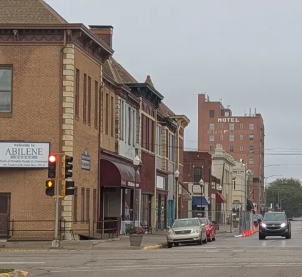
Dwight D. Eisenhower, who grew up in Abilene, Kansas, stayed so often at that city’s Historic Hotel Sunflower during his presidency that it became known as the “Little White House.”

A “presidential suite” was created on the building’s sixth floor, and redecorated and furnished before each Eisenhower visit, said the form submitted in 2001 to get that building placed on the National Register of Historic Places.

The eight-story, 94-year-old former hotel, now the site of Sunflower Apartments, is among attractions present in downtown Abilene, a city of about 6,400 people in north-central Kansas.

The home improvement network HGTV last month picked Abilene as having one of the 40 most charming small-town downtowns in the U.S. Abilene’s downtown was the only Kansas downtown to make the list.

Why did HGTV urge caution?

“Nothing charms like a small downtown that beckons visitors with historic architecture and boutique shops, or local culture and tree-lined streets,” HGTV said in a Sept. 17 article listing the cities involved.

“In creating this list of the best small downtowns in America (and it was tough to narrow this list to 40), we looked for vibrant towns that invite you in and encourage you to stay and explore,” HGTV said.

It added: “Caution: You may want to add all of them to your travel bucket list.”

Why was Abilene picked?

Abilene is “a place where vintage treasures, historic landmarks, and warm small-town hospitality come together to create an unforgettable getaway,” said the website abilenekansas.org.

“The small town of Abilene, Kansas, has received a boatload of accolades over the years, from coolest small town to most beautiful small town,” the HGTV article said. “There’s so much to love about the hometown of 34th President Dwight D. Eisenhower.”

More than 150 antique shops and booths are located throughout historic downtown Abilene, HGTV said.

“Ride on a 100-year-old steam engine on the Abilene & Smoky Valley Railroad, stand in awe as you watch a massive cattle drive and get a taste of the Old West during summer gunfight re-enactments,” it said.

Downtown Abilene is also the site of the former Abilene Union Pacific Railroad Passenger Depot, from which Eisenhower departed in 1911 to become a student at the U.S. Military Academy in West Point, New York.

What other U.S. cities made the list?

The following other 39 U.S. cities made HGTV’s list:

  • Athens, Georgia.
  • Bar Harbor, Maine.
  • Bastrop, Texas.
  • Bend, Oregon.
  • Breckenridge, Colorado.
  • Cape Charles, Virginia.
  • Carmel-by-the-Sea, California.
  • Charlottesville, Virginia.
  • Concord, North Carolina.
  • Conway, South Carolina.
  • Covington, Kentucky.
  • Dahlonega, Georgia.
  • Deadwood, South Dakota.
  • Fernandina Beach, Florida.
  • Franklin, Tennessee.
  • Galena, Illinois.
  • Greenville, South Carolina.
  • Harpers Ferry, West Virginia.
  • Ketchum, Idaho.
  • Lake Placid, New York.
  • Lewes, Delaware.
  • Lewiston, New York.
  • Livingston, Montana.
  • Marquette, Michigan.
  • Medora, North Dakota.
  • Middleburg, Virginia.
  • Montpelier, Vermont.
  • Mystic, Connecticut.
  • Pacific Grove, California.
  • Park City, Utah.
  • Portsmouth, New Hampshire.
  • Solvang, California.
  • St. Michaels, Maryland.
  • Taos, New Mexico.
  • Virginia City, Nevada.
  • Wickford, Rhode Island.
  • Fish Creek, Wisconsin.
  • Williams, Arizona.
  • York, Pennsylvania.

As reported in the Topeka Capital Journal