Tuesday, January 27, 2026
Home Blog Page 4571

Flint Hills Gobblers to host 14th Annual Spring Turkey Hunting

0

Event open to first 250 who register

EMPORIA – The Flint Hills Gobblers Chapter of the National Wild Turkey Federation will hold the 14th Annual Spring Turkey Hunting Clinic and Internet-Assisted Hunter Education Class on Saturday, March 28. The event will take place from 8 a.m. to 5 p.m. at Dry Creek Sporting Clays, south of Emporia and is open to anyone interested in learning how to become a better turkey hunter.

Participants 17 years old and younger will receive commemorative t-shirts and JAKES (Juniors Acquiring Knowledge, Ethics and Sportsmanship) memberships. Prizes will also be drawn for youth at the end of the clinic. Lunch will be provided. There is no fee to participate; however, preregistration is required.

Participants will go through several education stations covering various aspects of turkey hunting, including:

Turkey biology and management • turkey hunting equipment and safety • turkey calling and locator calling • scouting and roosting • bowhunting for turkeys • shotgun hunting and safety • trap shooting • and target shooting.

An Internet-Assisted Hunter Education Class will also be taught during the clinic; however it will be limited to 24 students.

For more information or to register for the clinic or Internet-Assisted Hunter Education Class, contact Gib Rhodes at (620) 437-2012.

Lettuce sandy

0
Photo credit: Liz West

The first AAS winning lettuce since 1985, Sandy is an attractive oakleaf type lettuce with a multitude of sweet tasting frilly dark green leaves. Not just pretty and tasty, Sandy has exceptional disease resistance, especially to powdery mildew and is slow to bolt. Use Sandy as cut and come again baby leaf, or grow to full maturity for loose salad heads. The uniformly mounded loose heads are well adapted to both raised beds and containers. When planted with cool season flowers, Sandy will add an abundance of interesting texture to patio containers. Sandy is the second AAS Winner that is available as organic seed.
Can be planted in patio containers with cool season edible flowers to enjoy.  Typically not bitter when heat-stressed. Sandy has exceptional bolt resistance and is especially resistant to Powdery Mildew disease. Can be used for baby leaf cut and come again or grown to full maturity for loose salad heads.


Bird feeding

0
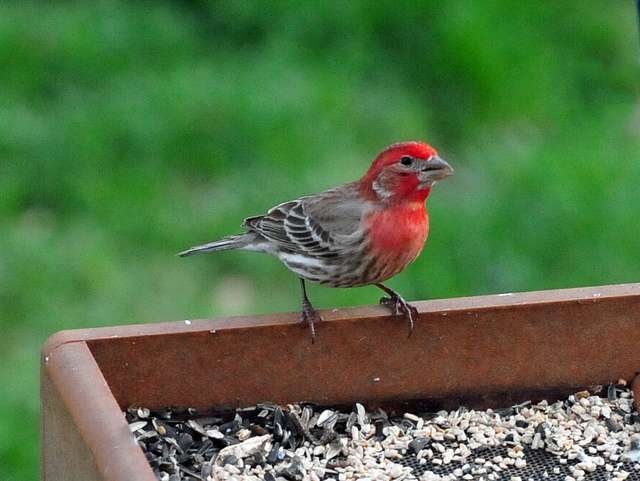
Photo credit: Heather Paul Heather Paul

Severe winter weather is not only hard on people but can be a life
and death struggle for birds.   Though birds also require water and
shelter, food is often the resource most lacking during cold weather.
Many different bird food mixes are available because various species often prefer different grains. However, there is one seed that has more universal appeal than any other: black oil sunflower. If you are new to the bird-feeding game, make sure there is a high percentage of this seed in your mix. White proso millet is second in popularity and is the favorite of dark-eyed juncos and other sparrows as well as the red-winged blackbird.
As you become more interested in bird feeding, you may want to use more than one feeder to attract specific species of birds. Following is a list of bird species with the grains they prefer.
– Cardinal, evening grosbeak and most finch species – sunflower seeds, all types.
– Rufous-sided towhee – white proso millet
– Dark-eyed junco – white and red proso millet, canary seed, fine cracked corn.
– Many sparrow species – white and red proso millet.
– Bluejay – peanut kernels and sunflower seeds of all types.
– Chickadee and tufted titmouse – peanut kernels, oil (black) and black-striped sunflower seeds.
– Red-breasted nuthatch – oil (black) and black-striped sunflower seeds.
– Brown thrasher – hulled and black-striped sunflower seeds.
– Red-winged blackbird – white and red proso millet plus German
(golden) millet
– Mourning dove – oil (black) sunflower seeds, white and red proso plus German (golden) millet.
Extended cold periods can also make water unavailable. A heated birdbath can be a tremendous draw for birds during times when all other water is frozen. Energy use is usually less than what most people expect IF the heater has a built-in thermostat.
If you would like more information, Chuck Otte, Agriculture Extension Agent for Geary County has a series of backyard birding guides at http://gearycountyextension.com/NRMW.htm (Ward Upham)

Take Steps to Better Health: Walk Kansas Starts March 15

0

The program that promotes activity and fitness typically has about 16,500 participants annually. 

MANHATTAN, Kan. – It’s as simple as putting one step in front of another. That’s the idea behind Walk Kansas, an eight-week K-State Research and Extension program that starts March 15, designed to promote activity and better health.

“The days are getting longer, and many of us are eager to get outside and be more physically active,” said Sharolyn Jackson, Walk Kansas coordinator with K-State Research and Extension. “Even Kansans who do not routinely walk or have other fitness routines find Walk Kansas to be an easy way to get moving.”

Groups of six people, one serving as a captain, work toward a common goal – typically to walk at least 150 minutes per person per week, which collectively is enough to walk 423 miles over the eight-week period. Though the team does not actually walk across Kansas, 423 miles is the equivalent of the distance across the state. Registration is through K-State Research and Extension county or district offices. Most registration materials are also on the website www.walkkansas.org.

Teams that want a greater challenge can set a goal to walk the equivalent of across the state and back, 846 miles or around the perimeter of Kansas, 1,200 miles.

“The walking can be done individually or in groups, on a treadmill at home, in your neighborhood, or at a gym – whatever works for the individual,” Jackson said. “While walking is easy for most people, any activity can count as long as you do it at the intensity where you just barely carry on a conversation with someone, and you do it for at least 10 consecutive minutes. Log your minutes of activity each day, and report that number to the team captain each week. The website converts the time walked into miles.”

“Walking reduces stress, combats depression, improves heart health and helps fight off unwanted pounds – and you feel better almost immediately after getting some physical activity,” she said.

This year’s theme is “Walk Tall, Walk Strong, Walk Kansas,” she added, noting an emphasis on posture, strength training (which can count toward Walk Kansas minutes), and walking or any activity that promotes cardiovascular health.

Don’t have a team? Jackson recommends contacting your local K-State Research and Extension office and asking to be placed on a team.

This year marks the 14th year for Walk Kansas. With a cumulative total of 203,250 participants over the first 13 years, it is considered one of the most successful K-State Research and Extension programs in the state’s extension history.

“We have a lot of conveniences in our lives today,” Jackson said. Taking care of ourselves is a privilege. Investing in your personal health now pays off down the road, and being physically active is one of the most important steps we can take to improve our health.”

Kansas to Host Central Plains Irrigation Conference Feb. 17-18

0

The annual event focuses on irrigation-related topics through informational sessions and an industry exposition.

COLBY, Kan. – The 2015 Central Plains Irrigation Conference and Exposition will take place Feb. 17-18 at the City Limits Convention Center, Colby, Kansas. The popular annual event focused solely on irrigation-related topics is hosted in Kansas every third year. Sponsors include Kansas State University, Colorado State University, the University of Nebraska and the Central Plains Irrigation Association.

The conference portion of the event will include many technical irrigation sessions presented by academic researchers from the areas of agronomy and irrigation engineering, for example, as well as representatives from governmental agencies such as the U.S. Department of Agriculture’s Agricultural Research Service.

Session topics include the crop water budget, optimizing crop water productivity in a variable climate, sensor technologies for irrigation management, advancements in subsurface drip irrigation and center pivot irrigation, updates on groundwater issues and crop options for deficit irrigation.

“The overall theme for this event from a crop water standpoint, particularly for western Kansas, is management with limited water supply,” said Danny Rogers, K-State Research and Extension professor and irrigation engineer. “But, the management issues we talk about with irrigation have application whether you have full water or limited water capabilities. There will be something for everyone.”

Bob Gillen, head of tri-center operations for K-State Research and Extension’s Western Kansas Agricultural Research Centers, will present the first day general session on lessons from 100 years of agricultural research in northwest Kansas. Ajay Sharda, assistant professor in K-State’s Department of Biological and Agricultural Engineering, will lead a general session discussion about the potential of technology and precision agriculture on the second day of the event.

The conference includes a menu-driven program, Rogers said, so participants can choose what to attend during the two days. The exposition side of the event will allow for industry representatives and irrigators to interact.

“Producers can come in and see, touch and talk about the new sprinkler options, soil sensors, plant health sensors, potentials for aerial sensors and other items out there,” Rogers said. “It’s a chance to have one-on-one conversations with industry folks, specialists and fellow irrigators.”

For a full list of sessions and presenters and the registration form, visit Central Plains Irrigation Conference & Exposition. Register early by Jan. 30 at a discounted rate of $85 per person. After Jan. 30, registration is $100 per person. The fee covers access to technical and general sessions, the exposition and on-site meals. For more information, contact Donna Lamm at 785-462-7574 or [email protected].