Tuesday, January 27, 2026
Home Blog Page 4572

Roger’s View From The Hills

0
Roger Ringer
Roger Ringer

Sometimes you just don’t feel all that funny

“OUR LIVES BEGIN TO END THE DAY WE BECOME SILENT ABOUT THINGS THAT MATTER.”       Martin Luther King
     It may be the weather or the fact that I am on my way to get a needle stuck in my back, that I am not feeling particularly funny.  Maybe it is the fact that after the known lies and false science that was pushing the global warming crowd that they are back with a new set of figures to push their agenda again.
      Or that we are two years away from the presidential elections and the news media is busy determining who we are going to nominate and vote for at that time.  What ever happened to reporting the news not creating it?
      Could it be that there are people who really believe that UN troops are threatening our way of life.  (Really, those blue bereted peace keepers that could not stop either side in a dozen conflicts from shooting each other)?
      What is fully expected is the new proposal from Der Fuher to increase taxes instead of stop spending.
       At long last the price of gas is coming back towards reasonable levels and we can fill up with wondering at the amount of money left over from the last few years.  Yet when we have the ability to buy a little more what we choose it is a looming worldwide disaster.
       The dynamic of how the world operates takes a different flow, and possibility, when energy is affordable is a fact that governments and bureaucrats don’t want us to know about.
     It is expensive to produce energy and those who are in the business adjust to the fluctuation.  Many fortunes were made from $10 oil.  There is a lot of available energy at a higher range and there is a happy medium out there.  It is just not so easy as when oil is $95 a barrel.
      When the medium is discovered and the politician and nationalists are put out of the control, the rate of efficiencies will go on and alternatives will be cheapened.
As time goes on we know that the developments will make our heads spin and it is the old boy under the shade tree that figures it out and not the PHD spoon fed the taxpayers dollars.
Right now we have a bunch of 8th century clowns threatening to attack us.  Guess it is time for rag heads and Indians.
Nope I am just not feeling so funny today.

Pratt Wrestling Competes at UNK Midwest Classic and Baker

0

On Jan. 17, the Pratt Community College men’s wrestling team competed in the UNK Midwest Classic in Kearney, Neb. The three opponents included number five Northeast Oklahoma A&M, NAIA York College, and NAIA Hastings College.

The Beavers went 2-1 on the day before heading into an exhibition match with the UNK Lopers who have won the NCAA Division 2 National Championships three out of the last four years.

Leading the day for the Beavers was Micah Felton, who went 3-1 on the day and won a dramatic OT match in the UNK exhibition. The Beavers now improve their record to 4-5 on the year.

#5 NEO – 56, Pratt – 0
NAIA York College – 13, Pratt – 33
NAIA Hastings College – 13, Pratt – 28

On Jan. 20, the team competed against number 19 NAIA Baker University in Baldwin City, Kan.
125 – Double Forfeit 0-0
133 – Nathan Garcia (Baker) over Unknown (For.) 6-0
141 – Juan Rivera (Baker) over Unknown (For.) 6-0
149 – Daniel Melcher (PCC) over Dylan Arnall (Baker) (MD 9-1) 0-4
157 – Joshua Thomas (Baker) over Austin Hughey (PCC) (Fall 3:20) 6-0
165 – Connor Middleton (Baker) over Syed Ali (PCC) (Fall 6:32) 6-0
174 – Trevor Sutton (Baker) over Travis Quarterman (PCC) (Dec 2-0) 3-0
184 – Micah Felton (PCC) over Joshua Ortiz (Baker) (Dec 3-2) 0-3
285 – Jacob Crane (PCC) over Unknown (For.) 0-6

FINAL SCORE: #19 Baker 33 Pratt 13

The Beavers are now 4-6 on the season and travel back to Baldwin City this weekend to compete in the Kansas Cup.

Credit:Pratt Community College

Managing Your Mortgage, Your Money And More

0

(NAPS)—Settling into a new place can be an exciting time. You’re unpacking, meeting new neighbors, getting the “lay of the land” and making decisions about how to furnish and decorate your home. At the same time, you’re assuming many new financial responsibilities, such as mortgage payments and maintenance costs. That’s one reason it’s important to protect yourself and your family by making sure you have a sound financial foundation.

Savings: More Important

Than Ever

While setting aside money for emergencies is a good idea no matter what, it’s essential that, as a homeowner, you keep a reserve handy in case the unexpected happens. Homeowners can find themselves facing expensive repairs that shouldn’t—or can’t—be delayed. Adequate savings can keep you from having to choose between postponing a needed repair and risking further damage to your home—which may require spending beyond your budget. Savings can also be used to pay for home improvement projects, such as remodeling a kitchen or bathroom or building an addition, that may enhance the value of your investment and help you make the most of your home.

An obvious place to put your savings is in a traditional FDIC-insured bank account. Another alternative would be to place your money in a money market fund. These are conservative investments that offer competitive interest rates and check-writing privileges, so assets in money market funds can be easily used to pay your mortgage and expenses in case of an emergency.

An investment in a money market fund is not FDIC insured or guaranteed by any other government agency.

Pay Yourself First

It can be difficult to think about saving money when you’re a new homeowner; you may have just spent a significant amount of money on a down payment, and you are already diverting a large portion of your income toward the mortgage, property taxes and homeowner’s insurance. Even on a tight budget, however, saving money doesn’t have to be a painful experience.

Simply get into the habit of “paying yourself first.” Every time you get paid, put aside a set amount before using any of it to pay bills or make purchases. Many financial companies, such as First Investors, can facilitate this by making the process automatic; a fixed amount can be automatically deducted from your paycheck or your bank account on a regular basis and put into a mutual fund account.

Protecting Your Home

Most owners buy homeowner’s insurance, and for good reason. Your home is likely your largest single asset and investment. It must be protected in case of fire, burglary or natural disaster.

But a home is also a major source of expenses: mortgage payments, property taxes, maintenance and the like. If your household loses the earning power of a loved one, your family might not be able to afford those costs. That’s where life insurance steps in. Its benefits can be used to help cover mortgage payments and other home-related expenses so that your family can remain in their home.

Don’t Overlook Life Insurance

Life insurance can also help:

  • Replace lost income, so your family can maintain its current lifestyle;
  • Ensure that goals—such as a child’s education—can still be achieved;
  • Pay final expenses, such as medical bills and funeral expenditures.

Speak With Your

Insurance Representative

An insurance representative can also discuss what products may be suitable for your unique needs and make specific investment and insurance recommendations.

Learn More

For further information about First Investors funds or variable products, you can get a free prospectus and summary prospectus by contacting a representative, calling (800) 423-4026 or visiting www.firstinvestors.com. Since 1930, First Investors has been helping individuals and everyday families reach their financial goals with competitive investment, life insurance and annuity products.


A good insurance policy can help protect your home and your family’s ability to live in it.

Top 10 Pantry Essentials for Fast, Healthful Cooking

0

(NAPS)—Stock your kitchen with these basic building blocks for a wide variety of good-for-you recipes that are quick and easy to create.

“Keeping healthy foods on hand is one of the easiest ways to get started with a healthy eating plan,” said registered dietitian Sarah-Jane Bedwell, author of “Schedule Me Skinny.”

  1. Canola Oil—This kitchen workhorse is one of the most healthful cooking oils available and excellent for almost any kind of recipe. It contains the least saturated fat and most plant-based omega-3 fat of all common cooking oils, plus its neutral flavor and light texture work well with many different dishes and cooking styles.
  2. Vinegar—The acid in vinegar, including white wine, red wine or balsamic, brightens and balances flavors. It’s key to salad vinaigrette, and a splash can add depth and sweetness to soups and sautés.
  3. Peanut Butter—An inexpensive source of protein, peanut butter is a healthful addition to baked goods. It’s also a quick base for Asian-style peanut sauce on noodles or meat.
  4. Lower-Sodium Chicken or Vegetable Broth—Boost flavor by using broth for homemade soup in a flash, whole grains or a braised dish. Store-bought broth tends to be higher in salt, so look for the lower-sodium varieties.
  5. Honey or Brown Sugar—Sweetener isn’t just for baked goods. Use a touch to help caramelize foods and bring out the natural sweetness in vegetables.
  6. Whole Wheat Flour—Essential for baking, flour is also useful for thickening sauces, binding veggie pancakes and more. The white whole wheat variety can be a great way to add extra whole grains but maintain a light texture.
  7. Basic Spices—No need to buy a whole rack’s worth of spices. For most dishes, you’ll be good to go with pepper, cinnamon, cumin, chili powder, garlic flakes, thyme and an Italian herb blend.
  8. Whole Grains—Brown rice, whole grain pasta, oats, barley and quinoa are packed with nutrition and nicely filling. Keep them on hand to round out any meal.
  9. Quick Protein—Canned or dried beans and lentils as well as canned salmon and tuna are excellent pantry staples: nutritious, affordable and versatile. Toss them into salads, mix with whole grains or mash them into burgers.
  10. Canned Tomatoes—Essential for sauces, soups and stews, canned tomatoes are faster (and, at most times of the year, tastier) to use than peeling, seeding and chopping your own. Select those that are lower in sodium.

“These are ingredients I reach for again and again,” Bedwell added. “With a well-stocked pantry and a little bit of planning, it’s truly possible to prepare healthy meals in minutes.”


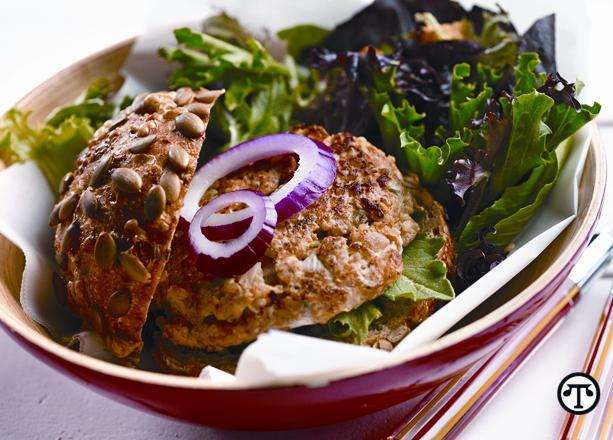
This entrée or appetizer is a delicious way to incorporate whole grain and other pantry essentials.


Salmon and Quinoa Patties

Yield: 8 patties

Serving size: 1 pattie


2 Tbsp canola oil, divided

1 cup minced onion

½ cup finely chopped celery

1 cup cooked quinoa

2 cans, 6.5 oz each, salmon, rinsed and drained

3 eggs

2 Tbsp green relish

½ tsp salt


In large nonstick pan, heat 1 Tbsp canola oil over medium heat. Add onion and celery and sauté for about 5 minutes. Remove from heat. In large bowl, combine prepared quinoa with cooked onions and celery. Add salmon, eggs, relish and salt. Stir well to combine. Shape mixture into 8 patties, about 1⁄3 cup mixture each. In saucepan, heat remaining canola oil over medium heat. Cook patties for 3 to 4 minutes, undisturbed, or until golden brown. Flip over and continue cooking for about 4 additional minutes.

Nutritional Analysis per Serving: calories: 150; total fat: 9 g; saturated fat: 1.5 g; cholesterol: 90 mg; sodium: 360 mg; carbohydrates: 7 g; fiber: 1 g; sugar: 1 g; protein: 10 g.


Learn More

Find more flavorful recipes using heart-smart canola oil and other pantry essentials at www.CanolaInfo.org.


You can enjoy delicious, simple and wholesome Salmon and Quinoa Patties with grilled vegetables on whole grain rolls or as mini appetizers.


Growing your own firewood

0

With high energy costs, some homeowners are turning to wood for heat. I’m one of them.
Fortunately, the farm has a number of volunteer trees that can be used for firewood. The most common species is Siberian elm but there are also some hackberry and mulberry. Though there may be enough volunteer trees to supply the need, better firewood trees would reduce the time and effort required to supply the wood needed. Actually, storm-damaged trees or trees in the wrong place will always provide a measure of the demand but a significant supply could be supported by a firewood “plantation.”
Plant species is an important consideration as not all trees have the same density and therefore heat value. The greater the dry weight, the better. The highest value for trees commonly found in Kansas is Osage Orange (Hedgeball tree) at 4,800 pounds per cord. Osage orange has a gnarly growth habit and a nasty set of thorns. This species also sparks which isn’t a problem in a wood-fired boiler but certainly would be in an open fireplace.
Black locust is next with 4,200 pounds per cord. Black locust is a fast grower and also has excellent burning qualities and makes a nice bed of coals. However, it is hard to split, suckers, and has some relatively small thorns, especially on young trees. Bur oak and red oak come in at 3,800 and 3,500 pounds per cord respectively but are not fast growers. Mulberry, however, has the same weight as red oak but grows more quickly.  Silver maple has less heat value (3,000 pounds per cord) but is a very fast growing tree.
Black locust would be my first choice for this purpose though you may wish to plant rows of several species. However, each situation is different and another species may work better for you.  So how do you set out your plantation? Dr. Wayne Geyer, one of our retired forestry professors, has done many woody biomass studies over the past 35 years. Following are some recommendations that have come out of his studies.
– Plant locust a few rows in from a field edge to reduce suckering in the field.
– Plant on a close spacing, 4 to 6 feet apart. This maximizes yield and reduces side branching.
– Control weeds the first two years.
– Harvest every 5 years, most trees will resprout and can be reharvested.
– Plant about 1 acre per year for 5 years if you wish to supply the majority of the firewood needed to heat your home.


By: Ward Upham