The Kansas Tractor Club, formed in 2012, is a non-profit group of people with a common interest in antique tractors. Many members purchase, restore and show our tractors at local events. We want to pass on this love of collecting tractors and other farm equipment to preserve and educate future generations about America’s agricultural heritage. In the spring of each year, the club awards a $1,000 scholarship to a student interested in an ag related career. You may find more information about the club, including upcoming events, on the Kansas Tractor Club website.
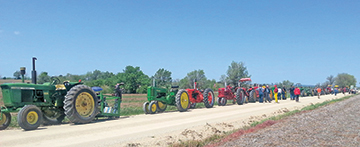
The Kansas Tractor Club has set May 3rd for our spring drive. In case of rain, the drive will be held on May 10.
Everyone is welcome to bring any tractor for this drive. You don’t have to be a member of the club.
We will be unloading at Chuck Henry’s place located on Old Highway 40, at the east side of Solomon. The drive will begin at 9:30 AM. Try to unload and attend the drivers meeting at 9:15 AM to go over the rules and details of the drive.
There will be no entry fee for this drive.
Lunch (bring your own) will be at Eisenhower Park in Abilene.
The club will provide water and a bathroom on the drive.
We will take an early break just after the start of the drive to tour Gail Rodda’s restored antique tractors, Model Ts’ & Model A. We will have another break on the afternoon trip back to Solomon.
RULES:
Your tractor must be able to maintain a 10 MPH speed or better. No riders are allowed unless there is a safe place for them to sit. If someone is moving too slow and falling behind the others, pass safely. Someone in a pickup will be available to assist them if they need help. If you do break down and can’t be repaired, someone will be available to take you back to Solomon to get your trailer. Someone will assist in loading your tractor. Other details will be addressed during the drivers meeting the morning of the drive.
Let your family and friends know about the drive. All are welcome!!!
Any donations offered will go to cover the cost of the drive and/or to the Kansas Tractor Club Scholarship fund.
Kansas Tractor Club Tractor Drive Open To All
Planning a picnic? Food safety should be part of the party

K-State food scientist shares tips for preparing foods safely
As warmer days become more common, so does the itch to get outside.
If outdoor time means picnic time, Kansas State University food scientist Karen Blakeslee said food safety’s four principles – Clean, Separate, Cook and Chill – are still in play.
“Wash your hands, separate food items, (and) keep raw meats away from ready-to-eat foods,” said Blakeslee, who is also coordinator of K-State’s Rapid Response Center for food science. “When preparing food, make sure you’re keeping knives and cutting boards separate so you’re not causing any cross contamination issues.”
Blakeslee also reminds consumers to pack their food thermometer to assure meats and other foods are cooked properly. Hamburgers steaks, roasts and chops should be cooked to an internal temperature of 145 degrees Fahrenheit; ground meat (such as beef, pork and lamb) to 160F; and all poultry to 165F.
“Don’t rely on color to determine if a food is cooked properly,” she said. “K-State meat scientists have done a lot of research over the years that shows that a food may look pink, but is done, and vice versa: a meat may look brown inside but may not be cooked to the proper temperature.”
Cold foods should be kept at 40F or colder, Blakeslee said.
“One suggestion I would give is to have a couple of ice chests,” she said. “One is for beverages, because that is the one that is opened most often. The other one can contain all of the food that you may pack, including raw meat of any sort, like hamburgers. Pack raw meats separately to prevent cross contamination.”
Blakeslee said ice should surround the food. Pack ice on the bottom of the cooler – underneath food – then pack ice over the side and top of food, as well.
More tips from Blakeslee:
- Bring a plastic tablecloth. “Picnic tables are in public places that are used by everybody. Plus, there are critters that run around and crawl on those tables.”
- Bring wash rags and extra water. Keeping hands clean during outdoor gatherings can be a challenge. Blakeslee suggests packing wet wash rags with soap on them in plastic bags, disposable hand wipes, or extra water and hand soap. “Hand sanitizer is okay, but it really doesn’t work well unless your hands are clean first,” she said. “They’re good in a pinch, but even better after you’ve washed your hands.”
- Share the responsibility for bringing food. Potlucks are fine, but often people bring many of the same foods. “Assign different foods to different people,” Blakeslee said. “Some people can bring a salad, others can bring a dessert and so on. This helps reduce the stress on everyone.”
Blakeslee publishes a monthly newsletter called You Asked It! that provides numerous tips on being safe and healthy. More information is also available from local extension offices in Kansas.
Red, white and blue for the green thumb
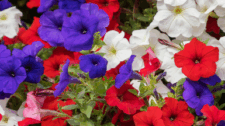
Make a splash in the garden with the 60-30-10 rule.
Plan now to use basic design principals to create a patriotic garden this summer, says University of Missouri Extension field horticulturist Gwen Funk.
“Designing your outdoor living space comes with many opportunities for creativity,” says Funk. “One might be thinking about themed garden beds, pots and hanging baskets,” she adds. “Using a red, white and blue color scheme around your patio or deck could add a festive, energizing ambiance.”
For harmony and interest, follow the 60-30-10 rule when choosing flowers for your beds and containers: Buy 60% of your flowers in a dominant color, 30% in a secondary color and 10% in an accent shade.
The dominant flower will be the anchor of your garden or container. It should be bold and draw the eye of the viewer immediately. The secondary color supports the main attraction, and the accent enhances the other two.
Red and blue sit on the opposite side of the color wheel. In general landscape design, this makes each color seem more saturated and creates visual appeal, says Funk. Pair with a neutral white to create balance.
Red as the primary color creates a feeling of energy and festivity while blue creates a feeling of spaciousness and relaxation, she says. Choosing white as the main color creates a fascinating twilight moon garden, she says.
Design beds with native plants with Missouri’s varied climate conditions, local pollinators and songbirds in mind, she adds.
Funk suggests considering these plants:
Red flowers. Cardinal flower (Lobelia cardinalis) if planting in the shade. This July-October-blooming flower prefers shade and moist areas. Royal catchfly (Silene regia) produces bright red star-shaped flowers and may bloom from May to September. Royal catchfly prefers dry, well-drained, sunny locations. The native red bee balm (Monarda didyma) will support many pollinators and may attract hummingbirds.
Blue flowers. Blue wild indigo (Baptisia australis) is drought-tolerant and blooms in late spring. Blue star (Amsonia illustris) can withstand shadier conditions. Both flowers have a full, shrublike appearance and bloom late spring to early summer.
White flowers. New Jersey tea (Ceanothus americanus) is a low-growing, branching shrub that can grow in partial shade to full sun in well-drained soil. Expect blooms late spring to early summer. Another species of Baptisia, Baptisia alba, or white wild indigo, sports pure white blooms on tall spikes from May to July.
Other choices such as red zinnias are heat-tolerant and long-blooming. Red geraniums are suitable for containers or borders. White Shasta daisies are a classic perennial choice, while alyssum offers low-growing fragrant flowers. Blue salvia and bachelor’s buttons round out the trio with blue flowers.
Remember the classic design principle of “a thriller, a filler and a spiller” for hanging baskets and other containers, says Funk:
• A full sun option might include red salvia or tall blue delphinium (thriller), white petunias or white verbena (filler) and blue lobelia or trailing blue torenia (spiller).
• A drought-tolerant combination is red geranium (thriller), white angelonia or white lantana (filler) or blue scaevola (spiller).
• A hummingbird and pollinator container might include red bee balm (thriller), white alyssum (filler) and blue bacopa (spiller).
Learn more about “Container gardening: thrillers, fillers and spillers” at https://extension.missouri.edu/news/container-gardening-thrillers-fillers-and-spillers.
Managing spring flowers and weeds

Most years, Spring signals the start of a colorful garden and a host of blooming flowers.
Yet, at this point in the season minimal care is needed for spring-flowering bulbs, Kansas State University horticulture expert Cynthia Domenghini said. To enjoy blooms in April, Domenghini suggests following simple care tips to ensure roots are taking in the nutrition to support future growth.
Roses
Before new leaf buds open (bud break), roses should be fertilized and pruned.
“April is a great time to plant new roses in the landscape as well,” Domenghini said. “Specific maintenance practices vary based on the classification, or type, of rose.”
Domenghini recommends tips from the Growing Roses publication, available from the K-State Research and Extension bookstore.
Easter Lilies
Containerized lilies are common in the spring as they are used to celebrate the Easter holiday.
“This perennial bulb can be grown in the landscape to enjoy for years to come,” Domenghini said.
The Easter Lily Fact Sheet provides care instructions.
Henbit and Chickweed
Henbit weed is in bloom, creating waves of purple through the landscape.
“Weeds drive most gardeners crazy, but many weeds provide food for pollinators,” Domenghini said. “Henbit is one of the first sources of pollen and nectar for honey bees and bumble bees after the long winter.”
Henbit and chickweed are winter annuals that germinate in the fall but become more noticeable in the spring, Domenghini added. Treating these weeds is best done by applying a pre-emergent in the fall.
“Controlling for these weeds this time of year is much less effective,” Domenghini said.
Manual removal is recommended if the plants can’t be tolerated in the landscape.
The henbit and chickweed fact sheet provides tips for prevention and management in the spring.
Grassy Sandbur
Another annual — grassy sandbur — is a grassy weed commonly found in lawns, and spreads profusely as the stickers produced attach to clothing and pets.
“Maintaining a dense lawn is the best defense against this weed,” Domenghini said.
Alternative solutions can be found in the Grassy Sandbur fact sheet.
Domenghini and her colleagues in K-State’s Department of Horticulture and Natural Resources produce a weekly Horticulture Newsletter with tips for maintaining home landscapes and gardens. The newsletter is available to view online or can be delivered by email each week.
Interested persons can also send their garden and yard-related questions to Domenghini at cdom@ksu.edu, or contact your local K-State Research and Extension office.