Saturday, January 24, 2026
Home Blog Page 184

Strawberry Rhubarb Pie

0

I’ve just returned from a wonderful trip back to Northeast Missouri. Finished up the closets at my parent’s home, and we are ready to close up everything on the sell of their house in Lewistown. After about 2 days in Lewistown, my friend, Tara, and I journeyed on to Hannibal, Missouri, where we enjoyed the warm hospitality of my college town. I spoke at the women’s club on Tuesday, had lunch with High School friends, and enjoyed dinner with college friends. Wednesday led us back home after a quick stop in Cameron, Missouri, for a quick stop at my sis, Judy’s home.

It was wonderful to see old friends and enjoy the ambiance of the Historical town of Hannibal. We were amazed at how many of the historical homes were being restored. I can’t wait to go back and check on the progress. We learned from store owners Hannibal will host 40-50 boats this summer from paddle wheelers to the ‘Viking’ Line as they cruise the mighty Mississippi. We enjoyed the flea markets and unique stores in the downtown area. My only regret was there was no time for a maid-rite at the Mark Twain Dinette, which was across the street from our motel. Next time I’ll get my fix!!!

One very pleasant stop was for breakfast at the Becky Thatcher Cafe. We had the pleasure of not only a great meal, but the genuine service and hospitality provided by ‘FLO’, our server. We saddled up to the front counter stools and enjoyed not only speedy service but great interaction with Ms. ‘Flo’. When it was time to head home it was hard to say goodbye. I seriously expect to be back again with my husband, Ervin, in tow!

Our conversation at the cafe focused around baked goods and pies. I told Ms. ‘Flo’ I was going to send her some recipes. I’ve got plenty of recipes to share, but I also wanted to consider the time of year in my choice, so look-out, it’s Strawberry Rhubarb pie time.

This is one of my favorite pies, especially with a scoop of vanilla ice cream on top.

I was sharing one of my favorite thickening tips in regard to the use of minute tapioca. A few years ago while making double crust peach pies I started putting my minute tapioca into a coffee grinder before adding it to the pie. It works marvelously. Sometimes after cooking I can pick out the tapioca flecks, but that does not happen when you grind it before implementation into the pie.

I did enjoy another wonderful dish while eating at a Cracker Barrel last week. As many are aware they have updated their menus. I tried the new shrimp and grits dish. I will definitely have it again should opportunity knock.

Probably my favorite part of the trip was shopping at a local flea market in downtown Hannibal. Lots of fun, and terrific people!

Strawberries in Southern Arkansas are probably starting to appear and if you’re like me

there’s rhubarb in the freezer. Enjoy my family recipe, and have an outstanding week. Simply yours, The Covered Dish.

Strawberry-Rhubarb Pie

3 cups rhubarb cut into ½ inch pieces

2 cups strawberries, sliced

1 ½ cups granulated sugar

½ teaspoon ground nutmeg

3 tablespoons quick cooking Tapioca*

Dash of salt

2 tablespoons butter

Pastry for double crust

Prepare bottom crust in pie pan, *Place tapioca in a coffee grinder and grind the 3 tablespoons until very small. Place all interior ingredients into a bowl blending to coat, except for the 2 tablespoons of butter. Chop the cold butter into very small pieces and place randomly across the top of the pie. Place the top crust over the filling and pinch the pie edges to seal. I like to grab a beaten eggs white and brush it over the top, sprinkling on garnishing sugar before baking in a 375 degree oven for 25 minutes, remove any edge covers and continue for 25 more minutes or until the pie the bubbling up and crust is golden brown.

My pet peeve is over baked pie crusts. You should be able to eat the crust all the way to the edge of the pie. Covering the crust edges is imperative to make sure the pie comes out golden brown.

PS: My ultimate favorite pie is Sour Cream Raisin Pie.
Farm Pond Fishin’

0

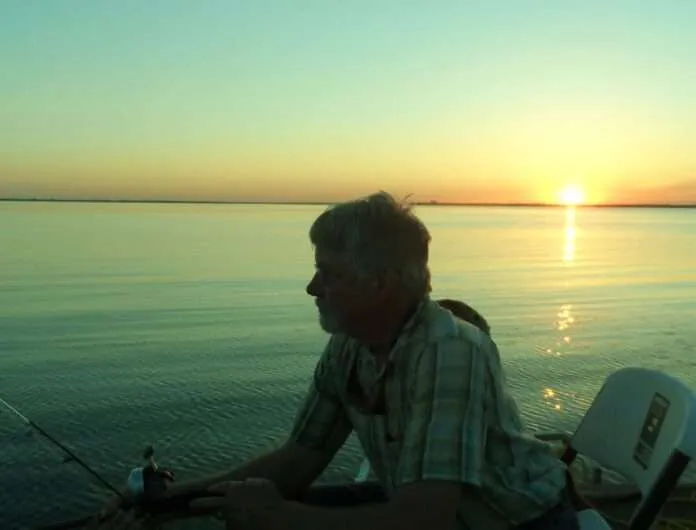
The phone rang early Saturday morning, and on the line was a friend from church inviting me to fish with him that afternoon on a large farm pond out in the sticks in the shadow of Coronado Heights, where he has been part of a lease for years. We talked about some of his past fishing adventures there and it brought back memories of fishing on our farm pond in Ohio when I was a kid. The first year we owned that farm, we found a spot in a field that never dried out. Government cost-share money was available back then to help build farm ponds, so after required soil testing and meeting other requirements, a dandy little farm pond was built, and stocked with the prescribed fish combination of that era, largemouth bass and bluegills. Endless memories were made around that pond, and it reminded me of a farm pond fishing trip Joyce and I took a few years back.

With rods, bait and tackle boxes in hand we clamored down the side of the grassy overgrown dam and onto a roughly built but sturdy dock that put us ten feet out from the bank and four feet above the water. Hooks were baited and cast into the water before us, which rippled slightly with the breeze. That breeze, along with copious amounts of nasty spray, kept the ravenous mosquitoes at bay. The sun slid slowly behind nearby trees, leaving its beams to dance upon the rippling water and offering reprieve from the heat as it ushered in the cool evening. Barn swallows by the dozens strafed the pond, either scooping insects from the surface, or snagging them on the wing in mid-air. The deep “harumm” of granddaddy bullfrogs echoed back and forth from behind tufts of cattails. One line was baited with liver and fished on the bottom, while the other rig held a feisty Canadian night crawler suspended beneath a bobber. After twenty minutes with no action, I climbed the steep grassy bank to the truck to retrieve our ever-present cameras. As my back was turned to open the truck door, Joyce asked “Did you bring the net?” I pondered why she would ask that question when we were fishing in a small farm pond, but when I spun around and saw the pole in her hands bent toward the water like a divining rod, the reason for her question became obvious. I scrambled back down the bank as she hoisted a dandy three pound channel cat up onto the dock…Welcome to the sport of farm pond fishing!

The agricultural land of central Kansas is dotted with small farm ponds, many out of sight along field drives or in the middle of pastures. Unless a pond is spring-fed, the water in them comes from runoff, so during the dry springs and summers of late, water levels are often low, and some lesser-quality ponds even go dry. The only other down side I can see to fishing farm ponds is the lack of the large variety of fish species found in most Kansas reservoirs. Typically, farm ponds contain largemouth bass, channel catfish, bluegills and possibly a few crappies and bullheads. Most ponds are on privately owned property, meaning permission to fish there is required. Once permission is granted however, you will often have the whole place to yourself every time you’re there, because fishing pressure on these ponds is often nil. A boat is not usually needed, although a canoe, or one of the popular small two-person crafts can come in handy to get you out past any weeds or moss growing along the bank. The dock from which we fished was the perfect length to get us out beyond the cattails. Since farm ponds are always fed either by springs or by run-off water, and since most of them are situated in pastures or otherwise grassy surroundings, the water in them is well filtered before reaching the pond, making them very clean.

So, if you’re used to big-lake fishing for walleye, crappie, white bass or stripers, if you love the drone of a big outboard motor as it pushes your big boat across a big lake, and if the presence of dozens of other fishermen all around you are an important part of your fishing experience, farm pond fishing may not be your gig. If, however you can be happy catching bluegills, channel catfish and largemouth bass from the bank or from a small boat and never see another human being in the process, farm pond fishing may be for you. Sign me up for choice number two! By the way, I declined my friend’s invitation this time because I had this column to write; how ironic! Continue to Explore Kansas Outdoors!

Steve can be contacted by email at [email protected].

“Colon Cancer Screening is Important”

0

Colon cancer is the second leading cause of cancer-related deaths in men and women. The lifetime risk of developing colon cancer is 1 in 24 for men and 1 in 26 for women. Early detection and treatment are instrumental at improving survival rates, and regular screening decreases the risk of colon cancer in the first place.


Colonoscopy remains the gold standard for colon cancer screening. While detecting cancer early on is important for survival from any cancer, detecting and removing precancerous polyps during a colonoscopy before they develop into cancer is the main reason regular screenings with colonoscopy have been found to reduce colon cancer rates.


During a colonoscopy, with a patient asleep or sedated under anesthesia, a long flexible scope with a light and a camera is used to look throughout the large intestine, the colon, for any polyps or abnormalities. Those polyps can be removed with a forceps or a loop at the time they are detected. Afterwards, patients are monitored, wake up, have something to eat, and are ready to proceed about their day.


Thankfully, a large majority of patients do not have any complications from colonoscopy. The complication rate depends on age and risk factors and the reason for the procedure. The overall rate is approximately 0.5%. The most serious complication risk, a perforation or tear in the colon, is about 1 in 1,000.


Of course, oftentimes the worst part of undergoing a colonoscopy is the preparation beforehand; getting cleaned out. This is important so the physician performing the procedure has a good, thorough look everywhere in the colon. While cumbersome, with new strategies for doing the prep, many people find this process less awful than they used to.


Stool tests have been an easier, cheap, non-invasive method for colon cancer screening for many years. Often these tests look for blood in your stool. The latest, more expensive option, Cologuard, checks for blood and DNA abnormalities, and is the most successful of the stool tests at detecting colon cancer, at 94%. However, it is only about 43% effective at detecting advanced adenomas, those precancerous polyps that are already getting larger and closer to becoming cancer. This limits the test’s potential at preventing cancer.


The Cologuard test should not be used for people with risk factors such as a history of colon polyps or a family history of colon cancer. A positive test result should be followed up by a colonoscopy.


The FDA recently approved a new blood test for colon cancer screening. However, it only detected 83% of colon cancers, and only 13% of precancerous advanced adenomas. With this poor detection rate, out of 100 people with cancer, the blood test would falsely tell 17 people that they did not have cancer, and it would miss most precancerous polyps.


Ever since the Affordable Care Act in 2010, insurance companies have been required to cover colon cancer screening tests. This is because early detection not only saves lives but also saves money.


Each method has its own pros and cons, so please talk with your doctor regarding which screening method makes the most sense for you. In the end, “the best colon cancer screening method is the one that gets done.”


Andrew Ellsworth, MD. is part of The Prairie Doc® team of physicians and currently practices family medicine at Avera Medical Group in Brookings, South Dakota. Follow The Prairie Doc® at www.prairiedoc.org, Facebook, Instagram, Youtube and Threads. Prairie Doc Programming includes On Call with the Prairie Doc®, a medical Q&A show (most Thursdays at 7pm streaming on Facebook), 2 podcasts, and a Radio program, providing health information based on science, built on trust

Aggie Tattoos

0
Thayne Cozart
Milo Yield

Body and facial tattoos have gone from being a rage a decade or so ago to being commonplace today. Everyone from basketball players to teens to grandparents, of both sexes, have some personal image or message indelibly imprinted or inked on their smooth or wrinkled hides.

Personally, I have nary a tattoo on my ol’ bod and I never wanted one. I’ve never understood why tattoos became the “in thing.” To me, they sure don’t make anyone look more attractive or appealing. From what I read, tattoos are expensive to put on and more expensive (and painful) to have taken off. I can’t imagine that getting a tattoo that covers your arms, shoulder, or legs is not a bit painful to acquire. All the above boils down to “what’s the reason?”

I suppose there are a range of reasons for getting a tattoo, including “to send a message,” or “convey an image of toughness,” or “pure peer pressure.” But, I’d guess the biggest reason for a tattoo is simply “because I want one.”

So, what kind of tattoos are appropriate for aggie folks who want to convey a message about involvement in their profession of agriculture. About any favorite image of a farm animal or a crop plant would work. But, I want to concentrate on appropriate tattoos that convey a message. Here are some aggie tattoo suggestions for “positive messaging.” How about?

• “Market’s Up!” (accompanied with a big smiley face emoji)

• “John Deere Green”

• “Hard Case-IH Man”

• “Certified Angus Beef”

• “Bullish on Beef”

• “Let’s Hear it for Herefords”

• “I’m Hoggish on Pork”

• “Jerseys — Cream of Cows”

• “Dyed in the Wool”

• “Goats: The Better Butter”

• “Get Looped into Team Roping”

• “Save the Ogallala Aquifer”

• “Bullish on Broadband”

• “Boom Over Bust Every Time.”

• “Bumper Crops Pay The Bills”

Now, here are some aggie tattoo suggestions for conveying “negative messaging.”

• Market’s Down” (accompanied with frowning emoji)

• “Breakdowns Always Untimely”

• “Winter Calving is Hell”

• ” Ice Fishing Vacation Fell Through”

• “Fencing Advice: Get Tight”

• “Died in the Wool”

• “Farm Bill? Farm Bull!”

• “Always Too Dry Or Too Wet”

• “Day Late, Dollar Short”

• “My Broker Broke Me”

• “Why Is Parity A Bad Word?”

• “Whip Wildfires Before They Start”

• “Bird Flu Blues”

• “Cedars: Aliens To Worry About”

***

The hot topic at a recent Old Geezer Gang morning coffee wuz taxes. The discussion ranged all over the topic, but here’s wuz the best line that ended the discussion: Pointing to the watch pocket on his jeans and at the pliers pocket on my overalls, the wag said, “Now I know that these tiny pockets are for stashing your left-over money after taxes.”

***

It’s not April yet by a few days, but Mother Nature is ushering in spring early anyway. Friends are reporting that the purple martins, killdeers, and buzzards have returned to the Flint Hills.

Here in Riley, Kan., some daffodils and phlox are blooming, as are some flowering trees and shrubs.

Some of the Flint Hill have already been burned, but most ranchers are waiting and hoping for some much needed moisture to burn.

As for me, I’ve already planted my first seeding of radishes and peas. And, I spent a wad of cash just this week buying the materials for permanent raised beds in my garden.”

***

Another sure sign of spring is my urge to go fishing. So, to satisfy that urge, my new fishing buddy, ol’ Castin Krankitt, and I headed to the pond of my old friend at Gridley, Kan., Parker Looseley. We didn’t have a banner day of fishing, but we combined to catch a nice mess of crappie and bass. For the first fishing outing of the spring, it wuz a success.
***

Words of wisdom for the week: “If it’s not going to matter in five years, don’t spend five minutes being upset about it now.” Have a good ‘un.


Wheat Scoop: Breeding Better Wheat: A Conversation with Dr. Guorong Zhang

0
Kansas Wheat

For the audio version, visit kswheat.com.

Kansas wheat growers know that success starts with strong, resilient varieties. Few understand this better than Dr. Guorong Zhang, a wheat breeder at Kansas State University’s Agricultural Research Center in Hays. In a recent episode of the Wheat’s On Your Mind podcast, Zhang discussed his breeding philosophy, career path, and the future of wheat development in Kansas.


Zhang’s journey began on a small farm in eastern China’s Zhejiang Province, where his family farmed rice and jute on less than an acre. After studying at Zhejiang Agriculture University, he spent time in barley research before coming to the U.S. for a Ph.D. in plant breeding at North Dakota State. That experience led him through research roles in soybean and biofuel crops, and eventually to K-State in 2012, where he took over the Hays breeding program.


“At the beginning, yield was my main focus,” Zhang said. “Farmers need high-yielding varieties to be profitable. Over time, I added more objectives—disease resistance, drought tolerance, and quality.”


His program has produced widely adopted varieties including Joe, KS Dallas, and KS Bill Snyder. Named in honor of the Hall of Fame football coach, the Snyder variety gained attention for its strong yield potential and broad adaptability. Zhang continues refining its drought tolerance as part of ongoing improvements.


Kansas weather has created some of Zhang’s toughest hurdles. In 2021, a hailstorm destroyed up to 80% of his trial plots in Hays, setting the program back significantly. These experiences have reinforced his focus on resilience in both environmental and disease-related stress.


“We’re getting better data, faster,” Zhang said, referencing the integration of double haploid breeding and drone phenotyping into his program. “The goal is to develop varieties that can handle both environmental stress and disease pressure.”


Field testing takes place across eight locations in western Kansas, including five farmer-managed sites. These trials give Zhang’s team insight into how lines perform under real-world growing conditions. He values the feedback received during field days and uses it to refine breeding goals for future releases.


“The western Kansas variety has strong resistance to Triticum mosaic virus and wheat streak mosaic virus, as well as improved drought tolerance,” Zhang said of two new releases expected this year. “The central Kansas variety has exceptional yield potential and strong disease resistance.”


His breeding program also includes collaborative work with universities like Colorado State to tackle new threats like wheat stem sawfly. Together, they evaluate new lines and share research data to speed up resistance development for high-risk regions.


Even as technology and challenges evolve, Zhang stays grounded in the basics: better yield, better disease resistance, and better quality. “We want Kansas farmers to have access to the best possible wheat varieties,” he said.


For more on Dr. Guorong Zhang’s breeding program and other updates, visit kswheat.com.