
Tuesday, January 27, 2026
Home Blog Page 234

Lovina’s daily diary for a January Friday

0

Lovina’s Amish Kitchen
Lovina Eitcher,
Old Order Amish
Cook, Wife &
Mother of Eight


Diary for January 10, 2025

4:40 a.m. Our alarm rings, telling us it’s time to start a new day. Joe only works until 12:30 today, so I don’t have to pack more than some snacks for him and fill his water jug. I make him breakfast, which is the usual weekday sausage patty, egg, and cheese on tortilla. I cut an 8-inch soft tortilla into four pieces and use two every morning to make a sandwich. It’s a way to stay away from too much bread. 

5:10 a.m. Joe leaves for work.

6 a.m. While son Benjamin goes out to do the morning chores, I pack his lunch. He doesn’t want breakfast, so it doesn’t take me too long. 

6:25 a.m. Benjamin leaves for work. Daughter Lovina arrives. Daniel dropped her off here on his way to work. She goes up to her old bedroom to take a nap. 

I sit on my recliner and after trying to read, I fall asleep. I didn’t set an alarm, so I don’t wake up until 8 a.m. After a shower, I get some mail ready, then gather the dirty laundry, as I want to wash clothes today. 

We are getting more snow. It is a wet snow so the steps and ramp are slippery. I scatter some ice melt to help prevent it. 

9 a.m. Lovina makes us breakfast, which is sausage, egg, and grilled cheese. I mix up a batch of sour cream cutout cookies so the dough can chill while I do laundry. Daughter Verena goes over to daughter Loretta and Dustin’s house to help her. Her special friend Daniel Ray doesn’t have to work today, so he goes to help Verena with the work at Dustin and Loretta’s house too. Denzel and Byron love tearing it up with Daniel Ray. Those two little boys are still getting used to having a baby sister in the house. 

Dishes are washed, floors swept up, and so on.

12:30 p.m. Daniel stops in to pick up Lovina on his way home from work.

1 p.m. Joe is home from work. I make Joe and Kevin something for lunch and then finally get started on the laundry. I was waiting for the solar batteries to charge more. Usually when they are low we can start the generator, but we are out of gas. Son Benjamin will go get our gas jugs filled after he comes home from work. 

4 p.m. Benjamin is home from work and will leave soon to go to town to get gas. He also runs a few errands for me. I don’t know what we would do without him around. He does the chores most of the time and helps me with being caregiver to son Kevin.

4:30 p.m. Laundry is hung on the lines in the basement. Joe is refueling both coal stoves while I bake the cookies. I frost them after they are cooled.

6:30 p.m. We all go over to Dustin and Loretta’s house for supper. Daughter Elizabeth and Tim bring supper in to Dustin and Loretta. They tell us to come, too, as they brought enough for us. I am glad to not have to make supper. I take some freshly baked cookies to add to our supper. 

It is so good to see Tim, Elizabeth, and their children. We haven’t seen them since Christmas. I don’t think we’ve ever gone that long without seeing them before. Life gets too busy sometimes. Tim and Elizabeth are making their unattached garage into living quarters to move into. Sadly, their house has so many different kinds of mold in the walls and elsewhere. They received two professional opinions that it is not worth saving. I am so glad for everyone who has helped them, as Joe and I have not been able to help yet. By the time Joe gets home from work, his health doesn’t allow him to do too much more. 

8 p.m. Supper’s over. We spend the rest of the evening visiting and playing games. Abigail, 8 (our firstborn grandchild), comes to sit on my lap. She says, “Grandma, I hope I can always sit on your lap.” She is such a sweetheart. It is so hard to believe that she has grown up this much already. The children are excited to meet their new little cousin Kylie. She is now six days old, and it really seems like she just eats and sleeps. She loves sucking on her hand when her feeding time is due. So precious, and such a blessing from our God.

10 p.m. Good night! I wish you God’s many blessings!

Peanut Butter Cream Pie

1 cup creamy peanut butter

1 cup powdered sugar

1 (9-inch) premade graham cracker pie crust

8 ounces cream cheese (softened)

1 cup granulated sugar

2 cups heavy cream

1 teaspoon vanilla

1 cup milk

1 (3.4-ounce) package instant vanilla pudding mix

Combine peanut butter and powdered sugar until mixture is crumbly. Spread half of these peanut butter crumbles evenly in the bottom of the graham cracker crust. Set aside remaining crumbles for the topping. Beat together the cream cheese and granulated sugar until smooth. Add the heavy cream and vanilla, beating until light and fluffy. In a separate bowl, whisk together milk and pudding mix until thickened. Fold the pudding mixture into the cream cheese mixture until well combined. Pour over the peanut butter crumbles in the crust. Top with remaining peanut butter crumbles. Refrigerate for several hours before serving. 

Lovina’s Amish Kitchen is written by Lovina Eicher, Old Order Amish writer, cook, wife, and mother of eight. Her three cookbooks, The Cherished Table, The Essential Amish Cookbook, and Amish Family Recipes, are available wherever books are sold. Readers can write to Eicher at Lovina’s Amish Kitchen, PO Box 234, Sturgis, MI 49091 (please include a self-addressed stamped envelope for a reply); or email [email protected] and your message will be passed on to her to read. She does not personally respond to emails.

Lettuce Eat Local: So Vanilla

0

Mmm, wrinkly beans soaked for months in a volatile fermented liquid, turning it a nice light brown color. That doesn’t strike your fancy? How about synthetic chemical compounds that are aromatic but also maybe containing a side of petroleum? Or, if you’re lucky, perhaps [although most likely not] with some naturally aromatic secretions from…beaver rear ends. 

Nothing like kicking off a food column with some really appealing thoughts, the kind that really whet your appetite. You may have guessed by now that I was describing vanilla extract and imitation vanilla products — one of the most popular and ubiquitous flavors out there, yet one that we don’t put a lot of thought into. Vanilla is so normal that you can even use it as an adjective for ordinary; “having no special or extra features.” 

Vanilla is so…vanilla. 

On the other hand, how incredible is it that those long, slender bean pods are the fruit of gorgeous orchids? According to Cook’s Vanilla, “Vanilla beans are one of the world’s most difficult crops to cultivate. After harvest, the beans require an arduous and tricky nine-month process of sun drying to cure properly. Vanilla simply does not lend itself to mechanization or other methods of mass production.” This explains some of the price tag on authentic vanilla extract. 

Vanilla is indigenous to Mexico, and only a few other not-far-from-the-Equator countries are able to successfully grow vanilla orchids. The vines can grow up to 50 feet long, and the orchids must be pollinated (typically by hand) within their 24-hour bloom or they die. Americans were introduced to vanilla by President Thomas Jefferson in 1789, and now we are the largest consumers of vanilla in the world. 

Recipes and ingredient lists don’t often distinguish between “real” vanilla extract (from the bean) and “fake” vanilla flavoring (imitation); America’s Test Kitchen says the two are identical at the molecular levels and a tasting panel could not tell the difference when sampled in cookies and pudding. And while vanilla extract has a more complex flavor, imitation vanilla is actually stronger tasting — some products contain up to 15 times more vanillin (the appropriately named flavor component in vanilla). Considering some vanilla extract brands can cost 50 times more than flavoring brands…it’s impossible to say that one is “better” than the other. 

Interesting, one research study noted that all vanilla usage in the United States has skyrocketed since 2019 and pandemic-induced home baking. To be fair, it’s almost impossible to find a sweet recipe that doesn’t include vanilla; it’s as much a given as salt, if not more (although there should always be at least a pinch). In some ways, I feel it’s overused, and occasionally leave it out just to be a rebel. But that’s rare, because what really, what can a little bit hurt?

More often, as in every single time, I add more vanilla than called for. It’s been years since I’ve measured it — in my cooking classes, I typically narrate my ingredient additions and vanilla gets the classic “precisely one teaspoon” quip as I splash in an unidentified yet decisively generous amount. Seriously, one teaspoon is for wimps. If it’s going to be vanilla, make it vanilla. And not the boring kind.


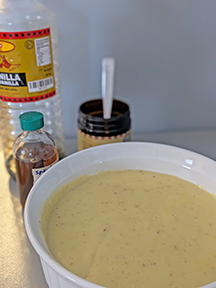
Triple Vanilla Pudding

Again, vanilla doesn’t have to be so “vanilla.” It’s a lovely flavor, no matter which style you are using, so let’s just make sure we can taste it. I could easily make this at least a triple-triple vanilla with all the types, brands, and products I have — from homemade extract to different origins to vanilla bean sugar. I think it’s almost impossible to overdo it, although I might change my mind if I get too carried away here. We didn’t even have a chance to discuss Mexican vanilla or vanilla bean paste, but you’ll see them in my recipe since they round out the flavor and really make it bloom (like a vanilla orchid of course). 

Prep tips: we add the vanilla after the cooking process since heat denatures some of the flavor compounds. Serve this as is, or borrow from vanilla ice cream’s ideal and garnish with all the toppings.

⅔ cup sugar

¼ cup flour

2 tablespoons cornstarch

½ teaspoon salt

4 cups whole milk

4 egg yolks, beaten

1 tablespoon butter

a splash of “regular” vanilla, imitation and/or extract

a splash of Mexican vanilla, imitation and/or extract

a smidge of vanilla bean paste

Mix sugar, flour, cornstarch, and salt in a medium saucepan. Gradually whisk in milk, then bring to a simmer over low heat, whisking often; cook a few minutes until nicely thickened. Carefully whisk in a ladle of the hot pudding to the beaten eggs, then transfer back to the saucepan, whisking constantly. Cook for another minute, then remove from heat and stir in butter and vanillas. Cool completely. 

Broccoli Soup

0

The great thing about running a recipe, shortly after you have written it, is you remember all the ‘little’ tips that helps answer lots of questions! I debated whether to run this new recipe so soon after other soups in the column, but I decided it was definitely worth doing, especially with all the recent snows!

Broccoli, the things I remember the most is how we called it trees, and cauliflower bushes, when our son was starting to eat table food. I also recall how I started out serving both of these fiber filled vegetables with a small drizzle of cheese over the top. Next; you start reducing the cheese at each serving, and go to perhaps a little drizzle of butter, until you are ready to eat it steamed or sauteed.

Our son loved his vegetables so much it was no effort at all and he never asked for the cheese!

What does broccoli bring to us as a vegetable? WOW, it’s probably one of the best out there, my friends. It helps maintain healthy blood pressure, the fiber content helps to regulate the body. The vitamin C and multiple antioxidants boosts the immune system to fight off bacteria. It also inhibits the development of cancer within the body. Not to mention it’s also filled with potassium. That’s enough to convince families to put it in their diet a couple times each week. If I had a large family, I would probably have fresh on hand, and also frozen. Use the fresh the first time and the frozen later in the week, so you aren’t visiting the grocery store too much.

When Dad was still in the nursing home most of the residents would become disgusted by the broccoli served to residents. They never saw the broccoli flowerets, only the hard stems. Now, am I criticizing this? YES, but not from a nutrient standpoint. Actually the stems have just as much nutrient content as the large flowers. The problem is, for seniors and many small children, this is too hard to chew and digest. Actually; the outer rind needs to be peeled to remove the stringy portion before it is served. As I delve into the reasonings for only serving stems I came up with a quick analogy. Perhaps, it is laziness? Why? The stems take longer to cook than the flowers, therefore you must be more attentive in the cooking process. We must start with the stems and then add the flowers towards the end, much like stir-fry. Probably the biggest reason for all the stems is also price. The sad part is broccoli is actually cheaper to purchase by buying the entire ‘bunch’. That’s my sermonette for the day, what’s your opinion on that one?

After I made the broccoli soup I made ‘one’ big decision. Personally; I won’t make it again with the peppers. Though I take reflux meds, the peppers bothered me a bit. You are truly eating broccoli soup, not potatoes or tons of cheese, in this dish. I also think I would enjoy smoking my own cheese and trying it again with smoked Gouda or cheddar combo. Why do I want to smoke it versus from the store? You can actually taste the smoked flavors when I smoke cheese. Commercial smoked cheese tastes like smoked cheese when you eat it on an appetizer tray, but sometimes in a dish it just dissipates. You end up wondering why you spent extra $ on smoked cheese when you cannot taste it.

Take a look at the recipe, and all the additional tips at the bottom. Next week, we will chat about swimming biscuits! Simply yours, The Covered Dish.

Fresh Broccoli Soup

3-4 tablespoons olive oil or butter

1 medium onion, chopped fine

10 baby carrots, chopped fine

2 small red peppers, may omit

16 ounces broccoli, fresh or frozen, broken into small pieces

½ teaspoon white pepper

½ teaspoon garlic powder

¾ teaspoon salt of choice

½ teaspoon smoked paprika

2 tablespoons dry celery

3 tablespoons white flour

32 ounces chicken stock, I used with salt

3 cups milk, or half n’ half, milk blend, or heavy cream and milk blend

2-3 tablespoons butter

2 cups of cheese of choice, I used part American and part Cheddar mix.


8 – 10 quart stockpot

Place olive oil in stockpot, and sauté onion, carrot and peppers until onions become translucent.

Add all of the broccoli cooking until just tender. I like to work all the spices into the mix now, so it gets worked into the vegetables. When the broccoli is about half-way cooked work the flour into the mixture and add the chicken stock. Allow mixture to cook on medium low for around 15 minutes. Mixture will gently thicken for you.

When the cooking is complete remove from burner and set on cool oven top. Using a submersible blender, blend everything smooth, being careful not to burn yourself. If you don’t own a submersible blender, you will have to let this totally cool, and then place in a regular blender. I was able to keep part of my soup smooth and some with a few ‘pieces’, which the family liked. At this time; stir in the 3 cups of milk, or other dairy mixtures as indicated in recipe. Add freshly grated cheese for the best flavor outcome. Add the butter and serve after the soup has cooled a bit, it truly tastes better after it sets on low a little while.

Points to remember:

1. The carrots and sweet peppers can increase the ‘sweetness’ to the soup

2. Frozen broccoli is rather large, so cut it down in size.

3. Consider green onions instead of regular sweet onions

4. Think about Parmesan cheese instead of the American and Cheddar. If you go this route, remember Parmesan is a bit salty, so you might want to pull the ¾ teaspoon of salt and add it at the end, as necessary.

5. I had concern over the amount of protein in the soup, so I considered adding white northern beans, either whole or blended to the soup. Another idea is to add about a cups of blended cottage cheese to increase the amount of protein.

6. If you put something hot in a blender you risk an ‘explosion’ if the lid is down on the blender. Before I had a submersible blender, I would cool the product slightly and then do small batches in the regular blender and use a hand-towel over the top, not a tight lid.

7. I was striving to make a soup that could be done in only one pot, versus 2 or 3 different steps in different cooking pans, etc.

8. I find myself adding the spices and working them into the main ingredients more frequently versus towards the end of cooking.

9. Fresh grated cheese just tastes better. Cellulose powder is added to pre-shredded cheese to keep it from clumping. This can alter taste and the melt of the cheese.

10. The soup tastes very fresh, not heavy with more cheese and sometimes potatoes.

What’s in Your Hopper?

0

A few years back we embarked on an adventure to build a simple and inexpensive deer feeder. A friend had an old unused fuel tank stand made from angle iron – the kind that once held a three-hundred-gallon drum on its side. I bought it for a song, and then came the challenge of what to use for a hopper to hold the corn. I’m not sure my wife has ever thought INSIDE the box, and she came up with the idea of using a poly cart like the ones that hold our weekly trash. I called the local solid waste utility company, found an old one with a broken axle and bought it for another song. We wanted to use a “flinger” style mechanism to dispense the corn, and since the bottom of poly carts are flat, that required somehow making the inside of the poly cart funnel shaped to funnel the corn down to the mechanism. That problem was solved by cutting two pieces of scrap plywood to fit inside the hopper, making the inside wedge-shaped.

We purchased the dispensing mechanism which consists of a small wheel mounted above a motor that’s driven by a square six-volt battery. It’s all controlled by a timer which turns the dispenser on and off at programed times, spinning the wheel and flinging corn around onto the ground. A thick plastic funnel comes with the dispenser and bolts around a hole cut into the bottom of the hopper. That funnel is specially designed so that when it’s positioned the right height above the flinger, it allows corn to run out of the hopper onto the flinger wheel, but causes it to “bridge-up” and stop until the wheel spins. In other words, if the funnel was wider or placed too far above the wheel, the corn would not “bridge-up” and stop running when it hit the motionless wheel, but instead would just pour constantly onto the ground until it had all run out.

Fast forward to spring a couple years later, when we were using the feeder to feed corn to turkeys prior to spring turkey season. I remember going there one evening to check the amount of corn in the hopper and was surprised to find it empty with lots of corn on the ground. I backed the pickup up to the feeder and climbed up onto it with a bucket of corn like I had done numerous times before, but when I dumped the bucket into the hopper, the corn all ran straight through onto the ground. Upon inspection, I found that the plastic funnel had been chewed off by some critter making it much shorter and allowing the corn to just pour through the hole. The feeder was now useless until a new funnel of some sort was put onto the bottom of the hopper.

A couple weeks later we headed out to pick up our then-useless deer feeder for repairs. It dawned on me that the hopper was made to be easily removed and that’s all we needed anyway, so we began removing the bolts that held it to the frame. As we worked, it seemed like I could hear an occasional rustling sound inside the hopper. I felt like Clark Griswald from the movie “Christmas Vacation,” trying to find the squeaking noise coming from the Christmas tree. But each time I stopped to listen, the rustling noise stopped too, so I dismissed it to my imagination. When the hopper was finally loose, we toppled it over into the bed of the pickup, and Joyce began hearing my “imaginary” rustling noise also. Supposing a no-good packrat was inside, I pulled the hopper to the back of the pickup and started to open the lid. My plan was to stand to the side and let the open lid dangle over the back of the tailgate in hopes that our freeloader would jump out the back and be gone without incident. While rolling the hopper around, the rustling inside turned to scratching and clawing and with the hole in the hopper facing away from us,

I prepared to open the lid and confront the intruder. I unsnapped the tarp strap that held the lid closed, but before I could fling it open, a squirrel bailed out the hole in front, clearing the side of the pickup in one bound like Rocky the Flying Squirrel. Joyce and I starred at each other in disbelief; I think her only words were” I didn’t see that comin’!” The critter had actually chewed a hole through the half-inch plywood inside and had quite the cozy little nest built within; we pulled grass and leaves out of there for ten minutes.

The most amazing thing about the whole squirrel-nest-inside-the-deer-feeder-hopper thing is that the only way into it was up through the hole in the plastic funnel on the bottom. I know squirrels can squeeze their bodies into some impossible places, but I’d loved to have watched it leap from the frame of the feeder onto the motor, then stuff itself up through the gnawed-out plastic funnel and into the poly cart. This gives a whole new meaning to the term “squirrel corn.” So, as you continue to Explore Kansas Outdoors, if something seems squirrely, it probably is!

Steve can be contacted by email at [email protected]

KU News: Physicians reveal outlooks and concerns about use of artificial intelligence in medical care

0

From the Office of Public Affairs | http://www.news.ku.edu

Headlines

Physicians reveal outlooks and concerns about use of artificial intelligence in medical care

LAWRENCE — New research from University of Kansas philosophy and medical researchers analyzes physician and physician assistants’ views about the use of artificial intelligence in the medical profession, including its potential future applications. Published in JAMIA Open, the findings are based on responses from more than 500 members of the Kansas State Board of Healing Arts, the state’s medical licensing and regulatory board.

Meagan Patterson named associate vice provost in Faculty Affairs

LAWRENCE — Meagan Patterson, professor of educational psychology, has been named associate vice provost for faculty policy and recognition at the University of Kansas. Her appointment became effective Jan. 1. This new position will take a leadership role in developing policy, reviewing policy processes and developing educational programming related to faculty policy. Additionally, this role will develop and promote faculty recognition initiatives and coordinate university-level faculty award committees in the Office of Faculty Affairs.

Full stories below.

————————————————————————

Contact: Jon Niccum, KU News Service, 785-864-7633, [email protected]

Physicians reveal outlooks and concerns about use of artificial intelligence in medical care

LAWRENCE — Whether it’s the Emergency Medical Hologram in “Star Trek” or the “MedPod” in the “Alien” films, the creators of science fiction have long considered the healing possibilities of artificial intelligence. Now physicians are also pondering the modern reality of such futuristic concepts.

“It’s easy to speculate about how medicine will change with the emergence of AI. But for this research, we were concerned with assessing how medical professionals are actually thinking about it in the present,” said John Symons, professor of philosophy at the University of Kansas.

His new paper “Perceptions and attitudes toward artificial intelligence among frontline physicians and physicians’ assistants in Kansas: a cross-sectional survey” suggests that perceptions of benefits, trust, risks, communication barriers, regulation and liability issues influence health care professionals’ intention to use AI, regardless of their technological familiarity.

The research appears in JAMIA Open.

Co-written by Robert Badgett and Rosey Zackula of the University of Kansas School of Medicine-Wichita, Rajeev Seecheran of the University of New Mexico and Tanner Dean with Intermountain Health, Salt Lake City, the research found that the top concerns medical professionals have are liability-related and responsibility-related. But the respondents also shared a concern about how the practice of medicine and the satisfaction of interacting with patients might be reduced or eliminated.

“Let’s say I’m a physician in Kansas, and I have 1,000 avatars of me out there on people’s phones. These reflect my expertise, my bedside manner, etc.,” Symons said.

“People would interact with these avatars during their day. They’d say, ‘OK, doctor, I’ve got this ailment. What do you think?’ Obviously, the amount of time people can spend with these devices far exceeds the availability of a doctor. But how is my responsibility going to be distributed across 1,000 instances of me … or at least of my presence, of my image?”

As alluded to in the title of the paper, both physicians and physician assistants’ responses were nearly identical. While that proved somewhat predictable, what really surprised Symons were responses involving AI fluency.

“We would expect that people who are more familiar with the technology would have more refined or different kinds of concerns,” Symons said. “But, typically, all the concerns echo an interest in the more social consequences of AI. That is broadly consonant with the kinds of research we’re doing at the Center for Cyber-Social Dynamics, where we’re seeing social transformation as becoming a more pressing concern than traditional concerns about privacy or security.”

To obtain a comprehensive sample of participants, an email invitation was sent to all 12,290 actively licensed physicians and physician assistants of the Kansas State Board of Healing Arts (KBHA). The KBHA is the state’s medical licensing and regulatory board for 16 different health professions. Of these active members, 532 responses were received.

Currently, physicians are already using AI in limited capacities.

“There are research applications of AI that are extremely prominent in the biomedical fields. There are office levels of paperwork applications of AI we can point to. You can also find many examples in imaging and diagnostics. But so far, day-to-day clinical use of AI isn’t part of your normal internal medicine practice,” Symons said.

What are some ways it might be used by physicians in the near future?

“Likely applications of AI will involve avatars for doctors,” he said.

“Your doctor will be present as an AI on your phone or computer. It’s very likely that — assuming we can tackle the legislative problems, liability issues and the economics of such things — we will have broadened access to high-quality medical advice when we want it. And it would also be great if these artifacts were somehow attached to the authority and competence of a practicing doctor so they could write prescriptions and review the interaction you had with the AI.”

A native of Cork, Ireland, Symons has been at KU since 2012. An expert in metaphysics and epistemology of science and philosophy of technology, he has written or edited a dozen books, including “The History and Philosophy of Materialism” (2024), “Formal Reasoning: A Guide to Critical Thinking” (2017) and “The Architecture of Cognition: Rethinking Fodor and Pylyshyn’s Systematicity Challenge” (2014). He is the director of the Center for Cyber-Social Dynamics.

“The use of AI will dramatically alter the way we value labor and expertise in the medical professions,” Symons said.

“All of this is provisional, of course, on the kinds of institutional frameworks that insurance companies and large medical groups impose on us. While it’s difficult to foresee how the economics of medicine will change in the United States, it’s clear that something has to change. We’re all dissatisfied with the current model of medical care, and this will be an opportunity for new economic models for health care to emerge.”

-30-

————————————————————————

Don’t miss new episodes of “When Experts Attack!,”

a KU News Service podcast hosted by Kansas Public Radio.

https://kansaspublicradio.org/podcast/when-experts-attack

————————————————————————

Contact: Elizabeth Barton, Office of Faculty Affairs, [email protected]

Meagan Patterson named associate vice provost in Faculty Affairs


LAWRENCE — Meagan Patterson, professor of educational psychology, has been named associate vice provost for faculty policy and recognition at the University of Kansas. Her appointment became effective Jan. 1.

This new position will take a leadership role in developing policy, reviewing policy processes and developing educational programming related to faculty policy. Additionally, this role will develop and promote faculty recognition initiatives and coordinate university-level faculty award committees in the Office of Faculty Affairs.

Amy Mendenhall, vice provost for faculty affairs, said the new associate vice provost position will allow Faculty Affairs to expand already established relationships across KU and further support the mission of the office.

“This position will enable the Office of Faculty Affairs to grow our efforts to support faculty and faculty leaders in developing and implementing clear, equitable and aligned policies that relate to the faculty role and promote and recognize the valuable work and contributions of KU faculty,” Mendenhall said. “I am excited for Meagan to bring her experience in policy development and implementation, as well as existing partnerships with units across campus on academic initiatives, to this role.”

Patterson recently served the Office of Faculty Affairs as a provost fellow. In this position, she laid the groundwork for some of the initiatives that will be further developed in her new role as associate vice provost. As a faculty fellow, Patterson reviewed faculty-related policies and led initiatives such as updating outdated policies, creating supplemental policy resource documents and communicating with units across campus to clarify and provide guidance.

Patterson has been with the Department of Educational Psychology in the School of Education & Human Sciences since 2007. Previously, Patterson has served as a program coordinator within the Department of Educational Psychology, a faculty fellow with the Center for Teaching Excellence, a member of faculty senate and a research mentor for the McNair Scholars program.

“I am excited to join the team at the Office of Faculty Affairs and look forward to working with groups across campus to recognize the great work being done within their units and create policies that reflect their goals, priorities and values,” Patterson said.

Patterson’s research focuses on children’s knowledge and attitudes about gender, race and politics and how adults talk with children about these topics. She has taught courses on child development, the psychology of learning, social psychology and college teaching and serves as the director of KU’s graduate certificate program in postsecondary teaching. She has received multiple teaching awards, including the Budig Teaching Professorship in Education.

Before coming to KU, Patterson received her bachelor’s degree in psychology and linguistics from the University of North Carolina at Chapel Hill and her master’s and doctorate in developmental psychology from the University of Texas at Austin.

-30-

————————————————————————

KU News Service

1450 Jayhawk Blvd.

Lawrence KS 66045

[email protected]

http://www.news.ku.edu


Erinn Barcomb-Peterson, director of news and media relations, [email protected]


Today’s News is a free service from the Office of Public Affairs