Tuesday, January 27, 2026
Home Blog Page 233

Getting it in writing – Agriculture land leases

0
Photo by Ben Collins

Over half of the farmland in Kansas is leased.

Therefore, there are many different lease arrangements, factors to consider, and places where misunderstandings can happen. Additionally, many leases are still oral leases that are “signed” with a handshake.

One of the best ways to create a better understanding between tenant and landlord in most cases is to have a written lease.  Having a written lease can lead to many topics for discussion that otherwise might not be considered.

They would include but are not limited to:

Hunting/fishing rights
Recreation access
Payment due dates
Termination procedures

In addition to the previously mentioned items, a written pasture lease for example can spell out responsibilities of both parties in regards to:

Care of fences
Noxious weed control
Water supply maintenance
Grazing capacity restrictions and beginning and ending date of grazing season

A bonus of a written lease is that it documents the terms of the business relationship in case the contract is questioned. This can be especially important if the land changes hands.

Obviously, it is not necessary to have a written lease in order to have good communication between tenant and landlord but it can be helpful in spelling things out and avoiding misunderstandings and hard feelings.

There may be some cases when introducing the possibility of implementing a written lease might damage the business relationship. Whether you have a written lease or not, make sure those lines of communication are kept open, visit with each other at least a few times a year.

Local county and district extension offices have several resources concerning leases, written leasing arrangement forms, cash rental rate averages, Kansas Agricultural Lease Law Publication C-668, etc. Go to www.agmanager.info and click onto the Farm Management tab.

If you have questions contact your local county or district extension office. I can be contacted in the Cottonwood District, Great Bend office at 620-793-1910 and Stacy Campbell can be contacted in the Hays office at 785-628-9430.

Alicia Boor is an Agriculture and Natural Resources agent in the Cottonwood District (which includes Barton and Ellis counties) for K-State Research and Extension. You can contact her by e-mail at [email protected] or calling 620-793-1910.

Lettuce Eat Local: It’s A Wasabi Winter

0

Amanda Miller
Columnist
Lettuce Eat Local


It’s still winter out there.

The snow was gorgeous. I was particularly delighted the one night when those fat flakes were falling gently down, the rest of the world so still that you could hear their soft patter. It was like the air froze along with everything else, calm and beautiful in the starlight. Cold, but ethereal. 

The blizzardy snow was also a kind of spellbinding; the flurries were so fast and furious that they were all you could see, and the snow obfuscated the landscape from ground to sky in white. I didn’t have to go outside, so it was almost magical. 

But at this point it doesn’t feel quite so enchanting anymore. The snow that’s left on the ground has melted and refrozen on repeat, and while that unfortunately doesn’t seem to hinder my son from scooping it up and eating it, it is just not as appealing on many levels: crusty and dusty. 

And it’s cold out there, so cold. I figure if it’s going to be cold, it might as well snow; which is a viewpoint I still hold to, but also, just because there’s going to be snow, doesn’t mean it has to be this cold. 

You know it’s bad when I regret not wrestling into coveralls for my ten minutes of chicken chores. Some days the wind has felt like me, too cold to move, but other days I wonder if this is what Antarctica feels like as the cold wind hits as I step outside, literally taking my breath away. 

I’ve learned to appreciate some of the finer points of winter, since being married to a farmer who works hypothetically less during a few of the colder months. But I would without fail rather be too warm than too cold, so eventually, this weather is just too much. Or too little, looking at the numbers on the thermometer. 

I used to have days when it’s like my bones got cold and just couldn’t warm up fully, no matter how many layers I’d put on. Growing kids has recalibrated my internal thermostat to a good extent, and I often have a hard time even wearing long sleeves. But the t-shirts have gotten a rest the last couple weeks, as cozy and warm must be the name of the game to survive. 

It doesn’t help that the winter emotional blahs correlate with the weather sometimes. Seasonal Affective Disorder is a real thing, and while Kansas sunshine makes a huge difference to me, it’s not always enough for everyone. Our family just had a chaotic week that left us with some emotional whiplash, and our mood the last few days has been a bit frosty and meh. 

Time to bring out the warming foods. Of course we think of hot soups, hot casseroles, hot chocolate…and I also think of hot sauce. While spicy foods don’t actually heat up your body temperature, they can make you feel warmer momentarily. A placebo doesn’t have to be effective to work. 

An often overlooked source of spicy in our Midwestern world is wasabi. Though essentially all the wasabi you’ll encounter around here is going to be horseradish dyed green, it’s still delightful and that little extra pop of color can’t hurt in this winter wonderland. Its spiciness can sear through our nostrils and its piquant flavor can stampede through our tastebuds, energizing us physically and mentally. The wasabi/horseradish burn tastes ironically like a cold hot, a nice complement to these wintry, yet hopefully warm, days.


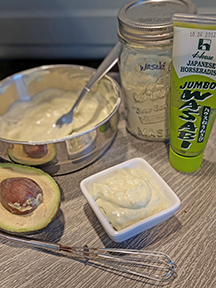
Creamy Avocado Wasabi Sauce

Some people who don’t handle spicy food well can still enjoy wasabi-style heat (like Brian), since it burns and then leaves, instead of lingering like chile-based spice. We are hosting a sushi-making night this week, so it’s perfect timing for me to whip up some wasabi sauce, but I need to remember to use it on more than just sushi — it was already delicious dipped with baby carrots, but I’m thinking roasted cauliflower, scrambled egg sandwiches, or even swirled into other warm-food favorites like chowders or creamy pasta for a little zing. 

Prep tips: I used two kinds of wasabi because I had them, but just one style will work. Keep in mind different brands may have highly variable heat levels, so you do you. 

¼ cup mayonnaise 

¼ cup thick plain yogurt or sour cream

1 avocado

2 teaspoons powdered wasabi

2 teaspoons prepared wasabi

2 teaspoons hot or regular honey

½ tablespoon rice vinegar

¼ teaspoon salt, or to taste

Smash/whisk all ingredients together; adjust to taste. 

Lovina’s daily diary for a January Friday

0

Lovina’s Amish Kitchen
Lovina Eitcher,
Old Order Amish
Cook, Wife &
Mother of Eight


Diary for January 10, 2025

4:40 a.m. Our alarm rings, telling us it’s time to start a new day. Joe only works until 12:30 today, so I don’t have to pack more than some snacks for him and fill his water jug. I make him breakfast, which is the usual weekday sausage patty, egg, and cheese on tortilla. I cut an 8-inch soft tortilla into four pieces and use two every morning to make a sandwich. It’s a way to stay away from too much bread. 

5:10 a.m. Joe leaves for work.

6 a.m. While son Benjamin goes out to do the morning chores, I pack his lunch. He doesn’t want breakfast, so it doesn’t take me too long. 

6:25 a.m. Benjamin leaves for work. Daughter Lovina arrives. Daniel dropped her off here on his way to work. She goes up to her old bedroom to take a nap. 

I sit on my recliner and after trying to read, I fall asleep. I didn’t set an alarm, so I don’t wake up until 8 a.m. After a shower, I get some mail ready, then gather the dirty laundry, as I want to wash clothes today. 

We are getting more snow. It is a wet snow so the steps and ramp are slippery. I scatter some ice melt to help prevent it. 

9 a.m. Lovina makes us breakfast, which is sausage, egg, and grilled cheese. I mix up a batch of sour cream cutout cookies so the dough can chill while I do laundry. Daughter Verena goes over to daughter Loretta and Dustin’s house to help her. Her special friend Daniel Ray doesn’t have to work today, so he goes to help Verena with the work at Dustin and Loretta’s house too. Denzel and Byron love tearing it up with Daniel Ray. Those two little boys are still getting used to having a baby sister in the house. 

Dishes are washed, floors swept up, and so on.

12:30 p.m. Daniel stops in to pick up Lovina on his way home from work.

1 p.m. Joe is home from work. I make Joe and Kevin something for lunch and then finally get started on the laundry. I was waiting for the solar batteries to charge more. Usually when they are low we can start the generator, but we are out of gas. Son Benjamin will go get our gas jugs filled after he comes home from work. 

4 p.m. Benjamin is home from work and will leave soon to go to town to get gas. He also runs a few errands for me. I don’t know what we would do without him around. He does the chores most of the time and helps me with being caregiver to son Kevin.

4:30 p.m. Laundry is hung on the lines in the basement. Joe is refueling both coal stoves while I bake the cookies. I frost them after they are cooled.

6:30 p.m. We all go over to Dustin and Loretta’s house for supper. Daughter Elizabeth and Tim bring supper in to Dustin and Loretta. They tell us to come, too, as they brought enough for us. I am glad to not have to make supper. I take some freshly baked cookies to add to our supper. 

It is so good to see Tim, Elizabeth, and their children. We haven’t seen them since Christmas. I don’t think we’ve ever gone that long without seeing them before. Life gets too busy sometimes. Tim and Elizabeth are making their unattached garage into living quarters to move into. Sadly, their house has so many different kinds of mold in the walls and elsewhere. They received two professional opinions that it is not worth saving. I am so glad for everyone who has helped them, as Joe and I have not been able to help yet. By the time Joe gets home from work, his health doesn’t allow him to do too much more. 

8 p.m. Supper’s over. We spend the rest of the evening visiting and playing games. Abigail, 8 (our firstborn grandchild), comes to sit on my lap. She says, “Grandma, I hope I can always sit on your lap.” She is such a sweetheart. It is so hard to believe that she has grown up this much already. The children are excited to meet their new little cousin Kylie. She is now six days old, and it really seems like she just eats and sleeps. She loves sucking on her hand when her feeding time is due. So precious, and such a blessing from our God.

10 p.m. Good night! I wish you God’s many blessings!

Peanut Butter Cream Pie

1 cup creamy peanut butter

1 cup powdered sugar

1 (9-inch) premade graham cracker pie crust

8 ounces cream cheese (softened)

1 cup granulated sugar

2 cups heavy cream

1 teaspoon vanilla

1 cup milk

1 (3.4-ounce) package instant vanilla pudding mix

Combine peanut butter and powdered sugar until mixture is crumbly. Spread half of these peanut butter crumbles evenly in the bottom of the graham cracker crust. Set aside remaining crumbles for the topping. Beat together the cream cheese and granulated sugar until smooth. Add the heavy cream and vanilla, beating until light and fluffy. In a separate bowl, whisk together milk and pudding mix until thickened. Fold the pudding mixture into the cream cheese mixture until well combined. Pour over the peanut butter crumbles in the crust. Top with remaining peanut butter crumbles. Refrigerate for several hours before serving. 

Lovina’s Amish Kitchen is written by Lovina Eicher, Old Order Amish writer, cook, wife, and mother of eight. Her three cookbooks, The Cherished Table, The Essential Amish Cookbook, and Amish Family Recipes, are available wherever books are sold. Readers can write to Eicher at Lovina’s Amish Kitchen, PO Box 234, Sturgis, MI 49091 (please include a self-addressed stamped envelope for a reply); or email [email protected] and your message will be passed on to her to read. She does not personally respond to emails.

Lettuce Eat Local: So Vanilla

0

Mmm, wrinkly beans soaked for months in a volatile fermented liquid, turning it a nice light brown color. That doesn’t strike your fancy? How about synthetic chemical compounds that are aromatic but also maybe containing a side of petroleum? Or, if you’re lucky, perhaps [although most likely not] with some naturally aromatic secretions from…beaver rear ends. 

Nothing like kicking off a food column with some really appealing thoughts, the kind that really whet your appetite. You may have guessed by now that I was describing vanilla extract and imitation vanilla products — one of the most popular and ubiquitous flavors out there, yet one that we don’t put a lot of thought into. Vanilla is so normal that you can even use it as an adjective for ordinary; “having no special or extra features.” 

Vanilla is so…vanilla. 

On the other hand, how incredible is it that those long, slender bean pods are the fruit of gorgeous orchids? According to Cook’s Vanilla, “Vanilla beans are one of the world’s most difficult crops to cultivate. After harvest, the beans require an arduous and tricky nine-month process of sun drying to cure properly. Vanilla simply does not lend itself to mechanization or other methods of mass production.” This explains some of the price tag on authentic vanilla extract. 

Vanilla is indigenous to Mexico, and only a few other not-far-from-the-Equator countries are able to successfully grow vanilla orchids. The vines can grow up to 50 feet long, and the orchids must be pollinated (typically by hand) within their 24-hour bloom or they die. Americans were introduced to vanilla by President Thomas Jefferson in 1789, and now we are the largest consumers of vanilla in the world. 

Recipes and ingredient lists don’t often distinguish between “real” vanilla extract (from the bean) and “fake” vanilla flavoring (imitation); America’s Test Kitchen says the two are identical at the molecular levels and a tasting panel could not tell the difference when sampled in cookies and pudding. And while vanilla extract has a more complex flavor, imitation vanilla is actually stronger tasting — some products contain up to 15 times more vanillin (the appropriately named flavor component in vanilla). Considering some vanilla extract brands can cost 50 times more than flavoring brands…it’s impossible to say that one is “better” than the other. 

Interesting, one research study noted that all vanilla usage in the United States has skyrocketed since 2019 and pandemic-induced home baking. To be fair, it’s almost impossible to find a sweet recipe that doesn’t include vanilla; it’s as much a given as salt, if not more (although there should always be at least a pinch). In some ways, I feel it’s overused, and occasionally leave it out just to be a rebel. But that’s rare, because what really, what can a little bit hurt?

More often, as in every single time, I add more vanilla than called for. It’s been years since I’ve measured it — in my cooking classes, I typically narrate my ingredient additions and vanilla gets the classic “precisely one teaspoon” quip as I splash in an unidentified yet decisively generous amount. Seriously, one teaspoon is for wimps. If it’s going to be vanilla, make it vanilla. And not the boring kind.


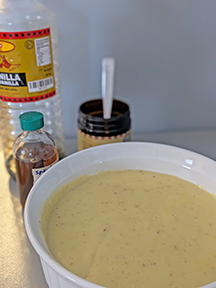
Triple Vanilla Pudding

Again, vanilla doesn’t have to be so “vanilla.” It’s a lovely flavor, no matter which style you are using, so let’s just make sure we can taste it. I could easily make this at least a triple-triple vanilla with all the types, brands, and products I have — from homemade extract to different origins to vanilla bean sugar. I think it’s almost impossible to overdo it, although I might change my mind if I get too carried away here. We didn’t even have a chance to discuss Mexican vanilla or vanilla bean paste, but you’ll see them in my recipe since they round out the flavor and really make it bloom (like a vanilla orchid of course). 

Prep tips: we add the vanilla after the cooking process since heat denatures some of the flavor compounds. Serve this as is, or borrow from vanilla ice cream’s ideal and garnish with all the toppings.

⅔ cup sugar

¼ cup flour

2 tablespoons cornstarch

½ teaspoon salt

4 cups whole milk

4 egg yolks, beaten

1 tablespoon butter

a splash of “regular” vanilla, imitation and/or extract

a splash of Mexican vanilla, imitation and/or extract

a smidge of vanilla bean paste

Mix sugar, flour, cornstarch, and salt in a medium saucepan. Gradually whisk in milk, then bring to a simmer over low heat, whisking often; cook a few minutes until nicely thickened. Carefully whisk in a ladle of the hot pudding to the beaten eggs, then transfer back to the saucepan, whisking constantly. Cook for another minute, then remove from heat and stir in butter and vanillas. Cool completely. 

Broccoli Soup

0

The great thing about running a recipe, shortly after you have written it, is you remember all the ‘little’ tips that helps answer lots of questions! I debated whether to run this new recipe so soon after other soups in the column, but I decided it was definitely worth doing, especially with all the recent snows!

Broccoli, the things I remember the most is how we called it trees, and cauliflower bushes, when our son was starting to eat table food. I also recall how I started out serving both of these fiber filled vegetables with a small drizzle of cheese over the top. Next; you start reducing the cheese at each serving, and go to perhaps a little drizzle of butter, until you are ready to eat it steamed or sauteed.

Our son loved his vegetables so much it was no effort at all and he never asked for the cheese!

What does broccoli bring to us as a vegetable? WOW, it’s probably one of the best out there, my friends. It helps maintain healthy blood pressure, the fiber content helps to regulate the body. The vitamin C and multiple antioxidants boosts the immune system to fight off bacteria. It also inhibits the development of cancer within the body. Not to mention it’s also filled with potassium. That’s enough to convince families to put it in their diet a couple times each week. If I had a large family, I would probably have fresh on hand, and also frozen. Use the fresh the first time and the frozen later in the week, so you aren’t visiting the grocery store too much.

When Dad was still in the nursing home most of the residents would become disgusted by the broccoli served to residents. They never saw the broccoli flowerets, only the hard stems. Now, am I criticizing this? YES, but not from a nutrient standpoint. Actually the stems have just as much nutrient content as the large flowers. The problem is, for seniors and many small children, this is too hard to chew and digest. Actually; the outer rind needs to be peeled to remove the stringy portion before it is served. As I delve into the reasonings for only serving stems I came up with a quick analogy. Perhaps, it is laziness? Why? The stems take longer to cook than the flowers, therefore you must be more attentive in the cooking process. We must start with the stems and then add the flowers towards the end, much like stir-fry. Probably the biggest reason for all the stems is also price. The sad part is broccoli is actually cheaper to purchase by buying the entire ‘bunch’. That’s my sermonette for the day, what’s your opinion on that one?

After I made the broccoli soup I made ‘one’ big decision. Personally; I won’t make it again with the peppers. Though I take reflux meds, the peppers bothered me a bit. You are truly eating broccoli soup, not potatoes or tons of cheese, in this dish. I also think I would enjoy smoking my own cheese and trying it again with smoked Gouda or cheddar combo. Why do I want to smoke it versus from the store? You can actually taste the smoked flavors when I smoke cheese. Commercial smoked cheese tastes like smoked cheese when you eat it on an appetizer tray, but sometimes in a dish it just dissipates. You end up wondering why you spent extra $ on smoked cheese when you cannot taste it.

Take a look at the recipe, and all the additional tips at the bottom. Next week, we will chat about swimming biscuits! Simply yours, The Covered Dish.

Fresh Broccoli Soup

3-4 tablespoons olive oil or butter

1 medium onion, chopped fine

10 baby carrots, chopped fine

2 small red peppers, may omit

16 ounces broccoli, fresh or frozen, broken into small pieces

½ teaspoon white pepper

½ teaspoon garlic powder

¾ teaspoon salt of choice

½ teaspoon smoked paprika

2 tablespoons dry celery

3 tablespoons white flour

32 ounces chicken stock, I used with salt

3 cups milk, or half n’ half, milk blend, or heavy cream and milk blend

2-3 tablespoons butter

2 cups of cheese of choice, I used part American and part Cheddar mix.


8 – 10 quart stockpot

Place olive oil in stockpot, and sauté onion, carrot and peppers until onions become translucent.

Add all of the broccoli cooking until just tender. I like to work all the spices into the mix now, so it gets worked into the vegetables. When the broccoli is about half-way cooked work the flour into the mixture and add the chicken stock. Allow mixture to cook on medium low for around 15 minutes. Mixture will gently thicken for you.

When the cooking is complete remove from burner and set on cool oven top. Using a submersible blender, blend everything smooth, being careful not to burn yourself. If you don’t own a submersible blender, you will have to let this totally cool, and then place in a regular blender. I was able to keep part of my soup smooth and some with a few ‘pieces’, which the family liked. At this time; stir in the 3 cups of milk, or other dairy mixtures as indicated in recipe. Add freshly grated cheese for the best flavor outcome. Add the butter and serve after the soup has cooled a bit, it truly tastes better after it sets on low a little while.

Points to remember:

1. The carrots and sweet peppers can increase the ‘sweetness’ to the soup

2. Frozen broccoli is rather large, so cut it down in size.

3. Consider green onions instead of regular sweet onions

4. Think about Parmesan cheese instead of the American and Cheddar. If you go this route, remember Parmesan is a bit salty, so you might want to pull the ¾ teaspoon of salt and add it at the end, as necessary.

5. I had concern over the amount of protein in the soup, so I considered adding white northern beans, either whole or blended to the soup. Another idea is to add about a cups of blended cottage cheese to increase the amount of protein.

6. If you put something hot in a blender you risk an ‘explosion’ if the lid is down on the blender. Before I had a submersible blender, I would cool the product slightly and then do small batches in the regular blender and use a hand-towel over the top, not a tight lid.

7. I was striving to make a soup that could be done in only one pot, versus 2 or 3 different steps in different cooking pans, etc.

8. I find myself adding the spices and working them into the main ingredients more frequently versus towards the end of cooking.

9. Fresh grated cheese just tastes better. Cellulose powder is added to pre-shredded cheese to keep it from clumping. This can alter taste and the melt of the cheese.

10. The soup tastes very fresh, not heavy with more cheese and sometimes potatoes.