Wednesday, January 28, 2026
Home Blog Page 248

Spinach & Sausage Soup

0

OK, this week you get a ‘newbie’ soup, from my kitchen. I’ve made one very similar to this about 8-10 years ago, however they do differ by a few ingredients & spices. ErvIn and I adore soups, sometimes the prepping takes a little time, but the outcome is great. It’s quick for work and unless it’s a super rich soup, it’s usually easy on the calories. I’m wondering if it’s an age thing, or where we grew up, but I seldom ever turn down a good bowl of soup.

Today, I think I embarrassed Phillip, our son, because we went out for his birthday dinner today. The restaurant is one of our favorites in Springfield, Missouri, FD’s. It’s on the south end of the city, easy access for us, and the food there is excellent. So how did I embarrass him? The waitstaff individual asked me what I thought of the cup of gumbo? I responded with: ‘Very good for the state of Missouri’. Hey; I was honest, it was good for Missouri, now when I go south in a few days I expect absolutely excellent gumbo! DO NOT think I was making crude remarks, because FD’s is simply excellent quality and the prices are better than most restaurants in the area.

I didn’t get everything done on my list for the weekend, so I’ve got to put the pedal to the metal this week. I still have some cookie doughs to make for the freezer, and one batch of fudge. Plus I’m making some extra meals to take to my in-laws, in Springfield, this week. OH, and I’m making breakfast burritos too. That may come on the weekend!!!

We had a wonderful family Christmas on Saturday late afternoon. The food was excellent, and having little ones again was wonderful. Plus we found out we have another one headed our way in May. A great time was had by all, and guess what, the 2 toddlers slept all night!

I didn’t know what to call my soup this week, so feel free to rename it, just keep my name attached!

You could reach for turnip greens instead of spinach in the recipe, and of course, you can play around with the other ingredients. Petit Jean Andouille sausage is from Morrillton, Arkansas, and I think the heat of their link sausage is great. You will note I only used about ¾ of a pound instead of the entire 1 pound. I also peeled off the casing before cooking. The extra I put in the frig to cook with some breakfast eggs this week.

So how about a little tip this week that I have never done? I was on line reading last week and stumbled onto an article about Waffle House using only dehydrated potatoes. Yep, honest to goodness. I mentioned this to a friend, and she told me instant hash browns get a great deal crispier, then the fresh do. I’ve only used them in a breakfast casserole myself. So, I’m going to give it a try. It would be handier if you were in an RV or camping in general. I still like baking extra baked potatoes and frying the leftovers for breakfast the next morning.

I need to set the recipe and cart myself off to bed. By the time you read this column we will be just ‘days’ away from Christmas. Enjoy each moment my friends, and God Bless each and every one.


Spinach and Sausage Soup

3-4 tablespoons olive oil

1 medium-large onion, sweet, diced

3 stalks celery, diced

1 ½ – 2 cups diced/cubed sweet potatoes

¾ lb. Andouille Sausage, sliced and quartered

2 tablespoons dry celery

1 teaspoon cumin

1 teaspoon black pepper

1 teaspoon ground savory

1 (15-20 oz.) can diced tomatoes

2 cans canelli beans, or white northern

8 cups stock, or 2 boxes of chicken stock, 1 no sodium, 1 with sodium

5 ounces, chopped spinach

In a stockpot, place the olive oil and sauté the onion, celery and the sweet potatoes. If the sweet potatoes don’t get quite done, that’s fine, they will finish once the stock is added. When you’ve sweated the sweet potatoes at least half way; add the prepared sausage, stirring to lightly brown. Add all spices and work into vegetables and meat. Add the tomatoes, beans and stock. Allow to heat thoroughly and then bring in the spinach towards the end; simmer a bit before serving.

Yes, it has a bit of a kick, but it’s not overwhelming. We had it for lunch on Saturday and I’m definitely ready for another bowl for lunch tomorrow.

Whatever you do, do not add any salt, UNLESS you used 8 cups of all unsalted chicken stock. Then; taste as you go.


Your Tax Dollars At Work

0
lee pitts

I don’t mind paying my share of taxes but when I see what my tax dollars are spent on it makes me madder than a rained-on rooster. For example, how do you feel about your taxes being spent by the National Institutes of Health (NIH) on a $3 million program to expand access to sex change operations for minors as young as 13-years-old?

The NIH is using taxpayer money to promote transgenderism in children through the use of irreversible surgeries and hormones. They are also using our tax dollars on “The Trans Health Guide” website and other training materials that offer “gender-affirming medical and mental health care” which focuses on “transgender youth of color.” This is the same NIH that came under scrutiny after it was revealed that two youngsters committed suicide after taking hormones for two years and participating in an NIH study called “Psychosocial Functioning in Transgender Youth.”

Another $700,000 of your money was spent to create “an inclusive teen pregnancy program for transgender boys.” I don’t care how much of our money they spend, a transgender boy is NEVER going to birth to a baby.

Another $50,000 in grant money was spent “to diversify the outdoors” by encouraging LGBTQ teenagers to attend Teen Wilderness Conservation Camps. What really gets my dander up is that this program to encourage transgender, lesbian, gay, and bisexual kids to go on wilderness conservation trips is a program of the United States Department of Agriculture!

Would somebody please tell me what this has to do with agriculture?

The grant was awarded to the Northwest Youth Corps to encourage more lesbian, gay, bisexual, transgender, and queers to get outside and discover nature. (Their terminology, not mine.) One of the goals of the program is to teach urban lesbians, gays, bisexuals, and queers that nature can provide a “safe space” for them but what they’re gonna really discover is that nature is a very dangerous place where most animals and insects will either bite, sting or stab you.

They will also meet a lot of intimidating beasts in nature that are stronger, faster and longer in the tooth than they are. And how are these kids, who’ve been indoctrinated to believe that man is inferior to women, gonna feel when they find that in nature the male of the species is often bigger and better looking than the female?

The USDA feels that “nature is a great place for queer people to explore their identities.” I hope they bring their running shoes and are on the school cross country team because with the feds planting wolves and bears (not the Disney animatronic version) all over the west it may become essential for them to run like Hell.

The transgender youth are also going to see things in nature that will haunt them in their dreams. They’ll see things in the natural world they despise like hunters, fishermen and rapists like male lions that can mate over 50 times per day! They may also see vultures, coyotes and crows feeding on the carcass of a baby lamb that was killed by the aforementioned wolves.

What I really fear is that transgender, gay and queer kids may find that not everything they read in their textbooks is accurate. For example, one textbook said that man is the only animal or insect that kills members of its own kind. The author must have never had an aquarium or an ant farm as a kid because if he’d had an ant farm he’d know that ants frequently go to war and kill members of their own tribe. If he’d have had an aquarium he’d know that exotic fish are racists and you have to be careful what fish you add to an aquarium because fish often kill other fish just because they don’t look like them. If a kid had an aquarium they’d know that one has to make frequent trips to the pet store to buy guppies to feed to their aquarium fish. And, heaven forbid, I hope they never see a video of what sharks do to a school of fish (including other sharks) when there are no surfers to dine on.

Half of Kansans say they haven’t heard of the Ogallala aquifer. Here’s why you should care.

0

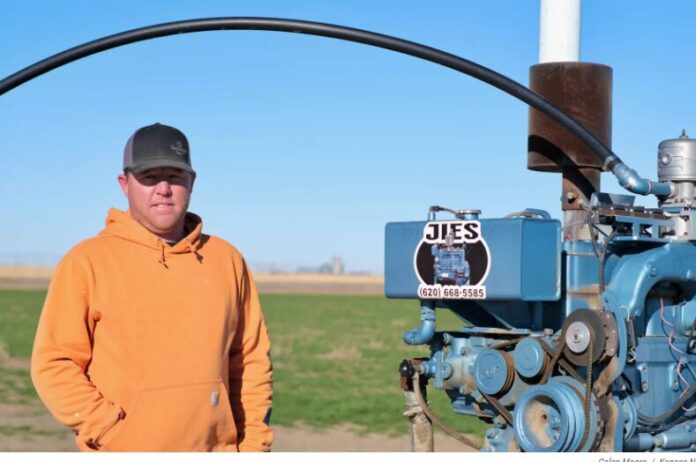
Bret Rooney stands next to one of his water wells that provides irrigation for his crops. Many wells like this are abandoned after drying up across western Kansas.

The Ogallala aquifer is a critical source of water in western Kansas, and it’s running dry. It plays a major role in the daily lives of Kansans, even for people who don’t live on top of it.

HASKELL COUNTY, Kansas — For a farmer like Bret Rooney, not a day goes by that he doesn’t ponder the pond under his feet. That is the Ogallala aquifer.

The subsurface reservoirs trapped between fractured layers of rock and soil saved this region after the infamous Dust Bowl, and remain the source of economic life in the present day.

But that groundwater has been running out after generations of pumping to support agriculture and the state’s economy.

Rooney bundles up on a cold morning and drives his truck out to his water pumps. These pumps are the soul of most western Kansas farms, but he’s been aware that something has been wrong. From decommissioning pumps to water just not spraying at the same rate it used to.

“Since my first day farming, we’ve noticed things were going on,” Rooney said. “We felt the physical effects of the depletion of the water and we’ve had to make adjustments and changes.”

If losing a third of the state’s main water source sounds like a big deal, it’s because it is. But these farmers seem to be the minority in their concern.

“It’s not just a farmer’s issue. You’re gonna struggle, whether you depend on them or their services,” Rooney said.

Not only is the aquifer physically invisible, but this environmental crisis has been broadly ignored.

Depletion of the water supply would be a critical blow to major farming and beef industries, which would send reverberations across the state. Simply living farther east in places like Wichita, Topeka or the Kansas City area won’t make you immune to the effects of lost jobs and tax revenue.

But the potential upset hasn’t drawn attention among Kansans, overall. A recent survey from the Midwest Newsroom and Emerson College Polling found that 48% of Kansans said they have never heard of the aquifer.

That number came to no surprise to state officials and academics who work with Kansas water issues.

“In my personal interaction with some people in the city, they don’t really even know that we do have a problem below us,” Jonathan Aguilar, water resources expert for Kansas State University, said in an interview.

For some in Kansas, water is taken very seriously.

Large parts of the region have seen more than half of their water disappear since the dawn of irrigation. Wallace County on the Colorado border for example has lost roughly 80%. And Kansas State University predicts that in 75 years, almost all of the Ogallala aquifer in Kansas could be depleted.

For someone like Aguilar, the lack of awareness is frustrating. Even his children have heard the same speeches from him by now when he sees water being wasted.

“If I see the sprinkler going off right after a rainstorm, they say ‘Papa, don’t. Don’t be mad at them’,” Aguilar said.

But Aguilar suspects part of the reason for this imbalance of attention is plainly because western Kansas is less populated, leading to more focus on water issues in the eastern half of the state.

“That’s why there’s more emphasis on erosion or reservoirs, rather than groundwater conservation,” Aguilar said.

Most of eastern Kansas gets drinking water from rivers and reservoirs. But that still doesn’t mean those places are immune to the effects of the depleting aquifer.

Some people may not worry about something until it’s happening in their own backyard.

Connie Owen, director for the Kansas Water Office, said since Kansas water systems are connected, when water drops in one area, other places will feel it.

“If you deplete the groundwater, that’s going to deplete the stream flow and there are parts of northwest, north central Kansas where depletion of the Ogallala can impact the Kansas River basin,” Owen said.

That means that when the Ogallala continues to be over pumped, even if you live far away in Lawrence or Topeka, your water quality will be affected. Less stream flow means more sediments in rivers and reservoirs that northeast Kansas communities use for their drinking water.

And that is costly because it forces municipalities to develop more intense water treatment centers.

“The rest of the state will have to have to deal with the fallout and make up the difference,” Owen said.

Owen also believes preserving natural resources is the right thing to do. She said that alone should be reason enough to get people’s attention.

“If there is a natural resource that exists, I think that there is a moral obligation to be a good steward of that and not decimate that for profit,” Owen said.

About 85% of the water used in Kansas is for crops, but in western Kansas, that water is also needed for its residents. Losing that water will lead to more than just crops being thirsty.

The Ogallala aquifer is not just a natural resource, but it made the economic life of western Kansas possible.

Nathan Hendricks is an agricultural economist for Kansas State University. He said without its stability, thousands could lose their jobs, and be displaced due to a lack of water.

“Western Kansas, has a significant livestock industry that’s been built up. That’s really based on the aquifer production,” Hendrickson said.

Agriculture alone in Haskell County for instance contributes over $1 million to the state’s economy. That’s nearly $1,000 per person.

Farming in western Kansas powers an $11 billion beef industry, a multibillion-dollar food production industry and tens of thousands of jobs, all of which have some direct connection to the groundwater.

Including indirect and induced effects, agriculture and agriculture-related sectors have a total impact of $81.2 billion in output and 253,614 jobs in Kansas.

A major drop in water resources would wreak havoc on the entire state’s economy.

Officials have said education will need to be part of the solution to get more eyes on the Ogallala aquifer.

Brayden Schumaker is a student at Kansas State University studying geology. He is really passionate about the Ogallala aquifer in Kansas but said other young people around him aren’t, even in some environmentally conscious circles.

But there’s reason to hope that there could be water left for Schumaker’s generation in the future. If more people pay attention to the problems at hand.

“If people really cared about environmental issues within Kansas, we can start solving them right now and not later,” Schumaker said.

Last year the Legislature and governor approved a law that requires groundwater management districts in western Kansas to develop water-saving plans. It also says that the districts need to do more outreach in the communities and get communities more involved in water conservation solutions. Action and outreach should be expected in the regions where it’s needed most, but outreach is still needed outside of western Kansas.

The Kansas Water Office, based in Topeka, is also pushing to teach about the Ogallala aquifer in schools.

Back in Haskell County, farmer Bret Rooney surveys the land that sits above the Ogallala aquifer. He said that this is something everyone should know about.

“Every single one of us relies on water, whether you’re in agriculture production like me, or you want to have a nice, soft lawn for your kids to go play on,” Rooney said. “It touches us all.”

The Kansas News Service ksnewsservice.org.

Be aware of consumer fraud this holiday season

0

Did you know that while 75% of Americans say they are aware of holiday scams, 40% still fall for them each year? The Federal Trade Commission estimates that one-third of all Americans have faced fraud of some kind.

Fraudsters often increase scam attempts during the holidays when businesses and financial institutions are closed, and people are on vacation, making it difficult to get fraud assistance. It is important to always be vigilant in protecting yourself from fraud scams, but it is especially important during the holidays.

Phishing scams are one of the most common types of holiday fraud. Scammers may send fake emails or text messages pretending to be from retailers, delivery companies, or even your bank. These messages may ask you to click on a link to verify account information or confirm a purchase. Often, the link leads to a counterfeit website and/or malware designed to steal your personal and financial information, infect your device with a virus, or even hold your device hostage unless you pay a fee. Never click on links you are unsure about, and promptly delete the message.

Using artificial intelligence (AI) to analyze suspicious emails or texts can help identify common patterns associated with phishing scams. Here are ways you can use AI to help.

  1. Identify red flags. Many AI tools are programmed to detect scam-like language, formatting irregularities, and other indicators of phishing, but their accuracy depends on the sophistication of both the AI technology and the scam itself.
  2. Combine AI with best practices. While AI can be a helpful tool, it should be used with traditional phishing detection methods. Red flags that can indicate a scam include generic greetings, urgent requests, threats, misspellings, and poor grammar. Verify links by hovering over them to confirm that the destination URL matches the sender’s identity. Avoid opening attachments from unknown sources.
  3. Address privacy concerns. When using AI tools with potentially sensitive information, ensure that the tool adheres to privacy and data security regulations to safeguard your information.

While AI can be effective in detecting scams, it is not foolproof and may not identify newer or highly personalized scams. To maximize security, be sure to supplement AI with other security measures or tools, use anti-phishing software, and report suspicious activity to IT or security teams.