Thursday, January 29, 2026
Home Blog Page 263

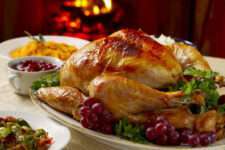
Let’s talk turkey! Six poultry preparation pointers

0
Photo courtesy: plainville farms

it’s time to talk turkey! Because of the increased number of turkeys prepared during the holidays, food-borne illnesses often increase. If not handled, thawed, and cooked properly, turkey and all poultry can carry Salmonella, a common type of bacteria that can cause food-borne illness. Consider these tips for preparing a safe and succulent turkey this year.

  1. Properly thaw the turkey. This is the first and most important food safety step. The best way to do this is in the refrigerator. Make sure the turkey is still in its original wrapper, and place a tray underneath it to catch juices and prevent cross-contamination. For every 4 to 5 pounds of turkey, you will need 24 hours of thawing time, so be sure to give yourself enough time to thaw it properly. Once thawed, refrigerate and cook it within 1 to 2 days.
  2. If you need to thaw the turkey more quickly, use the cold-water method. Place the turkey in an airtight package or leak-proof bag. Submerge the turkey in cold water for 30 minutes per pound, changing the water every half-hour so it stays cold. Cook immediately.
  3. If you purchased a smaller turkey, it may be possible to thaw it in the microwave if it will fit. Check the manufacturer’s instructions for the size of the turkey, minutes per pound, and the power level for thawing. Roast it immediately after thawing.
  4. It is never safe to thaw turkey and other meat on the counter. Doing so puts the meat in what food safety experts call the danger zone, 40 to 140 F, where bacteria multiply rapidly. Under ideal conditions, bacteria can double every 10 to 20 minutes. That means one cell can increase to more than 16 million cells in 8 hours. For this reason, all perishable foods such as poultry should never be held at room temperature for more than 2 hours.
  5. To roast a turkey, set the oven temperature no lower than 325 F. Despite what you may hear, cooking a turkey for a lengthy time, such as overnight, at a very low temperature is not safe. This encourages bacterial growth. To check for doneness, use a meat thermometer inserted into the thigh. Do not rely on the pop-up thermometer alone. Meat thermometers are available at reasonable prices in most supermarkets and variety stores. For safety, the thigh meat should reach 165 F. If the bird is stuffed, stuffing should reach 165 F as well.
  6. After the meal, promptly refrigerate leftovers in shallow containers. Some people leave turkey and other perishable items out for guests to enjoy all day, but this practice is unsafe. Place perishable items in the refrigerator. If people want to snack, they can take the food out of the refrigerator.

For more information on turkey preparation and storage, contact USDA’s Meat and Poultry Hotline at 888-674-6854.

Lettuce Eat Local: Oh Grandma

0

Amanda Miller
Columnist
Lettuce Eat Local

O my. The letter “O” doesn’t weigh more than any of the other letters of the alphabet, but writing about it this week is definitely heavier than normal. 

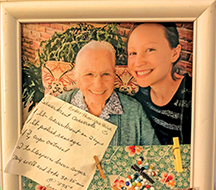
That’s because it corresponds with the death and burial of my precious one-hundred-year-old grandma. Often the transpirings of my life take precedence over culinary topics even though this is technically a food column, but Grandma Weber lived out much of her remarkable generosity from the space of her kitchen, so she fits right in here. 

Remembering Grandma on “O” week seemed quite timely as I was full of ideas right away. She played such an indelible role in my life that I might feel that about every letter, but oh well. Even just talking about letters is such a Grandma thing, since she was an avid Scrabble player for decades — so much so that she played a game of it every day for years. It’s my favorite game, too, perhaps not by coincidence. 

O tiles are only worth one point each in Scrabble, but lots of points in this context. I was chatting with cousins about my article trajectory after the visitation, and they were immediately coming up with ideas too. 

Oatmeal was one of the first suggestions. Now, my family loves oatmeal; Benson has been a fan of it all his life, and I do use it in some less-common ways, but Grandma might have us beat both in longevity and creativity. Apparently she enjoyed a breakfast concoction consisting of sauteed onions and celery, an egg, and toasted bread cubes atop a bowl of cooked oats, garnished with a dollop of her signature mustard dip — I’m sure that could be on a fancy tasting menu somewhere, but not in my kitchen. 

I also have a handwritten copy of one of her recipes which comprises oats, brown sugar…and sausage and sauerkraut. My mom’s note on it, “Better than you think :),” echoes my sentiments, which I admit may not be saying much.

Onions were also pulled up instantly from my treasure trove of memories, this time an example of her avidity in trying home remedies. I’ll never forget how we kids were staying at our grandparents’ house one time, and my older brother had a little cough. Grandma made him eat a raw onion and sit on the couch all day, while my younger brother and I had a high time running around outside and cackling at his misfortune. I’m guessing my son would stop faking a cough around his grandma if she had a pocketful of onions instead of cough drops. 

Okra has to be mentioned since she lived in the deep South for 65 years. My dad, the youngest of their seven children, said he couldn’t remember much of what she actually cooked as it was more for quantity than quality, but her cornmeal-fried okra was crisp and good (“Put ketchup on and anything is good.”). I heard recently that “okra water” is getting popular for people who like extra healthy (and slimy) beverages, and I have to wonder if Grandma didn’t try that at some point — she used to take a spoonful of minced garlic plus strawberry yogurt at bedtime because she read somewhere it was healthy. 

It’d be easier to question her judgment on some of these things if she hadn’t lived to be 100.

The really amazing part isn’t her living that long, it’s the way she lived those many years full of integrity: strength and gentleness, faithfulness and generosity. Her guestbooks show proof of how she was always hosting, how she fed thousands of people throughout her century. Grandma’s food nourished souls as well as bodies, because she gave it so generously. 

This will be published the week of Thanksgiving, which again feels extremely timely. If I can be even a little bit like her, I’ll be doing well…although I might skip the raw onion bit. See you later, Grandma. 


Grandma’s Sauerkraut Casserole

Grandma’s food was not gourmet, but she was a good cook, and she excelled at hospitality. As stories were shared about her, it only became more and more evident how generously open-handed she was in the home she made for her family and everyone they (often unexpectedly) brought to the table — even though she did all this in an era of huge gardens and slow food instead of UberEats and fast food. This unusual dish is incredibly simple to prepare, with easy to use ingredients, and can be economically stretched to feed surprise guests. It’s different…but honestly, as mentioned, it is better than your think! I’m very curious if anyone else has seen a recipe like this, so please email and let me know if you have!

Prep tips: I’m sure Grandma used home-canned sauerkraut, but any will do as long as there is plenty of juice — I’m going to be honest, I haven’t made this for a while, and don’t feel the need to at this moment, so I don’t remember if I added water or not; use your own judgment. If I made it again, I would add black and red pepper, and some fresh herbs, maybe some melty cheese. 

1 pound [2 cups] sauerkraut

1 pound polish sausage

1 ¾ cups oatmeal (rolled oats)

2 tablespoons brown sugar

Mix well and bake 30-35 minutes at 375 degrees°. 

Lettuce Eat Local: Noodles & (Peanut) Butter

0

Amanda Miller
Columnist
Lettuce Eat Local

“Noodles and butter, noodles and butter, you are my favorite treat. Noodles and butter, noodles and butter, there is no other, nothing else that I want to eat!” So proclaims a very catchy little tune by Caspar Babypants, a silly yet delightful children’s music artist. He goes on to assert that he doesn’t like chocolate cake, tangerines, or lollipops like others do; noodles and butter is “the only one I need.”
While I don’t prefer Benson to say he doesn’t like any food — I encourage him to replace it with “don’t prefer,” like I just did — nor to mention his dislike more than necessary, I can appreciate that the singer designates a savory food as his favorite. While my son admittedly eats a very broad range of foods, his volumetric appetite is frustratingly minimal…until the sugary things come out. I’m afraid he has more than a sweet tooth; he has sweet teeth.
Some of his best-loved foods are naturally sweet, as in the mangos, strawberries, and blueberries that he just told me are his favorites. I’m delighted with those picks, of course, although I’m fairly certain they would still lose out to marshmallows, suckers, or ice cream if faced with the choice.
It really does all depend on the day though, I suppose. He is three, after all — capriciousness is one of this age’s strongest suits. Nothing is certain from day to day, or even minute to minute.
So I can say, in general and with qualifications, that Benson does like noodles, just not preferred over root beer floats and bubblegum like Caspar. It helps sometimes to call them worms, in classic little-boy style.
Ki babe, on the other hand, is a carbs kind of girl, and so far noodles almost always pique her interest. We’ve had more luck with spaghetti as the shape of choice for both kids, maybe because those long wormy, floppy noodles are messier and more tactile fun. Seriously though, is there anything messier than spaghetti & marinara plus children? I’m not even safe with that menu, so it doesn’t bode well.
I don’t remember eating noodles often growing up, which is a little surprising since they are impressively economical, easy, and versatile. We would have spaghetti some, maybe homemade mac and cheese every now and then. And for a real treat, boxed mac and cheese — which feels so rude to say now, but that’s how we felt about it as kids, especially with a sprinkle of creole seasoning on it.
We have noodles somewhat often here on the farm, although typically not those two classics. I’ve gained an appreciation for rotini and penne, how a slightly different shape changes the whole feeling of the meal. Or, like rice noodles, where the same shape but a different grain completely changes what part of the globe our plate feels like it came from. I particularly like “cheating” and using whole-wheat spaghetti for Asian-style recipes: pasta isn’t just for Italians.
Nor is it just for Caspar Babypants. As long as we still get a little chocolate cake and tangerines.

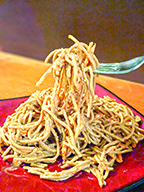
Peanut Sesame Noodles

Noodles and peanut butter is not my favorite treat per se, but it is one of my favorite pastas. I just asked Benson and he said his is “sandwich noodles,” so you can be glad he’s not the one writing the recipe. This dish is great just as is, but is also so versatile: throw in a protein of choice (we added smoked pork and it was spot on) and/or whatever veg you have on hand. Kiah turned one year old last week (!) and a plate of carbs seemed appropriate to serve during her birthday week; she enjoyed both eating and throwing them.
Prep tips: the amount of sriracha is totally up to you, and a different hot sauce works too if you don’t have that particular one.

¼ cup peanut butter
¼ cup tahini
¼ cup soy sauce
2 tablespoons rice vinegar
2 tablespoons brown sugar
1” knob fresh ginger
dash sriracha
1 pound whole-wheat spaghetti noodles, cooked and drained
1-2 carrots, shredded
1 tablespoon toasted sesame seeds

Combine first 7 ingredients in a blender, and process until smooth. Toss with noodles and carrots; season to taste; and garnish with sesame seeds. Serve warm or cold.

Ever curious

0
john marshal

Duane Schrag ‒ journalist, science fiend, photographer, craftsman and traveler ‒ died October 17 in Abilene where he had been in hospice care less than a week. The cause was metastatic pancreatic cancer. He was 69.

He was in many ways an expert and specialist, drawn to explore mysteries of the half- known or rarely explained ‒ of roads seldom traveled, of houses that needed rebuilding, of the sun’s light on one patch of Earth, of computer coding, of a parade that needed an amazing float.

At lunch once with friends in Lindsborg, Schrag drew on a paper napkin the complexities of spherical trigonometry whirling about Earth, and why science doubted that we could breathe free on Mars ‒ at least any time soon.

Another time he and Robin planned a road trip to Alaska and on to the Arctic Circle pulling their little camper ‒ but only after he had rebuilt the Jeep’s engine.

He built his own coffee bean roaster, then wrote a 30-step operating manual for producing best results.

On a stairwell wall at their home, a series of black and white photographs document precisely the Sun’s orientation to a single patch on planet Earth ‒ their home. The photos were taken with a view camera Schrag had built, the aluminum salvaged from a Boeing scrap pile in Wichita.

*

Duane Peter Schrag was born August12, 1955 in Basim Berar, India, the son of Christian teachers and missionaries in southern India. He is survived by the widow, Robin Black, of the home; a son, Brad, of Albuquerque, N.M., a daughter, Rebekah, of Salem, Ore.; three sisters, Joy Bartsch, Lincoln, Neb., Grace Johnson, Tecumseh, Neb., and Faith Busenitz., Whitewater, Kan.; and two step-daughters, Rachel Sherck, Manhattan, Kan., and Amanda Sherck, Ceresco, Neb.

He and Robin were married in Junction City on January 16, 2004.

The body was cremated. Plans for any celebration of life or for the ashes remain undetermined.

*

Schrag attended Lushington, a British boarding school in southern India, returned to Kansas and finished high school at Moundridge High School in 1973. He majored in photojournalism at Wichita State University and finished at Oregon State University.

He returned to Kansas, reported for the Washington County News and in 1985 joined the Hutchinson News, flagship of the Harris Newspaper Group, where his reporting and writing gathered force.

Schrag wrote with precision, stories layered with fact and the flavor of surprising detail: the suspicions lingering after a Garden City murder conviction; the fatal danger of Kansas’ unmarked railroad crossings; the long, lively days of another Bike Across Kansas event; the science and politics of wind and solar energy; the majesty of a lunar eclipse, the ruin of drought that choked a great river to a trickle; the tense thrill of pilot Steve Fossett’s round-the-world flight in the Virgin Atlantic GlobalFlyer, a record-breaking event that began and finished in Salina.

For Schrag, no circumstance was slight, no detail trivial. Only the peculiarities differed.

He was an early expert in the software coding and personal computers that would change every aspect of newspaper publishing. In the mid-1990s, he moved from the newsroom at Hutchinson to the computing rooms at the Harris Group business division. There, Schrag helped take the science of business data aggregation into the newsroom; his work prompted something new, allowing reporters and editors to share stories using a form of the business data process.

In 1997 he was named editor-publisher of the Tribune, a Harris Group newspaper in Chanute. There he met Robin.

Six years later Schrag transferred to The Salina Journal as an investigative and special projects reporter.

As drought savaged western Kansas in the early 2000s, Duane took Robin to Wallace County and Sharon Springs near the Colorado border to see the dry ravines and gorges where the Smoky Hill had once cut into the tableland. “He had to see this,” she said. “He couldn’t do the story of a river without seeing where it had been.”

Schrag joined The Land Institute, an environmental research facility, in 2010 and retired seven years later.

*

The projects continued: He had already built an immense wood-fired pizza oven, its heavy walls riddled with devices to transmit heat readings; near Manhattan, he rebuilt a 1948 8N Ford tractor for step-daughter Rachel; he wrote computer codes for an array of in-house radio programming, access to keyboard screens and phone, weather forecasts, radio and TV programs ‒ even while they were away.

He and Robin sang in the Messiah Chorus. Once he mounted his view camera on a balcony wall at Presser Hall, rigged it with remote control and snapped a full-front photo of chorus and orchestra in mid-concert.

He built and rebuilt the top of their back yard pergola.

They built floats for the annual Central Kansas Free Fair parade. This year, Schrag adapted the metal frame of a prior float (a giant ear of corn), rebuilding the armature and movement into a large rocket. It took him three months. The nose cone opened with compressed air and shot out Milky Way candy bars attached to parachutes. Wild Bill Hickock (paper maché, by step-daughter Amanda Sherck) was riding the rocket. It was their fifth year of floats: “Each year they got more complicated,” Robin said.

*

They traveled, often weeks on the road, to reach distant places and spend time among those who lived there: the Arctic Circle and Prudhoe Bay; across Canada or up to Cold Foot, Alaska; to Quebec (twice); over the Trans-Labrador Highway; to Newfoundland and Prince Edward Island.

They try to find the lonely roads, Robin said.

In-country, Philadelphia, the Outer Banks, the Grand Tetons, New Orleans (many times), Key West, Santa Fe, Taos, Glacier National Park and most everywhere in-between.

A few years ago outside Rockland, Maine, they found a replacement for their Jeep, a used Toyota Fj Cruiser in good condition. They bought it and drove home, Robin in the Cruiser, Duane with Jeep and camper.

“If there is a road we haven’t traveled,” she said, “someone should tell us.”

‒ John Marshall