Thursday, January 29, 2026
Home Blog Page 264

Lettuce Eat Local: Noodles & (Peanut) Butter

0

Amanda Miller
Columnist
Lettuce Eat Local

“Noodles and butter, noodles and butter, you are my favorite treat. Noodles and butter, noodles and butter, there is no other, nothing else that I want to eat!” So proclaims a very catchy little tune by Caspar Babypants, a silly yet delightful children’s music artist. He goes on to assert that he doesn’t like chocolate cake, tangerines, or lollipops like others do; noodles and butter is “the only one I need.”
While I don’t prefer Benson to say he doesn’t like any food — I encourage him to replace it with “don’t prefer,” like I just did — nor to mention his dislike more than necessary, I can appreciate that the singer designates a savory food as his favorite. While my son admittedly eats a very broad range of foods, his volumetric appetite is frustratingly minimal…until the sugary things come out. I’m afraid he has more than a sweet tooth; he has sweet teeth.
Some of his best-loved foods are naturally sweet, as in the mangos, strawberries, and blueberries that he just told me are his favorites. I’m delighted with those picks, of course, although I’m fairly certain they would still lose out to marshmallows, suckers, or ice cream if faced with the choice.
It really does all depend on the day though, I suppose. He is three, after all — capriciousness is one of this age’s strongest suits. Nothing is certain from day to day, or even minute to minute.
So I can say, in general and with qualifications, that Benson does like noodles, just not preferred over root beer floats and bubblegum like Caspar. It helps sometimes to call them worms, in classic little-boy style.
Ki babe, on the other hand, is a carbs kind of girl, and so far noodles almost always pique her interest. We’ve had more luck with spaghetti as the shape of choice for both kids, maybe because those long wormy, floppy noodles are messier and more tactile fun. Seriously though, is there anything messier than spaghetti & marinara plus children? I’m not even safe with that menu, so it doesn’t bode well.
I don’t remember eating noodles often growing up, which is a little surprising since they are impressively economical, easy, and versatile. We would have spaghetti some, maybe homemade mac and cheese every now and then. And for a real treat, boxed mac and cheese — which feels so rude to say now, but that’s how we felt about it as kids, especially with a sprinkle of creole seasoning on it.
We have noodles somewhat often here on the farm, although typically not those two classics. I’ve gained an appreciation for rotini and penne, how a slightly different shape changes the whole feeling of the meal. Or, like rice noodles, where the same shape but a different grain completely changes what part of the globe our plate feels like it came from. I particularly like “cheating” and using whole-wheat spaghetti for Asian-style recipes: pasta isn’t just for Italians.
Nor is it just for Caspar Babypants. As long as we still get a little chocolate cake and tangerines.

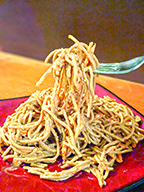
Peanut Sesame Noodles

Noodles and peanut butter is not my favorite treat per se, but it is one of my favorite pastas. I just asked Benson and he said his is “sandwich noodles,” so you can be glad he’s not the one writing the recipe. This dish is great just as is, but is also so versatile: throw in a protein of choice (we added smoked pork and it was spot on) and/or whatever veg you have on hand. Kiah turned one year old last week (!) and a plate of carbs seemed appropriate to serve during her birthday week; she enjoyed both eating and throwing them.
Prep tips: the amount of sriracha is totally up to you, and a different hot sauce works too if you don’t have that particular one.

¼ cup peanut butter
¼ cup tahini
¼ cup soy sauce
2 tablespoons rice vinegar
2 tablespoons brown sugar
1” knob fresh ginger
dash sriracha
1 pound whole-wheat spaghetti noodles, cooked and drained
1-2 carrots, shredded
1 tablespoon toasted sesame seeds

Combine first 7 ingredients in a blender, and process until smooth. Toss with noodles and carrots; season to taste; and garnish with sesame seeds. Serve warm or cold.


Ever curious

0
john marshal

Duane Schrag ‒ journalist, science fiend, photographer, craftsman and traveler ‒ died October 17 in Abilene where he had been in hospice care less than a week. The cause was metastatic pancreatic cancer. He was 69.

He was in many ways an expert and specialist, drawn to explore mysteries of the half- known or rarely explained ‒ of roads seldom traveled, of houses that needed rebuilding, of the sun’s light on one patch of Earth, of computer coding, of a parade that needed an amazing float.

At lunch once with friends in Lindsborg, Schrag drew on a paper napkin the complexities of spherical trigonometry whirling about Earth, and why science doubted that we could breathe free on Mars ‒ at least any time soon.

Another time he and Robin planned a road trip to Alaska and on to the Arctic Circle pulling their little camper ‒ but only after he had rebuilt the Jeep’s engine.

He built his own coffee bean roaster, then wrote a 30-step operating manual for producing best results.

On a stairwell wall at their home, a series of black and white photographs document precisely the Sun’s orientation to a single patch on planet Earth ‒ their home. The photos were taken with a view camera Schrag had built, the aluminum salvaged from a Boeing scrap pile in Wichita.

*

Duane Peter Schrag was born August12, 1955 in Basim Berar, India, the son of Christian teachers and missionaries in southern India. He is survived by the widow, Robin Black, of the home; a son, Brad, of Albuquerque, N.M., a daughter, Rebekah, of Salem, Ore.; three sisters, Joy Bartsch, Lincoln, Neb., Grace Johnson, Tecumseh, Neb., and Faith Busenitz., Whitewater, Kan.; and two step-daughters, Rachel Sherck, Manhattan, Kan., and Amanda Sherck, Ceresco, Neb.

He and Robin were married in Junction City on January 16, 2004.

The body was cremated. Plans for any celebration of life or for the ashes remain undetermined.

*

Schrag attended Lushington, a British boarding school in southern India, returned to Kansas and finished high school at Moundridge High School in 1973. He majored in photojournalism at Wichita State University and finished at Oregon State University.

He returned to Kansas, reported for the Washington County News and in 1985 joined the Hutchinson News, flagship of the Harris Newspaper Group, where his reporting and writing gathered force.

Schrag wrote with precision, stories layered with fact and the flavor of surprising detail: the suspicions lingering after a Garden City murder conviction; the fatal danger of Kansas’ unmarked railroad crossings; the long, lively days of another Bike Across Kansas event; the science and politics of wind and solar energy; the majesty of a lunar eclipse, the ruin of drought that choked a great river to a trickle; the tense thrill of pilot Steve Fossett’s round-the-world flight in the Virgin Atlantic GlobalFlyer, a record-breaking event that began and finished in Salina.

For Schrag, no circumstance was slight, no detail trivial. Only the peculiarities differed.

He was an early expert in the software coding and personal computers that would change every aspect of newspaper publishing. In the mid-1990s, he moved from the newsroom at Hutchinson to the computing rooms at the Harris Group business division. There, Schrag helped take the science of business data aggregation into the newsroom; his work prompted something new, allowing reporters and editors to share stories using a form of the business data process.

In 1997 he was named editor-publisher of the Tribune, a Harris Group newspaper in Chanute. There he met Robin.

Six years later Schrag transferred to The Salina Journal as an investigative and special projects reporter.

As drought savaged western Kansas in the early 2000s, Duane took Robin to Wallace County and Sharon Springs near the Colorado border to see the dry ravines and gorges where the Smoky Hill had once cut into the tableland. “He had to see this,” she said. “He couldn’t do the story of a river without seeing where it had been.”

Schrag joined The Land Institute, an environmental research facility, in 2010 and retired seven years later.

*

The projects continued: He had already built an immense wood-fired pizza oven, its heavy walls riddled with devices to transmit heat readings; near Manhattan, he rebuilt a 1948 8N Ford tractor for step-daughter Rachel; he wrote computer codes for an array of in-house radio programming, access to keyboard screens and phone, weather forecasts, radio and TV programs ‒ even while they were away.

He and Robin sang in the Messiah Chorus. Once he mounted his view camera on a balcony wall at Presser Hall, rigged it with remote control and snapped a full-front photo of chorus and orchestra in mid-concert.

He built and rebuilt the top of their back yard pergola.

They built floats for the annual Central Kansas Free Fair parade. This year, Schrag adapted the metal frame of a prior float (a giant ear of corn), rebuilding the armature and movement into a large rocket. It took him three months. The nose cone opened with compressed air and shot out Milky Way candy bars attached to parachutes. Wild Bill Hickock (paper maché, by step-daughter Amanda Sherck) was riding the rocket. It was their fifth year of floats: “Each year they got more complicated,” Robin said.

*

They traveled, often weeks on the road, to reach distant places and spend time among those who lived there: the Arctic Circle and Prudhoe Bay; across Canada or up to Cold Foot, Alaska; to Quebec (twice); over the Trans-Labrador Highway; to Newfoundland and Prince Edward Island.

They try to find the lonely roads, Robin said.

In-country, Philadelphia, the Outer Banks, the Grand Tetons, New Orleans (many times), Key West, Santa Fe, Taos, Glacier National Park and most everywhere in-between.

A few years ago outside Rockland, Maine, they found a replacement for their Jeep, a used Toyota Fj Cruiser in good condition. They bought it and drove home, Robin in the Cruiser, Duane with Jeep and camper.

“If there is a road we haven’t traveled,” she said, “someone should tell us.”

‒ John Marshall

Caring for Expectant Moms

0

Lately my teenager has been fascinated by medical dramas. Although my “doctor self” is usually rolling my eyes throughout the program, it’s often a good conversation starter.

One recent show featured a pregnant woman who experienced one medical crisis after another. Her kidneys, liver, and lungs failed in succession as the team raced to identify the underlying obstetrical problem and find a treatment. At the climax of the episode, her heart stopped. Of course, being television, the correct diagnosis was made, the experimental treatment worked, and the episode ended with a perfectly healthy mother at home, holding her perfectly healthy baby.

For all the erroneous and outrageous details that transform bad fictional medicine into good TV, they did get something right. Pregnancy is a dangerous condition. In fact, in America, pregnancy complications account for approximately two percent of all deaths among women between the ages of 20 and 44.

To put the two percent into perspective, consider that pregnancy complications can only happen in the months during and immediately following pregnancy. On average a woman in the United States will birth between one and two children. This means that between the ages of 20 and 44, the risk of pregnancy-related death isn’t spread across those 25 years as are the risks of cancer or car accidents. It is concentrated into the relatively few months during which she is pregnant. And for women younger than 20 and older than 44 the risk of pregnancy complications is even greater but, statistically speaking, women in those age groups simply don’t have enough babies to categorize pregnancy complications as a major cause of death.

Consider also that death by violence is not counted as a pregnancy complication, even though pregnancy is a significant trigger for violence.

What’s more, consider that these risks are not distributed equally between women. Socioeconomic status, education, physical location, and race all impact the likelihood of pregnancy complications, and death from those complications.

Issues that affect pregnant people affect their whole family. In medical school, I was taught “nothing is worse for a fetus than a dead mother.” It’s hard to disagree.

So, what can we do to make pregnancy safer? The answer to that question is multi-faceted. Access to quality obstetric care is one factor. However, we must also ensure women are as healthy as possible before they conceive. They need good nutrition and safe places to live and work. They need education to know what is normal, and what is not. They and their families need access to psychiatric care to address mental illness and addiction.

It may not make for good TV, but in the real world, the starting place is as basic, and as difficult, as that.


Debra Johnston, MD. is part of The Prairie Doc® team of physicians and currently practices as a Family Medicine Doctor at Avera Medical Group in Brookings, South Dakota. Follow The Prairie Doc® at www.prairiedoc.org, Facebook, Instagram, Youtube and Threads. Prairie Doc Programming includes On

Call with the Prairie Doc®, a medical Q&A show (most Thursdays at 7pm streaming on Facebook), 2 podcasts, and a Radio program (on SDPB), providing health information based on science, built on trust.

Beef Tips in Wine Sauce

0

This week’s recipe cannot get much easier! Yes, you will find it has one of my most griped about ingredients, canned soup. However; I cannot think of an easier Christmas Day meal. A salad, good bread, and a slice of delicious pie. Keeps the cook out of the kitchen all day, and instead enjoying the holiday. I may even be making this dish for our family in Christmas 2024. Why all the simplicity? Well, we are thinking of traveling!

This recipe was shared with me several years ago when I resided in Platte City, Missouri. It’s great for the holiday because you can go to evening church services and not worry about the dinner overcooking, etc. When I was growing up this was a crucial factor because I led the music and mom played the piano, at church.

I’ve jumped ahead of Thanksgiving currently. If it’s just the 4 our us I’m thinking of Cornish game hens, I still may do them, and if more are at the table, cut them in half. I’ll probably still cook a turkey breast so we can have cold turkey sandwiches! We’re also putting our dinner off until Friday, so the kids don’t have to eat so much turkey in one day! What’s accompanying this menu is still up for grabs. Phillip says we MUST have green bean casserole, and he is down to make it. ErvIn wants pineapple casserole which doesn’t really go with the menu, but I’m thinking of cooking it in muffin tins instead of a casserole dish, for a different look. I think a new take on dressing might be in order with cranberries and nuts. Potatoes, hm….not sure yet, a rice pilaf or homemade noodles might be good too.

Geez, I guess I need to start a grocery list. Last I checked the game hens were a bit pricey. Personally; I enjoy brussel sprouts and parsnips for vegetable sides, I know I’m odd! The thought of the noodles goes back to my grandma Lucy, her noodles were simply the best.

Last week we brought a whole garage full of items from my parent’s home in Lewistown, Missouri. I don’t know which way to go at the moment. I want the Christmas up, but the garage is calling too.

We wrapped a good season of racing at the Springfield, MO tracks this weekend during the 3 day ‘Turkey Bowl’. Long is an understatement to describe the last evening, Saturday. We were dirt covered and one exhausted/cold group. We will return to the tracks in late March or early April.

Now my friends, it’s time to put this gal to bed, and publish the column. Have a great week, keep the pantry stocked and the gas bill paid! Simply yours, The Covered Dish.

Beef Tips in Wine Sauce

2 lbs. Sirloin beef cut into 1 inch pieces, thin

2 cans Golden Mushroom Soup, (10-11 ozs. Each)

1 cup red/burgundy wine

1 envelope Lipton onion soup mix

Sliced mushrooms

pearl onions, optional

3 tablespoons Worcestershire sauce

Basically you are going to put everything into a covered baking dish and cook at 250 degrees for about 4 hours. Stir only one time during the cooking. This will serve 8 persons. Originally the recipe called for regular canned mushroom soup, but the color tone did not appeal to me, so the switch was made to

the Golden Mushroom Soup. I also like to use fresh sauteed mushrooms in this dish versus canned. The amount depends on the cook and guests likes and dislikes. I leave mine rather large so non-mushroom eaters can push them to the side. Usually mine is served with rice. Some fresh parsley or green onion tips would be nice on top.

Volunteer Trees

0
KSU horticulture

Sometimes a tree will sprout up out of nowhere and you did not plant said tree. These are called volunteer trees and don’t belong or fit in. Though trees are a vital part of our landscapes, there are situations where volunteer trees need to be controlled.. If the tree is still small and a desirable species, you may want to consider transplanting in the spring. If it is not, active control measures would be in order. Smaller trees are way easier to control than letting them get too big!


Most, but not all, trees re-sprout after cutting. Cutting those that don’t re-sprout is an effective control method. For example, eastern redcedar is a very common species that will not re-sprout after cutting. Those that do re-sprout include Siberian elm, hackberry, Osage orange (hedge-apple), oak, ash, aspen, cottonwood, maple, sycamore, willow and many more. These trees will either need to be dug out or the cut stump treated with herbicide after cutting.


Note that when we say volunteer trees, we mean those that come from seed rather than suckers that originate from the roots of an existing tree. The recommendations given in the remainder of this article are designed to kill these volunteer trees. Using herbicides on suckers will damage, and very possibly kill, the original tree. Trees that commonly produce suckers include tree of heaven, honey locust, black locust, hackberry, western soapberry, cottonwood, poplar, willow and boxelder.


It is also possible for larger trees of the same species to be root-grafted. Even though root-grafted trees are not suckers, they do share materials between the individual root systems and therefore herbicides used to treat one tree can be passed to its neighbor. Let’s say we have a tree we want to control that is a volunteer and there are no other trees of the same species close enough to be root-grafted that we do not wish to harm. What do we do? If the tree is any size, you probably do not want to dig it out. That leaves using an herbicide on the cut stump. Basal treatments are also possible but that is beyond the scope of this article. First decide what herbicide to use.


Triclopyr and glyphosate are the herbicides most commonly available to homeowners. Triclopyr is found in many brush killers and glyphosate is found in Roundup as well as numerous other products. Read the label before purchasing to make sure that a cut stump treatment is listed. Most often the undiluted product or lightly diluted product is applied to the stump immediately after cutting. A paint brush is often used for the application though some people will dip their pruning shears in the products immediately before cutting. Regardless, it is important that the stump is treated immediately or at least within 5 minutes. Note that a paint brush with foam rather than bristles is less likely to drip.


Trees do not need to be actively growing to be controlled. Actually, this time of year is a very good time to treat as long as applications are made when the temperature is above freezing.