Friday, February 6, 2026
Home Blog Page 373

Jr. Con Artists (Best Of)

0
lee pitts

Let me ask you a question and I want an honest answer. Don’t hold back. Do I look like an idiot? Do I have the word “sucker” written on my forehead and is it visible to everyone but me? Here’s the reason I ask.

As you may or may not know 4-H and FFA kids will do almost anything to get a buyer at the fair for their project animals. And apparently, some rare juvenile delinquents are not above running a con.

I was walking past the lamb pens at our local county fair during sucker season when I noticed a sad beast with pleading soulful eyes and a watery nose. I am not referring to a lamb but the kid in the straw with it. The nine year old boy, whom I knew, was hugging the lamb as tightly as he could.

“Is that you Billy? That’s a good looking little lamb you have there.”

“Oh, thank you Mr. Pitts. I’ve raised her since her mother abandoned her at birth. I call her Ali Baa Baa and she’s such a nice lamb I sure wouldn’t want to sell her and be responsible for her death. You wouldn’t buy Ali would you? She could run and play with the rest of your sheep and maybe she’d have good babies for you?”

One look at Ali Baa Baa convinced me that she was not breeding ewe material. (Southdown sheep haven’t been in fashion since Truman was President.) But I could not get that sorrowful sight out of my head. Every time I went through the lamb barn at our fair there was Billy clutching his lamb and crying his eyes out.

I’m a real softy so when the day of the Junior Livestock Auction came I was sitting in the front row. Little Billy led Ali Baa Baa into the sale ring and the bidding started at a buck a pound. But evidently I was not the only one who felt sorry for the pitiful kid and his lamb because the bidding quickly rose to five dollars. I didn’t understand why this lamb would be worth so much more than the rest, her Southdown breeding and all, but every time I thought about not bidding another crocodile tear would roll down Billy’s face.

I was eight hundred dollars poorer but the warm feeling in my heart was compensation enough. But that warm feeling quickly defrosted. Ali Baa Baa turned out to be one disgusting creature. She balled all night and was always underfoot, trying to suck your knee cap. And the warm glow I had experienced turned out to be caused by a stab to the heart.

When I attended the buyer appreciation dinner Billy and his father were unaware that I was in a rest room stall when they came in to wash up.

“Boy, we sure nailed Pitts didn’t we?” chuckled Billy’s father.

“Yeah, we pulled his leg of lamb! Ha, ha, ha,” said Billy. “Every time I saw old Pittsy coming by my pen I would jump in with Ali, hug her and look as sad as if you had cut off my allowance. I almost felt sorry for him.”

“I know what you mean,” said Billy’s father. “I could barely keep from laughing myself. And I don’t think he ever caught on that it was me bidding him up. That was real smart Billy, putting that tack in your shoe while you were in the sale ring. Those tears of pain looked like genuine tears of sorrow. I’m real proud of you son.”

The two con artists were laughing at my expense as they left the latrine.

Later that night they put on their sorrowful expressions and came over to personally thank me for buying Ali Baa Baa. “We sure do want to thank you for giving Ali a good home,” said the father. “I don’t know if little Billy could have stood the thought of having poor Ali killed.”

Then Little Billy got a real concerned look on his face that I think was genuine and asked, “By the way, how is Ali?”

I took one look at the two disgusting creatures in front of me and replied… “Deeeelicious!”

Who says revenge doesn’t taste sweet?

Blue-green algae showing up early in Kansas waterways

0

Warm temps, rain have hastened presence in some areas.

Reports of harmful blue-green algae in Kansas waterways have been coming in unusually early this year, possibly a result of warmer late-spring weather and more rain events, according to a Kansas State University fisheries and aquatics specialist.

Blue-green algae are not algae at all, but rather a type of bacteria called cyanobacteria. The bacteria thrive in warm, nutrient-rich water and — under the right conditions — can form blooms, called harmful algal blooms, or HAB.

Certain varieties of blue-green algae can produce toxins that are linked to illness in humans and animals.

“I have already seen harmful algal blooms in Kansas this year, and the Kansas Department of Health and Environment has several advisories out already,” said Joe Gerken, the fisheries and aquatics specialist with K-State Research and Extension.

Gerken said the HAB season seems to be starting earlier each year. Blooms typically occur when water temperatures are above 75 degrees Fahrenheit, although there are some cool season species.

“It is more common for blooms to occur thoughout the summer months, with a peak in August,” Gerken said.

In water, blue-green algal blooms are often described as looking like spilled green paint, or sometimes like pea soup. Blooms are not always large, and may cover only a small portion of the waterway with little visible algae present. Blooms can produce a swampy odor when the cells break down.

Humans and animals can become sick from harmful algal blooms if they have contact with water, or breathe in airborne droplets. Some of the signs of HAB illness include vomiting, diarrhea, rash, eye irritation, cough, sore throat and headache. Symptoms may begin as quickly as hours after exposure, or up to two days.

In addition, water contaminated with HAB may cause aquatic life to die. Landowners are encouraged to maintain ponds and other waterways. Gerken said the Kansas Department of Wildlife and Parks has a publication that provides guidance on producing fish and wildlife in Kansas ponds.

Those who suspect they – or their pets — may have become ill due to exposure with harmful algal blooms, should seek the advice of a medical professional or veterinarian.

More information on HAB and waterways in Kansas with suspected or confirmed contamination is available online from the Kansas Department of Health and Environment.

Hearing for Proposed Changes to Livestock Regulations

0

A public hearing will be conducted at 2:00 p.m. on Tuesday, July 2, 2024, to consider changes to the administrative regulations relating to livestock movement and public livestock markets. The hearing will be held in person at the Kansas Department of Agriculture at 1320 Research Park Dr. in Manhattan, as well as via video conferencing system.

KDA is proposing revisions to two regulations — K.A.R. 9-7-1 and K.A.R. 9-7-14 — relating to movement of livestock into or through Kansas, and revocation and replacement of regulations under Article 10 of KDA’s Kansas Administrative Regulations relating to public livestock markets. These changes reflect current management practices and standards of the livestock industry, update and modernize various requirements for public livestock markets and occasional livestock sales in Kansas, and organize the regulations to allow them to be more easily read and understood.

A copy of the proposed regulation changes, as well as an expanded notice of public hearing, may be accessed on the KDA website at agriculture.ks.gov/PublicComment. Anyone desiring to participate via video conference must pre-register to be provided with a video link; the registration is available in the notice of public hearing. Written comments can be submitted prior to the hearing on KDA’s public comment web page, or sent by mail to the Kansas Department of Agriculture, Attn: Ronda Hutton, 1320 Research Park Dr., Manhattan, KS, 66502.

Any individual with a disability may request accommodations in order to participate in the public hearing and may request a copy of the regulations in an accessible format. Persons who require special accommodations must make their needs known at least two working days prior to the hearing. For more information, including special accommodations or a copy of the regulations, please contact Ronda Hutton at 785-564-6715 or [email protected].

###

WHAT:          Public hearing on proposed changes to livestock movement and public livestock market regulations

WHEN:          2:00 p.m. on Tuesday, July 2, 2024

WHERE:       Kansas Department of Agriculture
1320 Research Park Dr., Manhattan, Kansas
Or virtual: via video conferencing system

Hearing for Proposed Changes to Livestock Market Regulations.pdf

Making an end-of-life plan is not just for the elderly

0

K-State extension specialist advises all adults to communicate their final wishes.

When young people turn 18, new opportunities come their way, such as the ability to vote in elections, serve in the military, and more. But it also comes with responsibilities now that they are legal adults.

On that to-do list is to make a plan for how they’d like their estate handled upon their death, says K-State Research and Extension Family and Consumer Science agent Renae Riedy, whose specialization is in family resource management and aging.

“Once people turn 18, young adults should make an estate plan, which is more than just what to do with the assets,” Riedy said.

Some of the key documents Riedy advises all adults to complete include a durable power of attorney for financial matters as well as health care directives, a HIPAA (Health Insurance Portability and Accountability Act) privacy authorization form, and a living will (if desired) as well as a do not resuscitate directive (if desired). These forms are available in an online publication titled, Advanced Health Care Planning in Kansas.

She also advises people to make a plan that addresses what they want done with their assets. This can be set up through a will and by using other tools such as transfer on death deeds, naming beneficiaries directly on the assets or a payable on death designations, depending on the asset. If an individual has minor children or pets, designating who will care for them is very important. A trust may be appropriate, depending on the circumstance Riedy said.

“Make sure you have a conversation with the person who you are going to appoint as the power of attorney and executor about your wishes and make sure they know where these important documents are located,” Riedy said.

Along with the formal forms, she encourages everyone to create a list of important assets. To help get the process started, Riedy suggests people refer to another online publication, Our Valuable Records.

“When writing down everything that is valuable to you, make sure you include how you want your digital assets — such as your online records and social media accounts — managed upon your death,” Riedy said.

“When writing down everything that is valuable to you, make sure you include how you want your digital assets — such as your online records and social media accounts — managed upon your death,” Riedy said.

To ensure your wishes are followed, Riedy said it is important to work with an attorney to write a will.

These topics can be hard to talk about, so Riedy also encourages people write a last letter of instruction to share information about their final wishes regarding what becomes of their body upon death and any other pertinent information that their loved ones need to know.

Riedy said, “By completing these forms and making plans, you are giving your family a gift because knowing your wishes will create less stress for them in a time of intense grief. And if you don’t make a plan, the state will make one for you and it may not be what you want.”


Star-Spangled Grilling and Smoking Food Safety Practices Everyone Needs to Know

0

On July Fourth, the aroma of barbecue will fill the air as the festivities bring together family and friends to celebrate with quintessential American cooking pastimes: grilling and smoking. Food is the biggest staple when it comes to celebrating Independence Day, aside from the fireworks. Whether you’re sizzling burgers on the grill or slow-cooking ribs in the smoker, the U.S. Department of Agriculture’s (USDA) Food Safety and Inspection Service is urging everyone to take food safety precautions during food preparations.

“Fourth of July is a great time to use the grill and smoker to cook delicious meats and poultry,” said Under Secretary for Food Safety Dr. Emilio Esteban. “Whichever method you use, reduce your risk of foodborne illness by using a food thermometer to measure the safe minimum internal temperature, and reduce cross-contamination by using separate utensils for raw and cooked meat and poultry.”

Here are grilling and smoking food safety tips to keep in mind during your celebratory cookout:

Thaw meat or poultry first. Smoking uses low temperatures to cook food, and frozen food would take too long to reach a safe internal temperature before bacteria can start to multiply. Frozen foods can be grilled safely, but they will take longer and may cook unevenly.

Marinate in the refrigerator. Marinating tenderizes and flavors meat and poultry before grilling and smoking. Always marinate in the refrigerator and NOT on the counter. If basting meat and poultry during grilling or smoking, and you want to use some of the marinade as a sauce, you should put aside a portion of the marinade that has not been in contact with the raw meat or poultry. If using a marinade that has already been used on raw meat or poultry, boil first to destroy harmful bacteria.

Keep raw meat and poultry separate. Use different cutting boards and utensils for raw meats and poultry and food that is fully cooked or is ready to eat to avoid cross-contamination with bacteria.

Keep the smoker and grill at a safe temperature. If you are using a smoker or grill to smoke meats, you will need two types of thermometers: one for the food to determine safe internal temperature and an oven-safe thermometer to monitor that the air temperature in the smoker or grill stays between 225 and 300 F throughout the cooking process.

Cook meats to a safe internal temperature as measured by a food thermometer.

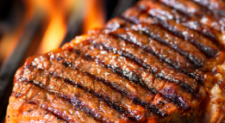
  • Cook all raw beef, pork, lamb and veal steaks, chops, and roasts to a minimum internal temperature of 145 F before removing meat from the heat source. For safety and quality, allow meat to rest for at least three minutes before carving or consuming.
  • Cook all raw ground beef, pork, lamb, and veal to an internal temperature of 160 F.
  • Cook all poultry to a safe minimum internal temperature of 165 F.

If you have food safety questions, call the USDA Meat and Poultry Hotline at 1-888-MPHotline (1-888-674-6854), email [email protected] or chat live at www.ask.usda.gov 10 a.m. to 6 p.m. Eastern Time, Monday through Friday.