Thursday, February 12, 2026
Home Blog Page 417

No, No and Nope

0

So, have you heard or read about the big Cicada “emergence” about to happen in several other Midwest and Southern states? These are not the annual cicadas we call “locusts” that are heard every August here in Kansas, but rather some of those that have been in the ground for 13 and 17 years. Cicadas are formally identified as “broods,” and starting any day now, two of these broods, brood XIX that emerge every 13 years, and brood XIII that emerge every 17 years are set to show themselves at the same time. This is a rare occurrence that last happened in 1803, and won’t happen again until the year 2245. Their sole purpose is to breed, after which they die; eggs are laid on tree branches, and upon hatching, the young fall to the ground and burrow themselves in around the trees, to emerge again in either 13 or 17 years. It’s been estimated there could be up to half a million of the critters per acre where they will be the worst. Audiologists are worried about the noise levels of the critters screeching “love songs,” warning that the sound from this many of them at once can actually be as loud as a jackhammer or lawnmower. “Bug Doctors” and those that study this sort of thing are about to wet themselves with excitement over the rare event, which some have labeled “cicada-geddon.”

I say all this in response to a discussion I heard on the radio today about eating cicadas. Years ago, I wrote a column entitled “My Reverse Bucket List,” where I listed a few things I DO NOT ever want to do, and KNOWINGLY and PURPOSLY eating bugs was one of them. If God had wanted me to eat bugs, he would have made me an ant eater or a bird, so today I still say no, no and nope to eating bugs.

However, it seems eating cicadas is not all that far-fetched. Amazon actually lists 4 cook books completely dedicated to cooking and eating cicadas; “The Cicada Cookbook,” “Cooking with Cicadas,” “Cicada Recipes for the Zombie Apocalypse” and “The Cheeky Cicada; A Culinary Adventure with Natures Symphony.” An internet search easily provided a list of possible cicada dishes, to include pan fried cicadas, chocolate covered cicadas, boiled cicadas, crispy cicada salad, cicadas marinara, spicy popcorn cicadas, cicada chips and even a recipe for chocolate cookies, each with a toasted cicada in the middle instead of a Hershey’s Kiss. Someone even suggested gathering a bunch while they are so plentiful and available, and freezing them by the bagful for later use. I can see it all now; the wife reaches into the freezer for a bag of frozen corn or peas and comes out with a

bagful of frozen locusts instead; that should make for interesting table talk at dinner.

I also stumbled across a few little pieces of advice and ditties concerning cooking and eating the little blighters. Concerning eating them, one person said “They’re great for the summer BBQ, while they are everywhere.” Another advised “No need to tear off the legs and wings, they just add to the crispiness.” Another slogan went something like this, “If you can’t beat em’, cook em’.”

Well, there you have it, a little history lesson, a little news story and a whole lotta’ cicada 101 all rolled into one. Just to reiterate, this won’t be happening in our neck-of-the-woods…this time, but in 17 states east and south of us. Also, just to reiterate, I still say no, no and nope to eatin’ bugs. Continue to Explore Kansas Outdoors (cicada free.)

Steve can be contacted by email at [email protected].
Top barbecue tips from the ‘Three Brisketeers’

0

Texas A&M AgriLife experts share four tidbits every barbecue lover should know.

When it comes to barbecue, few people in the Lone Star State know more than a trio of Texas A&M University meat scientists, affectionately known as the “Three Brisketeers.”

Together, these long-time friends and colleagues share more than 120 years of collective expertise in the art and science behind smoking and grilling meat to perfection. Whether beef brisket, pork ribs or poultry, they know the way to go when it comes to “smoking low and slow.”

The Three Brisketeers, from left to right, Davey Griffin, Ph.D., Jeffrey W. Savell, Ph.D., and Ray Riley, share some perspective about what makes barbecue a cultural and culinary experience like no other. (Michael Miller/Texas A&M AgriLife)

The Three Brisketeers are Davey Griffin, Ph.D., professor and Texas A&M AgriLife Extension Service meat science specialist, and Ray Riley, Rosenthal Meat Science and Technology Center manager, both in the Texas A&M College of Agriculture and Life Sciences Department of Animal Science, along with Jeffrey W. Savell, Ph.D., vice chancellor and dean for Agriculture and Life Sciences.

Here are some juicy tips the trio encourages every barbecue enthusiast to know.

Tip No. 1: Savor more than just the flavor

According to Savell, barbecue is not just about the food, it is about the journey. Enjoy the process of cooking and sharing a meal because smoking meat is as much about the human connection as it is the end product. So, remember to savor the time together as much as the dish.

“Barbecue brings us together,” Savell said. “Whether it’s a big festival or backyard cookout with friends and family, it’s all about that connection between us, our food and the memories we can create together.”

Tip No. 2: It’s all about quality, quality, quality

When it comes to barbecue, Riley said don’t skimp on quality. Use the highest quality cut of meat, spices, utensils and equipment that you can find. While you can make a good brisket with lower grade cut on a basic grill, upgrading to higher grades of meat and an improved smoker can really wow your guests.

“Quality matters, especially with meat and spices,” Riley said. “There are cuts for any budget and occasion, so go with the best quality meat available for your budget. Equipment like utensils and a smoker with a good thermometer make it easier to be consistent, but it all starts with the meat and what you put on it.”

Tip No. 3 – Knowledge is power

Griffin encourages everyone to learn the basics and always continue to learn. Whether learning from professional pitmasters, the Brisketeers, or through trial and error, knowledge and experience greatly improve your results. If you can learn the barbecue basics and understand your equipment, then you will be off to a strong start. However, if you can build upon that knowledge, then you will be on your way to mastery.

The Brisketeers are meat scientists – that’s right: there’s a science to meat. Their wisdom comes from applying this science, heat and seasoning at the right time, in the right ways, to allow meat to live up to its potential. It’s why they put on the Barbecue Summer Camps and Camp Brisket – to brings ideas together and share the art and science of barbecue. There’s no one tip that makes a difference – it’s the cumulative wisdom you gain that lets you make better barbecue.

“You can have the best equipment and the best meat, but grilling or using a smoker can be frustrating if you don’t know some basics,” he said. “You need to know how time and temperature work on certain cuts of meat and how spices or your wood choices play into the flavor. And knowing your equipment – the hot and cool and how it cooks – is critical to consistent success. Invest some time to learn and be ready for some trial and error.”

Tip No. 4 – Try new things and experiment in new ways

All Three Brisketeers agree that trying new things makes life more interesting, especially when it comes to barbecue. So, always be willing to try new things and experiment with different cuts and dishes.

“I encourage everyone to always try new things,” Griffin said. “Barbecue is always evolving, and different pitmasters have different tricks and techniques that you can take home and try on your own. That is one of the beautiful things about barbecue.”

So, there you have it, straight from the Three Brisketeers themselves. Fire up those smokers and grills, broaden your flavorful horizons, and enjoy the low and slow journey of barbecue. And, if you have any questions, visit them online at https://bbq.tamu.edu/.

Immunization Requirements for School Year 2024-2025

0

Immunization requirements and recommendations for the 2024-2025 school year are based on the Advisory Committee on
Immunization Practices (ACIP) and the Centers for Disease Control and Prevention (CDC) recommendations.

The current recommended and minimum interval immunization schedules may be found on the CDC webpage. The best disease prevention
is achieved by adhering to the recommended schedule. However, if a child falls behind, the catch-up schedule is
implemented. To avoid missed opportunities, immunization providers may use a 4-day grace period, in most instances, per
age and interval between doses. In such cases, these doses may be counted as valid

K.S.A. 72 – 6261 – Kansas Statutes Related to School Immunizations Requirements and K.A.R. 28-1-20,published
July,18, 2019 in the Kansas Register, definesthe immunizationsrequired forschool and early childhood
program attendance.

• Diphtheria, Tetanus, Pertussis (DTaP/Tdap): Five doses required. Doses should be given at 2 months, 4
months, 6 months, 15-18 months, and 4-6 years (prior to kindergarten entry). The 4th dose may be given as
early as 12 months of age, if at least 6 months have elapsed since dose 3. The 5th dose is not necessary if the
4th dose was administered at age 4 years or older. A dose of Tdap is required at entry to 7th grade (11-12 years).

• Hepatitis A (Hep A): Two doses required. Doses should be given at 12-23 months with a minimum
interval of 6 months between the 1st and 2nd dose.

• Hepatitis B (Hep B): Three doses required. Doses should be given at birth, 1-2 months, and 6-18 months. Minimum age
for the final dose is 24 weeks.

• Measles, Mumps, and Rubella (MMR): Two doses required. Doses should be given at 12-15 months and
4-6 years (prior to kindergarten entry). Minimum age is 12 months and interval between doses may be as short
as 28 days.

• Meningococcal-Serogroup A,C,W,Y (MenACWY): Two doses required. Doses should be given at entry to 7th
grade (11-12 years) and 11th grade (16-18 years). For children 16-18 years, with no previous MenACWY, only
one dose is required.

• Poliomyelitis(IPV/tOPV): Four doses required. Doses should be given at 2 months, 4 months, 6-18 months, and
4-6 years (prior to kindergarten entry). Three doses are acceptable if 3rd dose was given after 4 years of age and at
least 6 months have elapsed since dose 2.

• Varicella (Chickenpox): Two doses are required. Doses should be given at 12-15 months and 4-6 years (prior to
kindergarten entry). The 2nd dose may be administered as early as 3 months after the 1st dose, however, a dose
administered after a 4-week interval is considered valid. No doses are required when student has history of
varicella disease documented by a licensed physician.

Legal alternatives to school vaccination requirements are found in K.S.A. 72-6262.
In addition, to the immunizations required for school entry the following vaccines are recommended to protect students:
• Human Papillomavirus(HPV): Two dosesrecommended at 11 years of age or three doses if the series is started after
15 years.

• Influenza and COVID-19: Annual vaccination recommended for all ages > 6 months of age.

Vaccination efforts by school and public health officials, immunization providers, and parents are key to the success of
protecting our children and communitiesfromvaccine preventable diseases

Sunn hemp can boost summer pastures

0

Frequent droughts in Missouri have livestock producers discussing more adaptable summer pasture options.

“With tall fescue as the dominant Missouri forage, there are few options to enhance those fescue fields to graze through a long, hot, dry spell,” said Tim Schnakenberg, University of Missouri Extension agronomy field specialist.

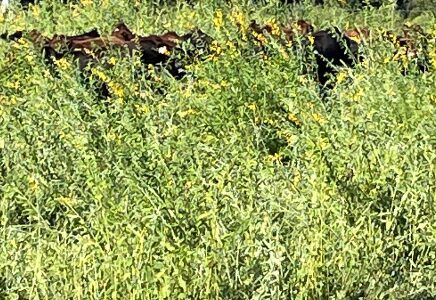
MU researchers have extensively evaluated sunn hemp as an option. Sunn hemp is a summer annual legume growing as tall as 6 feet, producing a large cluster of nutritious leaves from a single stem. Some summer annual forages will drop seed and come back the next year. But sunn hemp will not survive Missouri conditions even if it has a chance to produce seed, Schnakenberg said.

“Most of the time, we will not have enough time in our growing season to produce a seed crop, which is OK for us since the seeds are toxic to cattle,” he said. “No survivable seed means this crop must be planted each year if it is used as an ongoing forage option.”

Sunn hemp can be grown alone, combined with other summer cover crop forages in a mix or inter-seeded into tall fescue stands. Most research in Missouri has focused on inter-seeding. Compared to a legume like alfalfa, sunn hemp doesn’t require super high fertility to be established and productive. It also is a non-bloating legume with a rapid growth rate and high potential for regrowth following a grazing. It is excellent for diluting the toxicity of endophyte-infected Kentucky 31 fescue stands.

One benefit of introducing sunn hemp to complement a tall fescue stand is shade for the cool-season forage during the most brutal time of summer. In extreme situations, the fescue goes semi-dormant in drought. But with the shade of a bushy forage towering over the stand, the fescue is protected and better preserved. Cattle benefit from both the grass below and the higher-quality legume leaves above.

“The cost of the seed can be offset by the fact that it has been confirmed by Dr. Harley Naumann at the University of Missouri to produce as much as 40 pounds of usable nitrogen per acre each year for the grass crop it is growing in,” Schnakenberg said. “The protein level for the whole plant in Naumann’s studies has been as high as 17% 35 days after planting.” Naumann has found leaf samples to test as high as 25% during the same time period.

In a recent MU Extension study evaluating sunn hemp grazing by late-gestation cows, season-long sunn hemp accumulation reached 4,400 pounds per acre. Naumann and livestock specialist Chrisee Wheeler conducted the study at the MU Wurdack Extension and Education Center.

Establishing sunn hemp in tall fescue should not start early. This forage prefers to germinate in soils that are around 70 F, so it’s often established in early June in Missouri. Generally, the recommendation is to plant 25-30 pounds (pure live seed) per acre either by no-till or broadcast following a fescue hay harvest or grazing. No-till will produce the more consistent stands. Most of the growth occurs between 30 and 60 days after planting.

Once sunn hemp reaches about 1.5 to 3 feet tall, about 45 days after planting, it’s a good time to begin grazing by cattle, sheep or goats. Early grazing is important to ensure good forage quality for the season. Graze down to about 10-12 inches in the stalk before turning out of the field. Cows often will graze on their own down to about 10-12 inches minimum. Often, a 21-day rest period is the most beneficial grazing strategy for the health of the plant.

Another trait observed during sunn hemp grazing is its ability to regrow very well at the area of the stalk it was last grazed down to. Instead of the stalk growing upward like the original growth, it begins to branch at hidden axillary buds, causing a bushier plant with plenty of nutritious leaves for the next grazing.

“Naumann has also been experimenting with using sunn hemp as a late-summer hay source,” Schnakenberg said. “Traditionally, agronomists have discouraged its use for hay due to the woody stems, but Naumann has found the quality of the forage in a bale is better than expected. It’s best to make hay late in the summer or early fall so that there will be no need for high cutting for the benefit of having regrowth. There is more work planned on this.”

First frost will end the growing season of sunn hemp. Leaves will drop off and the stems will be all that is left. Pastures will look ragged by early winter due to the dead stems, but it will be just in time for the fescue below to continue building growth for winter stockpile.

For more information on using sunn hemp in a grazing system, contact your local MU Extension agronomy specialist.

Police Youth Academy coming up this summer

0

The Hutchinson Police Department is accepting applications for the 2024 Youth Academy. Spaces are limited. Applications must be submitted by June 14.

The Hutchinson Police Youth Academy is a free and fun educational opportunity by Hutchinson Police Department to allow youth in the community to interact with officers and get a chance to have some hands-on law enforcement experience.

Subjects that will be covered:

-Law Enforcement Center Tour
-Crime Scene Investigations
-Police Vehicles / Equipment / Drones
-Emergency Response Team Demo
-Firearms and Safety Demo
-K9 Demo
-Patrol Operations
-Crash Investigations
-Detectives / Investigations
-Police Records
-Animal Control
-Court Procedures

When: Thursday, July 11, 2024 from 8 a.m. until 5 p.m.
Where: Meet at the Law Enforcement Center (210 West 1st Ave)
Who: Due to limited space, we are only allowing youth who are going to be 7th graders next fall to attend.

Anyone within Reno County that meets the requirements may participate. This includes those students who are home schooled.

What: Participants will learn about Law Enforcement operations.

Lunch will be provided to all participants. This is a free event.

If your child meets the criteria and you wish for them to attend, please contact Captain Gates at 620-694-2825 for an application.