Representatives of Wichita State University and Westar Energy held a dedication ceremony today for an expanded and updated laboratory where WSU College of Engineering students learn about power systems.
The facility in Wallace Hall has been named the Westar Energy Lab to recognize the utility’s pledge of $125,000 to support the lab over a five-year period. The funds are being used to buy new equipment and tools to teach students about smart grids, synchrophasors, power quality and advanced system modeling, among other facets of electrical engineering.
“This support from Westar Energy is a wonderful example of how our corporate friends are willing to invest in educational excellence so that students are fully prepared to succeed in their chosen fields upon graduation,” said Elizabeth King, president and CEO of the WSU Foundation.
The lab will give WSU engineering students real-world experience with equipment relevant to today’s electric industry, said Kelly Harrison, vice president for transmission at Westar Energy.
“Westar Energy is delighted to partner with Wichita State University on the addition of this power systems lab to its engineering program,” Harrison said. “Partnerships like this between a Kansas-based business and an institution of higher learning help ensure that the technical skills students are acquiring align with the needs of businesses like Westar’s.”
John Watkins, chair of the WSU Electrical Engineering and Computer Science Department, thanked Westar Energy for its contribution.
“As the lab will be used in a broad range of electric energy classes, it will provide many students more hands-on experience,” Watkins said. “It is truly preparing our students for work in the power industry of the 21st century.”
Adapted by Jessica Kovarik, RD, LD, former Extension Associate; Based on material by Susan Mills-Gray and Tammy Roberts, MS, RD, LD, Nutrition and Health Education Specialists, University of Missouri Extension
When cooking a turkey, there is usually leftovers. With a little creativity and safe food handling, you can enjoy turkey-based meals with little preparation and cooking.
Anytime you prepare, cook and store food, you must practice safe food handling methods to be sure your leftover turkey is safe to eat. During mealtime, do not let the turkey sit out for more than two hours after it has been cooked. For safe storage, remove the stuffing and de-bone the turkey. Store the turkey in shallow containers in the refrigerator because shallow containers allow the turkey to cool faster, preventing growth of harmful bacteria.
Unless you freeze the leftovers, be sure to use the turkey and stuffing within 3-4 days. Leftover gravy should be used within 1-2 days. Other cooked dishes can be stored up to 4 days.
Frozen leftovers should be stored at 0 degrees Fahrenheit or below and used within 3-4 months. Turkey that is in gravy or broth, or other cooked turkey dishes can be frozen for 4-6 months. Stuffing and gravy can keep up to 1 month in the freezer.
Marking your leftovers with the date and name of the item will help you keep better track of them.
Lastly, when you reheat the turkey, stuffing or gravy, make sure it reaches a temperature of at least 165 degrees.
Here are a few ideas for using your leftover turkey…
Students at Kansas State University are working to make the campus more sustainable by converting used cooking oil from campus dining facilities into biodiesel to fuel many campus vehicles and landscaping equipment.
Students at Kansas State University are working to make the campus more sustainable by converting used cooking oil from campus dining facilities into biodiesel to fuel many campus vehicles and landscaping equipment.
Converting cooking oil into fuel – the Biodiesel Initiative at Kansas State University allows for collaboration among many campus departments and industry organizations
MANHATTAN, Kan. – The sound of a diesel engine is distinct. Sure, some are louder than others, and diesel enthusiasts can usually recognize the differences in sound between Cummins and Powerstroke engines, for example, when driving down the road.
One Cummins engine in particular, housed in a maroon Dodge Ram 2500 Heavy Duty truck on the Kansas State University campus, operates using a renewable fuel called biodiesel. Students, faculty, staff and visitors might meet the truck occasionally as it makes the rounds to pick up used cooking oil from residence hall dining facilities and the K-State Student Union.
The unique truck, which down the sides reads, “Powered by Biodiesel,” serves as the flagship for a major sustainability project at K-State, the Biodiesel Initiative. The waste oil goes to a conversion lab at the K-State Recycling Center, where students turn it into biodiesel for use in other K-State diesel trucks and landscaping equipment.
“We have a number of diesel trucks on campus that consume our biodiesel, and other smaller engines can use it as well,” said Ron Madl, K-State emeritus research professor of grain science and a leader of the Biodiesel Initiative.
According to the National Biodiesel Board (http://www.biodiesel.org/what-is-biodiesel/biodiesel-basics), biodiesel can be made from a diverse mix of feedstocks that include recycled cooking oil, soybean oil and animal fats. Because recycled cooking oil is the input at K-State, people who eat fried foods on occasion in one of the campus dining facilities contribute in a small way to the university’s sustainability.
Experiential learning
Madl wanted to get students more involved in research centered on sustainability when he served as co-director for K-State’s Center for Sustainable Energy (http://cse.ksu.edu). The K-State 2025 visionary plan (http://www.k-state.edu/2025/) also emphasizes sustainability planning as a way to help K-State become a top-50 public research university.
“All universities need to teach our young people how we can have a smaller footprint going forward,” Madl said. “Getting them involved in recycling—how we do it chemically and how we do it economically—is important.”
About two years ago, Madl established a biodiesel conversion lab from scratch with funding help from the Kansas Soybean Commission, the industry organization that also provided the Dodge truck for waste oil pick-up and salary support for student workers to run the lab.
The students represent many different majors, including grain science, biological and agricultural engineering, chemical engineering, chemistry and biochemistry. Together, they formed the Biodiesel Club that is currently supervised by Dan Higgins, professor of chemistry at K-State. Club members get hands-on experience in the conversion lab and learn about the process of making biodiesel.
“These students get great experience in understanding how processes operate with responsibility and maintaining safety,” Madl said. “Students can leverage this experience in their future careers and are setting an example about sustainability across campus.”
Rachel DeMyers, a junior chemical engineering major at K-State, is the current project manager for the lab but has been involved in the Biodiesel Initiative since the beginning.
“I like the hands-on experience and learning how to problem solve,” DeMyers said. “I was able to get an internship going into my junior year, which isn’t common, because I had confidence in my ability and leadership experience with this project.”
Joshua Benton, also a junior chemical engineering major, is the process lead in the lab. He enjoys working with students who have different backgrounds and skill sets.
“Everyone brings something different to the table,” Benton said. “One of our members is an English major, so she’s always on top of writing proposals and forming the charter for our group.”
DeMyers and Benton said students must go through a semester of safety training before working in the lab, and at least two students must be present when making biodiesel at all times.
Processing and using biodiesel
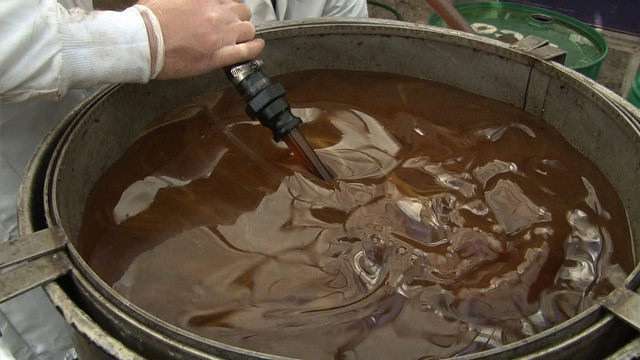
Once the students collect the waste oil at different locations on campus, they bring it to the conversion lab and test the quality of the oil, Madl said. The oil must have the right chemistry—a certain level of moisture and a low free fatty acid content—for a good reaction. The students then filter out the solid particles, such as leftover French fries.
When the oil meets those requirements, it goes into a reactor and is converted to 100 percent biodiesel, or B100. Then it’s blended with petroleum diesel to get B20, or 20 percent biodiesel, which is used to fuel many of the campus vehicles.
“I estimate that we will produce between 1,500 and 2,500 gallons of B100 per year,” Madl said. “We convert at least 50 gallons of waste oil per week in eight months of the year, as we shut down for the summer and during winter holidays.”
The lab wasn’t completely quiet the last two summers, however, as K-State professor of chemical engineering Keith Hohn has supported the initiative by providing National Science Foundation (NSF) Research Experiences for Undergraduates (REU) students to work on research projects in the conversion lab.
Another K-State faculty member, Ed Brokesh, recently became involved in the Biodiesel Initiative as well. As an instructor in biological and agricultural engineering, he uses biodiesel produced on campus to show students how it operates in their tractors compared to petroleum diesel. The students run engine performance tests to make the comparison.
“The students often hear and read about biodiesel but never actually get to see it in use,” Brokesh said. “Basically, there’s not much of a difference in the fuels. They both operate and perform the same way. One just happens to be out of petroleum, and one is out of soybean or other organic materials to create biodiesel.”
Brokesh said producing the fuel is one thing, but it is important to study the fuels and how they interact with different engines. Through research knowledge, he and his students can educate consumers—farmers in particular—about using biodiesel.
In addition to the Kansas Soybean Commission, other sources of financial support include the K-State Provost’s Academic Excellence Fund and a NSF grant awarded to K-State’s Department of Industrial and Manufacturing Systems Engineering that relates to cooperative research on sustainability, Madl said. Because the university does not have to purchase as much diesel fuel, it credits the conversion lab for the amount saved in fuel costs to help support the lab’s needs.
Sidebar: The Sustainable Campus: Looking to the Future
One of the latest equipment purchases for the biodiesel conversion lab at Kansas State University could help the university become even more sustainable in the future, said Ron Madl, K-State emeritus research professor of grain science and a leader of the Biodiesel Initiative.
“An issue that you have with biodiesel is about 20 percent of the production volume generated from our reactor is a waste product that has to be disposed of,” he said. “It is mostly glycerol, but there is methanol unused from the reaction itself. As a result, we’ve purchased a piece of equipment that will give us the ability to purify glycerol and separate it from the methanol. The methanol is then put back into the reactor for the next time we run a reaction, so we’re recycling the menthol and getting more use of that chemical.”
The purified glycerol, then, has another value, he said. K-State students are currently researching how to convert the glycerol into an industrial degreaser that K-State Facilities could possibly use internally.
The Pharisee stood and prayed thus with himself,
“God, I thank thee, that I am not as other men
are.” – Luke 18:11
Without speaking for anyone else, but only out
of notion, I suspect most of us out here on the
plains are grateful.
A year ago we said this in the wake of more
disaster, and the year before that, and here we are
again, praying for victims ‒ of great storms, of
murderous rampage, of war and famine, of poverty
and greed.
It hasn’t been a good year. Better than last, but
still not great. We have endured the brutality and
primal combat that corrodes our electoral process
and laid waste to the Washington agenda and the
state government. Yes, we are still here but I wonder
if many of us know why. To what purpose do
we go on? How many know, or care? That we are
thankful at all is itself a wonder.
And yet there are little clues.
We can no longer give thanks that we don’t
really know what terrorists are, or what war is
like, but we can be hopeful that our nation emerges
from tragedy with greater awareness of the dark
that threatens our society.
WE GIVE thanks in perilous economic times
that our community remains financially stable, if
not exactly strong.
That sirens in our town are still a major event
because they are so rare.
That we can go to work by walking, or on
bicycles if we like, and that when we do drive, we
don’t fight fumes and long lines of stalled commuters.
When we get there we wheel into a convenient
parking spot, free, and we don’t feel the need
to look around while fumbling for our keys.
That we have so many goodies − by way of
television and computers and libraries − of the
cities, but few of the baddies, by way of porn or
hustlers or muggers, or hopeless addicts and hapless
drunks.
THAT we can care about what happens to the
elders next door, and practice private charities,
especially this season but usually year ‘round.
That we are reasonably well-housed, and that
we are well-fed and well-clothed, without going
deeper into debt than we have been.
That we no longer worry so much about getting
bigger and richer, having seen what an obsession
with bigness and richness has done to other people
and communities.
That we know our service station manager, and
our school teachers, and our newspaper editor, and
our city councilmen and councilwomen, and we
don’t hesitate to talk it over with them when things
seem out of hand, and that we extend a hand or pat
a shoulder when things seem to be going well, and
thanks to them.
That we want churches to be strong, that we still
believe the Commandments and the Constitution.
That our community is brimming with people
who believe no day is dismal, and a dull sky is
as plausible as any other, and who embrace each
morning with the brightness and suddenness of
a hyacinth, as though spring were here, even in
February.
WHILE WE are grateful, we must resist the
temptation to give thanks that we are not as others.
That we do not pull into a little Midwest cocoon,
trying to preserve what is best and trying to ignore
the continuing horrors of poverty and racial hatred
and religious bigotry.
That we confront political and business corruption,
rather than ignore it, because it really is our
concern.
IN THIS community we may give thanks for
what we have and for what we may be or would
like to be, and then let’s add another prayer:
Of thanks that we know life is not going so
well for many of the world’s billions; that we
realize how we are diminished when bombs blast
in Baghdad or in Islamabad or Kabul, or when
storms rage over our neighbors with murderous
fury, or when a great city goes to the wall, or
when children starve in the sub-Sahara, or villages
are drowned in Southeast Asia; of thanks that we
know we are not truly alone out here on a Kansas
island.
WE GIVE thanks that we can still care, and
not only for those around us. And that we strive
not to be as the Pharisees. Gratitude becomes us.
Gratitude rooted in smugness does not. We can
truly be grateful if we realize that.
*
It has become a tradition at this time of year to
offer the above column on giving thanks, edited for
context and circumstance. – JM
***
And thanks for that
‘scholarship fund…’
What goes around can, indeed, come around.
The time-told adage comes this time from volunteers
of the Lindsborg Kiwanis flag project,
launched last spring. It’s a community-wide program
to install and maintain the U.S. Flag on certain
federal holidays at the homes of residents who
subscribe to the program.
During the program’s startup in mid-May, one
Lindsborg resident hoped to signed up for the project
but didn’t have the full $40 fee, according to
Kiwanis treasurer Gary Hartter. She told him that
she would need time to pay the total amount.
“It just happened that a couple of weeks earlier,
a gentleman had anonymously donated $40 and
told us it was for someone who might want a flag
but couldn’t afford one,” Hartter said.
“So I told her that her flag would be free this
year, compliments of an anonymous donor, like a
scholarship fund,” Hartter said.
The woman was elated. Hartter felt good about
the circumstance, and in short time it slipped
his mind. A few months later, in August, Hartter
found a surprise in the mail: a $40 check from the
woman, with a note that she “wanted to be part of
the Flag ‘scholarship’ donor program.”
*
Note: About 50 residents now participate in the
Flag program, which recently included Veterans’
Day on Nov. 11.
– JOHN MARSHALL
Information courtesy of Kansas Farm Bureau’s Safety and Ag Ed Division
A space heater may cozy up the corner of a room, but shouldn’t be viewed as a primary or long-term heat source.
Space heaters should be UL listed and have “tip switch” shutoff safety features. They also should be positioned and used according to the manufacturer’s instructions.
A cheaper alternative for keeping warm and staying safe is to add a sweater, heavier pair of socks or a blanket.
– See more at: http://www.kfb.org/news/kfbenews/index.html#sthash.SkgJ9vT6.dpuf[box][/box]