
Monday, February 9, 2026
Home Blog Page 420

Cattle cycle bottoms to historic low. Will peak be historic low?

0
Photo credit: U.S. Department of Agriculture

The cattle herd is progressively shrinking, and as of Jan. 1, it totaled 87.2 million head. This year’s inventory is the fewest since 1951, when the herd totaled 82.1 million.

Each subsequent peak in cattle inventory is lower than the previous peak, while each trough (or low point) is deeper than its predecessor.

Since 1950 there have been seven peaks (1955, 1965, 1975, 1982, 1996, 2007 and 2019) and six troughs (1958, 1967, 1979, 1990, 2004 and 2014, not including the current trough run). The number of years between peaks and troughs has averaged 5.3 years. The time moving from peak to trough is taking longer when it was two to four years from 1950 through 1979, and since then it has taken seven to eight years.


Cycle and peaks

Conversely, the time to move from trough to peak has shortened when it was seven to eight years from 1950 to 1975, and since then it has been three to six years to peak out of the bottom of the cycle. Cattle herds peak faster while painfully taking their time to hit bottom.

Since the record inventory peak of 132 million head of cattle in 1975, each peak and trough are lower as shown in the accompanying figure. In other words, the cattle herd is progressively smaller. The most recent Cattle report pegged inventory level on Jan. 1 is now lower than the previous trough in 2014, which totaled 88.2 million head. The last peak was five years ago in 2019, which was the number of years to achieve that peak in 2019. So, with a new lower trough in the making, does the cattle inventory rebound or languish lower still?


Other factors

Cattle inventory changes for several reasons, most prominently given that the time from birth to slaughter ranges from 20 months to 36 months, depending on the time of weaning and feeding practices. Other factors can speed up the slaughter pace, such as poor margins, high-priced feed or the lack of feed, weather that is too cold or hot and other considerations.

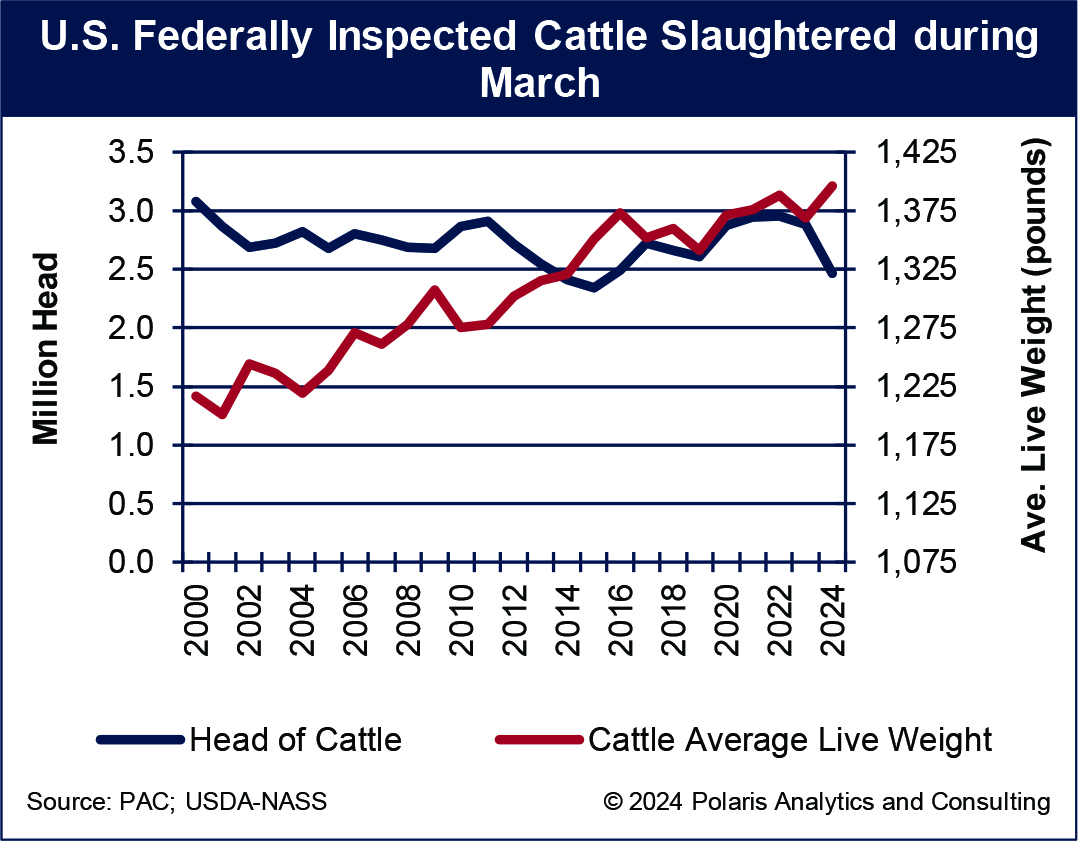
Despite the cattle herd being progressively fewer, not all is lost. The average live weight during March of each year has increased steadily since 2000, when live cattle weights averaged 1,217 pounds and for March this year were a record 1,396 pounds, an increase of 15%. (The monthly Livestock Slaughter report for March was released April 25.)

However, as much as the cattle herd has shrunk since peaking in 2019, the drop in the number of head slaughtered fell dramatically in March this year to fewer than 2.5 million head, down nearly 15% from March 2023. The number of cattle slaughtered and the average live weights for March are shown in the accompanying chart.
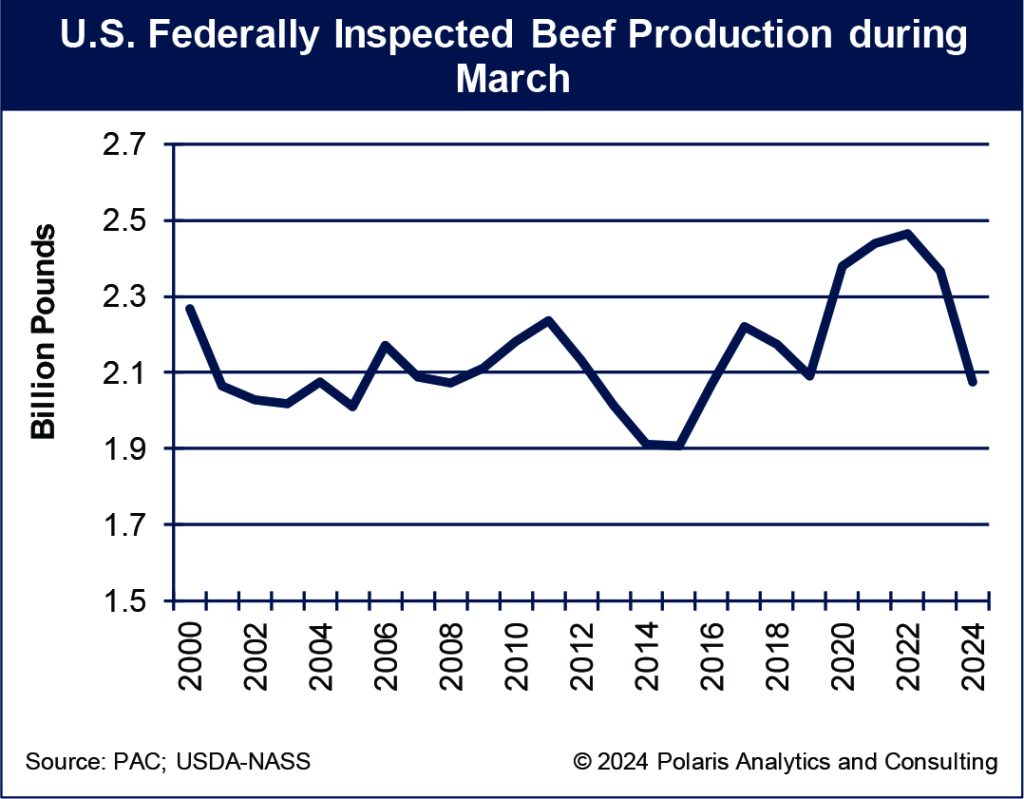
Conceivably, the increasing live weights at slaughter could offset the drop in the number of head being slaughtered. However, given the compounding impact of culling the herd over the last year, beef production during March fell 12% to less than 2.1 billion pounds, a drop of nearly 300 million pounds in one year as shown in the accompanying chart, despite the record live weights. The annual change in production was the steepest drop during March since at least 2000.


What’s possible

Is there a silver lining over the horizon? If history is our guide, and now that a new trough is in, could the climb in headcount for cattle gain traction? While calf season is underway, and the size of the calf crops of the past few years has been shrinking, the prospects of a rapid turnaround are tepid at best.

Ranchers and producers have incentives to produce larger herds with lower feed costs and higher prices for the cattle. Even if the trough is set, any peak from here will arrive fast but lower than the previous peak, if history is our guide. But with the time required to build herds and to put weight on each head, this current trough is painfully looking for the bottom as the cattle herd progressively shrinks, even though each head slaughtered is heavier.


Dog owners encouraged to be aware of heartworm risk as temperatures rise

0
carterse
Risk of heartworm transmission rises as mosquitoes become more active

Rising mosquito activity heading into the summer months poses an increased risk of transmitting heartworm disease to dogs, which can lead to damage of the heart, lungs and arteries if left untreated.

Cathy Campbell, DVM, veterinary diagnostician at the Texas A&M Veterinary Medical Diagnostic Laboratory, TVMDL, in Bryan-College Station, explains the heartworm life cycle, the best time for testing, and tips for prevention.

What are heartworms and how are they transmitted to dogs?

Heartworm disease is caused by the parasitic worm Dirofilaria immitis and is transmitted to animals through mosquitoes, according to the American Heartworm Society. Mature heartworms can live within dogs for up to seven years.

“When a mosquito happens to bite an animal infected with heartworms, it ingests microfilariae, or baby heartworms, through a blood meal,” Campbell said.

Those microfilariae morph into larvae inside the mosquito in 10-14 days. That infected mosquito tends to fly around and bite a dog, transmitting the larvae to a new host. Once transmitted, the larvae enter the dog’s bloodstream and migrate to the heart.

“Larvae set up housekeeping in the heart and grow into sexual maturity in six to seven months,” Campbell said. “Mature worms produce microfilariae, which are released into the bloodstream where they await another mosquito to come and bite the dog, take up a blood sample and continue the cycle.”

It takes six to seven months in the heartworm’s life cycle before they can be detected on a test. Therefore, most veterinarians recommend testing dogs for heartworms around 6 to 7 months of age.

Testing to detect heartworms in dogs

TVMDL offers two different approaches to testing.

The first approach is to detect the baby heartworms produced by adult heartworms in the heart. TVMDL’s clinical pathology section can detect microfilariae using either a filter method or through a modified Knott’s test.

However, not all heartworm infections produce baby heartworms, so it is best to include an “occult” heartworm test using an enzyme-linked immunosorbent assay, ELISA — the second testing approach.

Technicians at TVMDL use the ELISA test to detect antigens associated with pregnant female heartworms. A positive result indicates adult female heartworms are present. This is the primary testing method to detect heartworms.

TVMDL’s role in testing for heartworm disease

Most private veterinary clinics can perform heartworm antigen/ELISA testing in-house, Campbell said. TVMDL primarily conducts confirmatory heartworm testing with a different antigen test after these clinics have gotten an initial positive result.

Confirmatory testing is performed for several reasons. The first is to confirm a dog truly is positive for heartworms prior to undergoing treatment, because the treatment drug used for heartworms can have significant side effects and should not be used unless adult heartworms are present.

The second reason is to document heartworm prevention drug failure. Several manufacturers guarantee coverage of treatment for a dog that has been on their product but developed heartworms despite well-documented testing and dispensing of medication by a licensed veterinarian. There is evidence of a preventative-resistant heartworm variant, primarily in the Mississippi delta region of the U.S.

Lastly, sometimes test results can be unclear. TVMDL can offer a differing testing option to help support or confirm findings.

Although TVMDL serves a confirmatory role for most antigen heartworm tests, the agency typically conducts initial testing for the heartworm antibody test in felines. Due to the infrequency with which this test is needed in private practice on cats, many veterinary clinics do not perform this test in-house and defer testing to TVMDL.

Prevention recommendations

TVMDL encourages veterinarians to educate their clients on the benefits of giving year-round heartworm preventatives to both their canine and feline patients and supports annual testing of canines.

“Texas’ mild climate lends toward year-round mosquito activity,” Campbell said. “Missing a dose of heartworm preventative, or even administering a dose late, may allow a window of opportunity for mosquitoes to infect pets.”

For additional information on heartworm disease, visit the American Heartworm Society. For more information on testing, visit TVMDL’s testing services or call the TVMDL laboratory nearest to you.

Farmers and Firefighters Join Forces to Eliminate Forever Chemicals

0

This International Firefighters’ Day, the Kansas Soybean Commission encourages farmers to talk to their local fire departments about soy-based firefighting foam’s health and environmental benefits.

Firefighters and farmers in Kansas serve as the backbones of our local communities, united by a shared commitment to safety and service. As our first line of defense, firefighters face numerous risks navigating hazardous environments with smoke and carcinogens. Firefighters rely on various tools, including firefighting foam, to combat fires. However, traditional foams can pose risks, exposing them to harmful PFAS or “forever chemicals.” With farmer investment, the safer alternative SoyFoam™ TF 1122 eliminates this exposure, prioritizing the well-being of our first responders.

Cross Plains Solutions’ SoyFoam™ TF 1122 is the first and only firefighting foam GreenScreen Certified® at the Gold level. This partnership between Cross Plains Solutions and the soy checkoff gives firefighters one less thing to worry about while keeping our communities safe. SoyFoam is 100% free of intentionally added per- and polyfluoroalkyl substances (PFAS) and is made with no fluorines. It’s also certified ready biodegradable by the Organization of Economic Cooperation and Development and is certified as 84% biobased through the U.S. Department of Agriculture BioPreferred® program.

“SoyFoam™ is very cost competitive and made from renewable products,” Bob Haselwood, Commissioner from Berryton, says. “Firefighting foams currently on the market pose long-term cancer risks. Foam made from soy flour is a good product, especially considering young generations of firefighters.”

Another benefit of SoyFoam for the soybean industry is that it’s made with soy flour. While soy-based products for biofuels, adhesives, coatings, lubricants and plastics primarily use soybean oil, SoyFoam uses the meal component of the soybean. With the growth of renewable diesel aimed at decarbonizing the transportation sector, finding new demand streams for the increased soybean meal crush, which makes up 80% of the bean, remains at the top of mind. Cross Plains Solutions estimates the current applications of SoyFoam™ TF 1122 have the potential to use the protein from 12 million bushels of soybeans, and new uses for the product, beyond firefighting applications, are on the horizon.

“We are proud to partner with U.S. Soy to launch this breakthrough firefighting foam for use by fire departments across the nation,” said Cross Plains Solutions’ Managing Partner Alan Snipes. “Our manufacturing plant in Georgia is ready to produce SoyFoam now, so fire departments can ask their suppliers to offer it. We also see demand for numerous additional applications, ranging from canisters to sprinkler systems.”

The U.S. Environmental Protection Agency (EPA) reports that PFAS is found in water, air, fish, and soil at locations across the nation and the globe. Exposure is linked to several adverse health effects, including certain cancers, thyroid dysfunction, changes in cholesterol and small reductions in birth weight. So, mitigating forever chemicals through soy-based products can create a real impact, not only for the safety of our first responders but also to maintain the integrity of our local communities’ soil health, air quality and drinking water.

As we commemorate International Firefighters’ Day on May 4, the Kansas Soybean Commission urges local farmers to provide information to their local fire departments to use SoyFoam, not only to protect their firefighters but to safeguard their communities as well. To learn more about the product, visit crossplainssolutions.com.

GreenScreen® Certified is an independent certification program owned by the nonprofit Clean Production Action, which promotes the use of PFAS-free and preferred chemicals in materials, products, and manufacturing.

The Kansas Soybean Commission, established in 1977, includes nine volunteer farmer-commissioners who are elected by their peers. They oversee investments of the legislated “soybean checkoff” assessment in research, consumer information, market development, industry relations and farmer outreach to improve the profit opportunities for all Kansas soybean farmers.

Rice County Historial Society

0

“A Place to Call Home” is currently on display at the Rice County Historical Society/Coronado Quivira Museum and will run until July 31, 2024. The exhibit from the Smoky Hill Museum provides stories from people who risked it all to settle in Kansas.

The stories reveal the decisions immigrants made, the hardships they faced, and the hope that brought them to a new home of the Plains.

The Coronado Quivira Museum is located at 105 West Lyon, Lyons, Kansas. It is open Tuesday through Friday from 10:00 a.m. to 4:00 p.m. and on Saturday from 10:00 a.m. to 1:00 p.m. For additional information call (620) 257-3941 or go to www.cqmuseum.org.

Cucumber Beetles and Bacterial Wilt

0

Description: Cucumber beetles can either be striped or spotted. Striped cucumber beetles are more common with ¼-inch long bodies, black head and antennae, straw-yellow thorax and yellowish wing covers. There are three parallel longitudinal black stripes down the body. Spotted cucumber beetles have 12 black spots on the wing covers with yellow
on the underside of the abdomen.

Life Cycle: There are two generations of cucumber beetles each year. They overwinter
as adults. After mating the females lay eggs in the soil at the base of cucurbit plants
making it easy for larvae to feed on roots when they emerge. Two to three weeks later
the larvae pupate in the soil giving rise to the second generation later in the growing
season. It takes about four to six weeks for a single generation to go from egg to adult.

Damage: Cucurbit plants are targeted by cucumber beetles whose feeding reduces
growth and can cause plant death. Young pumpkin and squash plants are common
targets. Holes in leaves, stems, flower and fruits caused by feeding can affect yield.
Cucumber beetles also transmit the disease, bacterial wilt, which causes sudden
browning and death of cucumbers and muskmelons. Once infected the plant cannot be
cured making prevention key.

Control: Protect young plants now by using row covers, cones or another physical
barrier. Seal the edges of the barrier to prevent beetles from entering. Use transplants
which can stand up to bacterial wilt better than seedlings. Mulch with straw around
plants to create a habitat for predators such as wolf spiders. Remove crop debris after
each growing season and manage weeds. Monitor plants regularly and manually remove cucumber beetles. Sticky cards can be used to help monitor for pests present in
the garden.

Insecticides with permethrin (Bonide Eight Vegetable, Fruit & Flower Concentrate and
Hi Yield Garden and Farm Insect Control) can be used when pollinators are not present.
Always follow all label instructions and only use insecticides in combination with proper
cultural controls.

KS Extension Office