Sunday, March 29, 2026
Home Blog Page 964

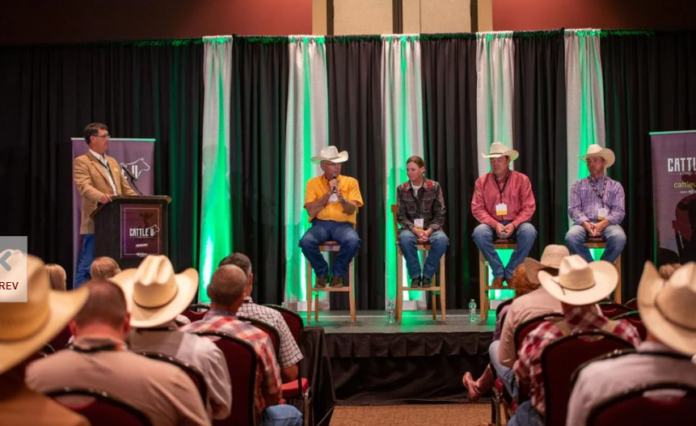
Marketing panel tackles vexing challenges all producers face

0

As reported in High Plains journal, future marketing challenges and drought were two topics that dominated discussion among panelists who took part in the Aug. 5 Cattle U and Trade Show at United Wireless Arena, Dodge City, Kansas.

“Not necessarily, in my opinion, of the betterment (of the industry) but out of necessity,” Campbell said.

Smaller producers have been “steamrolled” by the large-chain process. “The COVID-19 pandemic in 2020 changed how consumers buy beef and opened new opportunities for small independent meat packers who have developed a niche,” he said.

“These small independent packers are still killing a lot and that is good thing,” Campbell said. “I’m not sure it will feed the masses.”

The concentration of the meat packing industry is still the dominant factor, he said, and makes it tougher on smaller marketers and ultimately impacts the farmer and rancher. who “cannot sell a hamburger one at a time.”

The end result remains troublesome and clouds the future, he said.

Kelli Payne, president of Oklahoma National Stockyards, Oklahoma City, Oklahoma, says pre-pandemic many producers were making all the right decisions and through the pandemic and post-pandemic they are continuing to make good decisions and in the future will continue to do so but there risks, too.

Corbitt Wall, commercial cattle manager for DV Auction and host of the Feeder Flash daily cattle marketing summary and based in Canyon, Texas, said his concern with vertical integration is that it’s a top-to-bottom model rather than a bottom-to-top process, which allows producers—regardless of size—to have an opportunity to profit.

He likened what he has seen to the change in the hog industry. He remembers when he worked at the U.S. Department of Agriculture in 2000, the feeder pig industry was still a viable market.

“They were just as excited as Kelli is selling a nice set of black baldies,” he said.

The problem at the current pace—without reform—is in 25 to 30 years he envisions a cattle industry that will be similar to the pork industry as smaller producers and backgrounders continue to feel the brunt of the cost squeeze.

“We don’t have enough negotiation now,” Witt said. “It scares me.”

Josh Mueller, a fourth-generation farmer and rancher from Halstead, Kansas, who along with his wife own El Dorado Livestock Auction, said producers also need to remember the business has a history of being cyclical. The pandemic caused a significant shift in consumer behavior and millennials are among those driving that shift.

In the 1980s and 1990s the focus of meat consumption was through fast food restaurants. Today many consumers consider themselves foodies, which means they are fans of meat and have a greater passion for it. Those positives can be built upon.

Another reason he is more optimistic is that packers do not want to own or raise cattle. It takes a lot of resources and land to raise cattle. Mueller said individuals who come to events, like Cattle U, and share their stories help the overall story that needs to be told.

“We need to come together and talk about,” he said of the marketing challenges, then quipped, “We are stubborn and bull-headed when it comes to cattle production.”

Drought concerns

Campbell said the drought has made it tough but he calls the 2002 one of the most devastating in its impact on producers’ long-term prospects. One difference is this year the market has prices that allow a producer to stay profitable.

Payne said the drought has been spotty and not as bad as it was seven to 10 years ago but there are producers who are selling more ahead of their original schedule. They are also starting to cull a little bit deeper into their herds. She worries it could get worse without more widespread moisture.

Wall said the northeast region of Texas and the region from Dallas to San Antonio have been hit the hardest and small producers are the ones who have really been hurt. “They are the bread and butter for sale barns,” he said.

Once those producers fully liquidate, those numbers will not come back. The liquidation level is high enough that Wall will not be surprised if in a couple of years the U.S. Department of Agriculture will no longer list Texas as the nation’s top cattle state.

Mueller said states that have been hit hard are really suffering but his region has been less impacted. “As far as cows coming to town early, I don’t see that.”

The Flint Hills and central Kansas have mostly been spared of the conditions of the western region; however, regardless of region, “everybody takes a turn at it,” he said. It is a reminder that producers need to always have a plan, regularly review it and be willing to act on it.

The experts said special sales can work to the sellers’ advantage, but they also noticed other trends too. Mueller said the seller might want to pay attention to the overall market in the week that leads up to the sale. He also says producers might want to make sure they match up with like-size cattle.

Wall said producers need to work closely with their marketing agent.

“You need to be best friends,” he said and quipped, “Drink coffee in the morning, tea in the afternoon and beer at night.”

The marketing agents are the key and it requires work on behalf of the seller. “Don’t just show up at the sale. If you have a nice set of cattle, let them know early.”

Payne said that 2 1/2 years ago Oklahoma National Stockyards partnered with Oklahoma Angus for special sales twice a year and that has been a success as Oklahoma Angus uses it as an opportunity to sell feedstock. Her team focuses on it each week. “Every sale is special,” Payne said.

Campbell said the overall market is the bigger factor and that is why he re-emphasized the importance of the producer and marketing representative relationship. A buyer from Nebraska won’t buy 30 head of cattle from La Junta because of cost of freight, but if he can combine several groups of cattle the buyer likes and can create a load there is an opportunity for the sellers to have an additional outlet.

Freight, fuel expenses

Freight prices were also on the minds of the marketers. Managers understand the cost of diesel, particularly on independent truckers, which are the primary carriers for their respective outlets, and it has pinched bottom lines. Wall said stories abound of truckers who give up their independent gig to take a six-figure salary to drive a truck for Walmart.

This all comes at a time when calves need to be hauled south from ranches in the northern Plains this fall. “The market is really good until they run out of trucks,” Wall said.

Payne works with truckers to find back hauls as a way to offset costs but that has become tougher. She has gained a greater appreciation for those truckers who continue to do it out of the love for the industry.

Campbell said the barns have to work closer with buyers to accommodate their trucks and at times that may mean feeding the cattle in the outlet’s pens additional days.

The panelists agreed that following protocols to keep cattle healthy should be a high priority. Wall said having a third-party verification on vaccines is gaining more popularity. Years ago, there was an assumption if cattle had a blackleg shot that met the definition of full inoculation but he added most pharmaceutical companies have a protocol that makes sense to follow.

Mueller said the increase in “all-natural beef” sales has added value—and responsibility—for producers to have third-party verification because buyers expect it. Mueller will not be surprised if that does not become a full market standard.

“Two shots are good and three rounds is almost better,” he said. If they are not weaned at least 45 days or preferably 60 days, the seller is unlikely to get a premium.

Payne also preferred 60 days but she noted if the producer needs to sell without the shot protocol, it maybe something he or she has to consider depending on the individual situation.

Although much of the focus is on getting top dollars for sellers, Campbell said to keep in mind what many marketers know when it comes to buyers.

“We don’t remember the good ones, but they remember the wrecks and the bad deals.”

Cattle U and Trade Show is an annual High Plains Journal event.

Forage, hay insurance may help reduce drought risk, economist says

0

As reported in High Plains journal an insurance management program may help hay and forage growers protect their bottom line in light of drought conditions that persist in the High Plains.

James Mitchell, an assistant professor and Extension economist at the University of Arkansas Department of Agricultural Economics and Agribusiness, spoke about the Risk Management Agency program during a recent National Cattlemen’s Beef Association webinar, “Pasture, Rangeland, Forage Program: A Tool for Your Toolbox.” The RMA is overseen by the U.S. Department of Agriculture. RMA programs are associated with crops, but in recent years Congress has allowed the agency to expand into other farm production sectors to help with risk management. Mitchell has studied the pasture and rangeland segment to help inform farmers and ranchers as they consider if a pasture, rangeland and forage policy is a fit for their operation.

“Risk management is about taking some risks off the table,” he said, adding that a risk management plan is a strategy that looks subjectively and objectively at how to limit risk. The pasture management plan, which includes forage production, was first tested as a pilot program in 2007 and then went nationwide about five years later. Coverage is a subsidized product and part of the premium is underwritten by the federal government.

The top five states in enrollment as of 2021 were Texas, about 29.6 million acres; Arizona, 28.4 million acres; Nevada, 25.2 million acres; Utah, 16 million acres; and New Mexico, 14.7 million acres. About 172 million acres in the country were enrolled nationwide in 2021. Five years ago it was a third of the size, he said.

Risk management can address two areas producers may have limited or no control over—prices and realized production of livestock, forage or crops—which may be different than what producers expect.

Policy plus

An insurance policy can help a rancher, Mitchell said, as he faces risks with pests, weeds, wildfires and inputs such as fertilizer and fuel. Decisions on soil fertility and quality also impact forage production.

What happens when there is not enough forage produced? The rancher has to buy supplemental feed and scramble to find and purchase hay. He may even have to reduce or liquidate a cow herd or change marketing strategy for calves.

“It is a high consequence outcome,” Mitchell said.

Most livestock webinars are about options, futures, the Livestock Risk Protection program, or forward contracts but few touch on the pasture, forage and rangeland because it is a relatively new program, he said.

“When you think about it, what is out there for forage production risks?” Mitchell said. “Besides this insurance product we mainly rely on farm management decisions for forage risk management.”

Evaluating a forage insurance plan as a risk management tool might prove worthwhile for producers, he said. It is a single-peril program based on rainfall index and a lack of moisture is the trigger point.

“We use rainfall as a proxy for forage production,” Mitchell said adding hay type, bale size and cool season versus warm season forages are hard to quantify for an insurance product.

The Pasture, Rangeland and Forage program is based on a rainfall index on by using the equivalent to a 12-by-12 mile grid at the equator and dimensions will be slightly different in each state, which is different from crop insurance, he said. If the rancher’s property straddles the grid he can choose which grid to be placed in. The rainfall totals are based on National Oceanic and Atmospheric Administration reports, which are collected on a daily basis, and those figures help to establish a baseline. Mitchell said there are more reporting stations in the southern Plains than the more sparsely populated northern Plains, which he hopes will be improved upon in the future to help those ranchers.

How it works

A grid ID has to be selected based on the identified land’s location and growers need to keep that number handy, Mitchell said. Producers can see how it works for them by using the calculator tool at https://prodwebnlb.rma.usda/gov/apps/prf.

In his example, Mitchell used Hempstead County, Arkansas. NOAA has been collecting precipitation data for 11, two-month intervals. The data dates back to 1948 and the rainfall index uses a weighted average of the four closest stations to the center of the grid. The index reflects precipitation relative to the long-run average for a grid. The indices have an expected index value and actual index value.

Normal is defined as 100 on the index shows. A rainfall index of 99 or lower indicates below average rainfall, while a rainfall index of 101-plus indicates above average rainfall. An indemnity payment is triggered when there is below average rainfall, and the index is below the producer’s chosen coverage level.

Decision points

As a result a producer has several key considerations.

He’ll need to designate whether he has grazing acres or hay acres. Premiums are lower for grazing acres and as a result if a loss occurs an indemnity payment is lower. Insurance for hay production is more expensive but also provides a higher payout in case of a loss.

A grower will need to choose the acres and he does not necessarily need to cover all of his forage acreage. The coverage level is the index value that triggered an indemnity payment when the realized precipitation is below the expected normal interval and the payout ranges from a high of 90% to 70% in 5% increments.

The higher coverage levels are more expensive and more likely to trigger a payment, he said.

In his calculation for the productivity factor. Mitchell notes USDA-RMA had a county base value of forage production of $59.50 per acre in Hempstead County. The producer has to choose how much of the base value he wants to cover.

The final decision is on the 2-month index intervals and the rancher will have to decide between hay or grazing acres. He will need to choose 2-month intervals to protect against low precipitation. He has to choose a minimum of two, 2-month intervals; he cannot exceed six 2-month intervals and he cannot choose overlapping intervals.

The producer also chooses how to allocate coverage across intervals with a maximum of 60% and a minimum of 10% for any of those 2-month intervals.

In his comparison, Mitchell says ranchers could distribute coverage evenly across intervals based on year-round forage availability, they could match growing season for a specific forage such as a cool season crop, or target specific intervals that could be matched with growth and harvest expectations.

Ranchers need to consider forage production and risks. They could also focus on maximizing the probability of receiving a payment. In Arkansas, September and October is most likely when it is a dry period but the policy will be more expensive for those months. That average premium for grazing is $10.69 per acre. For hay, the premium would be $38.57 per acre.

“A policy for haying acres is much more expensive than grazing acres,” Mitchell said, adding there is also variabilities that are taken into account by insurers.

In his comparison, Mitchell uses total insured acres of 100 acres of pastureland. The county base value is $59.50 per acre for grazing. At 90% coverage (which translates to $53.35 per acre) that meant the coverage level for 100 acres is $5,355 based. A producer than has what two-month intervals he wants to apply.

The subsidy level is 51% and the producer chooses 2-month intervals and then uses the calculator tool and he can see what the payouts could mean and there are also variables for the producer’s share for his premium. It also projects the indemnity payment.

On his overall intervals, an Arkansas producer paid $4.51 an acre to purchase the $53.55 per acre of coverage and received an indemnity payment of $9.28 per acre, which meant he netted nearly $5 an acre in protection.

He encouraged producers to look at past production when risks are highest for their operation. The PRF policy can be purchased from a crop insurance agent.

Consumer Alert: Assignment of Benefits – the good, the bad, and the ugly

0

Topeka, Kan. – Every year severe weather forces Kansans into the insurance claims process. Those seeking to make claims on home property damage will likely need to enlist the help of a contractor.

Working with a contractor can sometimes mean entering into a contractual agreement known as an “assignment of benefits” (AOB). Signing an AOB, enables a third-party individual/business to engage in the insurance claims process, make property repair decisions and directly invoice the insurance company on the policyholder’s behalf.

The Kansas Insurance Department urges all Kansans before signing an AOB to 1) Check your insurance policy for any AOB restrictions. 2) Call the insurance company to see if they partner with any local contractors. 3) Verify the credentials of a contractor by asking for references and checking reviews. 4) Read the AOB carefully and never sign under pressure.
“While the AOB process works for some, it might not be the right fit for you, especially if it means giving up control of how the claim is handled,” said Insurance Commissioner Vicki Schmidt. “I urge all Kansans to do their due diligence before signing an AOB contract.”

The Good – If working with a trusted contractor, signing an AOB leaves the insurance claims process in the hands of the contractor. Entering into this agreement removes the policyholder as a middleman and has the potential to streamline the process.

The Bad – When a contractor is given power over the decision-making process, they must act within the bounds set forth by the property owner’s insurance policy. Violation of the policy’s terms and conditions (mistaken or not) could cause a claim denial and leave the policyholder on the hook for the costly mishap.

The Ugly – Unscrupulous contractors often consider AOB agreements a blank check. They may try to perform unnecessary work or charge unfair prices higher than the market rate. This disregard for cost could leave the policyholder financially responsible for the amount not covered by insurance. Matters could get worse when there is a dispute between the contractor and the insurance company. AOB agreements allow contractors to pursue legal action against the insurance company in the policyholder’s name without their consent.

If Kansans have questions or concerns about an assignment of benefits contract, please talk to your insurance agent and/or call the Kansas Insurance Department at 800-432-2484.

Broccoli & Ham Quiche

0

Serves: 6

Cooking Time: 25 minutes

What You’ll Need:
  • 1/2 cup pancake and baking mix
  • 1 teaspoon onion powder
  • 1/2 teaspoon salt
  • 1/4 teaspoon black pepper
  • 1 cup shredded Cheddar cheese
  • 1 cup shredded Swiss cheese
  • 1/2 cup diced ham
  • 2 cup coarsely chopped broccoli florets, blanched (see note)
  • 1 cup half-and-half
  • 2 eggs, beaten

What To Do:

  1. Preheat oven to 400 degrees F. Coat a 9-inch pie plate with cooking spray.
  2. In a large bowl, combine baking mix, onion powder, salt, and pepper; mix well. Stir in both cheeses, ham, and broccoli. Add half-and-half and eggs; mix well. Pour into prepared pie plate.
  3. Bake 25 to 30 minutes, or until toothpick inserted in center comes out clean. Let cool 5 minutes, then cut and serve.

Notes:

  • If you’d prefer, feel free to substitute 2 cups of frozen broccoli florets.

Berry Trifles

0

Ervin and I just returned from taking my dad, Jerry, back to Northeast Missouri. It was a very fast turn-around, however, we had 2 wonderful weeks together. We enjoyed going out to eat, new recipes from my kitchen and lots of fried green tomatoes! There was also an evening of cruising on the lake.

Every time my dad is here I think about another dish he would enjoy. He may have to wait to enjoy this one, perhaps in September I’ll get the chance.

Trifles can be so unique, and also extremely refreshing. I’ve included quite a bit of history on this adaptable dessert. You name the season, you can make a trifle.
It can be fancy or super simple. One of my favorites is my pumpkin and gingerbread trifle. There’s still plenty of warm days ahead to feature a cool and refreshing berry dessert.

So let’s jump into trifles, shall we. When trifles were first created they were
absolutely saturated with alcohol. Here in America we don’t tend to do that too much. However, it is an alternative with the fruit that is used. Blueberries love amaretto and strawberries wouldn’t be too bad with Grand Marnier. What do I mean exactly? A good example would be to make a blueberry sauce and implement the amaretto inside the sauce. Since I want my trifle to work for a family setting I’m going to steer clear of the alcohol!

Inside this trifle we’ll rely upon fresh berries. There are also alternatives to this approach as I’ve indicated in the previous paragraph. The fruit can be made into a thickened sauce, if desired.

First I’m going to give you a rich recipe for a cream sauce to smooth on between the layers. If you overindulge with the sauce by the time you get to the top layer place a topping of whipped cream for the finale. The kind of cake that’s used can be store bought or scratch. Allow the cake to cool and cut it into 1 – 2 inch cubes.

Today I’ll use either an angel food, sponge, pound or white cake. When you design ‘your’ trifle you may want to go with a chocolate cake and a peanut butter filling! If you want a tropical take on a trifle use banana pudding and implement
Coconut, banana, pineapple, mango and cherries.

Once you lay a foundation with the cream filling you are off and sailing! The best part is how easy this is to construct once you reach your destination. Also consider using the trifle ingredients to construct individual parfaits. Cookies can also be used in place of cakes, especially in the parfaits.

Ok my friends, I’m off for now and on to another new dish. Enjoy the pleasures of summer. Simply yours, The Covered Dish. www.thecovereddish.com

Berry Trifle

Filling
1 box instant vanilla or cheesecake pudding (3.4 oz.)
2 cups milk of choice
8 ounces cream cheese
1/2 cup powdered sugar
8 ounces whipped cream

Topping
8 ounces whipped cream or
Leftover filling and whipped cream

Fruit
16-24 ounces blueberries, stemmed and washed
24 ounces strawberries, washed, stemmed and quartered
(Leave one large berry to fan out on the top for décor.)
(You may desire to prepare the strawberries and sprinkle 1/4-1/3 cup of sugar over them. Allow to set a few hours and you’ll have a nice juice to include.)

Cake
Cook’s choice: White cake, angel food, sponge cake, pound cake……..
Cut cake into 1-2 inch cubes. Each layer will need 2-3 cups of cake depending upon the size of the trifle bowl.

Directions:
Prepare pudding according to box directions. In a glass bowl soften cream cheese in the microwave, blend smooth, stirring in the powdered sugar. After the pudding has set for at least 4 minutes combine the cream cheese mixture to the pudding. Lastly using a rubber spatula blend the whipped cream into the mixture. Sometimes a metal spoon is a bit too heavy and it can knock down the whipped cream. Turn the ingredients together with a gentle hand. If the filling is thicker than you desire add a couple tablespoons of milk or cream to thin.

Cube the cake and place the first layer in the bottom of the trifle bowl. Sprinkle a portion of the strawberries and blueberries over the cake. Layer a covering of filling over the fruit. Time for the next layer. Repeat just like the first. “IF” you need more filling for the final layer and you’ve run out place 8 ounces of whipped cream on the top. Garnish with a fanned out strawberry and a sprig of mint.