Sunday, March 29, 2026
Home Blog Page 963

Words Women Use

0
Thayne Cozart
Milo Yield

Usually when I stray beyond rural topics, and venture into human relationship topics, I get negative repercussions from some folks or some groups.
But, sometimes I think delving into the intricacies of human relationships and conversations, especially between women and men, is worth the risk and can yield benefits to the human race — rural, suburban, and urban. So, with that thought in mind (and because I’m getting too old to really care what anyone thinks anymore), here is a look into the intricacies and interpretations behind the real meaning of “Words Women Use” when in the company of men.
As my front line of defense, I will mention that these “words” were sent to me by our daughter in Tennessee. She’s had many years of happy and fruitful marriage and raised four delightful grandkids, so I’m taking the stance that she knows what she’s talking about — and I’m sticking to it.
***
WORDS WOMEN USE

“FINE”
This is the word we use at the end of any argument that we feel we are right about, but need to shut you up. Never use “fine” to describe how a woman looks. This will cause you to have one of those arguments.

“FIVE MINUTES”
This is half an hour. It is equivalent to the five minutes that your football game or rodeo program is going to last before we can have the TV remote, so we feel that it’s an even trade.

“NOTHING”
This means something and you should be on your toes. “Nothing” is usually used to describe the feeling a woman has of wanting to turn you inside out, upside down, and backwards. “Nothing” usually signifies an argument that will last “Five Minutes” and end with the word “Fine.’

“GO AHEAD” (with raised eyebrows)
This is a dare. One that will result in a woman getting upset over “Nothing” and will end with the word “Fine.”

“GO AHEAD” (normal eyebrows)
This means “I give up” or “do what you want because I don’t care.”You will get a raised eyebrow “Go Ahead” in just a few minutes, followed by “Nothing” and “Fine” and she will talk to you in about “Five Minutes,” when she cools off.

“LOUD SIGH”
Not actually a word, but is still a verbal statement very misunderstood by men. A “Loud Sigh” means she thinks you are an idiot at that moment and wonders why she is wasting her time standing here and arguing with you over “Nothing.”

“SOFT SIGH”
Again, not a word, but a verbal statement. “Soft Sighs” are one of the few things that some men actually understand. She is content. Your best bet is to not move, breathe, and stay mute and hope she will stay content.

“THAT’S OKAY”
This is one of the most dangerous statements that a woman can say to a man. “That’s Okay” means it’s not OK and she wants to think long and hard before paying you retributions for what ever it is that you have done. “That’s Okay” is often used with the word “Fine” and used in conjunction with a raised eyebrow “Go Ahead.” At some point in the near future when she has plotted and planned, you are going to be in some mighty big trouble.

“PLEASE DO”
This is not a statement, it is an offer. A woman is giving you the chance to come up with whatever excuse or reason you have for doing whatever it is that you have done. You have a fair chance to tell the truth, so be careful and you shouldn’t get a “That’s Okay.”

“THANKS”
A woman is thanking you. Do not faint, just say “you’re welcome.”

“THANKS A LOT”
This is much different than “Thanks.” A woman will say, “Thanks A Lot” when she is really ticked off at you. It signifies that you have hurt her in some callous way, and will be followed by “the loud sigh.” Be careful not to ask “what is wrong?” after the “loud sigh” as she will only tell you “nothing.”
***
The first breath of fall is arriving. The scalding days are cooling off quicker in the evenings as the days shorten noticeably. However, it’s the arrival of the first late summer wild flowers that are my most pleasant signal of the impending fall. To wit, the first of the many kinds to yellow sunflowers — the Maximilians — have arrived, as has the white Snow-on-the-Mountain, which is in full bloom. Iron Weed, although a nuisance in pastures, has quite pretty purple blooms.
From now through September more and more beautiful fall prairie wild flowers will be showing up. I’m eager for the Blazing Star’s to start blooming.
***
Words question for this week: “Ever wonder how many voters are turning over in their graves these days?” Have a good ‘un.
The Gray State

0
john marshal

Kansas made big headlines this month when voters chose to continue the state Supreme Court’s guarantee of a right to abortion (with certain limits).
Shock bubbled through the national networks and across newspaper columns. Pundits were astounded that a red state would vote blue on this volatile issue.
Kansans do tend to vote Republican on most statewide ballots, but they aren’t hidebound. In the past half-century, Kansas has had 16 elections for governor; Democrat have won ten. But for the lunatic Brownback (2010-2017), Republican governors have been moderate, avoiding extremes. Kansans send Republicans to the Statehouse and Democrats to Cedar Crest.
The abortion referendum tells more. On Aug. 2, voters soundly rejected an amendment to nullify the Court’s ruling in 2019 that women in Kansas have a constitutional right to the procedure. The referendum drew 922,321 voters, nearly half the state’s registration; 59 percent (543,855) voted no, 41 percent (378,466) said yes.
Kansans may be seen from high places as red and the abortion vote as blue, but out on the flatland, the voting rolls say “gray.”
There are more than 1.9 million registered voters in Kansas: 851,882 Republicans, 495,574 Democrats, 560,309 Independents and 22,209 Libertarians.
Put another way, 56 percent (1,078,090 voters) choose not to register as Republicans.
A lot of pundits color Kansas red and deeply conservative, but this label misses the swipe. The Legislature’s dominant Republicans are financed and pressured by far-right cause lobbies and think tanks; they vote red as instructed. The people are another matter. When given direct responsibility, they think for themselves and vote gray.
*
In the last half-century, the Kansas population has shifted dramatically east, especially to the northeast (Johnson and Douglas Counties) and is growing in Wichita-Sedgwick. Two-thirds of the legislature are elected by voters in seven urban-suburban counties.
The referendum was to remove abortion protections from the Constitution. Many Kansans saw this as government intrusion into a highly personal matter, one that does not belong in the political arena. The referendum drew 33,000 new voters, 70 percent of them women.
*
A map of the vote shows far western counties, starting at the Colorado border, saying “yes”, some by margins of 70-30 percent or more. (Exception: In far southwest Seward County, the yes side won by only ten votes, 1,328 -1,318, four-tenths of one per cent.) As the vote moved east the “yes” margins grew smaller – 55-45 percent, then 52-48 percent or less.
The vote shifted toward “no” on ballots in western and central counties with larger farm cities. The combined vote in seven such counties – Seward, Finney, Ford, Ellis, Barton, Reno and Saline – was thin: 34,023 yes, 32,815 no – a 1,208 margin, 50.9 to 49.1 percent. A lot of Republicans brought “no” votes to the polls.
The western surge added to a tide of “no” ballots in the state’s most populous counties. Starting with Saline, Harvey, Sedgwick and moving east, voters added more than 434,000 “no” votes in 19 counties with margins as high as 74-26 percent (Wyandotte) and 81-19 percent (Douglas).
*
Kansas is less red and hardly blue, a place inclined to see a lot of gray in complicated matters. Most still believe that quality of life depends on the well-being of the general populace. A well-educated, productive and ethical citizenry benefits all. The August referendum tells us that Republicans, Democrats and Independents put the public interest above their own interests. The general quality of life remains a priority; crude displays of avarice and supremacy are considered vulgar.
Nothing is absolute in Kansas. We have learned that from the weather, and from those long ago who realized the great difference government had made in their lives. With each generation, life was better; the roads were smoother, the water cleaner, the electricity reliable.
A time of new and noble purpose came from those who in the beginning had known hard lives. They had come through a civil war, a panic, a great depression and two world wars. For years, legislators put public purpose before their own career advancement or self-preservation. There was no party label on polio immunization, or mental health reform, or flood control, or public education, or building the Turnpike. They did not sidestep their responsibilities, they embraced them.
The August referendum speaks to a new conservatism, the kind that must build for the long term on lessons from the past. It’s a call again to lift the state by helping communities ‒ rural and urban ‒ to be better places, not red or blue but each of value to the other.

Heifer’s Day In Town

0
Frank J Buchman
Frank Buchman

“I’ll just eat you alive if you don’t get out of here.”
That scrawny black renegade 600-pound heifer went about proving her point putting fear of life into cowboy and his horse.
“Whenever going through a gate, always make sure its shut and locked again.” The rule has been preached to every generation, yet sometimes somehow without fail the gate doesn’t always get latched.
Such was the case when two rampaging heifers plunged through the shut-but-unlocked gate into the city.
“Cattle are out heading down the tracks. Go get ’em,” ordered workers at the opposite end of the sale barn.
The wild critters were running full speed ahead straight south with riders in hot pursuit. “Quit chasing them,” orders were ignored.
Sure enough the rambunctious bovine girls in their first-time-to-town escaped into the timber. Strange surroundings alarmed one heifer, so she came back north sticking her head through green branches.
Foaming-at-the-mouth, glaring-bloodshot-eyeballs, she saw the horse and came chasing toward him lickity-cut. Uncertain which was more scared the heifer, the horse, or the cowboy.
She won that round as the horse sashayed out of her way. Another charge by the runaway bovine again bluffed the horse-rider team as the beef-girl headed toward downtown.
Grey horse hot on-her-heels when the heifer suddenly stopped and charged again. This time cowboy-spirit had taken hold as the heifer’s frontend butting was braced to a halt.
That ornery girl was so surprised she didn’t do anything at first, but then charged again. The big gelding was prepared and pushed the heifer back until she took off running again.
Past the automotive repair shop and three other businesses right toward the man mowing his lawn but didn’t charge him. Confused more than ever, the runaway looked east and saw the sale barn with other cattle bawling.
That direction she went at full run with rider close behind coming to an abrupt halt at the railroad tracks. Bogged in the gravel, out of breath panting, she decided to rest.
Sale barn crew was upon the heifer immediately, tying three legs, haltering her, and loading into a trailer.
Uncertain what happened to her wild partner, as nobody has seen that heifer since thinking she might show up in Timbuktu.
Reminded of Amos 9:2: “No one will get away; no runaways will make it.”
+++ALLELUIA+++
XVI–33–8-14-2022

Looking back 150 years at the three men who helped established Hutchinson

0

Multiple people from Hutchinson helped to establish its 150-year history. Several were known as city founders.

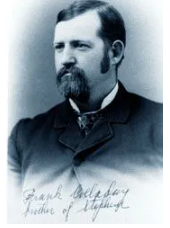
From C. C. Hutchinson founding the town in 1871 to Frank Colladay beginning a century-old hardware company, many members of the early Hutchinson community created a city to last.

“(Hutchinson) wasn’t worried about just establishing a town as quick as he possibly could — he was interested in setting up a town that was going to continue to grow without having growing pains,” said Reno County Museum chief curator David Reed.

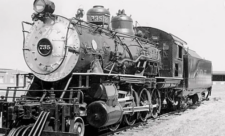
In 1885, Colladay arrived in Hutchinson on the Santa Fe Railroad. He was heading to California, but after stepping off the train car, he decided to remain in Kansas and establish a company.

Colladay began a hardware retail store at 16 N. Main St. in Hutchinson in 1888. He named it Frank Colladay Hardware.

“He was able to expand his reach far beyond the county and saw the demands of what the state was going to need as far as materials and tools,” Reed said. “The things that a growing population was going to need to help establish themselves.”

According to the Reno County Museum‘s archives, Colladay sold general hardware, stoves, sheet metals, sporting goods, cutlery, horse saddles and accessories and manufactured a full line of harnesses and straps for farm work.

He expanded into Texas and New Mexico, sending his sales team across state lines.

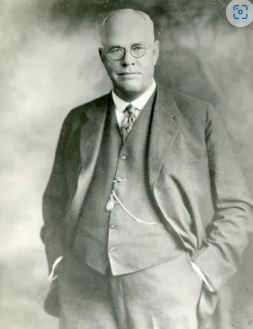
According to a biography written by Teresa Chansler in 1974, Carey began his business in Hutchinson with a coal mining company in partnership with a man known as R. E. Conn in 1885. By 1887, the company changed to Carey, Beers and Lee.

Carey and his business partners grew Carey, Beers and Lee for three years until 1890.

Frequent land trades in Hutchinson caused a land collapse, straining local banks and driving wheat prices up to 30 cents a bushel.

“Right there, I learned my first real business lesson. It was: never borrow money to buy something you don’t need,” Carey stated in the biography. “In 1890, I got my second lesson. It was this: Remember that, nine times out of 10, a poor man cannot afford to pay interest.”

After selling his properties to pay off his debts, Carey recovered and began his next business, an ice manufacturing company.

The business began in 1895, but Carey quickly turned to salt several years later.

The Santa Fe Railroad and two other rail lines in Hutchinson aided Carey with his business, utilizing it for trade and shipments across the state.

Carey began Carey Salt Company in May 1901, according to Willard Welsh’s 1946 book “Hutchinson, a Prairie City in Kansas,” despite threats from the other salt companies that were already established in Hutchinson.

He utilized the profits from his coal and ice manufacturing businesses to keep Carey Salt Company afloat — today, it continues in the exact location of Strataca in Hutchinson.

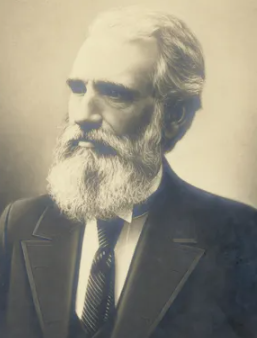
C. C. Hutchinson, the city’s namesake, visited its soon to be location on the Arkansas River in the summer of 1871. He was a Santa Fe Railroad Company surveyor.

According to literature by Fred Henney in a pamphlet titled “The Hutchinson Story” from 1950, Hutchinson created the city’s first draft.

“Hutchinson made a rough draft of a townsite not quite one-mile square. A wide Main Street was intersected at the center by a street to be called Sherman, after a lovely Vermont girl, Gertrude Sherman,” Henney wrote. “Two years later, she became Mr. Hutchinson’s wife.”

Reed said that Hutchinson aimed to create a prohibition city, so he banned saloons in town, trying to rid it of criminals.

According to Welsh, Hutchinson and earlier settlers wanted to create a city founded on peace so the town could grow without the hindrances of crime.

“He saw the potential where the town was, which is why I think he fought so hard for it to become the county seat,” Reed said.

One and a half centuries later, Hutchinson continues to thrive.

Bayer buys majority stake in gene-edited cover crop startup

0

As reported in High Plains journal the red-hot market for renewable diesel has inspired another deal in the ag tech space. An ag investor publication reports that Bayer has increased its stake in CoverCress, an ag start-up that developed and promotes a genetically modified oilseed cover crop, to 65%. Ag Funder News reported Aug. 2 that the remainder of the shares will be split between Bunge and Chevron.

The company’s valuation is not known, but the company said the buyout of the former investors, a group of venture capitalists, was a “meaningful exit.”

The deal will enable CoverCress to “further commercialize its namesake winter oilseed product into a cover crop that can provide lower carbon fuel feedstock to the renewable fuel industry while also bringing farmers another source of revenue during the growing season.”

The CoverCress team genetically modified the common weed pennycress into a cover crop that provides high-quality oil and can also be used as animal feed. CoverCress, originally called Arvegenix, has been working on the crop since 2013. The Bayer deal is a homecoming since several of its founding members had been employed by Bayer before starting CoverCress.

In April, CoverCress announced a partnership with Bunge establishing a long-term commercial relationship between the two companies.

Renewable diesel fuel can be made by several different chemical pathways, including gasification, pyrolosis and other chemical processes. Its feedstocks are vegetable oils or fats including soybean oil, safflower oil, canola oil and even used cooking oil. It differs from biodiesel in that there is no blendwall limit; renewable diesel can be substituted for petroleum-derived diesel 100%, with no modifications necessary to the engines.

Earlier this year (HPJ, April 29) CoverCress chief commercial officer Dale Sorenson told High Plains Journal, “We’re currently not pursuing the food market, but concentrating on bio-fuels.” The oil content of CoverCress is higher by weight than that of soybeans.

CoverCress has been working closely with the University of Illinois. This year it has recruited selected growers in the Midwest in a phased rollout. The U.S. Department of Agriculture has said it wants to double cover-crop acreage to 30 million acres by 2030.

USDA has joined with the Department of Energy and Department of Transportation to launched a Sustainable Aviation Fuel Grand Challenge to reduce the carbon-intensity of aviation fuel, providing a promising market for renewable diesel.