Sunday, January 11, 2026
Home Blog Page 4742

Missed opportunities result in scoreless Jayhawk battle for Barton Soccer

0
barton cc

Two extra periods still wasn’t enough Saturday at the Cougar Soccer Complex as the Barton Community College and Johnson County Community College men’s soccer teams couldn’t find the back of the net in a scoreless tie.  As both defenses stole opportunities and goalkeepers came up with acrobatic saves preserving the shutout, the offensive attackers had their chances banging multiple shots off the frame throughout the contest.  The tie keeps Barton near the top of the conference standings at 2-1-2 and 2-3-3 overall while Johnson County keeps pace at 1-1-2 in the Jayhawk and 6-4-2 overall.

Barton will step out of conference play on Tuesday as both the men’s and women’s teams travel to Hesston College on Tuesday.  Kickoff for the women’s game is 5:00 p.m. followed by the men’s contest at approximately 7:00 p.m.

The Covered Dish – Pork Chili

0

This week I am featuring a recipe that is bringing me a great deal of positive

comments at work. Every time I present a recipe that is rather different in

construction I wonder how it will be received. The response as indicated is

spectacular. I wrote this dish about 3 years ago, if you didn’t try it when it came

out I encourage you to go for it now.

With the cost of beef being so high it’s going to be rather expensive creating some

of our favorite beef recipes. In the Ozarks I have found the boneless sirloin chops

frequently at 2.39 a pound. This week locally they were 1.99 per pound. For a

hearty chili with ground beef, brisket or even a roast cut this is going to be about

2-3 times higher. You will also notice the use of a rue/thickening being made with

the beef stock. Everyone sorta’ looked at me strange when they saw this part of

the recipe. Don’t hesitate, it’s going to be great!

Every time I present a dish I encourage my students and guests to look into the

core of the dish to see how they might pull sections away and implement them

someplace else. Today I have grabbed a few favorite ingredients to create a white

chili recipe using this same base structure. I’ll let you know what the outcome is

in the next column.

White meat versus white meat? What do I mean? Well, if the pork is extremely

lean you will notice it is about 30-40 calories less than white chicken breast. Thus

a good reason to choose pork over chicken. Of course I did fry the pork meat so I

added in more cholesterol/fat going in this direction.

While I was typing the above paragraph I stopped and went to the kitchen and

created a white chili form that I am trying to name. It turned out beautiful using

the chili format above. Next week I’ll present it to you in plenty of time for the

cooler fall weather and sporting events/tailgating. There will ‘tons’ of variations,

all I can say is start saving chicken stock.

Tonight is football and I’m trying to get all the loose ends wrapped up so the rest

of week goes smoothly. You moms know what I’m talking about. The house

is picked up and tidy, kitchen clean, laundry all caught up and meal planning is

complete for the rest of the week.

Don’t forget I will be in McPherson, Kansas the first Saturday in October doing

my ‘Tailgating’ class. I’ll be full of tips and lots of yummy dishes to assist you in

the gatherings to come. On the fence about your winter travels? Solution? Join

me in March for my culinary cruise! Visit my website to check out all the details.

www.thecovereddish.com Simply yours, The Covered Dish.

Soul Warming Pork Chili

3 pounds boneless sirloin chops

3/4 cup flour

1 1/2 teaspoons Black Kettle Seasoning Salt

2/3 cup canola oil

2 medium onion, chopped

8-9 tablespoons flour

4 cups low sodium beef stock

*5 tablespoons chili powder

3 teaspoons cumin

1 teaspoon black pepper

1 teaspoon hot sauce

1 (4 ounce can) whole chilies, chopped slightly large

2 (15.5 ounce) cans chili beans

1 (15.5 ounce) can pinto beans

3 (14.5 ounce cans Tomatoes, Classic

(Contains celery, green peppers and onion pieces)

Heat oil in large skillet over medium/medium low heat. Mix flour and 1 1/2

teaspoons Black Kettle into a dredging dish, blending. When oil is hot begin frying

the chops, turn browning nicely on both sides. While the meat is cooking chop

the onion, leave somewhat big, not diced. Drain the cooked chops on paper

towels and sauté the onion in remaining oil and drippings. Remove onions,

draining well. Stir in 8-9 tablespoons of flour into drippings. (Once while making

an additional tablespoon of oil was necessary!) Add 4 cups of beef stock and

cook until thickened and boiling. Add only 3 tablespoons of chili powder, cumin,

pepper and hot sauce; stir to blend. Using a chef’s knife dice the chops into about

1/2 inch pieces, place in large stockpot. Add onions, chopped chilies, beans and

tomatoes. Stir to blend all ingredients. Lastly, add the mother/rue for the skillet

to the entire mixture. Heat on Medium low until it comes to a boil; reduce to

simmer for at least a couple of hours to blend.

Garnish the chili with pepper jack cheese, fresh onions or cilantro.

The original goal was to come up with a good pork chili that had a rich and creamy

sauce. The fried sirloin chops and gravy style sauce produced what I was seeking.

Another option would be to lighten the dish by grilling or smoking the chops.

*Chili powders can have varying degrees of heat. The container on hand was

about 6 months old and 5 tablespoons were used. You may need less if the

container is extremely fresh. Thus the reason for using only 3 tablespoons to

start. Sample the heat of the chili, then add more powder as necessary.

Variations: Use different types of chili powders, hot sauces, mixes or paprika.

Add more green chilies or for intense heat, jalapenos!

Prep: One Hour

Servings: 8-10

Cost: Not including oil, spices and flour, approx. $15.00

Lady Cougar soccer can’t recover from first half, fall 3-0 to Johnson County

0

Giving up three first half goals, the Barton Community College women’s soccer team couldn’t find the net in the second half dropping a conference battle Saturday 3-0 to Johnson County Community College at the Cougar Soccer Complex.   The loss drops the Lady Cougars to 2-2-1 in conference play and 4-4-2 on the season while Johnson County sits atop the standings at 3-0-0 and 7-3 overall.

Jenn Howell gave Johnson County the early lead pounding in a loose ball from a corner kick just 7:24 into the contest.  Sydney Alexander outmuscled the Cougar defense to blast a shot across the box finding the inside far post to give the Cavaliers the two-goal cushion with 20:14 to play.  Less than thirteen minutes later Annie Poelzl found Mackenzie Cox to put the icing on the cake capping the scoring with 7:31 before halftime.

Barton will step out of conference play on Tuesday as both the men’s and women’s teams travel to Hesston College on Tuesday.  Kickoff for the women’s game is 5:00 p.m. followed by the men’s contest at approximately 7:00 p.m.

Simple tree

0

“Pickin’ up Pawpaws”


You may know the song better than the tree or the fruit – “Pickinup pawpaws, puttin’ ’em in your pocket…” But pawpaw trees are actually native to Nebraska. It’s a small tree, about 20 feet in height, that grows in the open woods and ravines of the Missouri River bluffs in southeastern Nebraska.


Their short, stubby, banana-like fruits ripen in September or early October. Like bananas, they have a narrow window for harvesting since they ripen quickly. The fruits will fall naturally when they’re ripe but can be handpicked when they’re not entirely mature. If picked too early, though, they may not finish ripening. The signs of ripeness aren’t easily visible since coloration varies depending on the season and weather. A slight softening of the fruit, similar to peaches, may be a more reliable test of ripeness.


Pawpaws have a rich flavor that is a mix of banana, vanilla custard, pineapple and mango, and they’re very nutritious – high in potassium, iron and calcium.  The fruit can be used in cookies and breads where its creamy, custard-like flesh complements spices and other ingredients. They can also be eaten raw, but in small amounts as they can cause digestive problems.


As a tree, pawpaw or Asimina triloba has tropical-looking foliage that is conspicuous for its large size (leaves can be up to a foot long) that tends to turn a brilliant yellow in fall. They prefer moist, well-drained soils but are tolerant of clay and drought. They will tolerate dense shade but, for fruit production, are best grown in full sun. In the wild pawpaws can often be found in the shady understory of oak-hickory forests and they usually grow in colonies, spreading to form an attractive grove.


It’s an attractive landscape tree for even small spaces since they are narrower than they are high, and their tendency to colonize can be contained by mowing or otherwise removing young seedlings. They’re one of the last trees to leaf out in spring and early on the young leaves may appear yellowish or chlorotic but they soon turn a deep green.

Source: Karma Larsen, Nebraska Forest Service

Cold snap may have nipped Kansas sorghum, soybeans more than corn

0
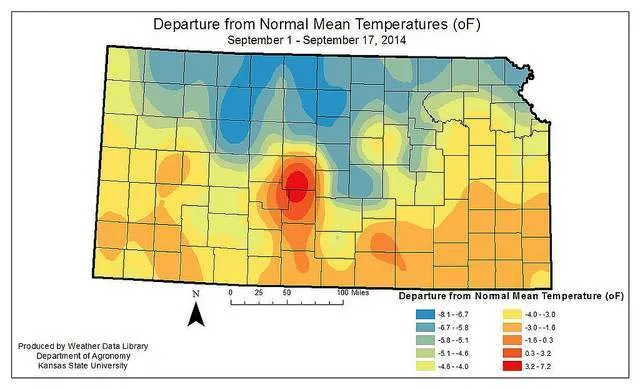
Departure from 30-yr average normal mean temperatures (1981-2010) recorded from September 1 to 18, 2014 for the state of Kansas. ~K-State Research Extension

September temperatures fall below 30-year average


MANHATTAN, Kan. – From time to time over the past few months it seemed like fall was trying to crowd out summer, and now it’s a little more serious. The latest cold snap may have been enough to impact grain filling and test weight for Kansas’ summer row crops, especially sorghum and soybeans, according to a Kansas State University agronomist.


“Based on preliminary temperatures, the lowest temperatures recorded around the state of Kansas may have a potential impact on the grain filling and final test weight for summer row crops, especially sorghum and soybean, since corn is close to 50 percent mature,” said Ignacio Ciampitti, crop specialist with K-State Research and Extension.


“In the last 17 days, we have recorded temperatures below 35 degrees F for several counties around the state,” said Mary Knapp, assistant state climatologist for Kansas. “The county with the lowest temperature was Osborne with 29 degrees F, but Ellis, Trego, Ness, and Decatur counties also presented lowest temperatures around 30 to 31 degrees.”


The northwestern and north-central corners of the state particularly have experienced the low temperatures. The central part of the state saw temperatures as low as 33 to 37 degrees F, while the south region (west, central and eastern portions) had overall temperatures above 40 degrees.


The temperatures experienced in the last 17 days fell below the 30-year average for 101 of Kansas’ 105 counties. For the north-central counties of Smith, Phillips, Mitchell, Graham, Rooks, Osborne and Trego, the departure was close to 7 degrees F below the 30-year average, Knapp said.


How temperatures affect crops


In most of the state, Ciampitti said, the state’s corn crop is beyond the dent stage (50 percent mature). Corn is affected with temperatures below or at 32 degrees F. Lower temperatures can produce an equivalent or greater damage even when the exposure time is relatively minimal. Clear skies, minimum humidity and no wind conditions increase freeze damage even with temperatures above 32 degrees.


“Any freeze damage at this point of the season will hardly produce any visible symptoms but can impact the final test weight and potentially seed quality (depending on the growth stage),” Ciampitti said.


Researchers in Wisconsin found that a light frost (affecting leaves) will produce a 5 percent yield reduction, while a killing frost (affecting leaf and stalk) will reduce yields by 12 percent, even when the corn is at the dent stage. The only point in which corn is not affected at all by freeze is at the black layer stage, Ciampitti said.


“Kansas’ soybean is into the final reproductive stages (dropping leaves),” the agronomist said. “Temperatures below 32 degrees can interrupt grain filling and impact yield, meaning lower test weight and seed quality.”


Necrosis of the leaf canopy is a visible symptom of freeze damage in soybeans, he added. Absolute temperature is more important than the duration of the cold stress – especially if temperatures drop lower than 28 degrees F. The timing of the freeze effect will increase the likelihood of affecting yields. As the crop approaches maturity, the impact of a freeze event on soybean yields declines.


The Kansas sorghum crop is more than halfway coloring (14 percent mature). Low temperatures will reduce seed growth and affect final test weight and seed quality.


“A freeze will kill sorghum if the stalks are frozen and impair the flow of assimilates and nutrients to the grain,” Ciampitti said. “A freeze at the hard-dough stage (before grain matures) will produce lower weight and chaffy seeds.”


Story by: Mary Lou Peter