Saturday, January 10, 2026
Home Blog Page 4741

Simple tree

0

“Pickin’ up Pawpaws”


You may know the song better than the tree or the fruit – “Pickinup pawpaws, puttin’ ’em in your pocket…” But pawpaw trees are actually native to Nebraska. It’s a small tree, about 20 feet in height, that grows in the open woods and ravines of the Missouri River bluffs in southeastern Nebraska.


Their short, stubby, banana-like fruits ripen in September or early October. Like bananas, they have a narrow window for harvesting since they ripen quickly. The fruits will fall naturally when they’re ripe but can be handpicked when they’re not entirely mature. If picked too early, though, they may not finish ripening. The signs of ripeness aren’t easily visible since coloration varies depending on the season and weather. A slight softening of the fruit, similar to peaches, may be a more reliable test of ripeness.


Pawpaws have a rich flavor that is a mix of banana, vanilla custard, pineapple and mango, and they’re very nutritious – high in potassium, iron and calcium.  The fruit can be used in cookies and breads where its creamy, custard-like flesh complements spices and other ingredients. They can also be eaten raw, but in small amounts as they can cause digestive problems.


As a tree, pawpaw or Asimina triloba has tropical-looking foliage that is conspicuous for its large size (leaves can be up to a foot long) that tends to turn a brilliant yellow in fall. They prefer moist, well-drained soils but are tolerant of clay and drought. They will tolerate dense shade but, for fruit production, are best grown in full sun. In the wild pawpaws can often be found in the shady understory of oak-hickory forests and they usually grow in colonies, spreading to form an attractive grove.


It’s an attractive landscape tree for even small spaces since they are narrower than they are high, and their tendency to colonize can be contained by mowing or otherwise removing young seedlings. They’re one of the last trees to leaf out in spring and early on the young leaves may appear yellowish or chlorotic but they soon turn a deep green.

Source: Karma Larsen, Nebraska Forest Service

Cold snap may have nipped Kansas sorghum, soybeans more than corn

0
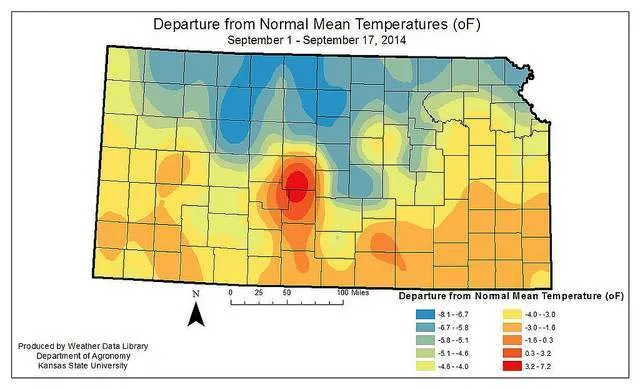
Departure from 30-yr average normal mean temperatures (1981-2010) recorded from September 1 to 18, 2014 for the state of Kansas. ~K-State Research Extension

September temperatures fall below 30-year average


MANHATTAN, Kan. – From time to time over the past few months it seemed like fall was trying to crowd out summer, and now it’s a little more serious. The latest cold snap may have been enough to impact grain filling and test weight for Kansas’ summer row crops, especially sorghum and soybeans, according to a Kansas State University agronomist.


“Based on preliminary temperatures, the lowest temperatures recorded around the state of Kansas may have a potential impact on the grain filling and final test weight for summer row crops, especially sorghum and soybean, since corn is close to 50 percent mature,” said Ignacio Ciampitti, crop specialist with K-State Research and Extension.


“In the last 17 days, we have recorded temperatures below 35 degrees F for several counties around the state,” said Mary Knapp, assistant state climatologist for Kansas. “The county with the lowest temperature was Osborne with 29 degrees F, but Ellis, Trego, Ness, and Decatur counties also presented lowest temperatures around 30 to 31 degrees.”


The northwestern and north-central corners of the state particularly have experienced the low temperatures. The central part of the state saw temperatures as low as 33 to 37 degrees F, while the south region (west, central and eastern portions) had overall temperatures above 40 degrees.


The temperatures experienced in the last 17 days fell below the 30-year average for 101 of Kansas’ 105 counties. For the north-central counties of Smith, Phillips, Mitchell, Graham, Rooks, Osborne and Trego, the departure was close to 7 degrees F below the 30-year average, Knapp said.


How temperatures affect crops


In most of the state, Ciampitti said, the state’s corn crop is beyond the dent stage (50 percent mature). Corn is affected with temperatures below or at 32 degrees F. Lower temperatures can produce an equivalent or greater damage even when the exposure time is relatively minimal. Clear skies, minimum humidity and no wind conditions increase freeze damage even with temperatures above 32 degrees.


“Any freeze damage at this point of the season will hardly produce any visible symptoms but can impact the final test weight and potentially seed quality (depending on the growth stage),” Ciampitti said.


Researchers in Wisconsin found that a light frost (affecting leaves) will produce a 5 percent yield reduction, while a killing frost (affecting leaf and stalk) will reduce yields by 12 percent, even when the corn is at the dent stage. The only point in which corn is not affected at all by freeze is at the black layer stage, Ciampitti said.


“Kansas’ soybean is into the final reproductive stages (dropping leaves),” the agronomist said. “Temperatures below 32 degrees can interrupt grain filling and impact yield, meaning lower test weight and seed quality.”


Necrosis of the leaf canopy is a visible symptom of freeze damage in soybeans, he added. Absolute temperature is more important than the duration of the cold stress – especially if temperatures drop lower than 28 degrees F. The timing of the freeze effect will increase the likelihood of affecting yields. As the crop approaches maturity, the impact of a freeze event on soybean yields declines.


The Kansas sorghum crop is more than halfway coloring (14 percent mature). Low temperatures will reduce seed growth and affect final test weight and seed quality.


“A freeze will kill sorghum if the stalks are frozen and impair the flow of assimilates and nutrients to the grain,” Ciampitti said. “A freeze at the hard-dough stage (before grain matures) will produce lower weight and chaffy seeds.”


Story by: Mary Lou Peter

Laugh tracks in the dust

0
Thayne Cozart
Milo Yield

One of life’s most enduring treasures and pleasures is spending quality time with friends. Last week I got to spend quality time with New Mexico friends, Albie and A. B. Kirky. They came for their semi-annual jaunt to the Flint Hills for four days of non-stop fishing.

The fishing wuz average at best, but Albie garnered the biggest game fish — a 7 pound channel catfish and A.B. scored the biggest bass of the week — a near four pounder who fell to an enticing grasshopper skewered on A. B.’s hook. My Flint Hills friend, ol’ Saul M. Reeder, who joined the fishing party two days, took home the “biggest fish” caught during the trip — a 7 1/2 pound carp that had found its way into a watershed lake and greedily sucked in Saul’s grasshopper.

As for me, I didn’t get skunked by any means, but I got out-fished for sure. But then again, the “guide” isn’t supposed to catch the most or the biggest fish of the trip.

But the finest “catch” of all wuz laughing and engaging in verbal jousting with old friends. It’s surprising how stories of old are still funny when told again and embellished with each retelling.

***

You can never underestimate the innovativeness of American farm boys.

At a rural high school in Iowa, a group of male students played a prank. They let three billy goats loose inside the school.

But before turning them loose, they painted numbers on the sides of  the goats: 1, 2 and 4.

School Administrators spent most of the day looking for No. 3.

Now that’s funny. I don’t care who you are.

***

Ol’ Nevah and I were just settling into bed one night last week when the phone rang.

I got out of bed and went into the living room to answer the phone.

I answered “Hello?” Then I said, “sure is,” hung up the receiver, and went back to bed.

A minute later the phone rang again. Again, I got out of bed and went into the other room and answered the phone, “hello” and then, once again, said “sure is,” and hung up on the caller.

When I got back to bed, ol’ Nevah asked, “who was that?”

I said, “I don’t have a clue, but it wuz a woman’s voice.”

A minute later the phone rang again and the whole process repeated itself.

After the third time of returning to bed, ol’ Nevah asked, “Well, what did the person say?”

I replied, “It’s odd, a woman just keeps saying, ‘Long distance from Tucson’ and I keep assuring her she’s right.”

***

In Texas there is a town called New Braunfels, where there is a large German-speaking population.

One day, a local rancher driving down a country road noticed a man using his hand to drink water from the rancher’s stock pond.

The rancher rolled down the window and shouted: “Freut mich Sie zu sehen! Trinken Sie nicht das Wasser. Die Kühe haben hinein geschissen.”

(Which means: “Glad to see you! Don’t drink the water. The cows have pooped in it.”

The man shouted back: “I’m from New York and I’m down here campaigning for tighter gun control laws. I can’t understand you. Please speak in English.”

The rancher replied: “I said, ‘use both hands to quench your thirst.’”

***

Thanks to J. M., a Wyoming reader who sent me this e-mail: “Milo, I heard on the news that scientists are close to cloning some of the ancient flesh-eating dinosaurs.

“Then I also heard the fish and game bureaucrats had pre-ordered two pairs of each. They think the cloned dinosaurs will help control the wolves, bears, and pumas that they have reintroduced that are eating our cattle, horses, and sheep.”

***

I just saw the results of a new rural voter political poll taken in advance of the mid-term elections coming in November.

The main result of the poll showed that U. S. farmers/ranchers rate the current administration as the fifth best ever of the 44 administrations in the nation’s history.

In the poll, the Reagan, Lincoln, and 8 other administrations tied for first; 15 others tied for second; 17 others tied for third; the only administration headed by a Georgia peanut farmer wuz in fourth. And, the current administration came in 5th.

***

I’m tired of the coming election and the political ads already and it’s still more than six weeks away. So, I’ll close for the week with some wise words about elections. Movie star Orson Wells once said, “Popularity should be no scale for the election of politicians. If it would depend on popularity, Donald Duck and The Muppets would take seats in the senate.”  And, some guy named Simon Sinek said, “Leadership is not about the next election, it’s about the next generation,”

Well said. Have a good ‘un.

Cattle on feed

0
credit -NDSU Ag

ISSN: 1948-9080

Released September 19, 2014, by the National Agricultural Statistics Service
(NASS), Agricultural Statistics Board, United States Department of
Agriculture (USDA).

United States Cattle on Feed Down 1 Percent

Cattle and calves on feed for slaughter market in the United States for
feedlots with capacity of 1,000 or more head totaled 9.8 million head on
September 1, 2014. The inventory was 1 percent below September 1, 2013.

Placements in feedlots during August totaled 1.72 million, 3 percent below
2013. Net placements were 1.65 million head. During August, placements of
cattle and calves weighing less than 600 pounds were 410,000, 600-699 pounds
were 280,000, 700-799 pounds were 395,000, and 800 pounds and greater were
635,000. For the month of August placements are the lowest since the series
began in 1996.

Marketings of fed cattle during August totaled 1.69 million, 10 percent
below 2013. August marketings are the lowest since the series began in 1996.

Other disappearance totaled 66,000 during August, 32 percent above 2013.

Number of Cattle on Feed, Placements, Marketings, and Other Disappearance on
1,000+ Capacity Feedlots – United States: September 1, 2013 and 2014
—————————————————————————-
——-
:          Number           :
Percent of
Item                  :—————————:

:    2013     :    2014
:previous year
—————————————————————————-
——-
:   —- 1,000 head —-
percent
:

On feed August 1 …………………..:   10,025         9,837
98
Placed on feed during August ………..:    1,772         1,720
97
Fed cattle marketed during August ……:    1,871         1,692
90
Other disappearance during August ……:       50            66
132
On feed September 1 ………………..:    9,876         9,799
99
—————————————————————————-
——-

Number of Cattle on Feed, Placements, Marketings, and Other Disappearance on
1,000+ Capacity Feedlots – United States: August 1, 2013 and 2014
—————————————————————————-
——-
:          Number           :
Percent of
Item                  :—————————:

:    2013     :    2014
:previous year
—————————————————————————-
——-
:   —- 1,000 head —-
percent
:

On feed July 1 …………………….:   10,375        10,127
98
Placed on feed during July ………….:    1,684         1,560
93
Fed cattle marketed during July ……..:    1,970         1,787
91
Other disappearance during July ……..:       64            63
98
On feed August 1 …………………..:   10,025         9,837
98
—————————————————————————-
——-

Number of Cattle on Feed on 1,000+ Capacity Feedlots by Month – States and
United States:
2013 and 2014
—————————————————————————-
———————–
:                 :                 :
September 1, 2014
:                 :
:—————————–—————
State      :September 1, 2013: August 1, 2014  :              :
Percent of  :  Percent of
:                 :                 :    Number
:previous year :previous month
—————————————————————————-
———————–
:      ————– 1,000 head ————-
—– percent —-
:

Arizona ……….:        266               262             257
97             98
California …….:        505               420             415
82             99
Colorado ………:        830               810             800
96             99
Idaho …………:        190               185             180
95             97
Iowa ………….:        550               600             580
105             97
Kansas ………..:      1,980             1,900           1,950
98            103
Minnesota ……..:        101               116             113
112             97
Nebraska ………:      2,090             2,160           2,130
102             99
Oklahoma ………:        280               240             245
88            102
South Dakota …..:        170               190             185
109             97
Texas …………:      2,430             2,470           2,450
101             99
Washington …….:        184               189             199
108            105
:

Other States …..:        300               295             295
98            100
:

United States ….:      9,876             9,837           9,799
99            100
—————————————————————————-
———————–

Number of Cattle Placed on Feed on 1,000+ Capacity Feedlots by Month –
States and United States: 2013 and 2014
—————————————————————————-
—————–
:              :              :             During August
2014
:    During    :    During
:—————————–—————
State      : August 2013  :  July 2014   :              :  Percent of
:  Percent of
:              :              :    Number    :previous
year :previous month
—————————————————————————-
—————–
:    ———— 1,000 head ———–           —–
percent —-
:

Arizona ……….:       23             23             21            91
91
California …….:       55             39             40            73
103
Colorado ………:      145             90            145           100
161
Idaho …………:       52             37             33            63
89
Iowa ………….:       66             56             63            95
113
Kansas ………..:      380            400            410           108
103
Minnesota ……..:       13             10             15           115
150
Nebraska ………:      440            375            425            97
113
Oklahoma ………:       47             32             50           106
156
South Dakota …..:       28             20             30           107
150
Texas …………:      440            410            410            93
100
Washington …….:       43             37             44           102
119
:

Other States …..:       40             31             34            85
110
:

United States ….:    1,772          1,560          1,720            97
110
—————————————————————————-
—————–

Number of Cattle Placed on Feed by Weight Group on 1,000+ Capacity Feedlots
by Month – States and United States: 2013 and 2014
—————————————————————————-
————
:                            During August

:—————————–—————————————-
State      :Under 600 lbs: 600-699 lbs : 700-799 lbs :  800+ lbs   :
Total

:—————————–—————————————-
: 2013 : 2014 : 2013 : 2014 : 2013 : 2014 : 2013 : 2014 :
2013 : 2014
—————————————————————————-
————
:                             1,000 head

:

Colorado ………:  25     30     20     15     45     35     55     65
145    145
Kansas ………..:  65     75     80     80    115    110    120    145
380    410
Nebraska ………:  55     55     65     50    100     95    220    225
440    425
Texas …………: 175    170    115     95     95     85     55     60
440    410
:

Other States …..:  85     80     47     40     70     70    165    140
367    330
:

United States ….: 405    410    327    280    425    395    615    635
1,772  1,720

:—————————–—————————————-
:                             During July

:—————————–—————————————-
State      :Under 600 lbs: 600-699 lbs : 700-799 lbs :  800+ lbs   :
Total

:—————————–—————————————-
: 2013 : 2014 : 2013 : 2014 : 2013 : 2014 : 2013 : 2014 :
2013 : 2014

:—————————–—————————————-
:                             1,000 head

:

Colorado ………:  30     25     20     15     30     20     40     30
120     90
Kansas ………..:  60     80     75     70    140    110    150    140
425    400
Nebraska ………:  45     55     55     50     90     85    180    185
370    375
Texas …………: 165    185     75     85    125     85     85     55
450    410
:

Other States …..:  90     80     45     40     60     55    124    110
319    285
:

United States ….: 390    425    270    260    445    355    579    520
1,684  1,560
—————————————————————————-
————

Number of Cattle Marketed on 1,000+ Capacity Feedlots by Month – States and
United States:
2013 and 2014
—————————————————————————-
—————–
:              :              :             During August
2014
:    During    :    During
:—————————–—————
State      : August 2013  :  July 2014   :              :  Percent of
:  Percent of
:              :              :    Number    :previous
year :previous month
—————————————————————————-
—————–
:    ———— 1,000 head ———–           —–
percent —-
:

Arizona ……….:       18             26             25           139
96
California …….:       60             47             40            67
85
Colorado ………:      180            145            150            83
103
Idaho …………:       46             41             37            80
90
Iowa ………….:       73             74             80           110
108
Kansas ………..:      390            390            345            88
88
Minnesota ……..:       20             15             17            85
113
Nebraska ………:      420            465            440           105
95
Oklahoma ………:       51             46             44            86
96
South Dakota …..:       37             39             34            92
87
Texas …………:      490            415            415            85
100
Washington …….:       47             40             33            70
83
:

Other States …..:       39             44             32            82
73
:

United States ….:    1,871          1,787          1,692            90
95
—————————————————————————-
—————–

Other Disappearance on 1,000+ Capacity Feedlots by Month – States and United
States:
2013 and 2014
—————————————————————————-
—————–
:              :              :             During August
2014
:    During    :    During
:—————————–—————
State      : August 2013  :  July 2014   :              :  Percent of
:  Percent of
:              :              :    Number    :previous
year :previous month
—————————————————————————-
—————–
:      ———- 1,000 head ———-            —–
percent —-
:

Arizona ……….:       1              7              1            100
14
California …….:       5              7              5            100
71
Colorado ………:       5              5              5            100
100
Idaho …………:       1              1              1            100
100
Iowa ………….:       3              2              3            100
150
Kansas ………..:      10             10             15            150
150
Minnesota ……..:       1              1              1            100
100
Nebraska ………:      10             10             15            150
150
Oklahoma ………:       1              1              1            100
100
South Dakota …..:       1              1              1            100
100
Texas …………:      10             15             15            150
100
Washington …….:       1              1              1            100
100
:

Other States …..:       1              2              2            200
100
:

United States ….:      50             63             66            132
105
—————————————————————————-
—————–

Terms and Definitions of Cattle on Feed Estimates

Cattle on feed are animals being fed a ration of grain, silage, hay and/or
protein supplement for slaughter market that are expected to produce a
carcass that will grade select or better. It excludes cattle being
“backgrounded only” for later sale as feeders or later placement in another
feedlot.

Placements are cattle put into a feedlot, fed a ration which will produce a
carcass that will grade select or better, and are intended for the slaughter
market.

Marketings are cattle shipped out of feedlots to a slaughter market.

Other disappearance includes death loss, movement from feedlots to pasture,
and shipments to other feedlots for further feeding.

Reliability of Cattle on Feed Estimates

Survey Procedures: During January and July all known feedlots in the United
States with capacity of 1,000 or more head are surveyed to provide data for
cattle on feed estimates. During the other months, all known feedlots from
16 States are surveyed. The 16 States account for approximately 98 percent
of the cattle on feed in feedlots with capacity of 1,000 or more head.
Individual State estimates are published monthly for 12 of the 16 States.
Data collected from the remaining 4 States are used to establish the “Other
States” estimates. These 4 States include Illinois, New Mexico, Oregon, and
Wyoming. The “Other States” category represents all cattle on feed with a
capacity of 1,000 or more head for the rest of the United States.

Estimating Procedures: These cattle on feed estimates were prepared by the
Agricultural Statistics Board after reviewing recommendations and analysis
submitted by each State office. Regional and State survey data were reviewed
for reasonableness with each other and with estimates from the previous
month when establishing the current estimates.

Revision Policy: Revisions to previous estimates are made to improve month
to month relationships. Estimates for the previous month are subject to
revision in all States each month when current estimates are made. In
February, all monthly estimates for the previous year, and the number of
feedlots and annual marketings from two years ago are reviewed and subject
to revisions.
The reviews are primarily based on slaughter data, state check-off or brand
data, and any other data that may have been received after the original
estimate was made. Estimates will also be reviewed after data from the
Census of Agriculture are available. No revisions will be made after that
date and estimates become final.

Reliability: Since all 1,000+ capacity cattle on feed operators in every
State are not included in the monthly survey, survey estimates are subject
to sampling variability. Survey results are also subject to non-sampling
errors such as omissions, duplications, and mistakes in reporting,
recording, and processing the data. The effects of these errors cannot be
measured directly.
They are minimized through rigid quality controls in the data collection
process and through a careful review of all reported data for consistency
and reasonableness.

To assist users in evaluating the reliability of estimates in this report,
the “Root Mean Square Error” is shown for selected items in the table on the
following page. The “Root Mean Square Error” is a statistical measure based
on past performance and is computed using the differences between first and
latest estimates. The “Root Mean Square Error” for cattle on feed inventory
estimates over the past 24 months is 0.1 percent. This means that chances
are
2 out of 3 that the final estimate will not be above or below the current
estimate of 9.8 million head by more than 0.1 percent. Chances are 9 out of
10 that the difference will not exceed 0.2 percent.

The table on the following page shows a 24 month record of the range of
differences between first and latest estimates for selected items. Using
estimates of number on feed as an example, changes between the first
estimate and the latest estimate during the past 24 months have averaged
9,000 head, ranging from 0 to 34,000 head. During this period the initial
estimate has been above the latest estimate 8 times and has been below the
latest estimate
9 times. This does not imply that the initial estimate is likely to
understate or overstate final inventory.

Reliability of Monthly Cattle on Feed Estimates [Based on data for the past
24 months]
—————————————————————————-
———————————————-
:  Root mean   :  90 percent  :
Difference between first and latest estimate
: square error :  confidence  :         :
:         :               :
:              :    level
:—————————–——————————
Item             :              :              :         :
:         :            Months
:              :              :         :
:         :—————————–
:              :              : Average
:Smallest : Largest : Below latest  : Above latest
—————————————————————————-
———————————————-
:   percent        percent        ——–
1,000 ——-            —– number —-
:

Number on feed ……………:     0.1            0.2           9         0
34            9               8
:

Placements ……………….:     1.7            2.9          18         0
88            4              14
:

Marketings ……………….:     1.5            2.5          17         0
67            0              13
—————————————————————————-
———————————————-

Information Contacts

Listed below are the commodity specialists in the Livestock Branch of the
National Agricultural Statistics Service to contact for additional
information. E-mail inquiries may be sent to [email protected].

Dan Kerestes, Chief, Livestock Branch ……….. (202) 720-3570

Scott Hollis, Head, Livestock Section ……….. (202) 690-2424
Travis Averill – Cattle, Cattle on Feed …… (202) 720-3040
Doug Bounds – Hogs and Pigs ……………… (202) 720-3106
Donnie Fike – Dairy Products …………….. (202) 690-3236
Tiffany Hora – Livestock Slaughter ……….. (515) 284-4340
Mike Miller – Milk Production and Milk Cows .. (202) 720-3278
Evan Schulz – Sheep and Goats…………….. (202) 720-6147

Access to NASS Reports

For your convenience, you may access NASS reports and products the following
ways:

All reports are available electronically, at no cost, on the NASS
web
site: http://www.nass.usda.gov

Both national and state specific reports are available via a free e-
mail subscription. To set-up this free subscription, visit
http://www.nass.usda.gov and in the “Follow NASS” box under “Receive reports
by Email,” click on “National” or “State” to select the reports you would
like to receive.

For more information on NASS surveys and reports, call the NASS Agricultural
Statistics Hotline at (800) 727-9540, 7:30 a.m. to 4:00 p.m. ET, or e-mail:
[email protected].

The U.S. Department of Agriculture (USDA) prohibits discrimination against
its customers, employees, and applicants for employment on the basis of
race, color, national origin, age, disability, sex, gender identity,
religion, reprisal, and where applicable, political beliefs, marital status,
familial or parental status, sexual orientation, or all or part of an
individual’s income is derived from any public assistance program, or
protected genetic information in employment or in any program or activity
conducted or funded by the Department. (Not all prohibited bases will apply
to all programs and/or employment activities.) If you wish to file a Civil
Rights program complaint of discrimination, complete the USDA Program
Discrimination Complaint Form (PDF), found online at
http://www.ascr.usda.gov/complaint_filing_cust.html, or at any USDA office,
or call (866) 632-9992 to request the form. You may also write a letter
containing all of the information requested in the form. Send your completed
complaint form or letter to us by mail at U.S. Department of Agriculture,
Director, Office of Adjudication, 1400 Independence Avenue, S.W.,
Washington, D.C. 20250-9410, by fax (202) 690-7442 or email at
[email protected].

Convincing a customer

0
Sandra Pugh
Sandra Pugh

When I went to beauty school, little did I know that part of the training was going to be diplomacy and psychology, but it sure was. Or maybe I just learned it really fast because it was the only way to survive in the job.

Some times a customer would come in and show me a picture that was the style they wanted their hair to look like. Nine times out of ten the style would not work for their hair but it was hard to get them to understand that it wouldn’t work.

One woman brought in a picture of a wig and she wanted her hair styled just like the wig. A wig is usually not real hair and the fiber is curled to do that particular style and only that style.

A wig usually has a lot of hair which makes it look really good too. This particular woman had thin hair, you couldn’t see her scalp yet, but it was thin and very fine. This was not a style for her hair.

The wig had the hair on both sides coming forward toward the face and the woman’s hair grew one side forward and one side back on the sides. This is normal on 99% of the people because our hair grows in a circle around the head and that is what creates that little pattern at the top of the crown that people call a cow lick.

I told this woman it would not work but she just kept insisting on that style so the only way to teach her that it wouldn’t do it was to set it that way and send her on her way.      I told her when I was finished with her hair that the right side that grew back from the face would be going back in the morning when she got up and it would not look like it did right then.

I don’t think she believed me and she was thrilled with her hair when she left because it looked as close to the wig picture as I could get it with the amount of hair that she had.

I received a call from her bright and early the next morning that her hair had not stayed overnight. It usually did but this time it was not like I had combed it. I asked her if the right side had reverted to going back instead of coming forward onto her face.

She said: “How did you know which side didn’t do well?” I said: “I told you yesterday that it wouldn’t work and that the right side would revert back to its old way over night.”

She always believed me after that when I told her a style wouldn’t work on her hair. We all have to learn the hard way I guess.

I am one of the 1% that their hair doesn’t grow in a complete circle. The top of my hair and the sides all three grow back towards the back of my head. There was a style in the 80’s that was perfect for my hair and I loved it.

It was cut short around the ears with the little point in the front of the ear. The top was cut short in the crown and longer towards the bangs. My bangs fell to the middle of my nose when they were straight.

I would curl all the hair on the top and the sides back and then the bangs would just fall over the forehead. It was a neat style and my hair would stay days after it was curled with a curling iron because it was cut to do that and it grew that way.

I had a customer come in and ask me one day to cut her hair like mine. She normally wore her hair off her forehead, it was curled back from the face but off the forehead, and I asked her a couple of times if she was sure.

I told her my hair was cut to do what it was doing. She said yes she wanted that cut. Here is another one that wouldn’t listen to me. But the customer is always right. Right??

So I cut it like mine and sent her on her way. She never wanted to pay to have it curled when I cut it so she left with it dry but not curled and combed. I was happy with the cut on her hair and knew that it would do exactly what my hair did when it was fixed.

When she came back in four weeks to get a cut she was not a happy customer when she sat down in the chair. She started in on me the minute the cape was around her neck.

She was mad because the hair wouldn’t stay off her forehead. I just laughed which probably didn’t make her any happier and told her: “Do you remember me telling you that the style is cut to make the hair to do what my hair is doing?”

She admitted that she remembered that conversation. I told her it was doing exactly what I had cut it to do and I was happy that the cut was doing what it was supposed to do. That didn’t make her happy and she said: “I want it like yours.”  I said: “It is like mine.”

“No,” she said, “I want the sides and the back like yours and the top like I always wear it.”  I told her I had cut it like she wanted but we would cut the top back like she always wore it and the rest like mine but the style wouldn’t look mine. But she was happy then.

Sometimes all the talking and psychology does not help convincing a customer that what they want is not realistic or what they want. We are all human and sometimes we have to learn the hard way to listen to others who might really know what they are talking about. To contact Sandy: [email protected]