Saturday, March 28, 2026
Home Blog Page 953

New Agricultural Systems Technology major prepares students for future of agriculture

0

Lincoln, Neb. —The department of Biological Systems Engineering is excited to announce a new major, Agricultural Systems Technology (AGST) that will be available to students starting Fall of 2023. This major will be offered through the UNL College of Agricultural Sciences and Natural Resources.

The announcement comes with new scholarship funding in honor of Dr. Jack Schinstock, a long-time UNL faculty member who passed way in 2018.   Each scholarship is $2,000, and students can apply at https://go.unl.edu/0b52.

By integrating agricultural technology, business and agricultural sciences, the program will prepare students to dive into a variety of careers in agriculture and make a lasting impact.

AGST builds upon a solid foundation laid by previous BSE majors. The department started a Mechanized Agriculture program in the 1950s, then expanded to Mechanized Systems Management in the 1990s. This major is the next evolution responding to industry needs, said David Jones, BSE Department Head.

“The history that is informing Agricultural Systems Technology includes the previous iterations,” he said. “Changes over the last five decades is an example of us continuing to evolve.”

The major will help students gain a practical understanding of agricultural technology and prepare them for the future, said Deepak Keshwani, BSE Associate Professor and Director of Undergraduate Programs. This is informed not only by research conducted in the department, but also strong industry ties.

“Agricultural Systems Technology captures that breadth of technology we see in agriculture today, but we also have to recognize that technology changes,” he said. “This program will provide core skills to help students make sense of technologies to come.”

Through the program, students can expect hands-on experience, research opportunities and plenty of time in the field. Internship work can also provide up to five credit hours. This experiential learning will help bolster understanding, Keshwani said.

“You’re not always going to be in the lecture hall,” he said. “It’s common for students to spend hours in the field collecting data to make sense of what they’re learning in the classroom.”

AGST also offers a more personalized approach by allowing students to design the major to align with their own interests and choose their own minor within the program.

All facets of the degree are designed to help students succeed whether they join the agricultural industry, continue their education, or run their own ag startup. It will help unite all the areas agricultural systems encompass, Jones said, by being complementary to agricultural engineering.

“One of the things this major is going to do is strengthen the partnership across science and technology,” he said. “Agronomists, engineers, scientists – these Agricultural Systems Technology students will be the glue bringing them together.”

For more information about the program and scholarship, visit bse.unl.edu/agst

Miss Kansas to join panel discussion on students and trauma

0

HAYS, Kan. – Fort Hays State University will host a panel discussion on the impact of childhood trauma at 11 a.m. on Tuesday, September 20, in the Black and Golf Room in the university’s Memorial Union Building.

According to federal statistics, more than two-thirds of children in the U.S. report experiencing a traumatic event by age 16. Adverse childhood experiences and trauma disproportionately affect rural schoolchildren, putting them at greater risk of academic underachievement throughout their lives.

Miss Kansas 2022, Ayanna Hensley will join a panel of experts in this field. The daughter of parents who struggled with substance abuse and incarceration, Ayanna decided to make promoting awareness of the impact of trauma and connecting those affected to intervention options the focus of her “Social Impact Initiative” as Miss Kansas.

Dr. Sarah Lancaster, an assistant professor in Fort Hays State University’s College of Education and an expert in this field, offers this preview of the September 20 panel discussion:

“Trauma is much more far-reaching than some realize. Chronic stress, poverty, parents in prison, witnessing an act of violence or feeling threatened by one, natural disasters, medical issues, etc., can all be trauma. The basic needs of all students have to be met before learning can occur. A student cannot “check” their personal life at the door and learn math because that’s what they are supposed to be doing at school.”

Two distinguished panelists from USD 305 in Salina will join Ayanna and Dr. Lancaster for the discussion, including Dr. Curtis Stevens, director of secondary education, and Dr. Lindsey Sellers, the counseling department chair.

Also joining the panel will be Rekala Tuxhorn, an instructor in the university’s Department of Social Work and an experienced K-12 therapist, and Amanda Brown from the FHSU Health and Wellness Services.

The event is offered as a service to education and social services professionals in our region and is open to the public. Attendees are asked to RSVP via email to [email protected].

By FHSU University Communications


Fried Green Tomatoes

0

In the last 4 weeks I’ve made fried green tomatoes 2-3 times. This week, however I hit the jackpot! My husband, Ervin & I were in downtown Branson doing a little birthday shopping for Phillip’s gal, Paige. We decided to pop in the Branson Café for a spot of lunch.
I made a quick detour while Ervin was ordering us an appetizer of ‘fried green tomatoes’. I ordered a delicious club sandwich and Ervin had the infamous meat loaf, with real potatoes I might add. After Ervin told me what he had ordered I set back and braced myself. Why? Every time I have eaten this delicacy the price is outlandish and the tomato slices are about the size of the top of a can of vegetable spray. Boy was I in for a surprise! Very nice battering, great size on the green tomatoes and we were served 6-8 nice slices. Remember where I was friends!

My next question was: ‘Are these only on the menu seasonally?’ Locals get ready they are on the menu year round! Hot diggity, someplace besides my kitchen for fried green tomatoes.

I’ve been eating fried green tomatoes since I was just a wee kid in Northeast Missouri. Dad wouldn’t let us have them until it was about the end of August and the bulk of the red tomato season had passed. So I’m talking around 60 ish years on this dish.

The biggest surprise about this delicacy is the fact that it did not originate in the ‘low’ country/southern part of the United States. It was brought to this nation by Jewish immigrants around 1908. Shocking information isn’t it? It later showed up mostly in the Midwestern states and in the Northeast sector. They truly only became popular after: ‘Fried Green Tomatoes at the Whistle Stop Café’ and the famous book and movie: ‘Fried Green Tomatoes’.

We never ‘doctored’ our fried green tomatoes with any sauces or dips, it just was not done. Today, however, in the South the dish might be served with fresh shrimp and a Cajun red tomato cream sauce.

Remember, if you have gathered your green tomatoes put them in the refrigerator so they don’t start to turn before you fry. We look for every excuse to enjoy a platter of these yummy treats. As I explored the history of this dish I reminded myself how important it is to study the ancestry of your family. You also want to look into the foods of the region. What nationality were the people who settled your homeland? My mother, Betty, had a rich history that started with her great grandparents and the state of Kentucky. This is where my family food history all began.

Now the fun part begins, I don’t have a recipe! Seriously, I’m going to guide you through what I do and you can figure out your likes and dislikes from there. Enough said, let’s dive into an outline:

Fried Green Tomatoes
Cast Iron Skillet
Cooking oil
Flour
Corn Meal
Bread Crumbs (the kind in a can)
Salt & Pepper*
Eggs
Buttermilk or cream
3-4 baseball size green tomatoes
Additional spices can be added, but to keep it traditional, don’t venture too far outside the box.

Wash and slice green tomatoes, set to the side. Pour about 1/2 an inch of oil into a cast iron skillet. Heat until oil reaches about 375 degrees.
Gather 2 dredging bowls. In the first bowl place flour & cornmeal, and ‘only’ if you like, a bit of bread crumbs, (I use Italian) and salt & pepper. Whisk well til’ blended. In the 2nd bowl whisk 2-3 eggs and perhaps 1/2 – 3/4 cup of buttermilk, blend well.

Dredge the slices of tomato in the dry mix, then the wet and back to the dry one more time. Place in preheated skillet. They should brown lightly before they are flipped over. (2-4 minutes) I use a fork for this, but many will use a set of tongs. Whatever works best for you. As I fry I place the cooked slices on a paper towel in a metal pan. Set them in an oven that would be preheated to 200 degrees.
*Seasoning salt works nicely too.

Yield: 20-25 slices, 10 for me and 15 for everyone else!!!

OK, if you forced me I’d guess: 1/4 cup cornmeal, 1/2 cup bread crumbs and 3/4 cup flour.

A Walk with Dad

0

It was about this time several years ago, when our part of the country was bone-dry like today, that I took what was probably my last outdoor hike with our dad. I swooped him up at his retirement home apartment and we headed to the McPherson Valley Wetlands just outside Inman for a hike. The trails had recently been mowed making the walking easy, but I had to measure my steps so my long legs didn’t out-distance him. We stopped on the first rise and I pointed out all the marshes that were now dry and the ones that still held water.

Next, we meandered down into one dry pool along the trail where I had trapped muskrats last winter. We looked over a now flattened muskrat hut that had once seemed as big as a Volkswagen. We could still make out a muskrat trail in the mud that led from one big bunch of cattails to another. A little further, and we topped the dike along the drainage ditch that runs nearly a mile to the next road and drains all the marshes along the way, but was now so dry the ducks have to hitchhike down it. Just behind us, the drainage split as it made its way around a large grove of trees. The previous winter at that place there had been a long beaver dam that had since been demolished with heavy equipment. We stepped over the left-over rubble from that beaver dam and down into the dry drainage ditch. It was fascinating to think that the previous winter the water was deep enough where we stood that I hesitated to wade into it with chest waders. We found a beaver den or two dug into the bank deep in the bottom of the dry drainage. Bottles, tree limbs and strangely enough a bright yellow golf ball all lay in the mud waiting to be covered once again when the rain comes. The grove of trees harbors mammoth cottonwoods probably as old as dad and I together. We clamored up out of the dry ditch, meandered through the trees and onto the road that led us back to the truck.

More often than not, a person’s love of the outdoors, especially hunting and trapping is fostered by their father or a father figure in their young life. I’ve grown used to being an exception to most rules, which applies in this case as well. Don’t get me wrong, our dad loved the outdoors, but was never a hunter or trapper. My brother used to live on 200 acres of Ohio wilderness, and dad loved roaming the many trails that meandered through his place. The highlight of dad’s year was to be there at my brothers for the annual Gilliland family deer hunt that happened every November. Dad used to take me fishing when I was little; we’d walk to a couple ponds just up the road and catch bullheads and bass. I remember him taking me pheasant hunting one time, probably because I pestered him until he did. Other than that, he never took any of us hunting or trapping, I think because his dad didn’t hunt or trap and our dad just never got bitten by those bugs.

I firmly believe our families hunting “genes” came from our grandfather Hosafros (our mother’s father) who made many trips to Wyoming to hunt deer, elk and moose. In 1961 he harvested a moose that’s in the Boone and Crocket record book (records of American big game animals taken with firearms.) But my brother and I first hunted deer with a motley crew of neighbor guys where we lived in north-central Ohio; the Beck family, whose numbers no one ever really knew, and Dave Burt, a local cop who lived on the road behind our farm. We’d gather in Dave’s kitchen for coffee and hot cocoa, and inevitably someone would spot a deer crossing the road and the hunt was on. I remember how jealous I was when my brother, who’s 11 years my junior harvested his first deer before I did and, on my farm, no less. Today he’s still the better deer hunter.

Our love of trapping began when I was in junior high as an older man named Mr. Wolf allowed me to tag along when he checked traps he had on our land. He helped me put together a few ragtag traps and the following year I trapped in the creek that ran through our place. Later in high school I caught muskrats and the occasional mink in a pond dad had built and in local creeks, and snagged a few fox on land surrounding our place. When my brother was old enough and had also been bitten by the trapping bug, I gave him dad’s pond to trap where he also caught muskrats, mink and coon.

At 91, dad’s pace was noticeably slower when we took our hike, and I think he was glad he’d hauled along his favorite walkin’ stick. Yes, I used to wish dad had taken us kids hunting and trapping, but I’m just glad he still enjoyed nature. So even if you dad (or mom) is not a hunter or trapper, go snag them sometime and take them for a hike in God’s Creation and help them enjoy their twilight years Exploring Kansas Outdoors!
Steve can be contacted by email at [email protected].

“Beep” Beef Branding

0

Have you ever stood in the checkout line at your favorite supermarket and twiddled your thumbs while all the folks in front of you slowly make their way past the cashier? Have you ever taken the time to consider what really happens with every single item in their shopping carts?
Here’s what really happens: When the cashier pushes the item past the scanning light, it reads the bar code and goes “beep” and registers on the total amount screen. Consider what that “beep” truly signifies. That “beep” means you are paying for every cent of cost and profit in getting that item to the cashier.
For manufactured items that includes costs — and the profits — of all the raw materials, all the machinery, all the labor, all the packaging, all the transportation, all the research, advertising and promotion.
For food items that “beep” represents the cost of the cashier’s labor, the cost of keeping the supermarket operating, the trucker, the processor, the packager — and the profit of every entity along the distribution line.
But, do you know what? That “beep” does not automatically represent a profit for the farmer or rancher who produced the food in the first place. It simply represents what the marketplace paid him on the day of sale — profit or loss.
Why is that a fact? Because the food producer never has a chance price his product to include all his costs, plus a reasonable profit.
Now I ask. Is electricity more important than food? Certainly not. Food is more important as a basic need. But, the price of electricity that you pay for is not set in the competitive open market. It’s set by a utility rate commission. In Kansas, that entity is the Kansas Corporation Commission.
Here’s how pricing electricity in Kansas works — and it’s similar everywhere. The Commission’s role, according to Kansas Statute 66-101 et seq., is to establish rates that are just and reasonable while ensuring efficient and sufficient service from the utility. The first step is to determine the utility’s annual revenue requirement. Five factors are taken into consideration when determining the revenue requirement. The cost of capital invested in assets is called a rate of return that reflects the actual cost of debt and a reasonable return or profit the utility has an opportunity to earn on equity invested by shareholders. The total investment or “rate base” upon which a return will be earned. The accumulated and on-going depreciation of plant(s) and equipment. The company’s reasonable and prudent operating expenses. Income taxes. The second step is to design rates that will efficiently/equitably collect that revenue requirement from the utility’s customers.
Now guess what the normal profit rate is for an electric utility? It’s around 10%. And that’s a reasonable profit rate for something as important in our lives as electricity. But I ask: If a 10% profit rate is reasonable and equitable for an electricity utility, why is it not the same for a food producer?
Well, all of the above “obfuscation” has a purpose. As my faithful readers know, when I see a problem in agriculture, I try to find a fair and equitable solution. I decided to start with the hard-pressed beef producers. Nationwide they are selling down their collective cowherd. They are experiencing severe drought and manipulated markets. In short, to stay in bizness, they need a guaranteed profit that can only be obtained by profitable prices when they sell their beef critters.
So, if bar codes work for every other entity in the beef supply chain except the rancher, it can work for the rancher, too. And, if 10% guaranteed profit rate is fair and equitable for electric utilities, that should be fine for ranchers, too.
So, I’m proposing that state utility rate commissions take on the role of setting a 10% profit rate for ranchers. And, the ranchers can cash in like everyone else in the beef supply chain by using government authenticated and issued “BEEF BAR CODES,” which will become popularly known as “Beef Beep Codes.”
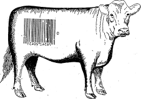
Here’s how it works: The rancher determines his break even price for his beef critters and the state government issues him an exclusive Beef Bar Brand. He and his cowboys and cowgirls then hot or freeze brand that Bar Code on the right hip of every animal for sale.
Then when the critter heads up the loading chute, after weighing, a scanning light reads the Beef Bar Code and keeps a running total for all the cattle. The final price the rancher gets from the buyer is the total on the computer read out. Simple as pie and fair to all. You ranchers can thanks me later with a good ol’ filet mignon.
Food bar code branding could work for every raw food commodity produced.
A heifer branded with a “Beef Bar Code Brand” is pictured below.