Wednesday, January 28, 2026
Home Blog Page 4549

Soybean researchers: Climate change suppressing U.S. yields

0
Soybeans with Rust
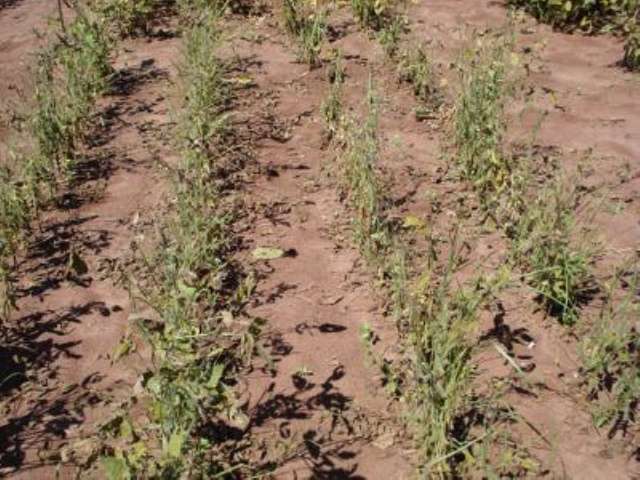
Soybean plants infected with soybean rust in soybean experimental plot. (IITA)
Climate change cost American soybean farmers an estimated $11 billion in unrealized potential yield in the past two decades, a newly published study says.

The study’s researchers included James Specht, emeritus professor of agronomy and horticulture at the University of Nebraska-Lincoln. Specht assisted lead researchers Spyridon Mourtzinis and Shawn Conley of the University of Wisconsin in developing and reviewing the study.

U.S. farmers have increased soybean yields in the past 20 years by about 1/3 of a bushel per acre per year, Specht said. Those gains, of about 0.8 percent a year, resulted from adoption of higher-yielding soybean varieties and improved farming methods.

But the gains would have been 30 percent higher if it weren’t for the higher temperatures and changing rainfall patterns resulting from climate change, the author-researchers concluded in their paper, which was published in Nature Plants. That works out to $11 billion in lost opportunity cost, they said.

“We’re doing OK, but we could have done a heck of a lot better without climate change,” Specht said.

The United States experienced a warming trend during the May-September growing season during the study period of 1994 to 2003. Rainfall patterns have changed as well, increasing in spring and fall but declining in June, July and August.

Mourtzinis and Conley compared soybean yields in 12 soybean-producing states to month-by-month temperature and rainfall changes. They found soybean yields declined by about 4.3 percent for every 1 degree F rise in average growing season temperatures.

They also found that changing rainfall patterns cut into soybean yields. They dropped when May, July and September were wetter than normal. They also dropped if June and August were drier.

The researchers appear to be the first to look at climate change’s state-by-state impact on agriculture during each month of the growing season. Previous studies have calculated global temperature changes and yield impacts by country.

“We were able to leverage decades of measured — not estimated — yield data from across the country, to account for agronomic and genetic yield advances and to isolate the impact of climate change on soybean yield and yield gain,” Conley said.

Successfully adapting to climate change depends upon where and when the crop is grown, Specht and the other researchers said. They found that some states saw improved soybean yields as a result of climate change, though not enough to offset the reduced yields seen in bigger producing states.

Specht said soybean production has recently increased in northern states and Canada because of warmer temperatures and changing rainfall patterns.

“This shift is a reflection of the impact of global warming,” he said. “Due to warmer springs and falls that allow for longer growing seasons in the Dakotas and southern Canada, soybeans now are being grown in places where in the past they could not be grown.”

The study’s authors estimated, for example, that Minnesota farmers saw an economic gain of about $1.7 billion over the past 20 years because of increased soybean yields resulting from climate change. However, Missouri farmers experienced smaller yields, reflecting a $5 billion opportunity cost.

“Our data highlight the importance of developing location-specific adaptation strategies for climate change based on early-, mid- and late-growing season climate trends,” the researchers concluded.

States studied were North Dakota, South Dakota, Minnesota, Wisconsin, Iowa, Illinois, Indiana, Ohio, Missouri, Kentucky, Arkansas and Mississippi.

The study was limited to non-irrigated soybean yields. Though Specht assisted with the study, Nebraska data was not included because a significant proportion of Nebraska’s crop is irrigated and the non-irrigated production data was not readily available.

Writer: Leslie Reed, University Communications
Photographing the Landscape

0

By: Eric Berg, Nebraska Forest Service

One of the wonderful things about taking photographs is that it forces us to stop, look at the details

and hopefully pay more attention to the world around us. Typically we tend to rush from one place to

another without even noticing the details of our ever-changing landscapes. Taking photos demands time

and intentionality, it causes us to slow down, gets us outdoors and helps us experience and truly see and

capture the beauty and detail of our landscapes.

With digital cameras, the process is far easier and less costly than it used to be. We can take hundreds

of photos at one time, with little to no expense, and revisit them later to select the best ones. So the

process doesn’t require the expense and purposeful, time-consuming effort it did when darkrooms and

costly film were part of the process. While technological advances have limited the need for careful

intentionality, they have opened up a broad range of opportunities for even the most amateur of

photographers.

What makes a good photo? That question can be as subjective as our personal preferences. But the

best photos elicit strong emotional reactions—sadness, surprise, anger or pleasure. Often they contain an

element of mystery, with the photo framed in a way that hints at something but doesn’t give the whole

story. They leave the viewer wanting more or give the viewer just enough information to fill in the gaps

with their own life experiences.

In terms of placement and focus, the old rule of thirds from photography courses still applies. The

most interesting elements in a photo tend to be the most compelling when they are slightly off-center and

not in the absolute center of the photo.

Good lighting is essential—whether it’s from the back, from the front or captured during that period

of “sweet light” which naturally occurs right before or after sunrise or sundown.

Landscapes are constantly changing and one of the advantages of taking photos is to make us more

aware of the amazing amount of change that occurs from one month or week or even moment to another.

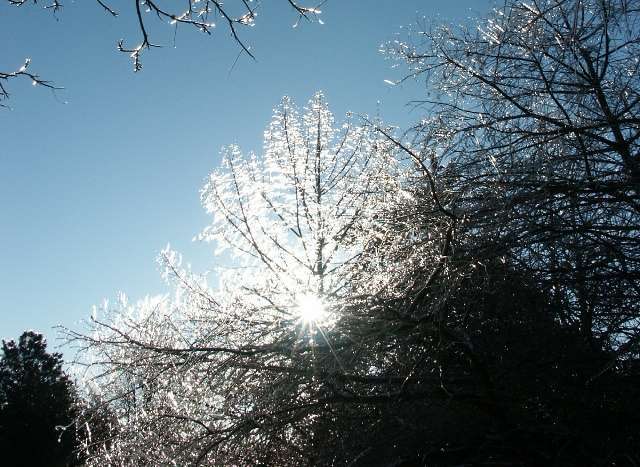
Lighting, temperature, moisture and the resulting frost, dew and color intensity can be significantly

different from one hour of the day to another. But these small changes can be visually compelling and

will reward anyone patient enough to notice and capture their impact.

It may not be gardening weather but, armed with a camera and a little bit of time, the rewards for

photographers can result in a harvest just as tangible.

The Covered Dish: Margarita Pie

0

By: Debbie Dance Uhrig

Just a few weeks ago I spoke about a new margarita dessert that I was writing.  I

debuted the Margarita Pie at a recent speaking engagement and the group truly

enjoyed it.  They had their spoons diving for a taste of this fun dessert.  The week

after New Year’s I shared a recipe called, ‘white jello, as many of you will recall.

At that time I mentioned I was going to twist this little recipe into another.  The

margarita pie is just that; an inversion/twist of another dish.

When I began to formulate the pie in my mind I knew I desired a pretzel crust.  To

sort of mimic the salt rim on a margarita glass.  You will not find it to be too salty

in the least.  I do recommend you use a good brand of pretzels.  If you put a good

quality pretzel against an off-brand you can truly taste the difference.  There’s

also room to put nuts in the crust if you desire,   I would probably use almonds.  If

you use a food processor, like I did, for the crushing of the pretzels, do an entire

bag and freeze the crumbs.   This allows you to prepare a pretzel crust in no time

flat it they’re already crumbled and ready to go.

This past weekend I took this recipe to McPherson, Kansas for my sizzlin’

Valentine class on Saturday the 7th.  I made a double of the pie recipe and put it

into a 9 x 13 pan for transporting.  This would also work for other presentation

purposes.  On the top of the pie I just did a ‘poof’ of whipped cream and a twist of

lime.  As I have mentioned you can also add a light sprinkling of sea salt.

Sometimes chefs will put a bit of green food coloring into a pie of this nature.  I

usually refrain from the use of food colorings unless it’s really necessary.

This was a good closure to the Mexican Dinner which featured Cocktail da

camaron (next week) queso dip, candied jalapenos and beef and chorizo

enchiladas.  The pie will also fill the bill this summer when the heat is on and

you’re looking for something refreshing and unique.

Versatility is what cooking and life in general is all about.  This dish could be

turned into individual parfaits with just a few easy turns.  Or, you could forego the

pretzel crust for a regular graham cracker crust.  Calorie content too high?  OK,

because of the gelatin in this dessert you should be able to use Neufchatel cream

cheese.   You could also switch to skim milk or only 2% milk.  On the whipped

cream use store bought cool whip/lite.  Take away the sugar and use a sugar

substitute.  It won’t be as rich and creamy, but you will have knocked quite a few

calories to the side.  Or, what I usually try to do is just enjoy a smaller piece of the

dessert!

Have fun with this refreshing dessert and don’t allow the blah’s of winter to get

you down.   Spring is just around the corner!  Simply yours, The Covered Dish.

Margarita Pie

Crust

1-(9 inch) pie pan, standard, not deep dish

1 1/4 cups finely crumbled pretzels

1/4 cup white granulated sugar

1/4 cup melted butter

Melt the butter and pour it into the pretzel and sugar mixture.  You will want to do a very fine

crumble using a plastic bag and rolling pin or your food processor.  Press crumble mixture into

pie pan bottom and sides.  Bake in a 350 degree oven for about 12-14 minutes.  Remove and

allow to cool.

Filling

1 envelope Knox unflavored gelatin, (2 1/2 teaspoons)

1/3 cup thawed limeade concentrate

1 (8 ounce) cream cheese, softened

1/2 cup sugar

1 tablespoon Triple Sec

2 tablespoons Tequila

1 cup milk or half and half

1 medium zested lime

1 (8 ounce) heavy cool whip

Dissolve gelatin in room temperature limeade; then heat in a small saucepan or microwave,

bringing to a boil.  Set aside and cool, may sit in refrigerator for a few minutes.

Together cream the sugar into the ‘softened’ cream cheese; now add triple sec and tequila and

milk or half & half.  Incorporate the gelatin/limeade into the cream cheese mixture, blending

until smooth.  Lastly with a gentle hand turn in the 8 ounces of heavy cool whip and the zest.

Spoon into cooled pie shell.  Allow the dish to set up for 8 hours or overnight in the refrigerator.

The pie could also be frozen if desired. Top with a puff of whipped cream, a slice of lime and a

sprinkling of sea salt. May also consider crumbling a few extra pretzels for the top!  Serves 8

For large gatherings make two recipes and prepare in a 9 x 13 baking dish.  Cover the entire top

of the pie with additional cool whip.

Laugh Tracks in the Dust

0
Thayne Cozart
Milo Yield

   Ol’ Nevah and I put a little pizzaz into our recent dual birthdays by attending a country music concert featuring Sammy Kershaw, the legendary c/w artist from Louisiana. The concert wuz held at the elaborately ornate Granada Theater in Emporia and it wuz a delight because the seats were comfy and the seating wuz roomy. Our seats were five rows from the stage, so we could see Sammy and his band pretty up close and personal.

The place wuz packed with the majority of the crowd old-timers like me who still enjoy good old time country music. Although Mr. Kershaw is definitely part of the over-the-hill gang of c/w artists, he still put on an entertaining concert.

Plus, the best part is that it wuz announced that one of my favorite old-time country artists, John Anderson, will be in concert at the Grenada in March. We plan to buy tickets to that performance for sure.

***

When I travel and stop at some convenience store, I usually buy a Skor candy bar for the road. I love ‘em. However, when I recently had to pony up well over a buck for that candy bar, I got to thinking about America’s eating priorities.

I sell farm fresh eggs to my friends for a bargain $1.50 a dozen. That comes to 12.5-cents per egg. Now, I’m sure there’s a lot more good nutrition in one egg than in a candy bar, but the price is only a small fraction as much.

Wonder how many eggs I’d sell if I priced them like candy bars and sold a dozen eggs for $12? Not many I’d bet.

***

And old friend from Royal Valley, Wash., out in the Columbia Basin, Balin Hayes, recently e-mailed me an interesting piece of humor (and education), written by a local linguist Richard Lederer, that I’m sure you old geezers and geezerettes like me will enjoy. It’s about words and phrases from our youth that have virtually disappeared from our modern conversations. The piece is entitled:

OLD WORDS AND PHRASES REMIND US OF THE WAY WE WORD”   

“About a month ago in this space, I illuminated old expressions that have become obsolete because of the inexorable march of technology. These phrases included don’t touch that dial, carbon copy, you sound like a broken record and hung out to dry. A bevy of readers have asked me to shine light on more faded words and expressions, and I am happy to oblige. Back in the olden days we had a lot of moxie. We’d put on our best bib and tucker and straighten up and tried to fly right. Hubba-hubba! We’d cut a rug in some juke joint and then go necking and petting and smooching and spooning and billing and cooing and pitching woo in hot rods and jalopies in some passion pit or lovers’ lane. Heavens to Betsy! Gee willikers! Jumpin’ Jehoshaphat! Holy moley! We were in like Flynn and living the life of Riley, and even a regular guy couldn’t accuse us of being a knucklehead or a nincompoop. Not for all the tea in China! Back in the olden days, life used to be swell, but when’s the last time anything was swell? Swell has gone the way of beehives, pageboys, spats, knickers, fedoras, poodle skirts, saddle shoes and pedal pushers. Oh, my aching back. Kilroy was here, but he isn’t anymore. Like Washington Irving’s Rip Van Winkle and Kurt Vonnegut’s Billy Pilgrim, we have become unstuck in time. We wake up from what surely has been just a short nap, and before we can say, ‘I’ll be a monkey’s uncle!’ or ‘This is a fine kettle of fish!’ we discover that the words we grew up with, the words that seemed omnipresent as oxygen, have vanished with scarcely a notice from our tongues and our pens and our keyboards. Poof, poof, poof go the words of our youth, the words we’ve left behind. We blink, and they’re gone, evanesced from the landscape and wordscape of our perception, like Mickey Mouse wristwatches, hula hoops, skate keys, candy cigarettes, little wax bottles of colored sugar water and an organ grinder’s monkey. Where have all those phrases gone? Long time passing. Where have all those phrases gone? Long time ago: Pshaw. The milkman did it. Think about the starving Armenians. Bigger than a bread box. Banned in Boston. The very idea! It’s your nickel. Don’t forget to pull the chain. Knee high to a grasshopper. Turn-of-the-century. Iron curtain. Domino theory. Fail safe. Fiddlesticks! You look like the wreck of the Hesperus. Cooties. Going like sixty. I’ll see you in the funny papers. Don’t take any wooden nickels. Heavens to Murgatroyd! And awa-a-ay we go! Oh, my stars and garters! It turns out there are more of these lost words and expressions than Carter had liver pills. This can be disturbing stuff, this winking out of the words of our youth, these words that lodge in our heart’s deep core. But just as one never steps into the same river twice, one cannot step into the same language twice. Even as one enters, words are swept downstream into the past, forever making a different river. We of a certain age have been blessed to live in changeful times. For a child each new word is like a shiny toy, a toy that has no age. We at the other end of the chronological arc have the advantage of remembering there are words that once did not exist and there were words that once strutted their hour upon the earthly stage and now are heard no more, except in our collective memory. It’s one of the greatest advantages of aging. We can have archaic and eat it, too.”

***

Wonderful stuff. I grew up with most of those words and phrases — and still use some of them.

I’ll give up the ghost for this week with a few wise words about language. Novelist and futurist George Orwell said, “Political language … is designed to make lies sound truthful and murder respectable, and to give an appearance of solidity to p

Barton’s Walker earns second KJCCC Player of the Week honor

0

For the second time this season, Ahmad Walker of the Barton Community College men’s basketball team has been named the KJCCC Player of the Week for his performances last week.  Despite two road conference losses by the then-No. 25 ranked Cougars, Walker tied his career high thirty points in a last second loss at Cloud County then three days later recorded his seventh double-double of the season in Saturday’s loss at Seward County.  Held scoreless during Saturday’s first half action, the Jayhawk West’s leading scorer put up twenty-four points and grabbed twelve rebounds while also dishing out seven assists.  For the week Walker shot over 56% from the field averaging twenty-seven points and nine rebounds to go along with over six assists per game.

On the season the Port Washington, New York, native ranks first in the Jayhawk West averaging 20.8 points per game while grabbing a sixth best 7.4 rebounds per game.  Walker has also led the Cougars in assists in all but five of his twenty games at 5.6 dimes per contest to rank second in the West and fourth in steals at 1.9.   Walker also ranks in the top ten in field goal percentage (54.9%) and free throw shooting (73.6%).

Most recently, Walker drained two treys in the final two minutes and contributed to the Cougars final fifteen minutes of Wednesday’s come-from-behind 80-78 victory over Dodge City Community College.  Walker finished with a new career high thirty-two points eclipsing the thirty-point mark for the third time this season, draining 4-of-4 from beyond the arc and 10-of-13 from the free throw line scoring in double figures for the sixteenth straight game while also leading the Cougars with eight rebounds.

The Barton men are 7-3 in Jayhawk Conference play and 19-5 on the season heading into a tough three-game five-day stretch beginning on Saturday with a 7:30 p.m. at Garden City Community College.  The Cougars will then return home Monday for a battle with No. 6 Butler Community College before wrapping up the stretch with a Wednesday trip to No. 17 Hutchinson Community College.